Defending Against Citizen Suits Under Environmental Laws Navigating - - PowerPoint PPT Presentation

defending against citizen suits under environmental laws
SMART_READER_LITE
LIVE PREVIEW

Defending Against Citizen Suits Under Environmental Laws Navigating - - PowerPoint PPT Presentation

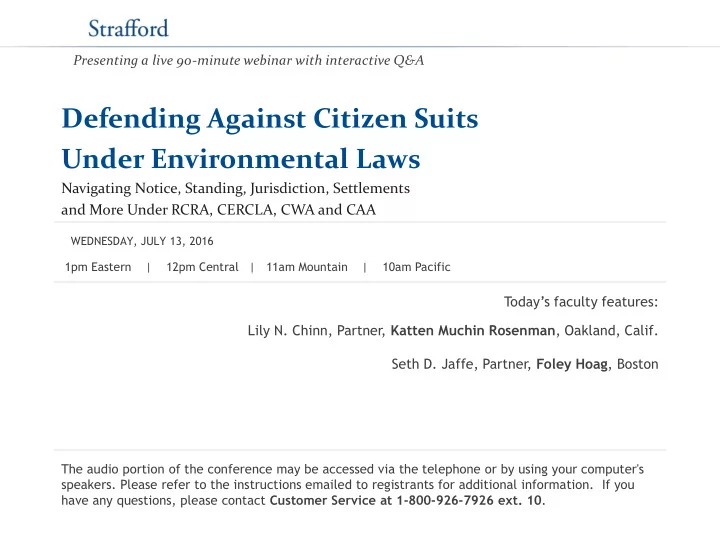
Presenting a live 90-minute webinar with interactive Q&A Defending Against Citizen Suits Under Environmental Laws Navigating Notice, Standing, Jurisdiction, Settlements and More Under RCRA, CERCLA, CWA and CAA WEDNESDAY, JULY 13, 2016 1pm


slide-1
SLIDE 1

The audio portion of the conference may be accessed via the telephone or by using your computer's

  • speakers. Please refer to the instructions emailed to registrants for additional information. If you

have any questions, please contact Customer Service at 1-800-926-7926 ext. 10.

Presenting a live 90-minute webinar with interactive Q&A

Defending Against Citizen Suits Under Environmental Laws

Navigating Notice, Standing, Jurisdiction, Settlements and More Under RCRA, CERCLA, CWA and CAA

Today’s faculty features:

1pm Eastern | 12pm Central | 11am Mountain | 10am Pacific WEDNESDAY, JULY 13, 2016

Lily N. Chinn, Partner, Katten Muchin Rosenman, Oakland, Calif. Seth D. Jaffe, Partner, Foley Hoag, Boston

slide-2
SLIDE 2

Tips for Optimal Quality

Sound Quality If you are listening via your computer speakers, please note that the quality

  • f your sound will vary depending on the speed and quality of your internet

connection. If the sound quality is not satisfactory, you may listen via the phone: dial 1-866-755-4350 and enter your PIN when prompted. Otherwise, please send us a chat or e-mail sound@straffordpub.com immediately so we can address the problem. If you dialed in and have any difficulties during the call, press *0 for assistance. Viewing Quality To maximize your screen, press the F11 key on your keyboard. To exit full screen, press the F11 key again.

FOR LIVE EVENT ONLY

slide-3
SLIDE 3

Continuing Education Credits

In order for us to process your continuing education credit, you must confirm your participation in this webinar by completing and submitting the Attendance Affirmation/Evaluation after the webinar. A link to the Attendance Affirmation/Evaluation will be in the thank you email that you will receive immediately following the program. For additional information about continuing education, call us at 1-800-926-7926

  • ext. 35.

FOR LIVE EVENT ONLY

slide-4
SLIDE 4

Program Materials

If you have not printed the conference materials for this program, please complete the following steps:

  • Click on the ^ symbol next to “Conference Materials” in the middle of the left-

hand column on your screen.

  • Click on the tab labeled “Handouts” that appears, and there you will see a

PDF of the slides for today's program.

  • Double click on the PDF and a separate page will open.
  • Print the slides by clicking on the printer icon.

FOR LIVE EVENT ONLY

slide-5
SLIDE 5

Defending Against Citizen Suits Under Environmental Laws

Lily Chinn | Katten Seth Jaffe | Foley Hoag July 13, 2016

slide-6
SLIDE 6

6

Topics for Today’s Webinar

  • What Are Citizen Suits And Why Are They

Unique?

  • Contrast With Other Citizen Litigation
  • Strategies and Defenses During Notice Period
  • Strategies and Defenses Post-Complaint
  • Citizen Suit Fee Shifting Provisions
slide-7
SLIDE 7

7

What Are Citizen Suits And Why Are They Unique?

  • Certain federal environmental statutes allows citizens to bring

enforcement actions in lieu of a federal or state agency

  • CWA, CAA, TSCA, RCRA, ESA, CERCLA
  • Requires a written notice prior to filing suit
  • Can result in same penalties as government enforcement (though

penalties go to U.S. Treasury and not citizen plaintiffs)

  • Provides for recovery of attorney and expert witness fees
  • Can sue government agency under citizen suit provision under certain

circumstances

  • But not for procedural violations – Askins v. Ohio Dep’t of Agric., Ohio Envtl.
  • Prot. Agency, 809 F.3d 868 (6th Cir. 2016).
slide-8
SLIDE 8

8

What Are Citizen Suits And Why Are They Unique?

  • Increasingly being used for reasons other than to remedy specific

environmental violations

  • Change corporate behavior or project
  • Change governmental policies
  • Prioritize governmental spending
  • Enable supplemental jurisdiction over state tort claims in federal

court

  • Obtain attorneys’ fees
  • EPA efforts to facilitate citizen suits with NextGen compliance in light of

declining budgets

slide-9
SLIDE 9

9

Contrast With Other Citizen Litigation

  • NEPA
  • Climate Change Cases
  • State Equivalents
slide-10
SLIDE 10

10

NEPA Cases

  • Not “enforcement” per se
  • Basically an Administrative Procedure Act claim alleging

arbitrary and capricious government agency action

  • Can be critical to success of private projects requiring

government action

  • Strategic Questions
  • Engage with actual or potential citizen plaintiffs?
  • Intervene as defendant in any litigation against agency –

MUST DO!

slide-11
SLIDE 11

11

Climate Change Litigation

  • Different types of cases, but generally not pursuant to citizen

suit provisions

  • Damages cases
  • Standing
  • Jurisdiction
  • Public Trust cases
  • Intervention?
slide-12
SLIDE 12

12

State Equivalents

  • Keep in mind possibility of proceedings under parallel state

laws

  • Can have different standing requirements (e.g., MA citizen suit

statute largely eliminates standing requirements)

  • Different substantive provisions
  • Different types of relief
slide-13
SLIDE 13

13

Strategies / Defenses During Notice Period

  • Assessment of Claims
  • Review relevant filings with government agencies and publicly

available information (e.g., Google Earth images)

  • Communications with Citizen Group
  • Understand alleged violations and citizen group’s goals (which

may or may not relate to alleged statutory violations)

  • Explain factual inaccuracies or remedial actions taken or planned
  • Can be used to support a sanctions motion if complaint filed after

potential defendant explained why claims were not factually/legally supported

slide-14
SLIDE 14

14

Strategies / Defenses During Notice Period

  • Come Into Compliance During Notice Period
  • May need to engage government agency
  • May need to negotiate longer period for remediation with citizen

group if significant work is required

  • Be Creative Regarding Potential Settlement Terms
  • May be able to address primary concerns of citizen group through

alternative means and settle case with minimal costs/fees

slide-15
SLIDE 15

15

Strategies / Defenses During Notice Period

  • Potential Legal Defenses
  • Deficient Notice
  • Absence of Continuing Violations
  • Diligent Prosecution Bar
slide-16
SLIDE 16

16

Notice Requirements

  • Statutes generally require 60-day notice to EPA, State, and defendant

except:

  • CAA, 42 U.S.C. § 7604(b), CWA, 33 U.S.C. § 1365(b), RCRA, 42 U.S.C.

§ 6972(c), allow suits alleging violations of hazardous pollutant provisions to be filed immediately after notice is given.

  • CAA waives the notice requirement for violations of administrative orders,

42 U.S.C. § 7604(b)(1)(A).

  • RCRA requires 90-days’ notice, unless the endangerment results from a

violation of the statute's requirements on hazardous waste disposal, 42 U.S.C. § 6972(b)(2)(A).

slide-17
SLIDE 17

17

Notice Requirements

  • The ESA may allow a suit to be filed immediately after giving notice

when an action may result in

  • “an emergency posing a significant risk to the well-being of any

species of fish or wildlife or plants,” 16 U.S.C. § 1540(g)(2)(C).

  • The SMCRA, 30 U.S.C. § 1270(b)(2), and the OCSLA, 43 U.S.C.

§1349(a)(3), allow a suit to be filed immediately after giving notice if a violation

  • causes "an imminent threat to the health or safety of the plaintiff or

would immediately affect a legal interest of the plaintiff."

slide-18
SLIDE 18

18

Notice Requirements

  • EPA notice regulations, e.g., 40 CFR Part 135 (CWA)

Notice must include “sufficient information to permit the recipient to identify:

  • the specific standard, limitation, or order alleged to have been

violated,

  • the activity alleged to constitute a violation,
  • the person or persons responsible for the alleged violation,
  • the location of the alleged violation,
  • the date or dates of such violation, and
  • the full name, address, and telephone number of the person

giving notice.”

slide-19
SLIDE 19

19

Notice Requirements

  • Cases on Notice Regulations
  • Regulation requires "sufficient information to permit the recipient

to identify" the alleged violations and bring itself into compliance. San Francisco Baykeeper, Inc. v. Tosco Corp. 309 F.3d 1153, 1158 (9th Cir. 2002)

  • Strict compliance – Enns Pontiac, Buick & GMC Truck v. Flores,

2011 U.S. Dist. LEXIS 43327 (E.D. Cal. Apr. 20, 2011)

  • General notice sufficient – Public Interest Research Group of N.J.,
  • Inc. v. Hercules, Inc., 50 F.3d 1239 (3d Cir. 1995)
slide-20
SLIDE 20

20

Notice Requirements

  • Notice requirements are mandatory – cases filed without complying

with them should be dismissed. Hallstrom v. Tillamook County, 493 U.S. 20 (1989)

  • Dismissal not required where some counts could be filed immediately

after notice. Dague v. City of Burlington, 935 F. 2d 1343 (2nd Cir. 1991) (rev’d in part on other grounds ).

  • CWA’s requirement of adequate notice does not mandate that citizen

plaintiffs list every specific aspect or detail of every alleged violation. Friends of the Earth, Inc. v. Gaston Copper Recycling Corp., 629 F.3d 387 (4th Cir. 2011).

  • Failure to give notice is not excused because EPA knew of the violations,

Greene v. Reilly, 956 F. 2d 593 (6th Cir. 1992), or because there is notice in fact, Envirotech Sanitary Sys., Inc. v. Shoener, 745 F. Supp. 271 (M.D.Pa. 1990).

slide-21
SLIDE 21

21

Notice Requirements

  • Impact of Improper Notice – Proper notice is a jurisdictional
  • requirement. If a letter was not sent or did not properly identify

the violations, then a complaint should be dismissed.

  • 42 U.S.C. § 7604(b) (CAA); 33 U.S.C. § 1365(b) (CWA); 42

U.S.C. § 6972(b) (RCRA)

  • Hallstrom v. Tillamook Cty., 493 U.S. 20 (1989).
  • Dismissal is generally without prejudice.
slide-22
SLIDE 22

22

Continuing Violations

  • Most statutes authorize suits against persons “alleged to be in

violation”.

  • Requires good faith allegation of a violation which is ongoing or

likely to recur. Gwaltney of Smithfield, Ltd. v. Chesapeake Bay Foundation, Inc., 484 U.S. 49 (1987).

  • Initially assessed at date of complaint. Carr v. Alta Verde

Industries, Inc., 931 F.2d 1055 (5th Cir. 1991).

slide-23
SLIDE 23

23

Continuing Violations

  • RCRA – Imminent and substantial endangerment must be

continuing, Meghrig v. KFC Western, Inc., 516 U.S. 479, (1996), but conduct that caused it need not. Conn. Coastal Fishermen’s Ass’n v. Remington Arms Co., Inc., 989 F.2d 1305, 1316 (2d Cir. 1993).

  • CAA – 1990 Amendments overruled the application of

Gwaltney; allowed citizens to sue any person “alleged to have violated (if there is evidence that the alleged violation has been repeated).” 42 U.S.C. 7604(a)(1)(ii).

slide-24
SLIDE 24

24

Continuing Violations

  • CWA – Violations are ongoing at the motion to dismiss stage if

there are allegations of the likelihood of recurrence of the

  • violations. Am. Canoe Ass'n v. Murphy Farms, Inc., 412 F.3d

536 (4th Cir. 2005).

  • Defendant has “heavy burden.”
  • Time since last violation is important. Public Interest Research

Group of N.J., Inc. v. Hercules, Inc., 830 F. Supp. 1525 (D.N.J. 1993) (rev’d in part on other grounds).

slide-25
SLIDE 25

25

Diligent Prosecution Bar

  • The Supreme Court has held that the purpose of the citizen suit

provision is to supplement rather than supplant government enforcement.

  • Congress intended citizen suits brought pursuant to 33 U.S.C. § 1365 to

play an "interstitial," rather than "potentially intrusive" role, that such suits are proper only when the federal, state, or local agencies fail to exercise their enforcement responsibility, and that such suits should not considerably curtail the governing agency's discretion to act in the public

  • interest. Gwaltney of Smithfield, Ltd. v. Chesapeake Bay Found., 484

U.S. 49, 60-61 (1987).

  • “If citizens could file suit ... in order to seek the civil penalties that the

Administrator chose to forgo, then the Administrator's discretion to enforce the Act in the public interest would be curtailed considerably.” Id.

slide-26
SLIDE 26

26

Diligent Prosecution Bar

  • A citizen suit is barred “if the Administrator or State has commenced

and is diligently prosecuting a civil or criminal action in a court of the United States, or a State to require compliance with the standard, limitation, or order.” 33 U.S.C. § 1365(b) (CWA).

  • The CWA further bars a citizen suit for civil penalties if EPA or State

agency “has commenced and is diligently prosecuting” an action for administrative penalties, but the state law must be “comparable” to federal law. 33 U.S.C. § 1319(g)(6)(A) (CWA).

  • Government enforcement is entitled to a presumption of diligence.

The Piney Run Preservation Ass'n v. The Cty. Comm'rs Of Carroll Cty., Md., 523 F.3d 453 (4th Cir. 2008).

slide-27
SLIDE 27

27

Diligent Prosecution Bar

  • Other federal statutes have similar but not identical provisions barring

citizen suits under certain circumstances where the government has acted.

  • TSCA = 15 U.S.C. § 2619(b)(1)(B) (includes administrative enforcement)
  • ESA = 16 U.S.C. § 1540(g) (includes administrative enforcement)
  • RCRA = 42 U.S.C. § 6972(b)(1)(B) (requires judicial enforcement)
  • CAA = 42 U.S.C. § 7604(b)(1)(B) (requires judicial enforcement)
  • CERCLA = 42 U.S.C. § 9659(d)(2) (no judicial enforcement required)
slide-28
SLIDE 28

28

Diligent Prosecution Bar

  • Depending on statute, diligent prosecution bar may require that a

judicial action has been filed.

  • Group Against Smog and Pollution Inc. v. Shenango Inc., 810 F.3d 116 (3d Cir.

2016) (CAA) (State consent decree entered into prior to filing of citizen suit barred action)

  • Chesapeake Bay Found., Inc. v. Severstal Sparrows Point, LLC, 794 F.Supp.2d

602 (D.Md. 2011) (RCRA) (Joint EPA/State consent decree barred imminent and substantial endangerment claim)

  • Friends of Milwaukee’s Rivers v. Milwaukee Metro. Sewerage Dist., 382 F.3d 743

(7th Cir. 2004) (CWA) (State judicial and administrative stipulations did not bar citizen suit)

  • Wash. Pub. Interest Research Group v. Pendleton Woolen Mills, 11 F.3d 883 (9th
  • Cir. 1993) (CWA) (EPA administrative order did not bar citizen suit)
slide-29
SLIDE 29

29

Diligent Prosecution Bar

  • The standard for substantive and procedural comparability between

state and federal law under CWA Section 309(g) varies by circuit.

  • Overall Comparability
  • Does state law have same overall enforcement goals as CWA?

 Arkansas Wildlife Fed’n v. ICI Americas, Inc., 29 F.3d 376 (8th

  • Cir. 1994) (CWA v. Arkansas state law)
  • Does state law seek to remedy same violations as the citizen suit?

 North & South Rivers Watershed Ass’n, Inc. v. Scituate, 949 F.2d 552 (1st Cir. 1991) (CWA v. Massachusetts state law)

slide-30
SLIDE 30

30

Diligent Prosecution Bar

  • Comparability By Category (Penalty Assessment, Public Participation,

Judicial Review)

  • Paper, Allied-Industrial, Chemical & Energy Workers Int’l Union v.

Continental Carbon Co., 428 F.3d 1285 (10th Cir. 2005) (CWA v. Oklahoma law)

  • McAbee v. City of Fort Payne, 318 F.3d 1248 (11th Cir. 2003)

(CWA vs. Alabama state law)

  • Lockett v. EPA, 319 F.3d 678 (5th Cir. 2003) (CWA v. Louisiana

law)

  • Citizens For A Better Environment-Cal. v. Union Oil Co. of Cal .,

83 F.3d 1111 (9th Cir. 1996) (CWA v. California state law)

slide-31
SLIDE 31

31

Strategies / Defenses Post-Complaint

  • Motion to Dismiss v. Motion for Summary Judgment
  • Potential Legal Defenses
  • Deficient Notice
  • Diligent Prosecution Bar
  • Continuing Violations / Mootness
  • Standing
  • Statute of Limitations
  • Factual Defenses to Violations
slide-32
SLIDE 32

32

Deficient Notice / Diligent Prosecution Bar

  • Deficient Notice
  • Allegations in the complaint should reflect notice letter.
  • If complaint alleges different and/or more detailed violations, the

notice letter may be jurisdictionally insufficient.

  • Diligent Prosecution Bar
  • If relevant government enforcement is initiated pre-notice letter or

pre-complaint, may be able to move to dismiss citizen suit.

  • If relevant government enforcement is initiated post-complaint,

may still be able to move to dismiss based on mootness.

slide-33
SLIDE 33

33

Continuing Violations / Mootness

  • Jurisdiction attaches if there is continuing violation when complaint is
  • filed. However, case may become moot if violation is eliminated post-

complaint.

  • Mootness is “heavy burden. U.S. v. W.T. Grant Co., 345 U.S. 629,

633 (1953). Friends of the Earth, Inc. v. Laidlaw Envtl. Servs. (TOC), Inc., 528 U.S. 167 (2000) (reversing a holding of mootness where it was not clear that the violations could not reasonably be expected to

  • ccur).
  • Mootness may bar injunctive relief, but not penalties. Gwaltney of

Smithfield, Ltd. v. Chesapeake Bay Found., Inc., 484 U.S. 49 (1987).

slide-34
SLIDE 34

34

Standing

  • Requirements
  • Actual or Threatened Injury
  • Casual Connection Between Injury and Defendant’s Conduct
  • Injury Is Likely Redressable By Relief Requested

 Friends of the Earth, Inc. v. Laidlaw Envtl. Servs. (TOC), Inc., 528 U.S. 167, 180-81 (2000)

slide-35
SLIDE 35

35

Standing

  • Injury for standing in environmental cases can be based on impacts to

recreational, aesthetic, and economic interests. Must have standing for each violation alleged.

  • Lujan v. Defenders of Wildlife, 504 U.S. 555 (1992); Friends of the Earth,
  • Inc. v. Laidlaw Envtl. Servs. (TOC), Inc., 528 U.S. 167 (2000); Friends of

the Earth, Inc. v. Gaston Copper Recycling Corp., 629 F.3d 387, 397 (4th

  • Cir. 2011)
  • Generalized statements about use and enjoyment of land in vicinity of

Defendant’s alleged actions do not meet the causality requirement. The injury must be fairly traceable to defendant’s conduct.

  • Lujan v. Nat’l Wildlife Fed’n, 497 U.S. 871, 886 (1990); Friends of the

Earth, Inc. v. Crown Cent. Petroleum Corp., 95 F.3d 358 (5th Cir. 1996)

slide-36
SLIDE 36

36

Statute of Limitations

  • General federal five-year SOL applies. 28 U.S.C. § 2462.
  • Claim generally accrues when plaintiff has entitlement to bring claim.

Sierra Club v. Okla. Gas and Elec. Co., 816 F.3d 666 (10th Cir. 2016).

  • Discovery rule generally does not apply to § 2462. Gabelli v.

Securities & Exchange Comm’n, 133 S. Ct. 1216 (2013).

  • SOL is tolled during notice period. Pub. Interest Research Grp. of N.J.
  • v. Powell Duffryn Terminals Inc., 913 F.2d 64 at 75 (3d. Cir. 1990).
slide-37
SLIDE 37

37

Statute of Limitations

  • Is violation a one-time event or a continuing violation?
  • If each day is a separate violation, SOL is triggered daily.
  • Nat'l Parks Conservation Ass'n, Inc. v. Tenn. Valley Auth., 480 F.3d 410,

418-19 (6th Cir. 2007)

  • Where violation is a one-time event, case must be brought within five

years of that event.

  • U.S. v. Midwest Generation, LLC, 781 F. Supp. 2d 677, 691-93 (N.D. Ill.

2011); U.S. v. EME Homer City Generation, LP., 727 F.3d 274, fn. 9 (3d

  • Cir. 2013) (Failure to obtain PSD/NSR permit under CAA is one-time

violation)

slide-38
SLIDE 38

38

CWA Factual Defenses

  • What is the scope of the NPDES Permit?
  • Is a permit shield defense available?
  • Was there a point source discharge of pollutants?
  • Non-point source pollution is not regulated by the NPDES

permitting program

  • Into a Water of the United States?
  • WOTUS rule is currently being challenged in appellate and

district courts around the country

slide-39
SLIDE 39

39

RCRA Factual Defenses

  • Is the harm imminent?
  • Is the endangerment caused by defendant’s conduct?
  • Does the waste at issue meet the definition of solid or

hazardous waste?

  • Does the complaint seek something other than injunctive

relief?

slide-40
SLIDE 40

40

CAA Factual Defenses

  • NSR/PSD – Has there been a significant net emissions

increase? How to calculate? When to calculate

  • Was sampling/analytical equipment properly maintained

and calibrated?

  • Have emissions caused an exceedance of any NAAQS?
  • If complaint alleges violations of matters addressed in

Title V operating permit, is permit shield available?

slide-41
SLIDE 41

41

ESA Factual Defenses

  • Has there actually been a take of an endangered or

threatened species?

  • Is any take likely to recur?
  • What is the impact of defendant’s activity on long-term

viability of species?

slide-42
SLIDE 42

42

Citizen Suit Fee Shifting Provisions

  • Most federal environmental statutes provide for the recovery of

reasonable attorney and expert witness fees to the “prevailing

  • r substantially prevailing party.”
  • TSCA = 15 U.S.C. § 2619(c)(2)
  • ESA = 16 U.S.C. § 1540(g)(4)
  • CWA = 33 U.S.C. § 1365(d)
  • RCRA = 42 U.S.C. § 6972(e)
  • CAA = 42 U.S.C. § 7604(d)
  • CERCLA = 42 U.S.C. § 9659(f)
  • Statutes give the court wide discretion in awarding fees.
slide-43
SLIDE 43

43

Citizen Suit Fee Shifting Provisions

  • The fee shifting provision can provide substantial leverage for citizen

groups, especially when a suit is based on self-reported violations required under an environmental permit.

  • Consider use of an Offer of Judgment under Federal Rule of Civil

Procedure 68 to neutralize this leverage by potentially shifting some fees/costs onto the citizen group.

  • If defendant makes an offer of judgment (including costs to date)

prior to trial and citizen plaintiff rejects the offer but does not obtain a more favorable judgment, the citizen plaintiff must pay defendant’s costs incurred after the offer was made.

  • Federal environmental statutes define “costs” to include

reasonable attorney and expert fees

slide-44
SLIDE 44

44

Citizen Suit Fee Shifting Provisions

  • Case law is split on whether Rule 68 offers of judgment are

appropriate for citizen suit cases.

  • Interfaith Cmty. Org. v. Honeywell Int’l, Inc., 719 F.3d 281, 289 (3d Cir.

2013) (holding that there is nothing incompatible between Rule 68 and RCRA’s fee shifting provisions, which “encourage plaintiffs to bring meritorious suits to enforce environmental laws”)

  • N.C. Shellfish Growers Ass’n v. Holly Ridge Assocs., LLC, 278 F.Supp.2d

654, 668 (E.D.N.C. 2003) (holding that Rule 68 offers were “incompatible with the purposes” of CWA citizen suits)

  • Friends of the Earth, Inc. v. Chevron Chem. Co., 885 F. Supp. 934, 940

(E.D. Tex. 1995) (voiding offer of judgment because Rule 68 offer would create an “undue hardship” on plaintiff and have a “chilling effect” on CWA citizen enforcement)

slide-45
SLIDE 45

45

Example: CWA Citizen Suit

  • Photo Credit:

Gulf Restoration Network

slide-46
SLIDE 46

46

Gulf Restoration Network, et al. vs. United Bulk Terminals

  • Notice of Intent to Sue – November 20, 2013
  • Violations based on aerial photographs collected since August

2012, and satellite photography from Google Earth

  • Parties negotiate during 60 day notice period, and plaintiffs

voluntarily delay filing complaint to allow for further negotiations

  • State administrative order – January 23, 2014
  • Complaint filed – March 18, 2014
  • Consent Decree finalized – August 18, 2015
slide-47
SLIDE 47

47

Settlement Components

  • $75,000 Supplemental Environmental Project focused on non-

native plant removal and wetland restoration

  • Attorneys fees and expert costs
  • Injunctive relief
  • Replacement of aging equipment
  • Installation of pollution control equipment
  • New best management practices
  • Monitoring and reporting requirements
slide-48
SLIDE 48

48

Example: ESA Citizen Suit

slide-49
SLIDE 49

49

Example: ESA Citizen Suit

  • Are dams causing a take?
  • Are any takes impacting the species?
  • Are plaintiffs’ proposed remedial measures necessary or

sufficient?

slide-50
SLIDE 50

50

Example: ESA Citizen Suit

  • Important substantive issue – Where existing facility

impacts newly listed species, facility is arguably in violation of ESA on date of listing

  • What to do?
  • Seek federal agency intervention as defendant -- good luck

with that, though context matters.

  • Accelerate, if possible, permit process, in order to make

case moot

slide-51
SLIDE 51

51

Example: ESA Citizen Suit

  • Determine what plaintiffs want?
  • Remove dam?
  • Expensive injunctive relief?
  • Substantial attorneys’ fees?
slide-52
SLIDE 52

52

Example: ESA Citizen Suit

  • Some cases have to be litigated
  • Find experts
  • Develop facts
  • Keep relevant case law in mind
  • Get that permit, ASAP!
slide-53
SLIDE 53

53

Example: ESA Citizen Suit

  • First Circuit law is not favorable towards statistical

evidence of takes – Court denied plaintiffs’ motion for SJ

  • Facilities obtained permits
slide-54
SLIDE 54

54

Avoiding Citizen Suits

  • Good luck!
  • Stay in compliance!
  • Regular audits / voluntary disclosure
  • Be proactive when problems are identified, even if not as

the result of an audit

  • Keep in mind the possibility of being a white knight in

transactional contexts

  • Develop relationship with regulators and important NGOs
slide-55
SLIDE 55

55

Questions?

  • Lily Chinn | 415-515-0265 | lily.chinn@kattenlaw.com |

https://www.kattenlaw.com/Lily-Chinn

  • Seth Jaffe | 617-832-1203 | sjaffe@foleyhoag.com |

http://www.foleyhoag.com/people/jaffe-seth