Deep Reinforcement Learning for Robotics: - - PowerPoint PPT Presentation

deep reinforcement learning for robotics frontiers and
SMART_READER_LITE
LIVE PREVIEW

Deep Reinforcement Learning for Robotics: - - PowerPoint PPT Presentation

Deep Reinforcement Learning for Robotics: Frontiers and Beyond Shixiang (Shane) Gu ( ) 2018.5.27 01 Deep RL: successes and limitations Computation-Constrained Data-Constrained


slide-1
SLIDE 1

01

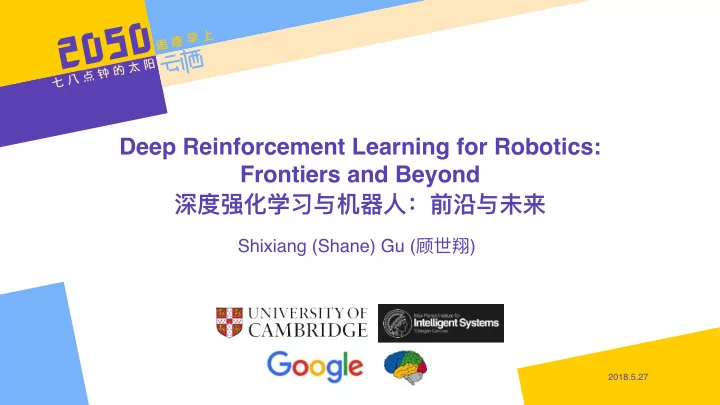
Deep Reinforcement Learning for Robotics: Frontiers and Beyond 深度强化学习与机器塀⼈亻:前沿与未来

Shixiang (Shane) Gu (顾世翔)

2018.5.27
slide-2
SLIDE 2

Deep RL: successes and limitations

Atari games [Mnih et. al., 2015] AlphaGo/AlphaZero [Silver et. al., 2016; 2017] Parkour [Heess et. al., 2017]

Simulation = success Real-world = not applied…

?

Computation-Constrained Data-Constrained

slide-3
SLIDE 3

Why Robotics?

vs

slide-4
SLIDE 4

Recipe for a Good Deep RL Algorithm

Sample-efficiency 采样效率 Stability 稳定性 Scalability 可扩展性 Human-free Learning ⽆旡需⼈亻的学习 Exploration 探索 Reset-free ⽆旡重置 Universal Reward 万能奖励 State/Temporal Abstraction 时空抽象化 Transferability/Generalization 可转移性,普及性 Risk-Aware ⻛飏险意识 Interpretability 可解释性 Algorithm 算法 Automation ⾃臫动化 Reliability 可靠性

slide-5
SLIDE 5

Outline of the talk

  • Sample-efficiency 采样效率
  • Good Off-policy Algorithm 好的离策算法:NAF [Gu et al, 2016], Q-Prop/IPG [Gu et al, 2017/2017]
  • Good Model-based Algorithm 好的有模型算法:TDM [Pong*, Gu* et al, 2018]
  • Human-free Learning ⽆旡需⼈亻的学习
  • Safe & reset-free RL 安全的,⽆旡重制的强化学习:LNT [Eysenbach, Gu et al, 2018]
  • “Universal” reward function 万能奖励函数:TDM [Pong*, Gu* et al, 2018]
  • Temporal Abstraction 时间抽象化
  • Data-efficient hierarchical RL ⾼髙采样效率,分层型强化学习:HIRO [Nachum, Gu et al, 2018]
slide-6
SLIDE 6

Notations & Definitions

  • n-policy model-free 在策⽆旡模型法: e.g. policy search ~ trial and error 试错
  • ff-policy model-free 离策⽆旡模型法: e.g. Q-learning ~ introspection 反思

model-based 有模型法: e.g. MPC ~ imagination 想象

slide-7
SLIDE 7

Sample-efficiency & RL controversy

Model-based On-policy Off-policy

More Less sample-efficiency 采样效率 learning signals 学习信号 instability 不泌稳定性

“蛋糕上的樱桃”

slide-8
SLIDE 8

Toward Good Off-policy Deep RL Algorithm

Off-policy actor-critic, e.g. DDPG [Lillicrap et al, 2016]

  • No new samples needed per

update!

  • Quite sensitive to hyper-parameters

“Better” DDPG

  • NAF [Gu et al 2016], Double DQN [Hasselt et al 2016], Dueling DQN [Wang et al 2016], Q-Prop/IPG [Gu et al 2017/2017], ICNN [Amos

et al 2017], SQL/SAC [Haarnoja et al 2017/2017], GAC [Tangkaratt et al 2018], MPO [Abdolmaleki et al 2018], TD3 [Fujimoto et al 2018], …

Actor ⾏行降动者 Trial & error 试错

?

On-policy Monte Carlo policy gradient, e.g. TRPO [Schulman et al, 2015]

  • Many new samples needed per

update.

  • Stable but very sample-intensive

Critic 批评者 Introspection 反思 imperfect 不泌是全知的。

slide-9
SLIDE 9

Normalized Advantage Functions (NAF)

[Gu, Lillicrap, Sutskever, Levine, ICML 2016]

Related (later) work:

  • Dueling Network [Wang et al 2016]
  • ICNN [Amos et al 2017]
  • SQL [Hajaorna et al 2017]
  • Benefit: 2 objectives (actor-critic) to 1 objective (Q-learning)
  • Halve #hyperparameters
  • Limitation: expressibility of Q-function
  • Doesn’t work well on locomotion
  • Works well on manipulation

3-joint peg insertion JACO arm grasp & reach

slide-10
SLIDE 10

Asynchronous NAF for Simple Manipulation

[Gu*, Holly*, Lillicrap, Levine, ICRA 2017] 2.5 hours

Train time/Exploration Test time Disturbance test

slide-11
SLIDE 11

Q-Prop & Interpolated Policy Gradient (IPG)

[Gu, Lillicrap, Ghahramani, Turner, Levine, ICLR 2017] [Gu, Lillicrap, Ghahramani, Turner, Schoelkopf, Levine, NIPS 2017]

  • On-policy algorithms are stable. How to make off-policy more on-policy?
  • Mixing Monte Carlo returns
  • Trust-region policy update
  • On-policy exploration
  • Bias trade-offs (theoretically bounded)

Add one eq balancing on-policy and

  • ff-policy grad

Trial & error 试错 Critic 批评者

+

Related concurrent work:

  • PGQ [O’Donoghue et al 2017]
  • ACER [Wang et al 2017]
slide-12
SLIDE 12

Toward Good Model-based Deep RL Algorithm

  • Rethinking Q-learning
  • Q-learning vs parameterized Q-learning

Off-policy + Relabeling trick from HER [Andrychowicz et al, 2017] Examples:

  • UVF [Schaul et al, 2015]
  • TDM [Pong*, Gu* et al 2017]

反思+⽆旡限记忆改写 反思 Introspection (off-policy model-free) + relabeling = imagination (model-based)? 反思(离策⽆旡模型)+⽆旡限记忆改写 = 想象(有模型)?

slide-13
SLIDE 13

Temporal Difference Models (TDM)

[Pong*, Gu*, Dalal, Levine, ICLR 2018]

  • A certain parameterized Q-function is a generalization of dynamics model
  • Efficient learning by relabeling
  • Novel model-based planning
slide-14
SLIDE 14

Toward Human-free Learning ⽆旡需⼈亻的学习

?

Autonomous, Continual, Safe, Human-free Human-administered, Manual resetting, Reward engineering

slide-15
SLIDE 15

Leave No Trace (LNT)

[Eysenbach, Gu, Ibarz, Levine, ICLR 2018]

  • Learn to reset
  • Early abort based on how likely you can go back to

initial state (reset Q-function)

  • Goal: reduce/eliminate manual resets = safe,

autonomous, continual learning + curriculum

Related work:

  • Asymmetric self-play [Sukhbaatar et al 2017]
  • Automatic goal generation [Held et al 2017]
  • Reverse curriculum [Florensa et al 2017]

Who resets the robot?

  • PhD students

能去能回 不泌落痕迹

slide-16
SLIDE 16

A “Universal” Reward Function “万能”奖励函数 + Off-Policy Learning

Goal-reaching reward, e.g.

UVF [Schaul et al 2015]/HER[Andrychowicz], TDM [Pong*, Gu* et al 2018]

Diversity reward, e.g.

SNN4HRL [Florensa et al 2017], DIAYN [Eysenbach et al 2018]

  • Goal: learn as many useful skills as possible sample-efficiently with minimal reward engineering
  • Examples:
slide-17
SLIDE 17

Toward Temporal Abstractions

?

When you don’t know how to ride bike… When you know how to ride bike… TDM learns many skills very quickly…

?

How to efficiently solve other problems?

时间抽象化

slide-18
SLIDE 18

HIerarchical Reinforcement learning with Off-policy correction (HIRO)

[Nachum, Gu, Lee, Levine, preprint 2018]

  • Most recent HRL work is on-policy
  • e.g. option-critic [Bacon et al 2015], FuN [Vezhnevets et

al 2017], SNN4HRL [Florensa et al 2017], MLSH [Frans et al 2018]

  • VERY data-intensive
  • How to correct for off-policy? Relabel the action.
  • 不泌是记忆改写,是记忆纠正
slide-19
SLIDE 19

HIRO (cont.)

[Vezhnevets et al, 2017] [Florensa et al, 2017] [Houthooft et al, 2016]

Test rewards at 20000 episodes Ant Maze Ant Push Ant Fall

[Nachum, Gu, Lee, Levine, preprint 2018]

slide-20
SLIDE 20
  • Optimizing for computation alone is not enough; also for sample-efficiency and stability; data is valuable.
  • Efficient algorithms ⾼髙采样效率算法
  • Human-free learning ⽆旡需⼈亻的学习
  • Reliability 可靠性

Discussion

NAF/Q-Prop/IPG/TDM LNT/TDM HIRO Sim2Real, Meta learning Distributional, Bayesian Natural language, Causality + etc. + etc. + etc. + Simulation + Multi-task + Imitation + Human-feedback

slide-21
SLIDE 21

Thank you!

Richard E. Turner, Zoubin Ghahramani Sergey Levine, Vitchyr Pong Timothy Lillicrap Bernhard Schoelkopf

…and other amazing colleagues from: Cambridge, MPI Tuebingen, Google Brain, and DeepMind

Ilya Sutskever (now at OpenAI), Ethan Holly, Ben Eysenbach, Ofir Nachum, Honglak Lee

Contact: sg717@cam.ac.uk, shanegu@google.com