Deep Foundation Testing, Multiple Topics Brent Robinson, Ph.D., P.E. - - PowerPoint PPT Presentation

deep foundation testing multiple topics brent robinson ph
SMART_READER_LITE
LIVE PREVIEW

Deep Foundation Testing, Multiple Topics Brent Robinson, Ph.D., P.E. - - PowerPoint PPT Presentation

Deep Foundation Testing, Multiple Topics Brent Robinson, Ph.D., P.E. www.grlengineers.com | info@grlengineers.com www.grlengineers.com | info@grlengineers.com Deep Foundation Testing, Multiple Topics PDA/CAPWAP applied to large diameter


slide-1
SLIDE 1

www.grlengineers.com | info@grlengineers.com www.grlengineers.com | info@grlengineers.com
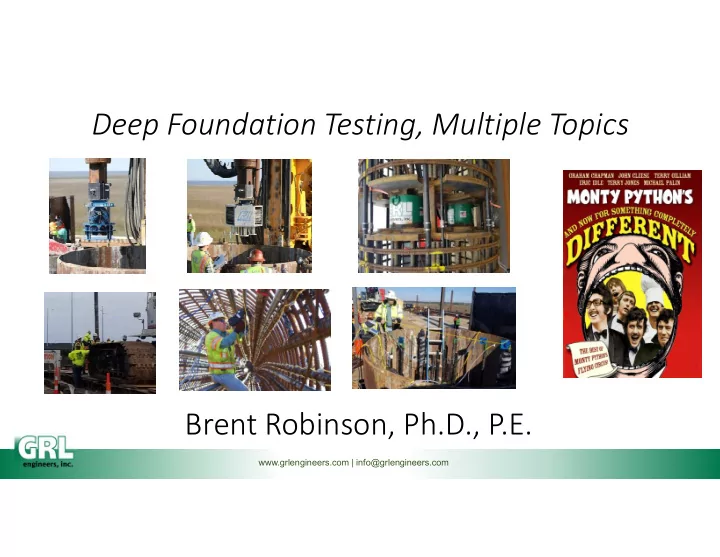
Deep Foundation Testing, Multiple Topics Brent Robinson, Ph.D., P.E.

slide-2
SLIDE 2

www.grlengineers.com | info@grlengineers.com www.grlengineers.com | info@grlengineers.com

  • PDA/CAPWAP applied to large diameter piles versus small diameter piles
  • PDA/CAPWAP challenges for open ended piles
  • Thermal Integrity Profiling (TIP)
  • How to interpret CSL results for acceptance of shafts; when to

remediate/repair/replace, etc. based on test results

  • Determining capacity and assessing integrity of a damaged pile or drilled shaft

through dynamic testing

  • SPT Analyzer best methods for determining energy transfer of automatic

hammers

Deep Foundation Testing, Multiple Topics

slide-3
SLIDE 3

www.grlengineers.com | info@grlengineers.com www.grlengineers.com | info@grlengineers.com

  • Not a lot of direct comparisons
  • Might need different hammers
  • Sites are variable
  • Test piles are spaced widely apart
  • Getting this type of research going is a big effort
  • Requires the ‘right’ geotechnical conditions, too

Driven--Large vs small diameter

slide-4
SLIDE 4

www.grlengineers.com | info@grlengineers.com www.grlengineers.com | info@grlengineers.com

Driven—Large vs Small Diameter

14” CEP, No Epoxy 24” CEP, Epoxy

slide-5
SLIDE 5

www.grlengineers.com | info@grlengineers.com www.grlengineers.com | info@grlengineers.com

  • Marquette Interchange, Wisconsin
  • 12.75, 14, 16 inch diameter at SLT site
  • Complications
  • Time after driving
  • Mobilization
  • Driving order (pore pressures)
  • Densification
  • Soil displacement
  • Vibration
  • Signal match (CAPWAP) distribution

precisions

Set-up—Large vs Small Diameter

16, 50 d 14 16, 78d 14 12

slide-6
SLIDE 6

www.grlengineers.com | info@grlengineers.com www.grlengineers.com | info@grlengineers.com

  • Scaling is not well understood
  • ADSC research project underway for drilled piles
  • Larger diameter piles likely take more displacement to fully mobilize
  • Can be a challenge with significant set up and inadequately sized hammer
  • Larger diameter piles more likely to also have lower velocities,

different dynamic response

  • Statically, different displaced volumes of soil or plugging behavior

Large vs Small Diameter

slide-7
SLIDE 7

www.grlengineers.com | info@grlengineers.com www.grlengineers.com | info@grlengineers.com

  • Experiences from other attendees

Large vs Small Diameter

slide-8
SLIDE 8

www.grlengineers.com | info@grlengineers.com www.grlengineers.com | info@grlengineers.com

  • PDA/CAPWAP applied to large diameter piles versus small diameter piles
  • PDA/CAPWAP challenges for open ended piles
  • Thermal Integrity Profiling (TIP)
  • How to interpret CSL results for acceptance of shafts; when to

remediate/repair/replace, etc. based on test results

  • Determining capacity and assessing integrity of a damaged pile or drilled shaft

through dynamic testing

  • SPT Analyzer best methods for determining energy transfer of automatic

hammers

Deep Foundation Testing, Multiple Topics

slide-9
SLIDE 9

www.grlengineers.com | info@grlengineers.com www.grlengineers.com | info@grlengineers.com

  • For many years, steel wave speeds constant
  • Past 10 years, PDI clients (GRL, Domestic,

International) noted apparently faster wave speeds on LDOEP

  • Timing of toe reflection was earlier than

expected

  • Different PDA units and models
  • Pile Short? Damage?
  • For restrikes, tough to say!
  • Initial Drives from very first blow confirmed
  • Wave speeds were increasing by 2-3%

Challenge 1: Wave Speed

Property US Wave Speed 16,800 ft/s Unit Weight 492 lb/ft3 Elastic Modulus 30,000 ksi

slide-10
SLIDE 10

www.grlengineers.com | info@grlengineers.com www.grlengineers.com | info@grlengineers.com

  • 42 inch O.D. x 0.75 inch wall (1067 mm x 19 mm), open end

pipe piles

  • ASTM A-252 Grade 3 steel, specified minimum FY = 50 ksi
  • Piles were made from hot rolled black steel coil converted to

spiral weld pipe

  • 70 ft long top section welded to previously driven first section
  • Two PR accelerometers attached 7 ft from top
  • Two additional PE accelerometers attached 71.2 ft from top
  • Distance between PR and PE accelerometers of 64.2 feet

Minnesota

slide-11
SLIDE 11

www.grlengineers.com | info@grlengineers.com www.grlengineers.com | info@grlengineers.com

Minnesota

slide-12
SLIDE 12

www.grlengineers.com | info@grlengineers.com www.grlengineers.com | info@grlengineers.com

  • Dynamic test records on 30 to 48 inch diameter have supported

the need for a 1 to 3% faster overall wave speed.

  • Not PDA unit dependent
  • Multiple Steel Grades, 45 ksi or more
  • Faster overall wave speed greater than 16,800 ft/s may be

justified by early, easy driving records with carefully documented lengths

  • Should not be assumed without early data—might miss pile toe

damage.

  • Faster overall wave speeds have NOT been observed on

smaller diameter steel pipe piles (<24 inch) or hot rolled H-piles.

Challenge 1: Wave Speed

slide-13
SLIDE 13

www.grlengineers.com | info@grlengineers.com www.grlengineers.com | info@grlengineers.com

  • Recent projects in the Midwest
  • Kentucky Lakes, Kentucky
  • Gnadenhutten, Ohio
  • Effect of constrictor plates on

dynamic behavior

  • Modeling in CAPWAP

Challenge 2: Constrictor Plates

slide-14
SLIDE 14

www.grlengineers.com | info@grlengineers.com www.grlengineers.com | info@grlengineers.com

Kentucky Lakes

  • Analysis complicated by constrictor plate, soil plug, pore water pressures
  • Use of radiation damping model
  • Modeling of soil plug
  • Resistance from constrictor plate included in shaft resistance total
  • Superposition of shaft resistance and end bearing used to evaluate

resistance during restrike

  • Under prediction of static resistance possible due to failure mode under

dynamic vs. static load

slide-15
SLIDE 15

www.grlengineers.com | info@grlengineers.com www.grlengineers.com | info@grlengineers.com

Ohio

slide-16
SLIDE 16

www.grlengineers.com | info@grlengineers.com www.grlengineers.com | info@grlengineers.com

  • Brown’s NCHRP Synthesis noted high accelerations
  • n the plug may cause it to slip dynamically but not

statically

  • Constrictor plate models indicated radiation

damping may be a solution

  • Current internal research looks at numerical

models

Challenge 3: Internal Soil

slide-17
SLIDE 17

www.grlengineers.com | info@grlengineers.com www.grlengineers.com | info@grlengineers.com 17

OUR PLUG MODEL

N-2 N-1 N

Mplug

We add at the bottom segment an interface force representing friction between inside pipe and plug

slide-18
SLIDE 18

www.grlengineers.com | info@grlengineers.com www.grlengineers.com | info@grlengineers.com

And a Plug End bearing in addition to the pile end bearing

18

OUR PLUG MODEL

N-2 N-1 N

Mplug

We add at the bottom segment an interface force representing friction between inside pipe and plug

slide-19
SLIDE 19

www.grlengineers.com | info@grlengineers.com www.grlengineers.com | info@grlengineers.com

Challenge 3: Internal Soil

  • Top Displacements
  • Plug End bearing:
  • 662 kips
  • Internal shaft

resistance: 331/662/800/1200 kips

slide-20
SLIDE 20

www.grlengineers.com | info@grlengineers.com www.grlengineers.com | info@grlengineers.com

  • Petek et al (forthcoming) ran database studies
  • Well documented case histories with dynamic, static and

suitable geotechnical studies are hard to find

  • Alpha method correlated reasonably well with static load

tests

  • Beta method was much more scattered
  • Dynamic tests, when available, were not well documented
  • Instrumented static load tests are difficult
  • Sensor survival when welded and protected

Challenge 4: Comparison Data

slide-21
SLIDE 21

www.grlengineers.com | info@grlengineers.com www.grlengineers.com | info@grlengineers.com

  • PDA/CAPWAP applied to large diameter piles versus small diameter piles
  • PDA/CAPWAP challenges for open ended piles
  • Thermal Integrity Profiling (TIP)
  • How to interpret CSL results for acceptance of shafts; when to

remediate/repair/replace, etc. based on test results

  • Determining capacity and assessing integrity of a damaged pile or drilled shaft

through dynamic testing

  • SPT Analyzer best methods for determining energy transfer of automatic

hammers

Deep Foundation Testing, Multiple Topics

slide-22
SLIDE 22

www.grlengineers.com | info@grlengineers.com www.grlengineers.com | info@grlengineers.com

Cloud

TAG – Thermal AGgregator

  • TAG doubles as TAP box for data

collection

  • Wireless System aggregates

information from TAP boxes to the TAG

  • Data sent to the Cloud via wireless

modem

  • Data retrieved in office via internet

connection (user password protected)

slide-23
SLIDE 23

www.grlengineers.com | info@grlengineers.com

350 Foundation Shafts (48 inch dia.)

23

6 – number completed when problem

noted (groundwater washed out concrete for all 6 piles when casing was pulled)

Construction technique was corrected

85 - number completed when CSL testing

is normally made (7 days)

120 - number completed when report is

normally issued (10 d)

Center  @ cage

slide-24
SLIDE 24

www.grlengineers.com | info@grlengineers.com

Recommended TIP Criteria

Satisfactory (S)

< 6% Radius Reduction and Cover Criteria Met Anomaly requiring further Evaluation (E) Radius Reduction > 6% or Cover Criteria Not Met

(a uniform 6% reduced radius is a 12% area reduction and a 22% bending capacity loss)

minimum cover – 4 inch - AASHTO minimum cover – 3 inch - ACI Need larger design cover to allow for cage eccentricity so net cover is sufficient

slide-25
SLIDE 25

www.grlengineers.com | info@grlengineers.com

36 hours 1.5 days “Peak”

Wisconsin Project

18 hours 0.75 days

Perimeter Main Diagonal

19oF vs peak 13oF vs peak Pile cored: “Good, clean concrete above and below a 6 inch void” (Due to tremie problem)

slide-26
SLIDE 26

www.grlengineers.com | info@grlengineers.com

Early local temperature reduction.

2 hours 4.5 hours 8 hours 18 hours

Thermal Integrity Profiling

Tell very early if shaft is OK or defective

Wisconsin Project

slide-27
SLIDE 27

www.grlengineers.com | info@grlengineers.com

4 ft diameter shafts - Michigan first shaft second shaft

bad good

4.5’ dia 4’

27

slide-28
SLIDE 28

www.grlengineers.com | info@grlengineers.com

4 ft dia – cast June 5 TIP 1 day, CSL 2 day

bad bad

28

slide-29
SLIDE 29

www.grlengineers.com | info@grlengineers.com

Pile 7 - TIP vs PIT – 10.75 inch micropile

slide-30
SLIDE 30

www.grlengineers.com | info@grlengineers.com www.grlengineers.com | info@grlengineers.com

Shaft Verticality and Profile Shaft Base Cleanliness Bi-Directional Static Load Test Thermal Integrity Profiling (TIP) Crosshole Sonic Logging (CSL) Weighted Tape

slide-31
SLIDE 31

www.grlengineers.com | info@grlengineers.com www.grlengineers.com | info@grlengineers.com

Shaft Verticality and Profile

slide-32
SLIDE 32

www.grlengineers.com | info@grlengineers.com www.grlengineers.com | info@grlengineers.com

Shaft Verticality and Profile Results

slide-33
SLIDE 33

www.grlengineers.com | info@grlengineers.com www.grlengineers.com | info@grlengineers.com

  • 34
  • 32
  • 30
  • 28
  • 26
  • 24
  • 22
  • 20
  • 18
  • 16
  • 14
  • 12
  • 10
  • 8
  • 6
  • 4
  • 2

2 4 6

  • 1.6
  • 1.2
  • 0.8
  • 0.4

0.0 0.4 0.8 1.2 1.6 Elevation (m) Radius (m)

TIP SHAPE Concrete Volume Theoretical

Comparison

  • f

Shaft Radius vs Elevation

slide-34
SLIDE 34

www.grlengineers.com | info@grlengineers.com

SQUID Results

slide-35
SLIDE 35

www.grlengineers.com | info@grlengineers.com www.grlengineers.com | info@grlengineers.com

Bi-Directional Test Results

0.0 0.2 0.4 0.6 0.8 1.0 1.2 1.4 1.6 1.8 0.0 0.5 1.0 1.5 2.0 2.5 3.0 3.5 4.0 4.5 5.0 5.5 6.0 6.5 7.0 7.5 8.0 8.5

  • 70
  • 65
  • 60
  • 55
  • 50
  • 45
  • 40
  • 35
  • 30
  • 25
  • 20
  • 15
  • 10
  • 5

Unit Base Resistance, qBASE, MPa Total Base Resistance, QBASE, MN Base Displacement, zBASE, mm

  • Fig. 10: Harbor River Bridge - Beaufort County, SC - Test Shaft TS-1 -

Total and Unit Base Resistance vs. Base Displacement (QBASE-zBASE, qBASE-zBASE)

slide-36
SLIDE 36

www.grlengineers.com | info@grlengineers.com www.grlengineers.com | info@grlengineers.com

Michigan

slide-37
SLIDE 37

www.grlengineers.com | info@grlengineers.com www.grlengineers.com | info@grlengineers.com

  • PDA/CAPWAP applied to large diameter piles versus small diameter piles
  • PDA/CAPWAP challenges for open ended piles
  • Thermal Integrity Profiling (TIP)
  • How to interpret CSL results for acceptance of shafts; when to

remediate/repair/replace, etc. based on test results

  • Determining capacity and assessing integrity of a damaged pile or drilled shaft

through dynamic testing

  • SPT Analyzer best methods for determining energy transfer of automatic

hammers

Deep Foundation Testing, Multiple Topics

slide-38
SLIDE 38

www.grlengineers.com | info@grlengineers.com www.grlengineers.com | info@grlengineers.com

Good (G)

First Arrival Time (FAT) increase 0 to 10%

Questionable (Q)

FAT increase 11 to 20%

Poor/Defect (P/D)

FAT increase >21%

No Signal (NS)

FAT increase >21%

Traditional rating in USA

Problems: Makes vague reference to “signal amplitude” but no specific guidance “Ratings other than Good (G) will require additional evaluation” (no specific guidance)

slide-39
SLIDE 39

www.grlengineers.com | info@grlengineers.com www.grlengineers.com | info@grlengineers.com

15% 30% 9dB 12dB First Arrival Time Delay Consider actual WS Relative Energy Reduction

Rating Guide Rating Guide

A B C

Terminology and Evaluation Criteria of Crosshole Sonic Logging (CSL) as applied to Deep Foundations (2019)

slide-40
SLIDE 40

www.grlengineers.com | info@grlengineers.com www.grlengineers.com | info@grlengineers.com

Category B (Conditionally Acceptable):

  • 1. Rule out debonding (flood pile top)
  • 2. Retest after longer wait time
  • 3. Desktop evaulation
  • 4. Tomography
  • 5. Consider depth location and # of affected profiles

Proposed guidance Proposed guidance

slide-41
SLIDE 41

www.grlengineers.com | info@grlengineers.com www.grlengineers.com | info@grlengineers.com

PVC tubes “debonding” ? CSL @ 8 days Re-test after remove PVC tubes CSL @ 11 days Better to use steel

  • tubes. Avoid PVC.
slide-42
SLIDE 42

www.grlengineers.com | info@grlengineers.com www.grlengineers.com | info@grlengineers.com

Desktop Evaluation

  • The number of affected profiles, depth and vertical extent
  • f affected zones, and severity
  • Low or high concrete strength (wave speed changes)
  • Construction records
  • Often a very important clue
  • Installation logs
  • Soil information
  • Concrete volume logs
slide-43
SLIDE 43

www.grlengineers.com | info@grlengineers.com www.grlengineers.com | info@grlengineers.com

Tomography

slide-44
SLIDE 44

www.grlengineers.com | info@grlengineers.com www.grlengineers.com | info@grlengineers.com

Category C (Highly Abnormal):

  • 1. Rule out debonding (flood pile top)
  • 2. Retest after longer wait time
  • 3. Tomography
  • 4. Consider depth location and # of affected profiles
  • 5. “More invasive methods”
  • a. Excavation if near ground surface
  • b. Core drilling if deep location

i. Pressure grout

  • ii. Strength test core
  • c. Other test (low strain, high strain PDA)
  • d. Repair or replacement

Proposed guidance Proposed guidance

slide-45
SLIDE 45

www.grlengineers.com | info@grlengineers.com www.grlengineers.com | info@grlengineers.com

Repaired by pressure grouting

slide-46
SLIDE 46

www.grlengineers.com | info@grlengineers.com

2 month later (after grouting)

slide-47
SLIDE 47

www.grlengineers.com | info@grlengineers.com

Defect confirmed by a PDA test

PDA sensors not at top of concrete

slide-48
SLIDE 48

www.grlengineers.com | info@grlengineers.com www.grlengineers.com | info@grlengineers.com

  • You need more than the CSL report
  • Installation Logs
  • Casings?
  • Diameter changes?
  • Air/Water/Soil Interfaces?
  • Soils and water encountered
  • Cage changes or congestion?
  • Measurement locations?
  • Internal structural elements? Couplers?
  • Structural Loads and Load Types?
  • Caliper or Bottom Devices?

Interpreting CSL (or TIP) for Acceptance

slide-49
SLIDE 49

www.grlengineers.com | info@grlengineers.com www.grlengineers.com | info@grlengineers.com

  • PDA/CAPWAP applied to large diameter piles versus small diameter piles
  • PDA/CAPWAP challenges for open ended piles
  • Thermal Integrity Profiling (TIP)
  • How to interpret CSL results for acceptance of shafts; when to

remediate/repair/replace, etc. based on test results

  • Determining capacity and assessing integrity of a damaged pile or drilled

shaft through dynamic testing

  • SPT Analyzer best methods for determining energy transfer of automatic

hammers

Deep Foundation Testing, Multiple Topics

slide-50
SLIDE 50

www.grlengineers.com | info@grlengineers.com www.grlengineers.com | info@grlengineers.com

Toe damage

EX-117 24 inch Concrete pile (Ex-117) APE D50-42, LE 91 ft. LP 72 ft. LE 91

slide-51
SLIDE 51

www.grlengineers.com | info@grlengineers.com www.grlengineers.com | info@grlengineers.com

Toe Damage

slide-52
SLIDE 52

www.grlengineers.com | info@grlengineers.com www.grlengineers.com | info@grlengineers.com

  • CAPWAP assumes elastic pile material properties
  • Once concrete is damaged, is it still elastic?
  • Once steel is crumpled, is it elastic?
  • How does it behave if there is a bend?
  • Static load tests are rare on piles with KNOWN damage
  • Therefore, PDI and GRL recommends, in most cases, using shaft

resistance above damage, discounting the rest

  • Open splices with splice plates?

Toe Damage—What to do?

slide-53
SLIDE 53

www.grlengineers.com | info@grlengineers.com www.grlengineers.com | info@grlengineers.com

Toe damage—Pipe to Rock

slide-54
SLIDE 54

www.grlengineers.com | info@grlengineers.com www.grlengineers.com | info@grlengineers.com

  • If modeled as ‘toe quake’
  • Does that adequately capture behavior of a yielded section?
  • We might be able to generally assess apparent section reduction
  • Skyline Steel cites uncertainty when asked about behavior of yielded

sections as well

Toe Damage—Signal Matching

slide-55
SLIDE 55

www.grlengineers.com | info@grlengineers.com www.grlengineers.com | info@grlengineers.com

  • Splice damage indicator, early toe
  • Broken
  • Splice damage indicator, normal toe
  • Partially broken
  • If there is a plate
  • Maybe compression OK
  • Uplift resistance only from upper section
  • Redundancy!

Splice damage

slide-56
SLIDE 56

www.grlengineers.com | info@grlengineers.com www.grlengineers.com | info@grlengineers.com Load Testing and Quality Assurance 56

CAPWAP and TIP on a 2.1 m diameter drilled shaft

TIP Measurements CAPWAP impedance

slide-57
SLIDE 57

www.grlengineers.com | info@grlengineers.com www.grlengineers.com | info@grlengineers.com

  • PDA/CAPWAP applied to large diameter piles versus small diameter piles
  • PDA/CAPWAP challenges for open ended piles
  • Thermal Integrity Profiling (TIP)
  • How to interpret CSL results for acceptance of shafts; when to

remediate/repair/replace, etc. based on test results

  • Determining capacity and assessing integrity of a damaged pile or drilled shaft

through dynamic testing

  • SPT Analyzer best methods for determining energy transfer of automatic

hammers

Deep Foundation Testing, Multiple Topics

slide-58
SLIDE 58

www.grlengineers.com | info@grlengineers.com www.grlengineers.com | info@grlengineers.com

slide-59
SLIDE 59

www.grlengineers.com | info@grlengineers.com www.grlengineers.com | info@grlengineers.com

slide-60
SLIDE 60

www.grlengineers.com | info@grlengineers.com www.grlengineers.com | info@grlengineers.com

slide-61
SLIDE 61

www.grlengineers.com | info@grlengineers.com www.grlengineers.com | info@grlengineers.com

slide-62
SLIDE 62

www.grlengineers.com | info@grlengineers.com www.grlengineers.com | info@grlengineers.com

slide-63
SLIDE 63

www.grlengineers.com | info@grlengineers.com www.grlengineers.com | info@grlengineers.com

slide-64
SLIDE 64

www.grlengineers.com | info@grlengineers.com www.grlengineers.com | info@grlengineers.com

slide-65
SLIDE 65

www.grlengineers.com | info@grlengineers.com www.grlengineers.com | info@grlengineers.com

slide-66
SLIDE 66

www.grlengineers.com | info@grlengineers.com www.grlengineers.com | info@grlengineers.com

slide-67
SLIDE 67

www.grlengineers.com | info@grlengineers.com www.grlengineers.com | info@grlengineers.com

slide-68
SLIDE 68

www.grlengineers.com | info@grlengineers.com www.grlengineers.com | info@grlengineers.com

slide-69
SLIDE 69

www.grlengineers.com | info@grlengineers.com www.grlengineers.com | info@grlengineers.com

slide-70
SLIDE 70

www.grlengineers.com | info@grlengineers.com www.grlengineers.com | info@grlengineers.com

slide-71
SLIDE 71

www.grlengineers.com | info@grlengineers.com www.grlengineers.com | info@grlengineers.com

MINNESOTA PRACTICE