Decrypting All Users' Secrets and PFX Passwords Paula Januszkiewicz - - PowerPoint PPT Presentation

decrypting all users secrets and
SMART_READER_LITE
LIVE PREVIEW

Decrypting All Users' Secrets and PFX Passwords Paula Januszkiewicz - - PowerPoint PPT Presentation

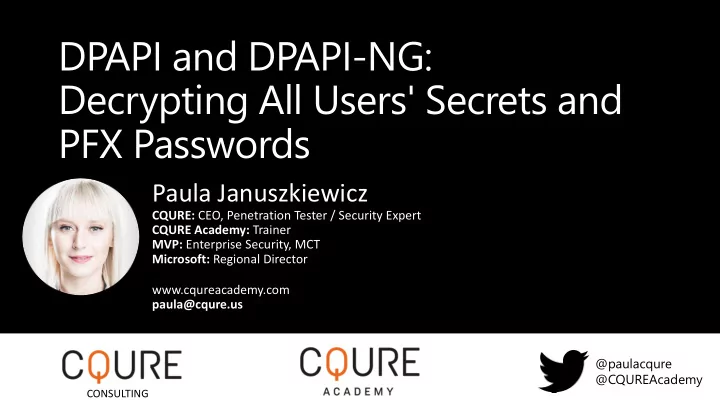
DPAPI and DPAPI-NG: Decrypting All Users' Secrets and PFX Passwords Paula Januszkiewicz CQURE: CEO, Penetration Tester / Security Expert CQURE Academy: Trainer MVP: Enterprise Security, MCT Microsoft: Regional Director www.cqureacademy.com


slide-1
SLIDE 1

DPAPI and DPAPI-NG: Decrypting All Users' Secrets and PFX Passwords

@paulacqure @CQUREAcademy

CONSULTING

Paula Januszkiewicz

CQURE: CEO, Penetration Tester / Security Expert CQURE Academy: Trainer MVP: Enterprise Security, MCT Microsoft: Regional Director www.cqureacademy.com paula@cqure.us

slide-2
SLIDE 2
slide-3
SLIDE 3

@paulacqure @CQUREAcademy

Class names for keys from HKLM\SYSTEM\CCS\Control\Lsa HKLM\SECURITY\Cache HKLM\SECURITY\Policy\Secrets HKLM\SECURITY\Policy\Secrets

slide-4
SLIDE 4

@paulacqure @CQUREAcademy

Classic Data Protection API

Based on the following components:

Password, data blob, entropy

Is not prone to password resets!

Protects from outsiders when being in offline access Effectively protects users data

Stores the password history

You need to be able to get access to some of your passwords from the past

Conclusion: OS greatlyhelpsus to protectsecrets

slide-5
SLIDE 5

@paulacqure @CQUREAcademy

Getting the: Classic DPAPI Secrets

DPAPI (classic)

  • A. MasterKey
  • 1. pwdhash = MD4(password) or SHA1(password)
  • 2. pwdhash_key = HMACSHA1(pwdhash, user_sid)
  • 3. PBKDF2(…, pwdhash_key,…), another elements from the file. Windows 10 no domain: SHA512,

AES-256, 8000 rounds

  • 4. Control – HMACSHA512
  • B. CREDHIST
  • 1. pwdhash = MD4(password) or SHA1(password)
  • 2. pwdhash_key = HMACSHA1(pwdhash, user_sid)
  • 3. PBKDF2(…, pwdhash_key,…), another elements from the file. Windows 10 no domain: SHA512,

AES-256, 8000 rounds

  • 4. Control – HMACSHA512
  • C. DPAPI blob Algorithms are written in the blob itself.
slide-6
SLIDE 6

@paulacqure @CQUREAcademy

Classic DPAPI Flow: getting the system’s secrets (easy)

slide-7
SLIDE 7

@paulacqure @CQUREAcademy

IIS Configuration / Application Pools

Used to group one or more Web Applications

Purpose: Assign resources, serve as a security sandbox

Use Worker Processes (w3wp.exe)

Their identity is defined in Application Pool settings Process requests to the applications

Passwords for AppPool identity can be ’decrypted’ even offline

They are stored in the encrypted form in applicationHost.config

Conclusion: IIS relies it’s security on Machine Keys (Local System)

slide-8
SLIDE 8

@paulacqure @CQUREAcademy

DPAPI + AD

DPAPI-PROTECTED BLOB

CLIENT Local LSASS process (local masterkey can’t be decrypted)

CryptUnprotectData()

DPAPI AD SERVER LSASS process

RPC Call BackupKey(masterkey) Decrypted masterkey

01 00 00 00 d0 8c 9d df 01 15 d1 11 8c 7a 00 c0 4f c2 97 eb 01 00 00 00 ......

G$BCKUPKEY_PREFERRED G$BCKUPKEY_940db612-ee8f-4a31-84b3-8f80c25be855

Scenario: offline changed user password or local masterkey can’t be decrypted

slide-9
SLIDE 9

@paulacqure @CQUREAcademy

Cached Logons

There is actually not much of a difference with XP / 2003! No additional salting. PBKDF2 introduced a new variable: the number of iterations SHA1 with the same salt as before (username).

slide-10
SLIDE 10

@paulacqure @CQUREAcademy

Getting the: cached data

MSDCC2 1.bootkey: classes from HKLM\SYSTEM\CCS\Control\Lsa + [class names for: Data, GBG, JD, Skew1] (+arrays’ permutations) int[] permutationBootKey = new int[] { 0x8, 0x5, 0x4, 0x2, 0xb, 0x9, 0xd, 0x3, 0x0, 0x6, 0x1, 0xc, 0xe, 0xa, 0xf, 0x7 }; 2.PolEKList: HKLM\SECURITY\Policy\PolEKList [default value] 3.lsakey: AES_DECRYPT(key, data) -> AES(bootkey, PolEKList) 4.NL$KM secret: HKLM\SECURITY\Policy\Secrets\NL$KM 5.nlkm_decrypted: AES_DECRYPT(lsakey, NL$KM secret) 6.Cache_Entry{id} -> HKLM\SECURITY\Cache\NL${id} 7.cache_entry_decrypted -> AES_DECRYPT(nlkm_decrypted, Cache_Entry{id})
slide-11
SLIDE 11

@paulacqure @CQUREAcademy

DK = PBKDF2(PRF, Password, Salt, c, dkLen) Microsoft’s implementation: MSDCC2= PBKDF2(HMAC-SHA1, DCC1, username, 10240, 16) Legend

slide-12
SLIDE 12

@paulacqure @CQUREAcademy

Classic DPAPI Flow: getting the user’s secrets

slide-13
SLIDE 13

@paulacqure @CQUREAcademy

Retrieving Golden Key from LSA – Mimikatz’ way

LSASS.EXE MEMORY

LSASRV.DLL

G$BCKUPKEY_PREFERRED G$BCKUPKEY_940db612-ee8f-4a31-84b3-8f80c25be855

GoldenKey.pfx LSASRV.DLL, LSASS.EXE, etc. PATTERNS (for different versions of modules)

slide-14
SLIDE 14

@paulacqure @CQUREAcademy

Retrieving Golden Key from LSA – CQURE’s way

LSASS.EXE MEMORY

LSASRV.DLL

G$BCKUPKEY_PREFERRED G$BCKUPKEY_940db612-ee8f-4a31-84b3-8f80c25be855

AD secret? HOW?! CQLsassSecretsDumper GoldenKey.pfx ? ? ? ? ? ? ?

slide-15
SLIDE 15

@paulacqure @CQUREAcademy

DomainKey contains some GUID and 256-byte len secret – RSA?? Dude, look in the AD...

DPAPI-AD: How (the hell) did we do it?

slide-16
SLIDE 16

@paulacqure @CQUREAcademy

Demo: What about KeePass?

slide-17
SLIDE 17

@paulacqure @CQUREAcademy

DPAPI in pictures Example: KeePass ProtectedUserKey.bin

Legend

The master password for KeePass files encrypted & stored as cipherText (80 bytes)

slide-18
SLIDE 18

@paulacqure @CQUREAcademy

Demo: What about RDP Connections?

slide-19
SLIDE 19

@paulacqure @CQUREAcademy

Getting the: DPAPI-NG Secrets

DPAPI-NG

  • A. RootKey Algorithms Key derivation function:

SP800_108_CTR_HMAC (SHA512) Secret agreement: Diffie-Hellman

  • B. DPAPI blob Key derivation: KDF_SP80056A_CONCAT

After getting the key, there is a need for decryption: Key wrap algorithm: RFC3394 (KEK -> CEK) Decryption: AES-256-GCM (CEK, Blob)

slide-20
SLIDE 20

@paulacqure @CQUREAcademy

DPAPI-NG: Data encryption flow

SID-PROTECTED BLOB

CLIENT Local LSASS process

NCryptUnprotectSecret()

CNG DPAPI AD SERVER LSASS process

RPC Call GetKey(SID, L0, L1, L2 params)

ACTIVE DIRECTORY RootKey RootKeyData?

Group key

slide-21
SLIDE 21

@paulacqure @CQUREAcademy

Looks familiar? It should! It’s DPAPI blob!

Protection descriptor: LOCAL=user

  • KEK (Key Encryption Key)

stored as DPAPI blob

  • Forced by protection

descriptor LOCAL=user

  • Key Wrap (RFC3394)

contains encrypted CEK (Content Encryption Key)

  • Data encrypted by CEK

DPAPI-NG: Protected data encoded as ASN.1 blob

slide-22
SLIDE 22

@paulacqure @CQUREAcademy

DPAPI-NG: getting to SID- Protected PFX files

slide-23
SLIDE 23

@paulacqure @CQUREAcademy

DPAPI-NG: getting to ASP.NET secrets

slide-24
SLIDE 24

@paulacqure @CQUREAcademy

CQURE DPAPI Toolkit

Tool Description CQMasterKeyAD DPAPIBlobCreator CQDPAPIKeePassDBDecryptor DPAPINGDecrypter CQDPAPIEncDec CQAspNetCoreDecryptData. CQDPAPIExportPFXFromAD CQAspNetCoreMasterKeyCreate CQRDCManDecrypter CQAspNetCoreEncryptData CQDPAPINGPFXDecrypter CQDPAPINGDNCoreMasterKeyDecrypter *CQImpersonateWithSeTcb

slide-25
SLIDE 25
slide-26
SLIDE 26

Q and A Time! Let’s move to Facebook or email!

slide-27
SLIDE 27

Thank You! If you have questions you can email me at paula@cqure.us You can also chat us up on the page https://cqureacademy.com/