Decision to Incision Timing: No financial disclosures related to - - PowerPoint PPT Presentation

decision to incision timing
SMART_READER_LITE
LIVE PREVIEW

Decision to Incision Timing: No financial disclosures related to - - PowerPoint PPT Presentation

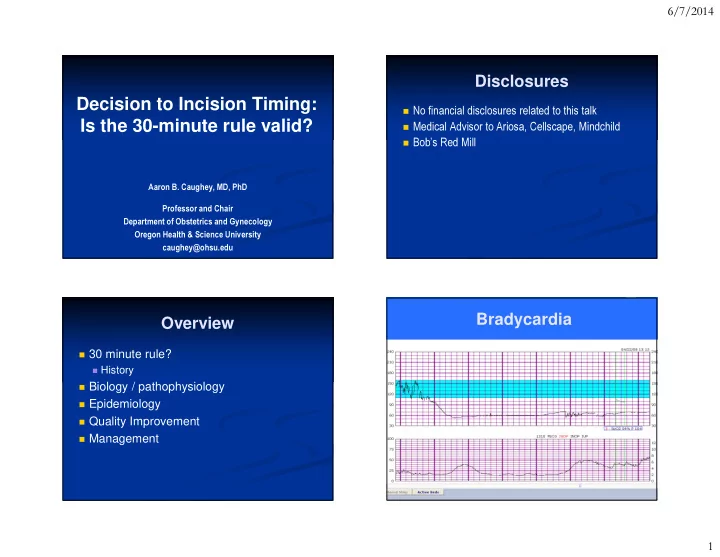
6/7/2014 Disclosures Decision to Incision Timing: No financial disclosures related to this talk Is the 30-minute rule valid? Medical Advisor to Ariosa, Cellscape, Mindchild Bobs Red Mill Aaron B. Caughey, MD, PhD Professor and


slide-1
SLIDE 1

6/7/2014 1

Decision to Incision Timing: Is the 30-minute rule valid?

Aaron B. Caughey, MD, PhD Professor and Chair Department of Obstetrics and Gynecology Oregon Health & Science University caughey@ohsu.edu

Disclosures

No financial disclosures related to this talk Medical Advisor to Ariosa, Cellscape, Mindchild Bob’s Red Mill

Overview

30 minute rule?

History

Biology / pathophysiology Epidemiology Quality Improvement Management

Bradycardia

slide-2
SLIDE 2

6/7/2014 2

How long would it take to achieve delivery?

1 m i n u t e s

  • r

. . . 1 5 m i n u t e s 2 m i n u t e s 3 m i n u t e s L

  • n

g e r

28% 43% 5% 7% 17%

  • A. 10 minutes or less
  • B. 15 minutes
  • C. 20 minutes
  • D. 30 minutes
  • E. Longer

Minimum time until injury?

1 m i n u t e s

  • r

. . . 1 5 m i n u t e s 2 m i n u t e s 3 m i n u t e s L

  • n

g e r

46% 22% 7% 5% 20%

  • A. 10 minutes or less
  • B. 15 minutes
  • C. 20 minutes
  • D. 30 minutes
  • E. Longer

Disconnect?

If injury occurs faster than we can

intervene, then why a 30-minute rule?

Should it be shorter?

The 30 minute rule

Established as a time threshold for

cesarean delivery to occur – 1980s

ACOG, RCOG, etc Became a more prominent rule of the land

in the late 1990s

ACOG Committee on Professional Standards for Obstetric-Gynecologic Services. 7th ed.; 1989. Tuffnell et al. BMJ 2001;322:1330–3

slide-3
SLIDE 3

6/7/2014 3

VBAC – 1990s

Why 30 minutes?

Improving outcomes? Feasibility? Whim?

Prolonged decelerations

J Healthc Risk Manag. 1999 Winter;19(1):11-20. Is the obstetric guideline of 30 minutes from decision to incision for Cesarean delivery clinically significant? Lavery JP1, Janssen J, Hutchinson L.

The time required to extract an infant from a hostile in utero environment is a frequent issue in medical negligence

  • cases. The American College of Obstetricians and

Gynecologists and the American Academy of Pediatrics suggest a time guideline of 30 minutes from decision for Cesarean delivery to the beginning (incision) of the procedure. This time frame is based on survey

data from hospitals throughout the United States and is not based on clinical outcomes or the pathophysiology of obstetric events.

What time threshold?

What outcomes are we interested in? Mortality

Short-term (neonatal) Long-term (infant and beyond)

Morbidity

HIE / CP Seizures? Apgars? Cord gases

slide-4
SLIDE 4

6/7/2014 4

Prolonged decelerations

Obstet Gynecol. 2002 Sep;100(3):557-60. The correlation of seizures in newborn infants with significant acidosis at birth with umbilical artery cord gas values. Williams KP1, Singh A.

238 neonates w/ UA pH <7.1 Primary outcome – seizures from HIE Examined all gas features

pO2; pCO2; base excess, pH

pH < 7.0 only was associated in MV model

How long?

US, 1995-2005 Cahill AG, et al. Terminal decelerations and outcomes. Obstet Gynecol. 2013 Nov;122(5):1070-6

How long? How long?

Time ≥10 min n=31 (%) Time <10 min n=920 (%) P value Acidemia ≤ 7.10 (n=12)

4 (12.9) 8 (0.9)

<0.01 Acidemia ≤ 7.05 (n=4)

2 (6.5) 2 (0.2)

<0.01 APGAR 5min < 7 (n=4)

2 (6.5) 2 (0.2)

<0.01 Special Care* or NICU Admission (n=38)

5 (16.7) 33 (3.6)

<0.01 NICU Admission (n=11)

3 (10.0) 8 (0.9)

<0.01

Cahill AG, et al. Terminal decelerations and outcomes. Obstet Gynecol. 2013 Nov;122(5):1070-6

slide-5
SLIDE 5

6/7/2014 5

Only Time?

Are there other features that matter? Leung et al – decelerations Variability? Etiology – uterine rupture, abruption, etc. Heart rate?

How long?

US, 1995-2005 Cahill AG, et al. Terminal decelerations and outcomes. Obstet Gynecol. 2013 Nov;122(5):1070-6

Variability

Decreased variability before bradycardia Combined with no recovery of the bradycardia mean pH 6.83 +/- 0.16 78% incidence of significant acidosis

Williams K, et al. Obstet Gynecol. 2002 Nov;100(5 Pt 1):951-4. Fetal heart rate parameters predictive of neonatal outcome in the presence of a prolonged deceleration.

Heart Rate

Tranquilli A, et al. J Matern Fetal Neonatal Med. 2013 Sep;26(14):1425-9. The correlation between fetal bradycardia area in the second stage of labor and acidemia at birth.

Time until acidemia P value

FHR 80s 25 mins

<0.01

FHR 70s 13 mins

<0.01

FHR 60s 8 mins

<0.01

FHR 50s 6 mins

<0.01

FHR 40s 5 mins

<0.01

slide-6
SLIDE 6

6/7/2014 6

What threshold?

Given the data, what approach? Should there be a set time? Should the standard time differ?

Hospital size Local geography / population Level

What to do? Is it a bradycardia? What to do? Is it a bradycardia? What to do? Is it a bradycardia? Is it a bradycardia?

slide-7
SLIDE 7

6/7/2014 7

What to do? Is it a bradycardia? Is it a bradycardia? What to do? Is it a bradycardia? Is it a bradycardia? What to do? Is it a bradycardia? Is it a bradycardia? What to do?

What is the Baseline status? What is the Etiology? What needs to be done to achieve Delivery? BED

slide-8
SLIDE 8

6/7/2014 8

What to do?

What is the Baseline status?

Decels Variability Meconium Chorioamnionitis Compromised mother or fetus?

Htn disorder; fetal anomaly; preterm

What to do?

What is the Etiology?

Abruption Tachysystole/Tetany Cord prolapse Uterine rupture Maternal

Hypotension (AFE); hypoxic (PE)

Fetal

Oligo; arrhythmia; rapid descent

What to do?

What needs to be done to achieve Delivery?

What is the exam? Include position Parity and prior OB Hx Patient BMI EFW Anesthesia? OR / staff?

What to do?

Individual level – BED Hospital level

Establish benchmarks Environment (Geography; Populations) Engineering (Internal and External)

Societal level

Encourage collaboration Public Health

slide-9
SLIDE 9

6/7/2014 9

Can we reduce the length of time?

Tuffnell et al. BMJ 2001;322:1330–3

Can we reduce the length of time? Can we reduce the length of time? Can we reduce the length of time?

slide-10
SLIDE 10

6/7/2014 10

What should be done?

Gather together leadership to discuss

OB providers (MFM, OB, CNM, FM)

Measure the outcomes – report the data Potentially use QI methods

Institutionally based (e.g. Lean)

Establish standards / standard behaviors

What time goal?

As fast as possible!!!

3 m i n u t e s ? 2 m i n u t e s ? 1 5 m i n u t e s ? 1 m i n u t e s ?

11% 27% 40% 22%

  • A. 30 minutes?
  • B. 20 minutes?
  • C. 15 minutes?
  • D. 10 minutes?

Thank You