Decision Decision- ec s o ec s o -making in Local Management of - - PowerPoint PPT Presentation

decision decision ec s o ec s o making in local
SMART_READER_LITE
LIVE PREVIEW

Decision Decision- ec s o ec s o -making in Local Management of - - PowerPoint PPT Presentation

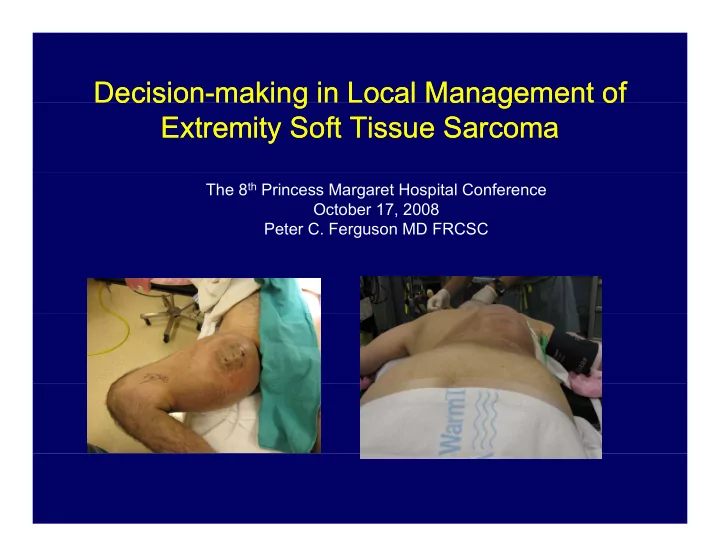
Decision Decision- ec s o ec s o -making in Local Management of making in Local Management of a a g g oca oca a age a age e e o o Extremity Soft Tissue Sarcoma Extremity Soft Tissue Sarcoma The 8 th Princess Margaret Hospital


slide-1
SLIDE 1

Decision Decision-

  • making in Local Management of

making in Local Management of ec s o ec s o a g

  • ca

a age e

  • a

g

  • ca

a age e

  • Extremity Soft Tissue Sarcoma

Extremity Soft Tissue Sarcoma

The 8th Princess Margaret Hospital Conference October 17, 2008 Peter C. Ferguson MD FRCSC

slide-2
SLIDE 2

Multidisciplinary Local Management Multidisciplinary Local Management – A A y g y g “Development in Cancer Management” “Development in Cancer Management”

  • Although surgery

remains the mainstay of treatment, decisions are not made independently not made independently by surgeon

  • Collaborative input into

di i d i l radiation and surgical planning

  • PMH a leader in this

PMH a leader in this collaborative treatment model

slide-3
SLIDE 3

Background Background Background Background

  • Soft tissue sarcoma (STS) represents one of

( ) p the first collaborations in accomplishing structure and function preservation in

  • ncology
  • Management involves surgical, radiation

l di l l di l i i

  • ncology, medical oncology, medical imaging

and pathology input Goal of treatment is local control function

  • Goal of treatment is local control, function

preservation, and usually limb preservation

slide-4
SLIDE 4

Objectives Objectives Objectives Objectives

  • To present the current paradigm for

To present the current paradigm for multidisciplinary decision making for local management of soft tissue local management of soft tissue sarcomas at PMH

  • To highlight the research
  • To highlight the research

accomplishments of our group that have led to this management paradigm led to this management paradigm

slide-5
SLIDE 5

Management of Management of Soft Tissue Sarcomas Soft Tissue Sarcomas Management of Management of Soft Tissue Sarcomas Soft Tissue Sarcomas

  • Surgery +/- radiation

COMPLETE l f

  • COMPLETE removal of

tumor

  • Reconstruction of

– Soft tissues – Bone – Nerves Blood vessels – Blood vessels

  • This applies to any

anatomic site

Extremity – Extremity – Head & neck – Retroperitoneum

slide-6
SLIDE 6

The Concept of the Surgical Margin The Concept of the Surgical Margin The Concept of the Surgical Margin The Concept of the Surgical Margin

  • Originally described

g y for sarcoma by Enneking

  • 4 categories

– Intralesional – Marginal – Wide Radical – Radical

slide-7
SLIDE 7

The Concept of the Surgical Margin The Concept of the Surgical Margin The Concept of the Surgical Margin The Concept of the Surgical Margin

  • Intralesional margin is

inadequate, associated with unacceptable risk

  • f local recurrence –
  • f local recurrence

approximately 40% by 2 years R di l i

  • Radical margin

generally overkill, associated with significant functional implications

slide-8
SLIDE 8

Gerrand CH et al, Gerrand CH et al, Classification of positive margins after resection of soft Classification of positive margins after resection of soft-

  • tissue sarcoma of the limb predicts the risk of local recurrence,

tissue sarcoma of the limb predicts the risk of local recurrence, JBJS (Br) 83 JBJS (Br) 83-

  • ( )

( ) B(8), B(8), November 2001, November 2001, pp 1149 pp 1149-

  • 1155

1155

↑Unplanned positive

margin, or intralesional i i excision

slide-9
SLIDE 9

Wide Margins Wide Margins Wide Margins Wide Margins

  • Depend on the tissue in

question

  • Generally for skin, fat or

muscle 2 cm is muscle, 2 cm is considered a safe wide margin to account for i i di microscopic disease

  • This includes tumor and

edema edema

  • However 1 mm of

fascia, which is a good barrier to tumor spread, is also a wide margin

slide-10
SLIDE 10

White LM et al, White LM et al, HISTOLOGIC ASSESSMENT OF PERITUMORAL EDEMA IN HISTOLOGIC ASSESSMENT OF PERITUMORAL EDEMA IN SOFT TISSUE SARCOMA, SOFT TISSUE SARCOMA, Int. J. Radiation Oncology Biol. Phys., Vol. 61, No.

  • Int. J. Radiation Oncology Biol. Phys., Vol. 61, No.

5, pp. 1439 5, pp. 1439– –1445, 2005 1445, 2005

  • 15 patients

underwent resection

  • f sarcoma without

neoadjuvant neoadjuvant treatment

  • Edema on T2-

weighted images ranged from 0 - 7.1 cm from edge of cm from edge of tumor (mean 2.5 cm)

slide-11
SLIDE 11

White LM et al, White LM et al, HISTOLOGIC ASSESSMENT OF PERITUMORAL EDEMA IN HISTOLOGIC ASSESSMENT OF PERITUMORAL EDEMA IN SOFT TISSUE SARCOMA, SOFT TISSUE SARCOMA, Int. J. Radiation Oncology Biol. Phys., Vol. 61, No.

  • Int. J. Radiation Oncology Biol. Phys., Vol. 61, No.

5, pp. 1439 5, pp. 1439– –1445, 2005 1445, 2005

  • In 6 cases malignant

cells were found in edema less than 1 cm from tumor cm from tumor margin

  • In 4 cases malignant

g cells were more than 1 cm from tumor margin with margin, with maximum distance 4 cm

slide-12
SLIDE 12

Why consider edema in STS? Why consider edema in STS? Why consider edema in STS? Why consider edema in STS?

  • Edema contains

microscopic disease microscopic disease which may lead to local recurrence if not considered in treatment considered in treatment plan

  • Therefore marginal

margins are not adequate a g s a e

  • adequa e

if surgery alone is undertaken

  • Treatment of edema may

y be by wide surgical excision or preoperative radiation

slide-13
SLIDE 13

Imaging in treatment decision making Imaging in treatment decision making Imaging in treatment decision making Imaging in treatment decision making

  • If we look at imaging

and feel that we can and feel that we can resect tumor

– with adequate wide margins margins – without sacrificing critical structures or – significantly affecting function function

  • surgery alone is usually

all that is necessary - usually only reserved usually only reserved for small, superficial tumors, irrespective of tumor grade g

slide-14
SLIDE 14

Imaging in treatment decision making Imaging in treatment decision making Imaging in treatment decision making Imaging in treatment decision making

  • If wide resection means

– sacrifice of critical structures or – severe functional consequences

  • Radiation will be used –

almost always in deep almost always in deep lesions

  • Therefore radiation is

necessary if marginal margins are anticipated

slide-15
SLIDE 15

Imaging in planning margins Imaging in planning margins Imaging in planning margins Imaging in planning margins

  • First must ascertain whether sarcoma is

First must ascertain whether sarcoma is superficial or deep to fascia

  • This has important ramifications for
  • This has important ramifications for

treatment and prognosis This can be determined clinically but

  • This can be determined clinically but

MR imaging is essential to confirm the location in relation to the fascia location in relation to the fascia

slide-16
SLIDE 16

Superficial sarcomas Superficial sarcomas Superficial sarcomas Superficial sarcomas

  • On imaging, if tumor is

– small – superficial to fascia and – there is no surrounding there is no surrounding edema

  • SURGERY ALONE

resection +/ skin resection +/- skin grafting

  • This is irrespective of

p tumor grade

slide-17
SLIDE 17

Superficial sarcomas Superficial sarcomas - multinodular multinodular Superficial sarcomas Superficial sarcomas - multinodular multinodular

  • We can be less

certain that 2 cm of skin/fat is an adequate margin in adequate margin in this situation

  • Tumor is

demonstrating more infiltrative growth pattern pattern

  • SURGERY +

RADIATION RADIATION

slide-18
SLIDE 18

Superficial sarcoma Superficial sarcoma – – subcutaneous subcutaneous edema edema edema edema

  • Studies have shown

that edema contains microscopic disease

  • Once again we can

be less certain of i i thi

  • ur margins in this

situation SURGERY +

  • SURGERY +

RADIATION

slide-19
SLIDE 19

Superficial sarcoma Superficial sarcoma – overlying bone

  • verlying bone

Superficial sarcoma Superficial sarcoma – overlying bone

  • verlying bone
  • Bone covered by

y periosteum, which is not as good a barrier to tumor invasion as muscular fascia muscular fascia

  • SURGERY +

RADIATION RADIATION

slide-20
SLIDE 20

Superficial sarcoma Superficial sarcoma – – extracompartmental area extracompartmental area extracompartmental area extracompartmental area

  • Axilla, femoral

triangle, popliteal fossa or antecubital fossa are not fossa are not bounded by fascia

  • Inadequate margin

q g between tumor and neurovascular structures structures

  • SURGERY +

RADIATION RADIATION

slide-21
SLIDE 21

Deep sarcomas Deep sarcomas Deep sarcomas Deep sarcomas

  • Usually impossible

to obtain adequate margin without sacrificing critical sacrificing critical neurovascular structures or bone

  • Radiation will allow

for closer margin without increasing without increasing risk of local recurrence

slide-22
SLIDE 22

“Planned positive” margin “Planned positive” margin Planned positive margin Planned positive margin

  • Sarcomas are

frequently adjacent to critical neurovascular structures or bone structures or bone

  • At time of resection,

there is often no margin h di i present when dissecting these critical structures

  • ff the tumor

slide-23
SLIDE 23

“Planned positive” margin “Planned positive” margin Planned positive margin Planned positive margin

  • This “planned positive”

i i t margin is not associated with increased risk of local id d recurrence, provided patient receives radiotherapy and py margins are

  • therwise adequate
  • Therefore a “planned
  • Therefore a planned

positive” margin is akin to a marginal negative margin margin

slide-24
SLIDE 24

Gerrand CH et al, Gerrand CH et al, Classification of positive margins after resection of soft Classification of positive margins after resection of soft-

  • tissue sarcoma of the limb predicts the risk of local recurrence,

tissue sarcoma of the limb predicts the risk of local recurrence, JBJS (Br) 83 JBJS (Br) 83-

  • ( )

( ) B(8), B(8), November 2001, November 2001, pp 1149 pp 1149-

  • 1155

1155

↑ “Planned positive” margin

slide-25
SLIDE 25

Encased Critical Structures Encased Critical Structures Encased Critical Structures Encased Critical Structures

  • Essential to

establish on preoperative imaging to ensure imaging to ensure patient is aware of functional ramifications

  • No way to save

these structures

these structures without gross tumor spillage

slide-26
SLIDE 26

Encased Critical Structures Encased Critical Structures Encased Critical Structures Encased Critical Structures

  • Generally must be

t d resected

  • For major motor nerves,

this leaves significant g functional deficit but still

  • ften better than

function after amputation

  • In upper extremity, this

can be overcome by can be overcome by nerve grafting or distal nerve transfers

slide-27
SLIDE 27

Fuchs B et al, Fuchs B et al, Sciatic Nerve Resection in the Thigh CO : A Functional Evaluation, CORR 382: 34-41.

  • 20 patients underwent resection of sciatic

p nerve during resection of posterior thigh sarcomas

  • Functional outcome on 10 long term survivors
  • Mean TESS score 74% (range 46-99%)
  • More than 1/3 of patients felt they were not at

all compromised in daily activities

  • Function superior to high above knee

amputation

slide-28
SLIDE 28

Encased Vascular Structures Encased Vascular Structures Encased Vascular Structures Encased Vascular Structures

  • Encased vessels

can be resected and reconstructed Reconstructed

  • Reconstructed

arteries usually remain patent and p function is not affected V i ll

  • Veins usually
  • cclude and edema
  • ften ensues
  • ften ensues
slide-29
SLIDE 29

Ghert MA et al, Ghert MA et al, The Surgical and Functional Outcome of Limb The Surgical and Functional Outcome of Limb-

  • Salvage

Salvage Surgery With Vascular Reconstruction for Soft Tissue Surgery With Vascular Reconstruction for Soft Tissue S f S f f S O ( ) f S O ( ) Sarcoma of the Extremity Sarcoma of the Extremity, Annals of Surgical Oncology, 12(12): 1102 , Annals of Surgical Oncology, 12(12): 1102 -

  • 1110

1110

  • Compared with a control group of 38 patients

p g p p without vascular reconstruction, 19 patients with vascular reconstruction had:

– Higher wound complications (68% vs. 32%) – Higher incidence of DVT (26% vs. 0%) Hi h lik lih d f d (87% 20%) – Higher likelihood of edema (87% vs. 20%) – Higher risk of amputation (16% vs. 3%) – Equivalent function – Equivalent function

slide-30
SLIDE 30

Bone involvement Bone involvement Bone involvement Bone involvement

  • Rare occurrence (5%),
  • ften a poor prognostic
  • ften a poor prognostic

factor

  • Imaging that suggests

bone involved will lead bone involved will lead to resection and reconstruction

  • Essential to know this
  • Essential to know this

preoperatively

  • Clinical exam also

important – mass that is important mass that is mobile over bone will likely have periosteum as a margin g

slide-31
SLIDE 31

Ferguson PC et al, Ferguson PC et al, Bone Invasion in Extremity Soft Bone Invasion in Extremity Soft-

  • Tissue Sarcoma : impact

Tissue Sarcoma : impact O C ( ) C ( )

  • n Disease Outcomes,
  • n Disease Outcomes, Cancer 106(12): 2692

Cancer 106(12): 2692-

  • 2700.

2700.

  • Patients presenting

p g with bone invasion are more likely to

– Present with metastases Require amputation – Require amputation

  • Decreased overall

survival survival

slide-32
SLIDE 32

Lymph node involvement Lymph node involvement Lymph node involvement Lymph node involvement

  • Rare in soft tissue

d t sarcoma compared to pulmonary metastases

  • Generally physical

y p y examination is all that is necessary

  • Certain histologic

Certain histologic subtypes warrant imaging of regional lymph nodes due to lymph nodes due to higher risk of lymphatic spread

slide-33
SLIDE 33

Riad S et al, Riad S et al, Lymph Node Metastasis in Soft Tissue Sarcoma in Lymph Node Metastasis in Soft Tissue Sarcoma in an Extremity, an Extremity, Clinical Orthopaedics and Related Research Clinical Orthopaedics and Related Research Number 426, pp. 129 Number 426, pp. 129– –134 134

  • Of 1066 patients, 39 (3.7%) developed lymph

node metastases

  • Most common histologic subtypes

E ith li id (3/15) 20% – Epithelioid sarcoma (3/15) 20% – Rhabdomyosarcoma (4/21) 19% – Clear cell sarcoma (2/18) 11.1% Clear cell sarcoma (2/18) 11.1% – Angiosarcoma (2/18) 11.1%

  • Contrary to previous similar studies, synovial

sarcoma rarely developed lymphatic mets (4%)

slide-34
SLIDE 34
slide-35
SLIDE 35
slide-36
SLIDE 36

Role for sentinel node biopsy? Role for sentinel node biopsy? Role for sentinel node biopsy? Role for sentinel node biopsy?

  • Isolated case

reports in clear cell sarcoma, epithelioid sarcoma and rhabdomyosarcoma U l if i

  • Unclear if prognosis

is changed, but warrants further warrants further investigation in patients at high risk p g

slide-37
SLIDE 37

The “Whoops” referral The “Whoops” referral The Whoops referral The Whoops referral

  • Excisional biopsy of a lesion (usually

superficial) thought to be benign

  • Final pathology shows sarcoma with involved

margins margins

  • If lesion was resected piecemeal, zone of

contamination is likely large contamination is likely large

probably consider preop RT

  • If resected en bloc through reactive zone

g (marginal excision)

re-excise and if margins still close – postop RT

slide-38
SLIDE 38

Limb Salvage Surgery Limb Salvage Surgery Limb Salvage Surgery Limb Salvage Surgery

  • Possible in 95% + of cases
  • Surgery alone is possible if wide margins are

achievable (2cm) without sacrificing critical structures (bone nerves vessels) based on structures (bone, nerves, vessels) based on preop MRI

  • Usually only small superficial sarcomas; often

Usually only small superficial sarcomas; often need split thickness skin graft

  • If not possible, combined treatment with

radiation and surgical resection is recommended

slide-39
SLIDE 39

Amputation Amputation Amputation Amputation

  • Indications all relative
  • Usually indicated if patient has more than one
  • f

– Vascular involvement – Motor nerve involvement (or multiple nerves in t it ) upper extremity) – Infected tumor Poor soft tissue coverage – Poor soft tissue coverage – Expected functional outcome poorer than with amputation

slide-40
SLIDE 40
  • 52 year old male
  • Rapidly growing soft

tissue mass on dorsum

  • f foot extending up to
  • f foot extending up to

ankle

  • Involvement of extensor

tendons, dorsal nerves, vessels, bone invasion

  • Below knee amputation
  • Below knee amputation

– excellent functional

  • utcome
slide-41
SLIDE 41
  • 19 year old male with

NF-1

  • Growing mass in calf –

MPNST MPNST

  • Involvement of bone, all

4 compartments of calf, posterior tibial vessels and nerve

  • Above knee amputation
  • Above knee amputation
slide-42
SLIDE 42
  • 90 year old male,

y , local recurrence of previously treated f sarcoma in forearm

  • Involvement of ulna,

t t d extensor tendons, ulnar nerve and vessels vessels

  • Below elbow

amputation amputation

slide-43
SLIDE 43
  • 67 year old male
  • Rapidly growing mass

right arm just above elbow elbow

  • Growing rapidly on

radiation

  • Involvement of brachial

vessels, median & ulnar nerve nerve

  • Shoulder disarticulation
slide-44
SLIDE 44

Management of Local Recurrences Management of Local Recurrences Management of Local Recurrences Management of Local Recurrences

  • Essential to have details on previous treatment

– radiation and surgical

  • If no previous radiation, lesion may be

managed similar to primary tumor but radiation managed similar to primary tumor, but radiation should be utilized

  • Management must be individualized based on

Management must be individualized based on

– Previous radiotherapy and surgery – Local anatomy – Reconstructive options – Probability of complications Functional consequences – Functional consequences

  • Always be aware of possibility of a new primary
slide-45
SLIDE 45

364 lower extremity EBRT at PMH (1986-98) without chemo. F l (6% 2% 0 02) 55 (7% 1% 0 004)

  • Females (6% vs. 2%, p = 0.02); > 55 yr (7% vs. 1%, p = 0.004)
  • Cox: age, gender, and RT independent factors
  • Median fracture time: 44 mos (range, 12 to 153 months)

Fracture rates: Crude rates 5-yr frequency O ll 6 3 % 4 % Overall 6.3 % 4 % High-dose (60-66 Gy) 10 % 7 % Low dose (50 Gy generally pre op) 2 % 0 6 % Low-dose (50 Gy, generally pre-op) 2 % 0.6 %

Holt et al. JBJS 2005

slide-46
SLIDE 46

Study Purpose Study Purpose Study Purpose Study Purpose

Review the management and outcomes Review the management and outcomes

  • f

patients who develop radiation- associated pathologic fractures after associated pathologic fractures after treatment

  • f

extremity soft tissue sarcomas in a single

  • rthopaedic

sa co as a s g e

  • t opaed c
  • ncology centre.
slide-47
SLIDE 47

Results Results Results Results

1986 - 2005: 1381 patients p ⇓

946 (68 5%) combined radiation + surgery 946 (68.5%) combined radiation + surgery

32 patients pathologic fracture (3 4%) 32 patients pathologic fracture (3.4%)

34 fractures

slide-48
SLIDE 48

Results Results Results Results

Location # Fractures Healed Not Healed

Acetabulum

2 (6%) 2

Prox Femur

12 (35%) 3 9 12 (35%) 3 9

Diaph Femur

8 (24%) 1 7

Distal Femur

2 (6%) 1 1

Distal Femur

2 (6%) 1 1

Prox Tibia

2 (6%) 2

Diaph Tibia

3 (9%) 1 2

Diaph Tibia

3 (9%) 1 2

Metatarsal

2 (6%) 2

Patella

3 (9%) 1 2

Patella

3 (9%) 1 2

slide-49
SLIDE 49

Nomogram for Prediction of Femur Nomogram for Prediction of Femur Fracture in Patients Undergoing Thigh Fracture in Patients Undergoing Thigh Sarcoma Resection Sarcoma Resection

Points

10 20 30 40 50 60 70 80 90 100

Sex

Male Female

Age_at_Sx

20 30 40 50 60 70 80 90

Compartment

Post Add Other Ant

Diameter

2 4 6 8 10 12 14 16 18 20 22 24 26 28 2 4 6 8 10 12 14 16 18 20 22 24 26 28

Radiation

Low High

Stripping

<10 10 to 20 >20 10 10 to 20

Total Points

20 40 60 80 100 120 140 160 180 200 220 240 260

Probability of Fracture

0.05 0.25 0.5 0.75 0.95