
SLIDE 1
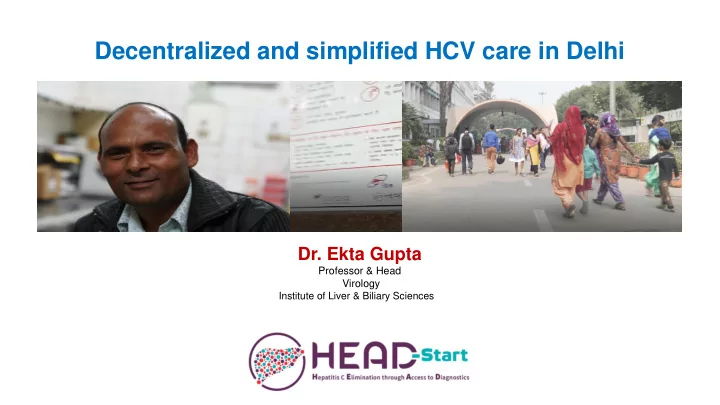
Decentralized and simplified HCV care in Delhi
- Dr. Ekta Gupta
Professor & Head Virology Institute of Liver & Biliary Sciences
Decentralized and simplified HCV care in Delhi Dr. Ekta Gupta - - PowerPoint PPT Presentation
Decentralized and simplified HCV care in Delhi Dr. Ekta Gupta Professor & Head Virology Institute of Liver & Biliary Sciences Introduction An estimated 12 18 million people are infected with Hepatitis C Virus (HCV) in India,
Professor & Head Virology Institute of Liver & Biliary Sciences
Arm1:
Hospital Screening n = 5 Hospitals
RDT Screening at hospitals Sample collected from HCV Ab+ and sent same day to ILBS Confirmatory testing at central lab (ILBS) Arm 2:
Partially decentralized screening n = 15 polyclinics
RDT screening at polyclinics Patient referred to hospital for confirmatory tests-sample collection Confirmatory testing at central lab (ILBS) Arm3:
Outreach Screening
RDT at screening camps Patient referred to hospital for confirmatory tests-sample collection Confirmatory testing at central lab (ILBS)
Hospital Polyclinics
1 Maharishi Valmiki Punjabi Colony Rohini Sec 18 Rohini Sec 4 2 Sanjay Gandhi Wazirpur Rohini Sec 2 Saraswati Vihar 3 Deen Dayal Upadhaya Tilak Vihar Pitampura Rani Bagh 4
Malviya Basant Gaon Timarpur Kashavpuram 5 Guru Teg Bahadur Vivek Vihar Nand Nagri Kanti Nagar
786 (2.0%) 704 (89.6%) 606 (86.1%) 494 (81.5%) 435 (88.1%) 407 (93.6%) 244 (60.0%) 235 (96.3%) RDT + HCV RNA tested HCV RNA + t/t initiated t/t completed Eligible for SVR SVR tested Cured 100 200 300 400 500 600 700 800 900
38768 786 704 606 494 435 407 244 235 RDT screened RDT + HCV RNA tested HCV RNA + t/t initiated t/t completed Eligible for SVR SVR tested Cured 5000 10000 15000 20000 25000 30000 35000 40000 45000
Site Type % RNA tests % Tx Initiation Cumulative Cascade retention Hospital, direct 92.7%* 88.1%** 81.7% Polyclinics, referred 48.4% 34.2% 16.6%
*p<0.001 **p=0.003
Site Type % RDT+ District Hospitals 3.1%* Polyclinics 1.6%
*p<0.001
Dr Sundeep Miglani, Addl Director DGHS. All the nodal officers at the five hospitals in Delhi. FIND Delhi office. Clinton Health Access Initiative (CHAI). WHO India. WHO Global Hepatitis Program. National Viral Hepatitis Control Program. The patients who participated in this program. Technical staff and Data entry operators. Unitaid for its funding and support.