Deadlock Questions? ! What is a deadlock? CSCI [4|6]730 ! What - - PDF document

deadlock questions
SMART_READER_LITE
LIVE PREVIEW

Deadlock Questions? ! What is a deadlock? CSCI [4|6]730 ! What - - PDF document

Deadlock Questions? ! What is a deadlock? CSCI [4|6]730 ! What causes a deadlock? Operating Systems ! How do you deal with (potential) deadlocks? Deadlock Maria Hybinette, UGA Maria Hybinette, UGA Deadlock: What is a deadlock? Example


slide-1
SLIDE 1

Maria Hybinette, UGA

CSCI [4|6]730 Operating Systems

Deadlock

Maria Hybinette, UGA

Deadlock Questions?

! What is a deadlock? ! What causes a deadlock? ! How do you deal with (potential) deadlocks?

Maria Hybinette, UGA

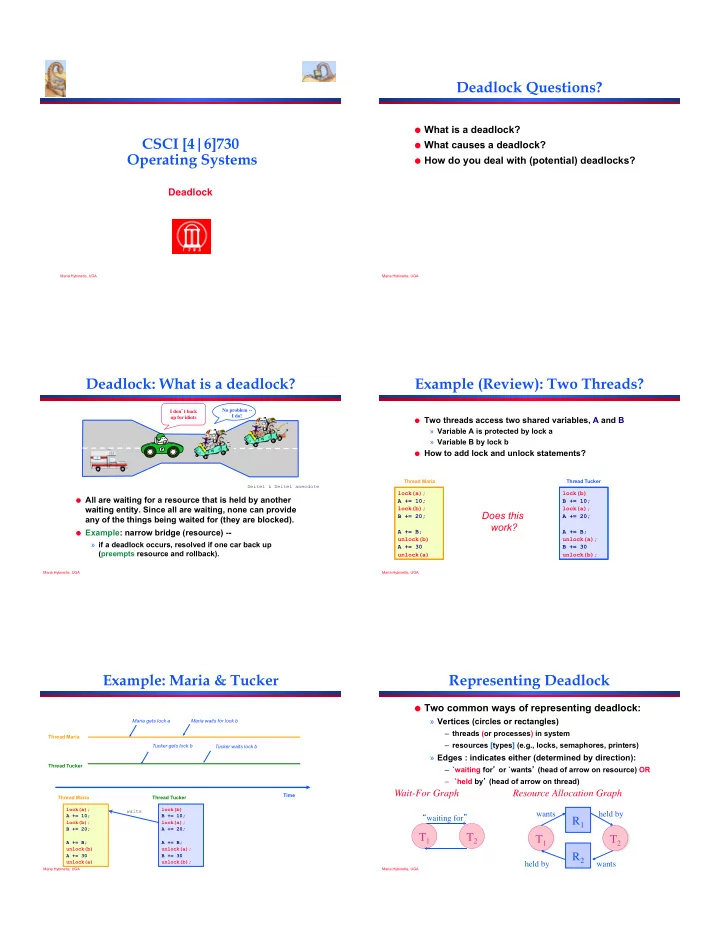
Deadlock: What is a deadlock?

! All are waiting for a resource that is held by another

waiting entity. Since all are waiting, none can provide any of the things being waited for (they are blocked).

! Example: narrow bridge (resource) --

» if a deadlock occurs, resolved if one car back up (preempts resource and rollback).

I don’t back! up for idiots! Deitel & Deitel anecdote No problem -- ! I do!!

Maria Hybinette, UGA

A += 10; B += 20; A += B; A += 30 B += 10; A += 20; A += B; B += 30

Thread Maria Thread Tucker

Example (Review): Two Threads?

! Two threads access two shared variables, A and B

» Variable A is protected by lock a » Variable B by lock b

! How to add lock and unlock statements? lock(b) lock(a); unlock(a); unlock(b);

Does this work?

lock(a); lock(b); unlock(b) unlock(a)

Maria Hybinette, UGA

Example: Maria & Tucker

lock(a); A += 10; lock(b); B += 20; A += B; unlock(b) A += 30 unlock(a) Thread Maria Thread Tucker Maria gets lock a Time Thread Tucker Thread Maria lock(b) B += 10; lock(a); A += 20; A += B; unlock(a); B += 30 unlock(b); Tucker gets lock b Maria waits for lock b Tucker waits lock b waits

Maria Hybinette, UGA

Representing Deadlock

! Two common ways of representing deadlock:

» Vertices (circles or rectangles)

– threads (or processes) in system – resources [types] (e.g., locks, semaphores, printers)

» Edges : indicates either (determined by direction):

– `waiting for’ or `wants’ (head of arrow on resource) OR – `held by’ (head of arrow on thread)

T1! T2!

“waiting for”!

T2! T1! R1! R2!

held by! wants! wants! held by!

Wait-For Graph! Resource Allocation Graph!

slide-2
SLIDE 2

Maria Hybinette, UGA

Conditions for Deadlock

! Mutual exclusion:

» Resource cannot be shared » Requests are delayed until resource is released

! Hold and wait:

» Thread holds one resource while it waits for another

! No preemption:

» previously granted resources cannot forcibly be taken away

! Circular wait:

» Circular dependencies exist in “waits-for” or “resource- allocation” graphs » Each is waiting for a resource held by next member of the chain.

All for conditions must hold simultaneously! All for conditions must hold simultaneously!

Maria Hybinette, UGA

What to do: Handling Deadlock

1.

Ignore

» Easiest and most common approach (e.g., UNIX).

2.

Deadlock prevention

» Ensure deadlock does not happen » Ensure at least one of 4 conditions does not occur

  • 1. Hold&Wait, No Preemption, Circularity, Mutual Exclusion
  • 2. System build so deadlock cannot happen

3.

Deadlock detection and recovery

» Allow deadlocks, but detect when occur » Recover and continue

4.

Deadlock avoidance

» Ensure deadlock does not happen » Use information about resource requests to dynamically avoid unsafe situations (Thursday)

Ostrich algorithm

Maria Hybinette, UGA

Deadlock Prevention

! Approach

» Ensure 1 of 4 conditions cannot occur » Negate each of the 4 conditions

! No single approach is appropriate (or

possible) for all circumstances

Mutual exclusion Hold and wait No preemption Circular wait

Maria Hybinette, UGA

10

Deadlock Prevention: Mutual Exclusion

! No mutual exclusion --> Make

resource sharable ; examples:

» Read-only files » Printer daemon needs exclusive access to the printer, there is only one printer daemon -- uses spooling.

Mutual exclusion Hold and wait No preemption Circular wait

Maria Hybinette, UGA

11

Deadlock Prevention Hold and Wait

!

Two General Approaches:

  • 1. Only request resources when it does

not hold other resources

– release resources before requesting new ones

lock(a); A += 10; unlock(a) lock(b); B += 20; unlock(b) lock(a) A += 30 unlock(a) Thread Tucker Thread Maria lock(b) B += 10; Unlock(b); lock(a); A += 20; unlock(a); lock(b) B += 30 unlock(b);

Mutual exclusion Hold and wait No preemption Circular wait

Maria Hybinette, UGA

12

Deadlock Prevention Hold and Wait

!

Two Approaches:

2. Atomically acquire all resources at

  • nce (all or none)

» Example: Single lock to protect all (other variations - e.g., release access to one variable earlier)

lock(AB); A += 10; B += 20; A += 30 unlock(AB) Thread Tucker Thread Maria lock(AB) B += 10; A += 20; B += 30 unlock(AB);

Mutual exclusion Hold and wait No preemption Circular wait

slide-3
SLIDE 3

Maria Hybinette, UGA

13

Deadlock Prevention Hold and Wait

!

Summary the Two Approaches:

  • 1. Only request resources when it does not hold other

resources

  • 2. Atomically acquire all resources at once

!

Problems:

» Low resource utilization: ties up resources other processes could be using » May not know required resources before execution » Starvation: A thread that need popular resources may wait forever

Mutual exclusion Hold and wait No preemption Circular wait

Maria Hybinette, UGA

14

Deadlock Prevention No Preemption

!

Two Approaches:

  • 1. Preempt requestors resource

– Example: B is holding some resources and then requests additional resources that are held by other threads, then B releases all its resources (and start over)

  • 2. Preempt holders resource

– Example: A waiting for something held by B, then

take resource away from B and give them to A (B starts over). !

Not possible if resource cannot be saved and restored

» Can’t take away a lock without causing problems

!

Only works for some resources (e.g., CPU and memory)

» May cause thrashing. Mutual exclusion Hold and wait No preemption Circular wait

Maria Hybinette, UGA

15

Deadlock Prevention Circular Wait Condition

! Impose ordering on resources

» Give all resources a ranking or priority; must acquire highest ranked resource first.

– Dijskstra: Establishing the convention that all resources will be requested in

  • rder, and released in reverse order,

Mutual exclusion Hold and wait No preemption Circular wait

Maria Hybinette, UGA

16

Deadlock Detection & Recovery

  • 1. Allow system to enter deadlock state
  • 2. Detection algorithm
  • 3. Recovery scheme

Maria Hybinette, UGA

17

Side Node

! Discovering a deadlock after it occurs, is

decidable

! Discovering it ‘before’ it occurs, is in general

un-decidable: same as the halting problem.

Maria Hybinette, UGA

18

Deadlock Detection Single Instance of Each Resource Type

! Maintain a wait-for graph (it works on RAGS as well)

» Nodes are processes. » Simplify: removes resource nodes and collapse edges » Pi ! Pj if Pi is waiting for Pj.

! Periodically invoke an algorithm that searches for a

cycle in the graph.

Resource Allocation Graphs (RAGs)

slide-4
SLIDE 4

Maria Hybinette, UGA

19

Example Code : A depth first search to find circles

L = {empty list} and Nodes = {list of all unvisited nodes}; current node = initial node // pick one randomly while( current node is not the initial node twice ) then done L.enqueue(current node); // add to node to end of L if( current node is in L twice ) there is a cycle " cycle and return if( there is an unmarked arc explore that one ) mark the arc as visited and use destination as new current node else // backtrack go back to previous node Back to initial node there is no cycle

For each node in the graph:

Maria Hybinette, UGA

20

Deadlock detection

! Do a depth-first-search on the resource

allocation graph (RAG)

D, E, G ? are deadlocked A, C, F ? are not deadlocked because S can be allocated to either and then the

  • thers can take turn to complete

Maria Hybinette, UGA

21

Example: Deadlock Detection

! Do a depth-first-search on the resource

allocation graph

Initialize a list to the empty list, designate arcs as ‘unvisited’

T

Maria Hybinette, UGA

22

Example: Deadlock Detection

! Do a depth-first-search on the resource

allocation graph

T

Maria Hybinette, UGA

23

Example: Deadlock Detection

! Do a depth-first-search on the resource

allocation graph

T

Maria Hybinette, UGA

24

Example: Deadlock Detection

! Do a depth-first-search on the resource

allocation graph

T

slide-5
SLIDE 5

Maria Hybinette, UGA

25

Deadlock Detection with Multiple Resources

! Theorem: If a graph does not contain a cycle

then no processes are deadlocked

» A cycle in a RAG is a necessary condition for deadlock » Is it a sufficient condition?

P3 P1 P2 P4 waiting waiting holding holding holding Printers CD-WR

Maria Hybinette, UGA

26

Deadlock Detection Algorithm: Multiple Resource Instances

! Available: Indicates the number of available resources of each type (m) ! Allocation: Number of resources of each type currently allocated (nxm) ! Request: current requests of each thread (nxm)

» If Request [ij] = k, then process Pi is requesting k more instances of type. Rj.

What I have (now!) What I am requesting now

Doesn’t Change

Maria Hybinette, UGA

27

Example

! Is there a possible allocation sequence of resources

so that each process can complete?

Maria Hybinette, UGA

28

Detection algorithm

Initially all processes are unmarked.

  • 1. Look for an unmarked process Pi, whose

needs can be satisfied (all):

» the ith whole row of R (need) is less than or equal to A (i.e, all the resource(s) is/are available)

  • 2. If such a process is found, add the i-th row of

C to A, mark the process and go back to step 1 (it is done processing and can release its resource)

  • 3. If no such process exists the algorithm

terminates

If all marked, no deadlock,

  • /w deadlocked

A marked process means it can run to completion

Maria Hybinette, UGA

29

Detection algorithm

Can we satisfy a ROW in the Request Matrix?

Maria Hybinette, UGA

30

Detection algorithm

slide-6
SLIDE 6

Maria Hybinette, UGA

31

Detection algorithm

Maria Hybinette, UGA

32

Detection algorithm

2 2 2 0

Maria Hybinette, UGA

33

Detection algorithm

2 2 2 0

Maria Hybinette, UGA

34

Detection algorithm

4 2 2 1 2 2 2 0

Maria Hybinette, UGA

35

Detection algorithm

4 2 2 1 2 2 2 0 No deadlock! No deadlock!

Maria Hybinette, UGA

36

Deadlock detection issues

! How often should the algorithm run?

» After every resource request? » Periodically? » When CPU utilization is low? » When we suspect deadlock because some thread has been asleep for a long period of time?

slide-7
SLIDE 7

Maria Hybinette, UGA

37

Recovery from deadlock

! What should be done to recover?

» Abort deadlocked processes and reclaim resources » Temporarily reclaim resource, if possible » Abort one process at a time until deadlock cycle is eliminated

! Where to start?

» Low priority process » How long process has been executing » How many resources a process holds » Batch or interactive » Number of processes that must be terminated

Maria Hybinette, UGA

38

Other deadlock recovery techniques

! Recovery through rollback

» Save state periodically

– take a checkpoint – start computation again from checkpoint

» Done for large computation systems

Maria Hybinette, UGA

39

Review: Handling Deadlock

! Ignore

» Easiest and most common approach (e.g., UNIX).

! Deadlock prevention

» Ensure deadlock does not happen » Ensure at least one of 4 conditions does not occur

! Deadlock detection and recovery

» Allow deadlocks, but detect when occur » Recover and continue

! Deadlock avoidance

» Ensure deadlock does not happen » Use information about resource requests to dynamically avoid unsafe situations

Ostrich algorithm

Maria Hybinette, UGA

40

Deadlock avoidance

! Detection vs. avoidance!

» Detection – “optimistic” (pretends that everything is A-OK) approach

– Allocate resources – “Break” system to fix it

» Avoidance – “pessimistic” (conservative) approach

– Don’t allocate resource if it may lead to deadlock – If a process requests a resource... ... make it wait until you are sure it’s OK (see if it safe to proceed)

» Which one to use depends upon the application

Maria Hybinette, UGA

41

Process-resource trajectories

instruction!

Process A!

t1! t2! t3! t4!

Maria Hybinette, UGA

42

Process-resource trajectories

instruction!

Process A!

t1! t2! t3! t4! Requests Printer! Requests CD-RW! Releases Printer! Releases CD-RW!

RP RC RLP RLC

slide-8
SLIDE 8

Maria Hybinette, UGA

43

Process-resource trajectories

instruction!

Process B!

tW! tX! tY! tZ!

Maria Hybinette, UGA

44

Process-resource trajectories

instruction!

Process B!

tW! tX! tY! tZ! Requests Printer! Releases CD-RW! Releases Printer! Request CD-RW!

RC RP RLC RLP

Maria Hybinette, UGA

45

Process-resource trajectories

Process B!

tW! tX! tY! tZ!

Process A!

t1! t2! t3! t4! instruction! instruction!

RP RC RLP RLC RC RP RLC RLP

Maria Hybinette, UGA

46

Process-resource trajectories

Process B!

tW! tX! tY! tZ!

Process A!

t1! t2! t3! t4! instruction! instruction! Both processes! Request the 1 CD-RW!

RC RP RLC RLP RP RC RLP RLC Mut utual ual Exclus lusion ion

Maria Hybinette, UGA

47

Process-resource trajectories

Process B!

tW! tX! tY! tZ!

Process A!

t1! t2! t3! t4! instruction! instruction! Both processes! Request the 1 Printer!

RC RP RLC RLP RP RC RLP RLC Mut utual ual Exclus lusion ion

Maria Hybinette, UGA

48

Process-resource trajectories

Process B!

tW! tX! tY! tZ!

Process A!

t1! t2! t3! t4! instruction! instruction!

RC RP RLC RLP RP RC RLP RLP

Unsafe: Forbidden! Zone!

slide-9
SLIDE 9

Maria Hybinette, UGA

49

Process-resource trajectories

Process B!

tW! tX! tY! tZ!

Process A!

t1! t2! t3! t4! instruction! instruction!

Trajectory showing! system progress!

RP RC RLP RLP RC RP RLC RLP

Maria Hybinette, UGA

50

Process-resource trajectories

Process B!

tW! tX! tY! tZ!

Process A!

t1! t2! t3! t4! instruction! instruction!

RC RP RLC RLP RP RC RLP RLP

B makes progress,! A is not running!

Maria Hybinette, UGA

51

Process-resource trajectories

B requests! the CD-RW!

Process B!

tW! tX! tY! tZ!

Process A!

t1! t2! t3! t4! instruction! instruction!

RC RP RLC RLP RP RC RLP RLP

Maria Hybinette, UGA

52

Process-resource trajectories

Process B!

tW! tX! tY! tZ!

Process A!

t1! t2! t3! t4! instructinons! instructions!

RC RP RLC RLP RP RC RLP RLP

Request is granted!

Maria Hybinette, UGA

53

Process-resource trajectories

Process B!

tW! tX! tY! tZ!

Process A!

t1! t2! t3! t4! instructinons! instructinons!

RC RP RLC RLP RP RC RLP RLP

A runs & makes! a request for printer!

Maria Hybinette, UGA

54

Process-resource trajectories

Process B!

tW! tX! tY! tZ!

Process A!

t1! t2! t3! t4! instructions! instructions!

RC RP RLC RLP RP RC RLP RLP

Request is granted;! A proceeds!

slide-10
SLIDE 10

Maria Hybinette, UGA

55

Process-resource trajectories

Process B!

tW! tX! tY! tZ!

Process A!

t1! t2! t3! t4! instructions! instructions!

RC RP RLC RLP RP RC RLP RLP

B runs & requests! the printer...! MUST WAIT!!

Maria Hybinette, UGA

56

Process-resource trajectories

Process B!

tW! tX! tY! tZ!

Process A!

t1! t2! t3! t4! instructions! instructions!

RC RP RLC RLP RP RC RLP RLP

A runs & requests! the CD-RW!

Maria Hybinette, UGA

57

Process-resource trajectories

A...! holds printer! requests CD-RW! B...! holds CD-RW! requests printer! ! !

Process B!

tW! tX! tY! tZ!

Process A!

t1! t2! t3! t4! instructions! instructions!

RC RP RLC RLP RP RC RLP RLP

Maria Hybinette, UGA

58

Process-resource trajectories

A...! holds printer! requests CD-RW! B...! holds CD-RW! requests printer! !

DEADLOCK!!

Process B!

tW! tX! tY! tZ!

Process A!

t1! t2! t3! t4! instructinos! instructions!

RC RP RLC RLP RP RC RLP RLP

Maria Hybinette, UGA

59

Process-resource trajectories

A danger!

  • ccurred here.!

! Should the OS! give A the printer,!

  • r make it wait???!

Process B!

tW! tX! tY! tZ!

Process A!

t1! t2! t3! t4! instructions! instructions!

RC RP RLC RLP RP RC RLP RLP

Maria Hybinette, UGA

60

Process-resource trajectories

This area is “unsafe”!

Process B!

tW! tX! tY! tZ!

Process A!

t1! t2! t3! t4! instructions! instructions!

RC RP RLC RLP RP RC RLP RLP

slide-11
SLIDE 11

Maria Hybinette, UGA

61

Process-resource trajectories

Process B!

tW! tX! tY! tZ!

Process A!

t1! t2! t3! t4! instructions! instructions!

RC RP RLC RLP RP RC RLP RLP

Within the “unsafe” area,! deadlock is inevitable.! We don’t want to! enter this area.! The OS should make! A wait at this point!!

Maria Hybinette, UGA

62

Process-resource trajectories

Process B!

tW! tX! tY! tZ!

Process A!

t1! t2! t3! t4! instructions! time!

RC RP RLC RLP RP RC RLP RLP

B requests the printer,! B releases CD-RW,! B releases printer,! then A runs to completion!!

Maria Hybinette, UGA

63

Safe states

! The current state:

“which processes hold which resources”

! A “safe” state:

» No deadlock, and » There is some scheduling order in which every process can run to completion even if all of them request their maximum number of units immediately

! The Banker’s Algorithm:

» Goal: Avoid unsafe states!!! » Question: When a process requests more units, should the system (a) grant the request or (b) make it wait?

Maria Hybinette, UGA

64

Deadlock Avoidance

! Dijkstra’s Banker’s Algorithm ! Idea: Avoid unsafe states of processes

holding resources

» Unsafe states might lead to deadlock if processes make certain future requests

– Eventually!

» When process requests resource, only give if doesn’t cause unsafe state » Problem: Requires processes to specify future resource demands.

Maria Hybinette, UGA

65

The Banker’s Algorithm

! Assumptions:

» Only one type of resource, with multiple units. » Processes declare their maximum potential resource needs ahead of time (total sum is 22 units of credit but only has 10)

! When a process requests more units should the system

make it wait to ensure safety?

6 2 5

Example: One resource type with 10 units

3

Maria Hybinette, UGA

66

Safe states

! Safe state – “when system is not deadlocked

and there is some scheduling order in which every process can run to completion even if all of them suddenly request their maximum number of resource immediately”

6 2 5 10 total 3

slide-12
SLIDE 12

Maria Hybinette, UGA

67

Unsafe/Safe state?

6 2 5 10 total 3 5 2 5 2

Unsafe!

The difference here is A possesses 1 more resource

Safe

Maria Hybinette, UGA

68

Avoidance with multiple resource types

Note: These are the max. possible! requests, which we assume! are known ahead of time!

Maximum # Needed

Maria Hybinette, UGA

69

Banker’s algorithm for multiple resources

! Look for a row, R, whose unmet resource needs are all smaller than or equal to A. If no such row exists, the system will eventually deadlock since no process can run to completion ! Assume the process of the row chosen requests all the resources that it needs (which is guaranteed to be possible) and finishes. Mark that process as terminated and add all its resources to A vector ! Repeat steps 1 and 2, until either all process are marked terminated, in which case the initial state was safe, or until deadlock occurs, in which case it was not

Maria Hybinette, UGA

70

Avoidance modeling

Available resource vector Total resource vector

Ma Maximu ximum m Request st Ve Vect ctor r

Row 2 is is what pro roce cess ss 2 mig might need

RUN ALGORITHM ON EVERY RESOURCE REQUEST

Maria Hybinette, UGA

71

Avoidance algorithm

More needed matrix

Maria Hybinette, UGA

72

Avoidance algorithm

More needed matrix

slide-13
SLIDE 13

Maria Hybinette, UGA

73

Avoidance algorithm

More needed matrix

Maria Hybinette, UGA

74

Avoidance algorithm

2 2 2 0

More needed matrix

Maria Hybinette, UGA

75

Avoidance algorithm

2 2 2 0

More needed matrix

Maria Hybinette, UGA

76

Avoidance algorithm

4 2 2 1 2 2 2 0

More needed matrix

Maria Hybinette, UGA

77

Deadlock avoidance

! Deadlock avoidance is usually impossible

» because you don’t know in advance what resources a process will need!