Dawn Song dawnsong@cs.berkeley.edu 1 Introduction MW 1-2:30pm - - PDF document

dawn song
SMART_READER_LITE
LIVE PREVIEW

Dawn Song dawnsong@cs.berkeley.edu 1 Introduction MW 1-2:30pm - - PDF document

294-24 Privacy and Security Enhancing Technologies Dawn Song dawnsong@cs.berkeley.edu 1 Introduction MW 1-2:30pm (starts at 1:10pm) Website: http://www.cs.berkeley.edu/~dawnsong/teaching/f07 Prerequisite: Grad students: none


slide-1
SLIDE 1

1

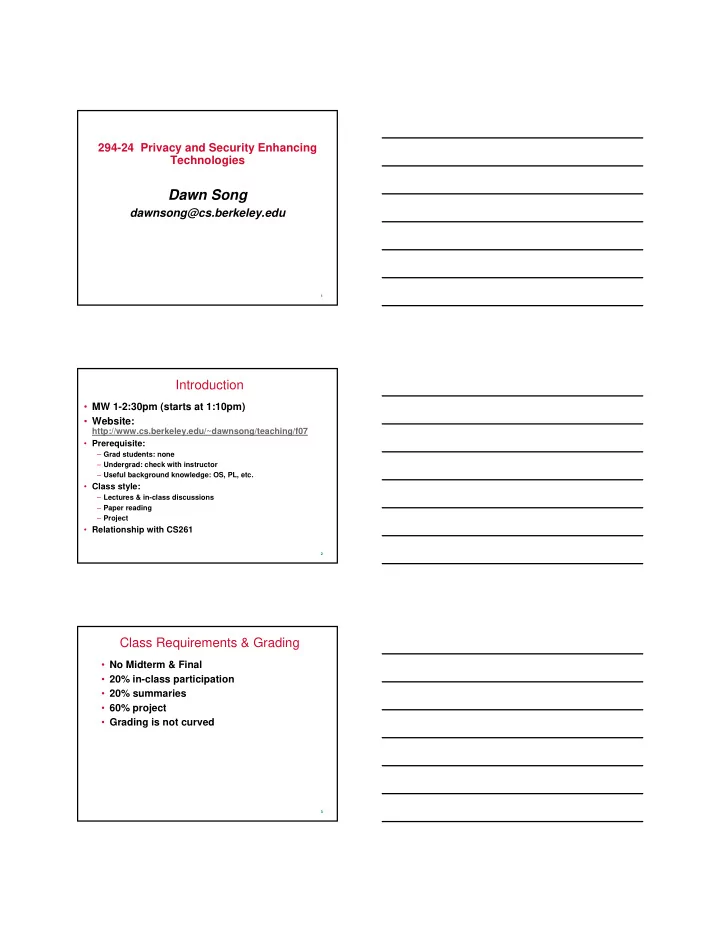
294-24 Privacy and Security Enhancing Technologies

Dawn Song

dawnsong@cs.berkeley.edu

2

Introduction

  • MW 1-2:30pm (starts at 1:10pm)
  • Website:

http://www.cs.berkeley.edu/~dawnsong/teaching/f07

  • Prerequisite:

– Grad students: none – Undergrad: check with instructor – Useful background knowledge: OS, PL, etc.

  • Class style:

– Lectures & in-class discussions – Paper reading – Project

  • Relationship with CS261

3

Class Requirements & Grading

  • No Midterm & Final
  • 20% in-class participation
  • 20% summaries
  • 60% project
  • Grading is not curved
slide-2
SLIDE 2

4

Paper Reading & Summaries (I)

  • Paper reading:

– 1-3 research papers per class

  • Regular paper summary (5%):

– Contents:

» Summarize main results of the paper » 3 most important technical points you learned from or liked about the paper » 3 most important technical points you didn’t like about the paper

  • r you wished the paper had done

– Submit in plaintext email to 294.24.f07@gmail.com midnight before class with subject summary-mm-dd for lecture on mm/dd – Optional readings no summaries required – Will be counted, and randomly selected for grading

5

Paper Reading & Summaries (II)

  • Star paper summary (15%)

– Given questions (usually open-ended) – Conduct thought exercise – Write down your thoughts/answers (usually one page)

» Not graded on right/wrong » You’ll get full score as long as you’ve demonstrated you’ve thought carefully about the question

– Due time specially noted

6

Class Project

  • 1 2-person semester-long project

– Ideally research quality – Will provide a candidate list

  • Group sign-up: Sep 12

– Sign-up sheet in class

  • Project proposal: Oct 1

– Two page max – Content

» Problem to be addressed » Motivation: Why important & Why previous approaches insufficient » Proposed approach » Evaluation for success

  • Project milestone report: Nov 7

– Current status and plan for action for the remaining time

  • Final project presentation & report due: Dec 10
slide-3
SLIDE 3

7

Topics Covered in Class

  • Pressing issues & state-of-the-art technologies in

selected areas

  • Part I: Malicious Code Defense
  • Part II: OS & Web Security
  • Part III: Privacy-enhancing Technologies
  • Your favorites not on the list?

– Let me know

8

Malicious Code---Critical Threat on the Internet

  • Worms, botnets, spyware, viruses, trojan horses, etc.

– Infiltrate/damage computer system without owner's consent

  • Unpatched PC survives less than 16 min [SANS04]
  • $10billion annual financial loss [ComputerEconomics05]

– Worms

» CodeRed: Infected 500,000 servers, $2.6billion in damage [CNET03] » SQL Slammer: Internet lost connectivity, affected 911, ATM, etc.

– Botnets

» Over 6 million bot-infected computers in 3 months [Symantec06]

– 61% U.S. computers infected with spyware [National Cyber Security Alliance06]

9

A Thriving Underground Economy

  • Average bot costs

– $0.04

  • Zero-day vulnerability for

– $75K [SecurityFocus07]

  • Excerpt from Underground Economy IRC Network
  • With one IRC channel, 24-hr period, just a few samples

– Accounts worth $1,599,335.80 have been stolen

  • “The Underground Economy: Priceless” [;login Dec06]
slide-4
SLIDE 4

10

It’s getting real---Storm Email Worm Case Study

  • Clicking on email attachment/links causes malicious code

installed

– Fake news story on deadly storm – E-cards from family & friends – Links to malicious website for drive-by downloads – Quick change to stay ahead of AV blocking

» Malicious code is modified every 30 minutes, undermining standard signature based AV's ability to block this threat

  • Infected machines form botnet

– Largest botnet: 1.7 million bots by end of July – P2P architecture instead of centralized

  • Stealth: install rootkits, etc.
  • Anti-VM: detects VM and won’t infect them
  • For profit:

– Botnet sent stock-picking spam, ripping profits for risen stock price

11

Defense is Challenging

  • Software inevitably has bugs/security

vulnerabilities

– Intrinsic complexity – Time-to-market pressure – Huge overhang of legacy code – Long time to produce/deploy patches

  • Attackers have real incentives to exploit them
  • Large scale of compromised machines being
  • rganized for malicious activities
  • What can we do?

12

Malicious Code Defense

  • Exploit & worm defense

– How to automatically generate anti-bodies?

  • Botnet analysis & defense

– Is it hopeless? Who wins the game?

  • Malware analysis & defense

– Privacy-breaching malware (Spyware, etc.)

» How to discover GoogleDesktop sends your info home? » Did you know that skype reads your /etc/password?

– Stealth malware (rootkits, etc.)

» Can you design a rootkit which simply can’t be detected?

– In-depth analysis

» How to detect hidden-behaviors in malware?

slide-5
SLIDE 5

13

OS Security

  • Isolation

– New methods to achieve this classic property

  • Virtualization

– Myth & demythify:

» Is virtualization the panacea? » What can virtualization do and not do?

  • Forensics

– What practical capabilities can we add to OS to support forensics?

  • Instrumentation

– Giving you a tool to pry inside OS, what can you do?

14

Web Security

  • Web is users’ window to internet

– On-line banking, mashup apps, etc.

  • Browser is the OS for web apps
  • What properties should browser enforce?
  • Web-based attacks & defenses

– Command injection, cross-site scripting, etc.

  • Click fraud, forum spams, etc.
  • Trust metrics & sybil attack in social networks

15

Privacy-enhancing Technologies (I)

  • How to enable rich functionalities while

preserving users’ privacy?

  • Practical cryptographic techniques for

– Privacy-preserving data mining & information sharing – Private operations on untrusted server/storage

» Searching on encrypted data, etc.

– Anonymous credentials – Note: no crypto prior knowledge required

slide-6
SLIDE 6

16

Privacy-enhancing Technologies (II)

  • Privacy issues in practice

– Data anonymization

» Very much needed. What can be done? What guarantees can we offer?

– Ubiquitous computing

» Privacy scene looks grim. Anything can be done?

– Web

» Googling & web inference, etc.

17

Summary

  • Fun class on most recent topics in security &

privacy

– Current threats & state-of-the-art technologies

» Malicious code defense » OS & Web security » Privacy enhancing techonologies

– A nice blend of theory & systems

» Systems + PL + crypto » How things should be done anyway! :-)

  • Interested? Then join us!

– May only be offered this semester

  • What to do to get an A?

– Curious about the material & do a fun project – Have a good time!

18

Questions?

  • I have questions for you too :-)