DAVITA HEALTHCARE PARTNERS INC. 2000 16th Street Denver, CO 80202 - - PDF document

davita healthcare partners inc
SMART_READER_LITE
LIVE PREVIEW

DAVITA HEALTHCARE PARTNERS INC. 2000 16th Street Denver, CO 80202 - - PDF document

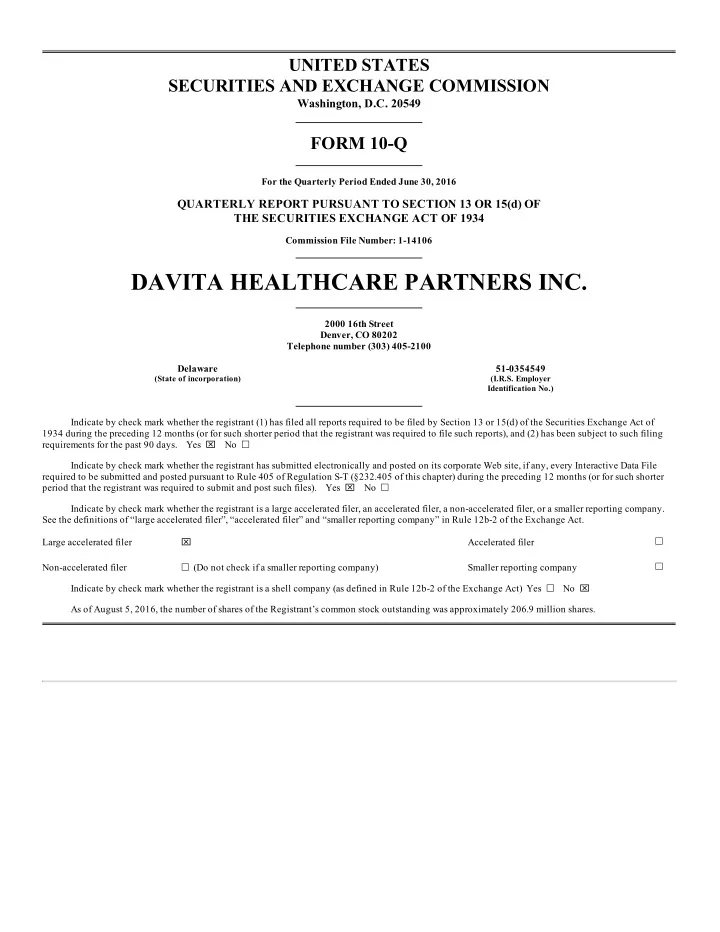
UNITED STATES SECURITIES AND EXCHANGE COMMISSION Washington, D.C. 20549 FORM 10-Q For the Quarterly Period Ended June 30, 2016 QUARTERLY REPORT PURSUANT TO SECTION 13 OR 15(d) OF THE SECURITIES EXCHANGE ACT OF 1934 Commission File Number:


slide-1
SLIDE 1

UNITED STATES SECURITIES AND EXCHANGE COMMISSION

Washington, D.C. 20549

FORM 10-Q

For the Quarterly Period Ended June 30, 2016

QUARTERLY REPORT PURSUANT TO SECTION 13 OR 15(d) OF THE SECURITIES EXCHANGE ACT OF 1934

Commission File Number: 1-14106

DAVITA HEALTHCARE PARTNERS INC.

2000 16th Street Denver, CO 80202 Telephone number (303) 405-2100 Delaware 51-0354549

(State of incorporation) (I.R.S. Employer Identification No.)

Indicate by check mark whether the registrant (1) has filed all reports required to be filed by Section 13 or 15(d) of the Securities Exchange Act of 1934 during the preceding 12 months (or for such shorter period that the registrant was required to file such reports), and (2) has been subject to such filing requirements for the past 90 days. Yes x No £ Indicate by check mark whether the registrant has submitted electronically and posted on its corporate Web site, if any, every Interactive Data File required to be submitted and posted pursuant to Rule 405 of Regulation S-T (§232.405 of this chapter) during the preceding 12 months (or for such shorter period that the registrant was required to submit and post such files). Yes x No £ Indicate by check mark whether the registrant is a large accelerated filer, an accelerated filer, a non-accelerated filer, or a smaller reporting company. See the definitions of “large accelerated filer”, “accelerated filer” and “smaller reporting company” in Rule 12b-2 of the Exchange Act. Large accelerated filer x Accelerated filer £ Non-accelerated filer £ (Do not check if a smaller reporting company) Smaller reporting company £ Indicate by check mark whether the registrant is a shell company (as defined in Rule 12b-2 of the Exchange Act) Yes £ No x As of August 5, 2016, the number of shares of the Registrant’s common stock outstanding was approximately 206.9 million shares.

slide-2
SLIDE 2

DAVITA HEALTHCARE PARTNERS INC. INDEX

Page No.

PART I. FINANCIAL INFORMATION Item 1. Condensed Consolidated Financial Statements: Consolidated Statements of Income for the three and six months ended June 30, 2016 and June 30, 2015 1 Consolidated Statements of Comprehensive Income for the three and six months ended June 30, 2016 and June 30, 2015 2 Consolidated Balance Sheets as of June 30, 2016 and December 31, 2015 3 Consolidated Statements of Cash Flows for the six months ended June 30, 2016 and June 30, 2015 4 Consolidated Statements of Equity for the six months ended June 30, 2016 and for the year ended December 31, 2015 5 Notes to Condensed Consolidated Financial Statements 6 Item 2. Management’s Discussion and Analysis of Financial Condition and Results of Operations 34 Item 3. Quantitative and Qualitative Disclosures about Market Risk 53 Item 4. Controls and Procedures 54 PART II. OTHER INFORMATION Item 1. Legal Proceedings 55 Item 1A. Risk Factors 57 Item 2. Unregistered Sales of Equity Securities and Use of Proceeds 82 Item 6. Exhibits 83 Signature 84 Note: Items 3, 4 and 5 of Part II are omitted because they are not applicable. i

slide-3
SLIDE 3

DAVITA HEALTHCARE PARTNERS INC. CONSOLIDATED STATEMENTS OF INCOME (unaudited) (dollars in thousands, except per share data)

Three months ended Six months ended June 30, June 30, 2016 2015 2016 2015

Patient service revenues $ 2,570,654 $ 2,363,579 $ 5,048,392 $ 4,635,394 Less: Provision for uncollectible accounts (111,428) (105,965) (220,633) (205,129) Net patient service revenues 2,459,226 2,257,614 4,827,759 4,430,265 Capitated revenues 897,826 866,190 1,784,873 1,716,705 Other revenues 360,599 310,814 686,155 575,613 Total net revenues 3,717,651 3,434,618 7,298,787 6,722,583 Operating expenses and charges: Patient care costs and other costs 2,671,025 2,446,076 5,253,358 4,808,688 General and administrative 386,895 347,960 773,324 689,761 Depreciation and amortization 180,381 158,843 349,736 312,632 Provision for uncollectible accounts 3,566 2,159 6,083 3,986 Equity investment loss (income) 505 (5,033) (882) (7,941) Goodwill impairment charges 176,000 4,065 253,000 4,065 Gain on sales of business interests, net (29,791) — (29,791) — Settlement charge — — — 495,000 Total operating expenses and charges 3,388,581 2,954,070 6,604,828 6,306,191 Operating income 329,070 480,548 693,959 416,392 Debt expense (102,894) (104,248) (205,778) (201,640) Debt redemption charges — (48,072) — (48,072) Other income, net 3,215 2,311 6,191 1,778 Income before income taxes 229,391 330,539 494,372 168,458 Income tax expense 134,888 122,762 261,710 36,829 Net income 94,503 207,777 232,662 131,629 Less: Net income attributable to noncontrolling interests (41,121) (37,300) (81,846) (71,769) Net income attributable to DaVita HealthCare Partners Inc. $ 53,382 $ 170,477 $ 150,816 $ 59,860 Earnings per share: Basic net income per share attributable to DaVita HealthCare Partners Inc. $ 0.26 $ 0.80 $ 0.74 $ 0.28 Diluted net income per share attributable to DaVita HealthCare Partners Inc. $ 0.26 $ 0.78 $ 0.73 $ 0.27 Weighted average shares for earnings per share: Basic 204,497,970 212,991,606 204,432,315 213,188,268 Diluted 208,047,172 217,606,198 207,987,530 217,790,617 See notes to condensed consolidated financial statements. 1

slide-4
SLIDE 4

DAVITA HEALTHCARE PARTNERS INC. CONSOLIDATED STATEMENTS OF COMPREHENSIVE INCOME (unaudited) (dollars in thousands)

Three months ended Six months ended June 30, June 30, 2016 2015 2016 2015

Net income $ 94,503 $ 207,777 $ 232,662 $ 131,629 Other comprehensive (loss) income, net of tax: Unrealized losses on interest rate swap and cap agreements: Unrealized losses on interest rate swap and cap agreements (2,616) (2,453) (8,085) (8,213) Reclassifications of net swap and cap agreements realized losses into net income 448 789 913 1,601 Unrealized gains (losses) on investments: Unrealized gains (losses) on investments 638 (99) 867 283 Reclassification of net investment realized gains into net income — (16) (93) (173) Foreign currency translation adjustments (4,844) 5,025 6,337 (12,860) Other comprehensive (loss) income (6,374) 3,246 (61) (19,362) Total comprehensive income 88,129 211,023 232,601 112,267 Less: Comprehensive income attributable to noncontrolling interests (41,270) (37,300) (81,995) (71,769) Comprehensive income attributable to DaVita HealthCare Partners Inc. $ 46,859 $ 173,723 $ 150,606 $ 40,498 See notes to condensed consolidated financial statements. 2

slide-5
SLIDE 5

DAVITA HEALTHCARE PARTNERS INC. CONSOLIDATED BALANCE SHEETS (unaudited) (dollars in thousands, except per share data)

June 30, December 31, 2016 2015

ASSETS Cash and cash equivalents $ 1,283,416 $ 1,499,116 Short-term investments 394,166 408,084 Accounts receivable, less allowance of $279,429 and $264,144 1,875,403 1,724,228 Inventories 197,388 185,575 Other receivables 558,081 435,885 Other current assets 187,763 190,322 Income taxes receivable — 60,070 Total current assets 4,496,217 4,503,280 Property and equipment, net of accumulated depreciation of $2,622,476 and $2,397,007 2,972,407 2,788,740 Intangible assets, net of accumulated amortization of $852,860 and $770,691 1,631,001 1,687,326 Equity investments 64,420 73,368 Long-term investments 102,374 94,122 Other long-term assets 64,254 73,560 Goodwill 9,360,957 9,294,479 $ 18,691,630 $ 18,514,875 LIABILITIES AND EQUITY Accounts payable $ 504,353 $ 513,950 Other liabilities 840,745 682,123 Accrued compensation and benefits 807,135 741,926 Medical payables 300,564 332,102 Current portion of long-term debt 144,183 129,037 Income taxes payable 48,682 — Total current liabilities 2,645,662 2,399,138 Long-term debt 8,957,257 9,001,308 Other long-term liabilities 420,776 439,229 Deferred income taxes 772,329 726,962 Total liabilities 12,796,024 12,566,637 Commitments and contingencies: Noncontrolling interests subject to put provisions 936,903 864,066 Equity: Preferred stock ($0.001 par value, 5,000,000 shares authorized; none issued) Common stock ($0.001 par value, 450,000,000 shares authorized; 217,338,629 and 217,120,346 shares issued and 206,904,375 and 209,754,247 shares outstanding, respectively) 217 217 Additional paid-in capital 1,047,820 1,118,326 Retained earnings 4,507,651 4,356,835 Treasury stock (10,434,254 and 7,366,099 shares, respectively) (749,598) (544,772) Accumulated other comprehensive loss (60,036) (59,826) Total DaVita HealthCare Partners Inc. shareholders’ equity 4,746,054 4,870,780 Noncontrolling interests not subject to put provisions 212,649 213,392 Total equity 4,958,703 5,084,172 $ 18,691,630 $ 18,514,875 See notes to condensed consolidated financial statements. 3

slide-6
SLIDE 6

DAVITA HEALTHCARE PARTNERS INC. CONSOLIDATED STATEMENTS OF CASH FLOWS (unaudited) (dollars in thousands)

Six months ended June 30, 2016 2015

Cash flows from operating activities: Net income $ 232,662 $ 131,629 Adjustments to reconcile net income to net cash provided by operating activities: Settlement charge — 495,000 Settlement payments — (493,775) Depreciation and amortization 349,736 312,632 Debt redemption charges — 48,072 Goodwill impairment charges 253,000 4,065 Stock-based compensation expense 23,717 28,299 Tax benefits from stock award exercises 23,658 28,040 Excess tax benefits from stock award exercises (10,604) (16,913) Deferred income taxes 19,952 4,418 Equity investment income, net 14,275 5,257 Gain on sales of business interests, net (29,791) — Other non-cash charges 23,120 20,653 Changes in operating assets and liabilities, other than from acquisitions and divestitures: Accounts receivable (104,005) (142,950) Inventories (9,213) (22,780) Other receivables and other current assets (107,610) (50,362) Other long-term assets (431) 378 Accounts payable 22,809 50,823 Accrued compensation and benefits 41,098 (26,316) Other current liabilities 112,825 177,733 Income taxes 121,972 (109,460) Other long-term liabilities (31,531) (2,912) Net cash provided by operating activities 945,639 441,531 Cash flows from investing activities: Additions of property and equipment (358,627) (290,873) Acquisitions (473,314) (45,059) Proceeds from asset and business sales 17,393 3,415 Purchase of investments available for sale (7,873) (3,872) Purchase of investments held-to-maturity (518,965) (1,039,632) Proceeds from sale of investments available for sale 5,337 1,550 Proceeds from investments held-to-maturity 545,685 434,684 Purchase of equity investments (8,785) (7,550) Proceeds from sale of equity investments 40,920 — Net cash used in investing activities (758,229) (947,337) Cash flows from financing activities: Borrowings 26,134,952 28,144,986 Payments on long-term debt and other financing costs (26,196,185) (27,476,994) Deferred financing and debt redemption costs (188) (58,539) Purchase of treasury stock (274,926) (84,113) Distributions to noncontrolling interests (94,153) (79,040) Stock award exercises and other share issuances, net 9,465 4,680 Excess tax benefits from stock award exercises 10,604 16,913 Contributions from noncontrolling interests 13,117 18,040 Purchase of noncontrolling interests (6,240) (10,840) Net cash (used in) provided by financing activities (403,554) 475,093 Effect of exchange rate changes on cash and cash equivalents 444 (793) Net decrease in cash and cash equivalents (215,700) (31,506) Cash and cash equivalents at beginning of the year 1,499,116 965,241 Cash and cash equivalents at end of the period $ 1,283,416 $ 933,735

See notes to condensed consolidated financial statements. 4

slide-7
SLIDE 7

DAVITA HEALTHCARE PARTNERS INC. CONSOLIDATED STATEMENTS OF EQUITY (unaudited) (dollars and shares in thousands)

Non- Non- controlling controlling DaVita HealthCare Partners Inc. Shareholders’ Equity interests interests Accumulated not subject to Additional

  • ther

subject to put Common paid-in Retained comprehensive put provisions stock capital earnings Treasury stock loss Total provisions

Balance at December 31, 2014 $ 829,965 215,641 $ 216 $ 1,108,211 $ 4,087,103 — $ — $ (25,017) $ 5,170,513 $ 189,798 Comprehensive income: Net income 96,510 269,732 269,732 61,168 Other comprehensive loss (34,809) (34,809) Stock purchase shares issued — — (6,079) 414 30,608 24,529 Stock unit shares issued 348 — — — Stock-settled SAR shares issued 1,131 1 (1) — Stock-settled stock-based compensation expense 56,899 56,899 Excess tax benefits from stock awards exercised 28,157 28,157 Distributions to noncontrolling interests (103,355) (71,280) Contributions from noncontrolling interests 25,795 28,849 Sales and assumptions of additional noncontrolling interests 10,654 6,875 Purchase of noncontrolling interests (8,538) (55,826) (55,826) (2,018) Changes in fair value of noncontrolling interests 13,035 (13,035) (13,035) Purchase of treasury stock (7,780) (575,380) (575,380) Balance at December 31, 2015 $ 864,066 217,120 $ 217 $ 1,118,326 $ 4,356,835 (7,366) $ (544,772) $ (59,826) $ 4,870,780 $ 213,392 Comprehensive income: Net income 55,243 150,816 150,816 26,603 Other comprehensive (loss) income (210) (210) 149 Stock unit shares issued — — (19,267) 268 19,267 — Stock-settled SAR shares issued 219 — (25,388) 353 25,388 — Stock-settled stock-based compensation expense 23,196 23,196 Excess tax benefits from stock awards exercised 10,604 10,604 Distributions to noncontrolling interests (54,413) — — (39,740) Contributions from noncontrolling interests 9,049 — 4,068 Sales and assumptions of additional noncontrolling interests 7,837 — — 9,887 Purchase of noncontrolling interests — (4,530) (4,530) (1,710) Changes in fair value of noncontrolling interests 55,121 (55,121) (55,121) Purchase of treasury stock (3,690) (249,481) (249,481) Balance at June 30, 2016 $ 936,903 217,339 $ 217 $ 1,047,820 $ 4,507,651 (10,435) $ (749,598) $ (60,036) $ 4,746,054 $ 212,649

See notes to condensed consolidated financial statements 5

slide-8
SLIDE 8

DAVITA HEALTHCARE PARTNERS INC. NOTES TO CONDENSED CONSOLIDATED FINANCIAL STATEMENTS (unaudited) (dollars and shares in thousands, except per share data) Unless otherwise indicated in this Quarterly Report on Form 10-Q “the Company”, “we”, “us”, “our” and similar terms refer to DaVita HealthCare Partners Inc. and its consolidated subsidiaries. 1. Condensed consolidated interim financial statements The condensed consolidated interim financial statements included in this report are prepared by the Company without audit. In the opinion of management, all adjustments necessary for a fair presentation of the results of operations are reflected in these consolidated interim financial statements. All significant intercompany accounts and transactions have been eliminated. The preparation of these financial statements requires management to make estimates and assumptions that affect the reported amounts of assets, liabilities, revenues and expenses. The most significant estimates and assumptions underlying these financial statements and accompanying notes generally involve revenue recognition and accounts receivable, contingencies, impairments

  • f goodwill and other long-lived assets, fair value estimates, accounting for income taxes, variable compensation accruals, consolidation of variable interest

entities, purchase accounting valuation estimates, long-term incentive program compensation and medical liability claims. The results of operations for the six months ended June 30, 2016 are not necessarily indicative of the operating results for the full year. The condensed consolidated interim financial statements should be read in conjunction with the audited consolidated financial statements and notes thereto included in the Company’s Annual Report on Form 10-K for the year ended December 31, 2015. Prior year balances and amounts have been reclassified to conform to the current year presentation. The Company has evaluated subsequent events through the date these condensed consolidated financial statements were issued and has included all necessary adjustments and disclosures. 2. Earnings per share Basic net income per share is calculated by dividing net income attributable to the Company, adjusted for any change in noncontrolling interests redemption rights in excess of fair value, by the weighted average number of common shares and vested stock units outstanding, net of shares held in escrow that under certain circumstances may be returned to the Company. Diluted net income per share includes the dilutive effect of outstanding stock-settled stock appreciation rights and unvested stock units (under the treasury stock method) as well as contingently returnable shares held in escrow. The reconciliations of the numerators and denominators used to calculate basic and diluted earnings per share are as follows:

Three months ended Six months ended June 30, June 30, 2016 2015 2016 2015

Basic: Net income attributable to DaVita HealthCare Partners Inc. $ 53,382 $ 170,477 $ 150,816 $ 59,860 Weighted average shares outstanding during the period 206,692 215,186 206,626 215,382 Contingently returnable shares held in escrow for the DaVita HealthCare Partners merger (2,194) (2,194) (2,194) (2,194) Weighted average shares for basic earnings per share calculation 204,498 212,992 204,432 213,188 Basic net income per share attributable to DaVita HealthCare Partners Inc. $ 0.26 $ 0.80 $ 0.74 $ 0.28 Diluted: Net income attributable to DaVita HealthCare Partners Inc. $ 53,382 $ 170,477 $ 150,816 $ 59,860 Weighted average shares outstanding during the period 206,692 215,186 206,626 215,382 Assumed incremental shares from stock plans 1,355 2,420 1,362 2,409 Weighted average shares for diluted earnings per share calculation 208,047 217,606 207,988 217,791 Diluted net income per share attributable to DaVita HealthCare Partners Inc. $ 0.26 $ 0.78 $ 0.73 $ 0.27 Anti-dilutive potential common shares excluded from calculation 1,811 691 2,042 1,046 6

slide-9
SLIDE 9

DAVITA HEALTHCARE PARTNERS INC. NOTES TO CONDENSED CONSOLIDATED FINANCIAL STATEMENTS—(continued) (unaudited) (dollars and shares in thousands, except per share data) 3. Accounts receivable Accounts receivable are reduced by an allowance for doubtful accounts. In evaluating the ultimate collectability of accounts receivable, the Company analyzes its historical cash collection experience and trends for each of its government payors and commercial payors to estimate the adequacy of the allowance for doubtful accounts and the amount of the provision for uncollectible accounts. Management regularly updates its analysis based upon the most recent information available to determine its current provision for uncollectible accounts and the adequacy of its allowance for doubtful accounts. For receivables associated with dialysis patient services covered by Medicare, the Company receives 80% of the payment directly from Medicare as established under the government’s bundled payment system and determines an appropriate allowance for doubtful accounts and provision for uncollectible accounts on the remaining balance due depending upon the Company’s estimate of the amounts ultimately collectible from other secondary coverage sources or from the patients. For receivables associated with services to patients covered by commercial payors that are either based upon contractual terms or for non-contracted health plan coverage, the Company provides an allowance for doubtful accounts by recording a provision for uncollectible accounts based upon its historical collection experience, potential inefficiencies in its billing processes and for which collectability is determined to be unlikely. Less than 1% of the Company’s dialysis and related lab services net accounts receivable are associated with patient pay and it is the Company’s policy to reserve 100% of the outstanding accounts receivable balances for dialysis services when those amounts due are outstanding for more than three months. During the six months ended June 30, 2016, the Company’s allowance for doubtful accounts increased by $15,285. This was primarily due to an increase in outstanding balances related to the U.S. dialysis and lab business. There were no unusual transactions impacting the allowance for doubtful accounts. 4. Investments in debt and equity securities and other investments Based on the Company’s intentions and strategy concerning investments in debt securities, the Company classifies certain debt securities as held-to- maturity and records them at amortized cost. Equity securities that have readily determinable fair values, including those of mutual funds, common stock and

  • ther debt securities, are classified as available-for-sale and recorded at fair value.

The Company’s investments in securities consist of the following:

June 30, 2016 December 31, 2015 Held to Available Held to Available maturity for sale Total maturity for sale Total

Certificates of deposit, commercial paper and money market funds due within one year $ 382,664 $ — $ 382,664 $ 406,884 $ — $ 406,884 Investments in mutual funds, debt securities and common stock — 50,056 50,056 — 33,482 33,482 $ 382,664 $ 50,056 $ 432,720 $ 406,884 $ 33,482 $ 440,366 Short-term investments $ 382,664 $ 11,502 $ 394,166 $ 406,884 $ 1,200 $ 408,084 Long-term investments — 38,554 38,554 — 32,282 32,282 $ 382,664 $ 50,056 $ 432,720 $ 406,884 $ 33,482 $ 440,366 The cost of the certificates of deposit, commercial paper and money market funds at June 30, 2016 and December 31, 2015 approximates their fair

  • value. As of June 30, 2016 and December 31, 2015, the available-for-sale investments included $3,561 and $2,589 of gross pre-tax unrealized gains,
  • respectively. During the six months ended June 30, 2016, the Company recorded gross pre-tax unrealized gains of $1,124, or $718 after tax, in other

comprehensive income associated with changes in the fair value of these investments. During the six months ended June 30, 2016, the Company sold investments in mutual funds for net proceeds of $1,347 and recognized a pre-tax gain of $152, or $93 after-tax, which was previously recorded in other comprehensive income. During the six months ended June 30, 2015, the Company sold investments in mutual funds for net proceeds of $385 and recognized a pre-tax gain of $284, or $173 after-tax, which was previously recorded in other comprehensive income. The investments in mutual funds classified as available-for-sale are held within a trust to fund existing obligations associated with several of the Company’s non-qualified deferred compensation plans. 7

slide-10
SLIDE 10

DAVITA HEALTHCARE PARTNERS INC. NOTES TO CONDENSED CONSOLIDATED FINANCIAL STATEMENTS—(continued) (unaudited) (dollars and shares in thousands, except per share data) As of June 30, 2016, the Company held $6,250 of preferred stock in two privately held companies that are accounted for under the cost method as these investments do not have readily determinable fair values. Certain HCP entities are required to maintain minimum cash balances in order to comply with regulatory requirements in conjunction with medical claim reserves. As of June 30, 2016, this minimum cash balance was approximately $58,437. 5. Goodwill Changes in goodwill by reportable segments were as follows:

Other-ancillary U.S. dialysis and services and related lab services HCP strategic initiatives Consolidated total

Balance at January 1, 2015 $ 5,610,643 $ 3,562,534 $ 242,118 $ 9,415,295 Acquisitions 21,910 29,910 45,273 97,093 Divestitures (3,370) (5,411) — (8,781) Goodwill impairment charges — (188,769) (4,065) (192,834) Foreign currency and other adjustments — — (16,294) (16,294) Balance at December 31, 2015 $ 5,629,183 $ 3,398,264 $ 267,032 $ 9,294,479 Acquisitions 52,792 248,622 19,598 321,012 Divestitures (4,222) (758) — (4,980) Goodwill impairment charges — (253,000) — (253,000) Foreign currency and other adjustments — — 3,446 3,446 Balance at June 30, 2016 $ 5,677,753 $ 3,393,128 $ 290,076 $ 9,360,957 Each of the Company’s operating segments described in Note 17 to these condensed consolidated financial statements represents an individual reporting unit for goodwill impairment testing purposes, except that each sovereign jurisdiction within the Company’s international operating segments is considered a separate reporting unit. Within the U.S. dialysis and related lab services operating segment, the Company considers each of its dialysis centers to constitute an individual business for which discrete financial information is available. However, since these dialysis centers have similar operating and economic characteristics, and the allocation of resources and significant investment decisions concerning these businesses are highly centralized and the benefits broadly distributed, the Company has aggregated these centers and deemed them to constitute a single reporting unit. The Company has applied a similar aggregation to the HCP operations in each region, to the vascular access service centers in its vascular access services reporting unit, to the physician practices in its physician services reporting unit, and to the dialysis centers within each international reporting unit. For the Company’s other operating segments, no component below the operating segment level is considered a discrete business and therefore these

  • perating segments directly constitute individual reporting units.

Based on continuing developments at the Company’s HCP reporting units during the second quarter of 2016, including the Medicare Advantage final benchmark rates for 2017 announced on April 4, 2016, further changes in expectations concerning future government reimbursement rates and the Company’s expected ability to mitigate them, as well as medical cost and utilization trends, underperformance of certain at-risk units in recent quarters and

  • ther market conditions, the Company performed additional impairment assessments for certain at-risk HCP reporting units during the quarter ended June 30,

2016. As a result of these second quarter assessments, the Company recognized additional goodwill impairment charges of $79,000 for its HCP Nevada reporting unit and $97,000 for its HCP Florida reporting unit during the quarter ended June 30, 2016, and a total of $253,000 in goodwill impairment charges recognized for its HCP reporting units during the six months ended June 30, 2016. The Company’s HCP Nevada, HCP Florida, HCP Colorado Springs and Kidney Care Malaysia reporting units remain at risk of goodwill impairment. As of June 30, 2016, these reporting units have goodwill amounts of $262,668, $442,835, $16,897 and $13,668, respectively. As of June 30, 2016, the latest estimated fair values of the HCP Nevada, HCP Florida, HCP Colorado Springs and Kidney Care Malaysia reporting units (fell short of) exceeded their total carrying amounts by approximately (25.6)%, (15.0)%, 13.0% and 10.2%, respectively. 8

slide-11
SLIDE 11

DAVITA HEALTHCARE PARTNERS INC. NOTES TO CONDENSED CONSOLIDATED FINANCIAL STATEMENTS—(continued) (unaudited) (dollars and shares in thousands, except per share data) For the Company’s at-risk HCP reporting units, further reductions in reimbursement rates, increases in medical cost or utilization trends, or other significant adverse changes in expected future cash flows or valuation assumptions could result in further goodwill impairment charges in the future. For example, a sustained, long-term reduction of 3% in operating income for HCP Nevada or HCP Florida could reduce their estimated fair values by up to 2.2% and 1.6%, respectively. Separately, an increase in their respective discount rates of 100 basis points could reduce the estimated fair values of HCP Nevada and HCP Florida by up to 4.8% and 4.5%, respectively. Except as described above, none of the Company’s various other reporting units was considered at risk of goodwill impairment as of June 30,

  • 2016. Since the dates of the Company’s last annual goodwill impairment tests, there have been certain developments, events, changes in operating

performance and other changes in key circumstances that have affected the Company’s businesses. However, except as further described above, these did not cause management to believe it is more likely than not that the fair value of any of its reporting units would be less than its carrying amount. 6. Health care costs payable The following table includes estimates for the cost of professional medical services provided by non-employed physicians and other providers, as well as inpatient and other ancillary costs for all markets other than California. The Company does not include inpatient and other ancillary costs for contracts held by its California licensed health plan and for contracts held by its California medical group entities; only professional medical services are included as state regulation does not allow those medical group entities to assume risk for inpatient services. Health care costs payable are included in medical payables in the condensed consolidated balance sheet. The following table shows the components of changes in health care costs payable for the six months ended June 30, 2016:

Six months ended June 30, 2016

Health care costs payable, beginning of the period $ 212,641 Add: Components of incurred health care costs Current year 857,955 Prior years 6,424 Total incurred health care costs 864,379 Less: Claims paid Current year 665,499 Prior years 194,385 Total claims paid 859,884 Health care costs payable, end of the period $ 217,136 The Company’s prior year estimates of health care costs payable increased by $6,424 resulting from certain medical claims being settled for amounts more than originally estimated. When significant increases (decreases) in prior-year health care cost estimates occur that the Company believes significantly impacts its current year operating results, the Company discloses that amount as unfavorable (favorable) development of prior-year’s health care cost

  • estimates. Actual claim payments for prior year services have not been materially different from the Company’s year-end estimates.

7. Income taxes As of June 30, 2016, the Company’s total liability for unrecognized tax benefits relating to tax positions that do not meet the more-likely-than-not threshold is $42,915, all of which would impact the Company’s effective tax rate if recognized. This balance represents an increase of $3,904 from the December 31, 2015 balance of $39,011. The Company recognizes accrued interest and penalties related to unrecognized tax benefits in its income tax expense. At June 30, 2016 and December 31, 2015, the Company had approximately $10,560 and $9,918, respectively, accrued for interest and penalties related to unrecognized tax benefits, net of federal tax benefits. 9

slide-12
SLIDE 12

DAVITA HEALTHCARE PARTNERS INC. NOTES TO CONDENSED CONSOLIDATED FINANCIAL STATEMENTS—(continued) (unaudited) (dollars and shares in thousands, except per share data) 8. Long-term debt Long-term debt was comprised of the following:

June 30, December 31, 2016 2015

Senior Secured Credit Facilities: Term Loan A $ 900,000 $ 925,000 Term Loan B 3,430,000 3,447,500 Senior notes 4,500,000 4,500,000 Acquisition obligations and other notes payable 71,515 70,645 Capital lease obligations 287,838 283,185 Total debt principal outstanding 9,189,353 9,226,330 Discount and deferred financing costs (87,913) (95,985) 9,101,440 9,130,345 Less current portion (144,183) (129,037) $ 8,957,257 $ 9,001,308 Scheduled maturities of long-term debt at June 30, 2016 were as follows: 2016 (remainder of the year) 76,295 2017 153,660 2018 169,716 2019 742,290 2020 66,640 2021 3,298,210 Thereafter 4,682,542 During the first six months of 2016, the Company made mandatory principal payments under its Senior Secured Credit Facilities totaling $25,000 on the Term Loan A and $17,500 on the Term Loan B. The Company has entered into several interest rate swap agreements as a means of hedging its exposure to and volatility from variable-based interest rate changes as part of its overall interest rate risk management strategy. These agreements are not held for trading or speculative purposes and have the economic effect of converting the LIBOR variable component of the Company’s interest rate to a fixed rate. These swap agreements are designated as cash flow hedges, and as a result, hedge-effective gains or losses resulting from changes in the fair values of these swaps are reported in other comprehensive income until such time as the hedged forecasted cash flows occur, at which time the amounts are reclassified into net income. Net amounts paid or received for each specific swap tranche that have settled have been reflected as adjustments to debt expense. In addition, the Company has entered into several active and forward interest rate cap agreements that have the economic effect of capping the Company’s maximum exposure to LIBOR variable interest rate changes

  • n specific portions of the Company’s floating rate debt, as described below. The cap agreements are also designated as cash flow hedges and, as a result,

changes in the fair values of these cap agreements are reported in other comprehensive income. The amortization of the original cap premium is recognized as a component of debt expense on a straight-line basis over the term of the cap agreements. The swap and cap agreements do not contain credit-risk contingent features. As of June 30, 2016, the Company maintains several interest rate swap agreements that were entered into in March 2013 with amortizing notional amounts totaling $688,750. These agreements have the economic effect of modifying the LIBOR variable component of the Company’s interest rate on an equivalent amount of the Company’s Term Loan A to fixed rates ranging from 0.49% to 0.52%, resulting in an overall weighted average effective interest rate

  • f 2.51%, including the Term Loan A margin of 2.00%. The overall weighted average effective interest rate also includes the effects of $211,250 of unhedged

Term Loan A debt that bears interest at LIBOR plus an interest rate margin of 2.00%. The swap agreements expire on September 30, 2016 and require monthly interest payments. During the six months ended June 30, 2016, the Company recognized debt expense of $274 from these swaps. As of June 30, 2016, the total fair value of these swap agreements was a net liability of approximately $70. During the six months ended June 30, 2016, the Company recorded a loss of $860 in other comprehensive income due to a decrease in the unrealized fair value of these swap agreements. The Company estimates that approximately $70 of existing unrealized pre-tax losses in other comprehensive income at June 30, 2016 will be reclassified into income over the next three months. 10

slide-13
SLIDE 13

DAVITA HEALTHCARE PARTNERS INC. NOTES TO CONDENSED CONSOLIDATED FINANCIAL STATEMENTS—(continued) (unaudited) (dollars and shares in thousands, except per share data) As of June 30, 2016, the Company maintains several forward interest rate cap agreements that were entered into in October 2015 with notional amounts totaling $3,500,000. These forward cap agreements will be effective June 29, 2018 and will have the economic effect of capping the LIBOR variable component of the Company’s interest rate at a maximum of 3.50% on an equivalent amount of its debt. These cap agreements expire on June 30, 2020. As of June 30, 2016, the total fair value of these cap agreements was an asset of approximately $2,698. During the six months ended June 30, 2016, the Company recorded a loss of $11,118 in other comprehensive income due to a decrease in the unrealized fair value of these cap agreements. The Company also maintains several forward interest rate cap agreements that were entered into in November 2014 with notional amounts totaling $3,500,000. These forward cap agreements will be effective September 30, 2016 and will have the economic effect of capping the LIBOR variable component

  • f the Company’s interest rate at a maximum of 3.50% on an equivalent amount of the Company’s debt. The cap agreements expire on June 30, 2018. As of

June 30, 2016, the total fair value of these cap agreements was an asset of approximately $55. During the six months ended June 30, 2016, the Company recorded a loss of $1,256 in other comprehensive income due to a decrease in the unrealized fair value of these cap agreements. As of June 30, 2016, the Company maintains several interest rate cap agreements that were entered into in March 2013 with notional amounts totaling $2,735,000 on the Company’s Term Loan B debt. These agreements have the economic effect of capping the LIBOR variable component of the Company’s interest rate at a maximum of 2.50% on an equivalent amount of the Company’s Term Loan B. During the six months ended June 30, 2016, the Company recognized debt expense of $1,220 from these caps. The cap agreements expire on September 30, 2016. As of June 30, 2016, the total fair value of these cap agreements was immaterial. The following table summarizes the Company’s derivative instruments as of June 30, 2016 and December 31, 2015:

June 30, 2016 December 31, 2015 Derivatives designated as hedging instruments Balance sheet location Fair value Balance sheet location Fair value

Interest rate swap agreements Other short-term liabilities $ 70 Other short-term assets $ 516 Interest rate cap agreements Other long-term assets $ 2,753 Other long-term assets $ 15,127 The following table summarizes the effects of the Company’s interest rate swap and cap agreements for the three and six months ended June 30, 2016 and 2015:

Amount of (losses) gains Amount of (losses) gains recognized in OCI on interest reclassified from rate swap and cap agreements Location of accumulated OCI into income Three months ended Six months ended losses reclassified Three months ended Six months ended June 30, June 30, from accumulated June 30, June 30, Derivatives designated as cash flow hedges 2016 2015 2016 2015 OCI into income 2016 2015 2016 2015

Interest rate swap agreements $ (168) $ (976) $ (860) $ (3,670) Debt expense $ (123) $ (684) $ (274) $(1,406) Interest rate cap agreements (4,115) (3,049) (12,374) (9,806) Debt expense (610) (610) (1,220) (1,220) Tax benefit 1,667 1,572 5,149 5,263 285 505 581 1,025 Total $ (2,616) $ (2,453) $ (8,085) $ (8,213) $ (448) $ (789) $ (913) $(1,601) As of June 30, 2016, the interest rate on the Company’s Term Loan B debt is effectively fixed subject to an embedded LIBOR floor which is higher than actual LIBOR as of such date. The Term Loan B is also subject to interest rate caps if LIBOR should rise above 2.50%. See above for further details. Interest rates on the Company’s senior notes are fixed by their terms. The LIBOR variable component of the Company’s interest rate on the majority of the Company’s Term Loan A is economically fixed as a result of interest rate swaps. As a result of embedded LIBOR floors on the Term Loan B debt agreement and the swap and cap agreements, the Company’s overall weighted average effective interest rate on the Senior Secured Credit Facilities was 3.52%, based on the current margins in effect of 2.00% for the Term Loan A and 2.75% for the Term Loan B, as of June 30, 2016. The Company’s overall weighted average effective interest rate during the second quarter of 2016 was 4.42% and as of June 30, 2016 was 4.43%. As of June 30, 2016, the Company had undrawn revolving credit facilities totaling $1,000,000, of which approximately $91,062 was committed for

  • utstanding letters of credit. In addition, the Company has approximately $1,286 of committed letters of credit outstanding related to HCP, which is backed

by a certificate of deposit. 11

slide-14
SLIDE 14

DAVITA HEALTHCARE PARTNERS INC. NOTES TO CONDENSED CONSOLIDATED FINANCIAL STATEMENTS—(continued) (unaudited) (dollars and shares in thousands, except per share data) 9. Contingencies The majority of the Company’s revenues are from government programs and may be subject to adjustment as a result of: (i) examination by government agencies or contractors, for which the resolution of any matters raised may take extended periods of time to finalize; (ii) differing interpretations

  • f government regulations by different Medicare contractors or regulatory authorities; (iii) differing opinions regarding a patient’s medical diagnosis or the

medical necessity of services provided; and (iv) retroactive applications or interpretations of governmental requirements. In addition, the Company’s revenues from commercial payors may be subject to adjustment as a result of potential claims for refunds, as a result of government actions or as a result of

  • ther claims by commercial payors.

Inquiries by the Federal Government and Certain Related Civil Proceedings Vainer Private Civil Suit: As previously disclosed, the Company received a subpoena for documents from the Office of Inspector General (OIG) for the U.S. Department of Health and Human Services (HHS) relating to the pharmaceutical products Zemplar, Hectorol, Venofer, Ferrlecit and erythropoietin (EPO), as well as other related matters, covering the period from January 2003 to December 2008. The Company subsequently learned that the allegations underlying this inquiry were made as part of a civil complaint filed by relators, Daniel Barbir and Dr. Alon Vainer, pursuant to the qui tam provisions of the federal False Claims Act (FCA). The relators also alleged that the Company’s drug administration practices for the Company’s dialysis operations for Vitamin D and iron agents from 2003 through 2010 fraudulently created unnecessary waste, which was billed to and paid for by the government. In June 2015, the Company finalized the terms of the settlement with plaintiffs, including a settlement amount of $450,000 and attorney fees and other costs of $45,000 which was paid in 2015. 2011 U.S. Attorney Medicaid Investigation: In October 2011, the Company announced that it would be receiving a request for documents, which could include an administrative subpoena from the OIG. Subsequent to the Company’s announcement of this 2011 U.S. Attorney Medicaid Investigation, the Company received a request for documents in connection with the inquiry by the U.S. Attorney’s Office for the Eastern District of New York. The request related to payments for infusion drugs covered by Medicaid composite payments for dialysis. It is the Company’s understanding that this inquiry is civil in

  • nature. The Company understands further that certain other providers that operate dialysis clinics in New York may have received a similar request for
  • documents. The Company cooperated with the government and produced the requested documents. In April 2014, the Company reached an agreement in

principle with the government. In March 2016, the Company finalized and executed settlement agreements with the State of New York and the U.S. Department of Justice (DOJ), including a settlement payment of an immaterial amount. Swoben Private Civil Suit: In April 2013, the Company’s HealthCare Partners (HCP) subsidiary was served with a civil complaint filed by a former employee of SCAN Health Plan (SCAN), a health maintenance organization (HMO). On July 13, 2009, pursuant to the qui tam provisions of the federal FCA and the California False Claims Act, James M. Swoben, as relator, filed a qui tam action in the United States District Court for the Central District of California purportedly on behalf of the United States of America and the State of California against SCAN, and certain other defendants whose identities were under seal. The allegations in the complaint relate to alleged overpayments received from government healthcare programs. In or about August 2012, SCAN entered into a Settlement Agreement with the United States of America and the State of California. The United States and the State of California partially intervened in the action for the purpose of settlement with and dismissal of the action against SCAN. In or about November 2011, the relator filed his Third Amended Complaint under seal alleging violations of the federal FCA and the California False Claims Act, which named additional defendants, including HCP and certain health insurance companies (the defendant HMOs). The allegations in the complaint against HCP relate to patient diagnosis coding to determine reimbursement in the Medicare Advantage program, referred to as Hierarchical Condition Coding (HCC) and Risk Adjustment Factor (RAF)

  • scores. The complaint sought monetary damages and civil penalties as well as costs and expenses. The United States Department of Justice reviewed these

allegations and in January 2013 declined to intervene in the case. On June 26, 2013, HCP and the defendant HMOs filed their respective motions to dismiss the Third Amended Complaint pursuant to Federal Rules of Civil Procedure 12(b)(6) and 9(b), challenging the legal sufficiency of the claims asserted in the

  • complaint. On July 30, 2013, the court granted HCP’s motion and dismissed with prejudice all of the claims in the Third Amended Complaint and judgment

was entered in September 2013. The court specifically determined that further amendments to the complaint would be futile because, in part, the allegations were publicly disclosed in reports and other sources relating to audits conducted by the Centers of Medicare & Medicaid Services (CMS). In October 2013, the plaintiff appealed to the United States Court of Appeals for the Ninth Circuit and the court’s disposition of the appeal is pending. 2015 U.S. Attorney Transportation Investigation: In February 2015, the Company announced that it received six administrative subpoenas from the OIG for medical records from six different dialysis centers in southern California operated by the Company. Specifically, each subpoena seeks the medical records of a single patient of each respective dialysis center. In February 2016, the 12

slide-15
SLIDE 15

DAVITA HEALTHCARE PARTNERS INC. NOTES TO CONDENSED CONSOLIDATED FINANCIAL STATEMENTS—(continued) (unaudited) (dollars and shares in thousands, except per share data) Company received four additional subpoenas for four additional dialysis centers in southern California. The subpoenas were similarly limited in scope to the subpoenas received in 2015. The Company has been advised by an attorney with the United States Attorney’s Office for the Central District of California that the subpoenas relate to an investigation concerning the medical necessity of patient transportation. The Company does not provide transportation nor does it bill for the transport of its dialysis patients. The Company does not know the scope of the investigation by the government, nor what conduct or activities might be the subject of the investigation. 2015 U.S. OIG Medicare Advantage Civil Investigation: In March 2015, JSA HealthCare Corporation (JSA), a subsidiary of HCP, received a subpoena from the OIG. The Company has been advised by an attorney with the Civil Division of the United States Department of Justice in Washington, D.C. that the subpoena relates to an ongoing civil investigation concerning Medicare Advantage service providers’ risk adjustment practices and data, including identification and verification of patient diagnoses and factors used in making the diagnoses. The subpoena requests documents and information for the period from January 1, 2008 through December 31, 2013, for certain Medicare Advantage plans for which JSA provided services. It also requests information regarding JSA’s communications about patient diagnoses as they relate to certain Medicare Advantage plans generally, and more specifically as related to two Florida physicians with whom JSA previously contracted. The Company is producing the requested information and is cooperating with the government’s investigation. In addition to the subpoena described above, in June 2015, the Company received a subpoena from the OIG. This civil subpoena covers the period from January 1, 2008 through the present and seeks production of a wide range of documents relating to the Company’s and its subsidiaries’ (including HCP’s and its subsidiary JSA’s) provision of services to Medicare Advantage plans and related patient diagnosis coding and risk adjustment submissions and

  • payments. The Company believes that the request is part of a broader industry investigation into Medicare Advantage patient diagnosis coding and risk

adjustment practices and potential overpayments by the government. The information requested includes information relating to patient diagnosis coding practices for a number of conditions, including potentially improper historical HCP coding for a particular condition. With respect to that condition, the guidance related to that coding issue was discontinued following the Company’s November 1, 2012 acquisition of HCP, and the Company notified CMS in April 2015 of the coding practice and potential overpayments. The Company is cooperating with the government and is producing the requested

  • information. In addition, the Company is continuing to review other HCP coding practices to determine whether there were any improper coding issues. In

that regard, the Company has identified certain additional coding practices which may have been problematic and is in discussions with the DOJ about the scope and nature of a review of claims relating to those practices. In connection with the HCP merger, the Company has certain indemnification rights against the sellers and an escrow was established as security for the indemnification. The Company has submitted an indemnification claim against the sellers secured by the escrow for any and all liabilities incurred relating to these matters and intends to pursue recovery from the escrow. However, the Company can make no assurances that the indemnification and escrow will cover the full amount of the Company’s potential losses related to these matters. 2015 U.S. Department of Justice Vascular Access Investigation and Related Qui Tam Litigation: In November 2015, the Company announced that RMS Lifeline, Inc., a wholly-owned subsidiary of the Company that operates under the name Lifeline Vascular Access (Lifeline), received a Civil Investigative Demand (CID) from the DOJ. The CID relates to two vascular access centers in Florida that are part of Lifeline’s vascular access business. The CID covers the period from January 1, 2008 through the present. The Company acquired these two centers in December 2012. Based on the language of the CID, the DOJ appeared to be looking at whether angiograms performed at the two centers were medically unnecessary and therefore whether related claims filed with federal healthcare programs possibly violated the FCA. Lifeline does not perform dialysis services but instead provides vascular access management services for dialysis patients. The Company cooperated with the government and produced requested information. The DOJ investigation was initiated pursuant to a complaint brought under the qui tam provisions of the FCA (the Complaint). The Complaint was originally filed under seal in August 2014 in the U.S. District Court, Middle District of Florida, United States ex. rel James Spafford v. DaVita HealthCare Partners, Inc., et al., Case Number 6:14- cv-1251-Orl-41DAB. In December 2015, a First Amended Complaint was filed under seal. In May 2016, the First Amended Complaint was unsealed. The First Amended Complaint alleges violations of the FCA due to the submission of claims to the government for allegedly medically unnecessary angiograms and angiography procedures at the two vascular access centers. The Complaint covers alleged conduct dating from July 2008, prior to the Company’s acquisition

  • f the centers, to the present. The DOJ has declined to intervene.

2016 U.S. Attorney Prescription Drug Investigation: In early February 2016, the Company announced that its pharmacy services wholly-owned subsidiary, DaVita Rx, received a CID from the U.S. Attorney’s Office for the Northern District of Texas. Based on the language of the CID, it appears the government is conducting an FCA investigation concerning allegations that DaVita Rx presented or caused to be presented false claims for payment to the government for prescription medications. The CID covers the period from January 1, 2006 through the present. In the spring of 2015, the Company initiated an internal compliance review of DaVita Rx during which it identified potential billing and operational issues. The Company notified the government in September 2015 that it was 13

slide-16
SLIDE 16

DAVITA HEALTHCARE PARTNERS INC. NOTES TO CONDENSED CONSOLIDATED FINANCIAL STATEMENTS—(continued) (unaudited) (dollars and shares in thousands, except per share data) conducting this review of DaVita Rx and began providing regular updates of its review. In the fourth quarter of 2015, the Company recorded an estimated accrual of $22,530 for potential damages and liabilities associated with write-offs and discounts of patient co-payment obligations, and credits to payors for returns of prescriptions drugs, related to DaVita Rx that were identified during the course of this internal compliance review. Upon completion of its review, the Company filed a self-disclosure with the OIG in early February 2016 and has been working to address and update the practices it identified in the self- disclosure, some of which overlap with information requested by the U.S. Attorney’s Office. The Company may accrue additional reserves for refunds and related damages and potential liabilities arising out of this review. The Company does not know if the U.S. Attorney’s Office, which is part of the DOJ, knew when it served the CID on the Company that it was already in the process of developing a self-disclosure to the OIG. The OIG informed the Company in late February that its submission was not accepted. They indicated that the OIG is not expressing an opinion regarding the conduct disclosed or the Company’s legal positions. The Company is cooperating with the government and is producing the requested information. Solari Post-Acquisition Matter: In 2016, HCP Nevada disclosed to the OIG for HHS that proper procedures for clinical and eligibility determinations may not have been followed by Las Vegas Solari Hospice (Solari), which was acquired by HCP Nevada in March 2013. In June 2016, the Company was notified by the OIG the disclosure submission had been accepted into the OIG’s Self Disclosure Protocol. The Company recorded an estimated accrual of $16,000 for potential damages and liabilities associated with this matter. HCP Nevada had previously made a disclosure and repayment of overpayments to National Government Services (NGS), the Medicare Administrative Contractor for HCP Nevada, for claims submitted by Solari to the federal government prior to HCP’s acquisition of Solari and claims made to the government post-acquisition for which the sellers had certain responsibilities pursuant to a management services agreement. The Company may accrue additional reserves for potential damages and liabilities related to this matter. The Company is cooperating with the government in this matter. Except for the private civil complaints filed by the relators as described above, to the Company’s knowledge, no proceedings have been initiated against the Company at this time in connection with any of the inquiries by the federal government. Although the Company cannot predict whether or when proceedings might be initiated or when these matters may be resolved, it is not unusual for inquiries such as these to continue for a considerable period of time through the various phases of document and witness requests and on-going discussions with regulators. In addition to the inquiries and proceedings specifically identified above, the Company is frequently subject to other inquiries by state or federal government agencies and/or private civil qui tam complaints filed by relators. Responding to subpoenas or government inquiries and defending the Company in relator proceedings has required and will continue to require management’s attention and significant legal expense. Any negative findings in any government inquiries or relator proceedings could result in substantial financial penalties or awards against the Company, exclusion from future participation in the Medicare and Medicaid programs and if criminal proceedings were initiated against the Company, possible criminal penalties. At this time, the Company cannot predict the ultimate outcome of these inquiries, or the potential outcome of the relators’ claims (except as described above), or the potential range of damages, if any. Shareholder Derivative Claims DaVita HealthCare Partners Inc. Derivative Litigation: On January 7, 2014, the U.S. District Court for the District of Colorado consolidated the two previously disclosed shareholder derivative lawsuits: the Haverhill Retirement System action filed on May 17, 2013 and the Clark Shareholder action filed

  • n August 7, 2012. The court appointed Haverhill lead plaintiff. The complaints filed against the directors of the Company and against the Company, as

nominal defendant allege, among other things, that the Company’s directors breached fiduciary duties to the Company relating to the 2010 and 2011 U.S. Attorney physician relationship investigations, the Vainer qui tam private civil suit described above and the Woodard qui tam private civil suit for which the Company previously announced a settlement in July 2012. The Company entered into a settlement with the lead plaintiff, which settlement (as previously disclosed), was described in a court-ordered notice sent to shareholders in late January 2015, and included enhancements to the Company’s corporate governance practices and provided that the Company will not oppose the derivative plaintiff’s application for an award of fees and expenses, the dollar amount of which is not material to the Company. The Court approved the settlement and entered an order granting final approval of the settlement on June 5, 2015 and final judgment in the case was entered on June 9, 2015. Other The Company received several notices of claims from commercial payors and other third parties related to historical billing practices and claims against DVA Renal Healthcare (formerly known as Gambro Healthcare), a subsidiary of the Company, related to historical Gambro Healthcare billing practices and other matters covered by its 2004 settlement agreement with the DOJ and certain agencies of the U.S. government. The Company has not received any further indication that any of these claims are active, except for one payor claim relating to a special needs plan, and some of the other claims may be barred by applicable statutes of limitations. The 14

slide-17
SLIDE 17

DAVITA HEALTHCARE PARTNERS INC. NOTES TO CONDENSED CONSOLIDATED FINANCIAL STATEMENTS—(continued) (unaudited) (dollars and shares in thousands, except per share data) Company is working to resolve the one active claim of which it is aware and, based on the dollar amount of the claim, expects that its eventual resolution will involve an amount that is immaterial. In addition to the foregoing, the Company is subject to claims and suits, including from time to time, contractual disputes and professional and general liability claims, as well as audits and investigations by various government entities, in the ordinary course of business. The Company believes that the ultimate resolution of any such pending proceedings, whether the underlying claims are covered by insurance or not, will not have a material adverse effect on its financial condition, results of operations or cash flows. 10. Noncontrolling interests subject to put provisions and other commitments The Company has potential obligations to purchase the noncontrolling interests held by third parties in several of its majority-owned joint ventures, non-owned and minority-owned entities. These obligations are in the form of put provisions and are exercisable at the third-party owners’ discretion within specified periods as outlined in each specific put provision. If these put provisions were exercised, the Company would be required to purchase the third- party owners’ noncontrolling interests at either the appraised fair market value or a predetermined multiple of earnings or cash flow attributable to the noncontrolling interests put to the Company, which is intended to approximate fair value. The methodology the Company uses to estimate the fair values of noncontrolling interests subject to put provisions assumes the higher of either a liquidation value of net assets or an average multiple of earnings, based on historical earnings, patient mix and other performance indicators that can affect future results, as well as other factors. The estimated fair values of the noncontrolling interests subject to put provisions is a critical accounting estimate that involves significant judgments and assumptions and may not be indicative of the actual values at which the noncontrolling interests may ultimately be settled, which could vary significantly from the Company’s current

  • estimates. The estimated fair values of noncontrolling interests subject to put provisions can fluctuate and the implicit multiple of earnings at which these

noncontrolling interests obligations may be settled could vary significantly depending upon market conditions including potential purchasers’ access to the capital markets, which can impact the level of competition for dialysis and non-dialysis related businesses, the economic performance of these businesses and the restricted marketability of the third-party owners’ noncontrolling interests. The amount of noncontrolling interests subject to put provisions that employ a contractually predetermined multiple of earnings rather than fair value are immaterial. The Company has certain other potential commitments to provide operating capital to several dialysis centers that are wholly-owned by third parties

  • r centers in which the Company owns a minority equity investment as well as to physician-owned vascular access clinics or medical practices that the

Company operates under management and administrative services agreements of approximately $3,700. Certain consolidated joint ventures are originally contractually scheduled to dissolve after terms ranging from ten to fifty years. Accordingly, the noncontrolling interests in these joint ventures are considered mandatorily redeemable instruments, for which the classification and measurement requirements have been indefinitely deferred. Future distributions upon dissolution of these entities would be valued below the related noncontrolling interest carrying balances in the consolidated balance sheet. 11. Long-term incentive compensation Long-term incentive program (LTIP) compensation includes both stock-based awards (principally stock-settled stock appreciation rights, restricted stock units and performance stock units) as well as long-term performance-based cash awards. Long-term incentive compensation expense, which is primarily general and administrative in nature, is attributed among the U.S. dialysis and related lab services business, the HCP business, corporate administrative support, and the ancillary services and strategic initiatives. The Company’s stock-based compensation awards are measured at their estimated fair values on the date of grant if settled in shares or at their estimated fair values at the end of each reporting period if settled in cash. The value of stock-based awards so measured is recognized as compensation expense on a cumulative straight-line basis over the vesting terms of the awards, adjusted for expected forfeitures. During the six months ended June 30, 2016, the Company granted 1,075 stock-settled stock appreciation rights with an aggregate grant-date fair value

  • f $14,954 and a weighted-average expected life of approximately 4.2 years, and also granted 220 stock units with an aggregate grant-date fair value of

$16,555 and a weighted-average expected life of approximately 3.4 years. For the six months ended June 30, 2016 and 2015, the Company recognized $50,647 and $69,692, respectively, in total LTIP expense, of which $23,717 and $28,299, respectively, represented stock-based compensation expense for stock appreciation rights, stock units and discounted employee stock plan purchases, which are primarily included in general and administrative expense. The 15

slide-18
SLIDE 18

DAVITA HEALTHCARE PARTNERS INC. NOTES TO CONDENSED CONSOLIDATED FINANCIAL STATEMENTS—(continued) (unaudited) (dollars and shares in thousands, except per share data) estimated tax benefits recorded for stock-based compensation for the six months ended June 30, 2016 and 2015 was $8,160 and $10,028, respectively. As of June 30, 2016, the Company had $139,505 of total estimated unrecognized compensation costs for outstanding LTIP awards, including $70,835 related to stock-based compensation arrangements under the Company’s equity compensation and stock purchase plans. The Company expects to recognize the performance-based cash component of these LTIP costs over a weighted average remaining period of 1.1 years and the stock-based component of these LTIP costs over a weighted average remaining period of 1.4 years. For the six months ended June 30, 2016 and 2015, the Company received $23,658 and $28,040, respectively, in actual tax benefits upon the exercise

  • f stock awards.

12. Share repurchases During the six months ended June 30, 2016, the Company repurchased a total of 3,690 shares of its common stock for $249,481, or an average price of $67.61 per share. On July 13, 2016, the Company’s Board of Directors approved an additional share repurchase authorization in the amount of $1,240,748. This recently approved share repurchase is in addition to the $259,252 remaining at that time under the Company’s Board of Directors’ prior share repurchase authorization announced in April 2015. As a result, the Company has a total of $1,500,000 available under the current Board authorizations for additional repurchases as of August 8, 2016. These share repurchase authorizations have no expiration dates. However, the Company is subject to share repurchase limitations under the terms of its Senior Secured Credit Facilities and the indentures governing its Senior Notes. 13. Comprehensive income

For the three months ended For the six months ended June 30, 2016 June 30, 2016 Interest Foreign Accumulated Interest Foreign Accumulated rate swap currency

  • ther

rate swap currency

  • ther

and cap Investment translation comprehensive and cap Investment translation comprehensive agreements securities adjustments (loss) income agreements securities adjustments (loss) income

Beginning balance $ (15,929) $ 1,497 $ (39,081) $ (53,513) $ (10,925) $ 1,361 $ (50,262) $ (59,826) Unrealized (losses) gains (4,283) 782 (4,844) (8,345) (13,234) 1,124 6,337 (5,773) Related income tax benefit (expense) 1,667 (293) — 1,374 5,149 (406) — 4,743 (2,616) 489 (4,844) (6,971) (8,085) 718 6,337 (1,030) Reclassification from accumulated

  • ther comprehensive income

into net income 733 — — 733 1,494 (152) — 1,342 Related income tax (expense) benefit (285) — — (285) (581) 59 — (522) 448 — — 448 913 (93) — 820 Ending balance $ (18,097) $ 1,986 $ (43,925) $ (60,036) $ (18,097) $ 1,986 $ (43,925) $ (60,036) 16

slide-19
SLIDE 19

DAVITA HEALTHCARE PARTNERS INC. NOTES TO CONDENSED CONSOLIDATED FINANCIAL STATEMENTS—(continued) (unaudited) (dollars and shares in thousands, except per share data)

For the three months ended For the six months ended June 30, 2015 June 30, 2015 Interest Foreign Accumulated Interest Foreign Accumulated rate swap currency

  • ther

rate swap currency

  • ther

and cap Investment translation comprehensive and cap Investment translation comprehensive agreements securities adjustments income (loss) agreements securities adjustments (loss) income

Beginning balance $ (6,743) $ 3,376 $ (44,258) $ (47,625) $ (1,795) $ 3,151 $ (26,373) $ (25,017) Unrealized (losses) gains (4,025) (83) 5,025 917 (13,476) 461 (12,860) (25,875) Related income tax benefit (expense) 1,572 (16) — 1,556 5,263 (178) — 5,085 (2,453) (99) 5,025 2,473 (8,213) 283 (12,860) (20,790) Reclassification from accumulated

  • ther comprehensive income

into net income 1,294 (27) — 1,267 2,626 (284) — 2,342 Related income tax (expense) benefit (505) 11 — (494) (1,025) 111 — (914) 789 (16) — 773 1,601 (173) — 1,428 Ending balance $ (8,407) $ 3,261 $ (39,233) $ (44,379) $ (8,407) $ 3,261 $ (39,233) $ (44,379) The reclassification of net swap and cap realized losses into income are recorded as debt expense in the corresponding consolidated statements of

  • income. See Note 8 to the condensed consolidated financial statements for further details.

The reclassification of net investment realized gains into income are recorded in other income in the corresponding consolidated statements of

  • income. See Note 4 to the condensed consolidated financial statements for further details.

14. Acquisitions and divestitures Sales of Tandigm Health and HCP Arizona business interests Effective June 30, 2016, we sold a portion of HCP’s ownership interest in the Tandigm Health joint venture, reducing our ownership from fifty percent to nineteen percent and resulting in a gain of $40,280. In addition, on June 1, 2016, we sold our HCP Arizona business, resulting in a loss of $10,489. Acquisition of Everett Clinic Medical Group (TEC) On March 1, 2016, the Company completed its acquisition of TEC pursuant to an agreement and plan of merger dated November 23, 2015, whereby TEC became a 100% consolidated subsidiary of HCP. The total consideration paid at closing for all outstanding common units of TEC was approximately $398,094, net of cash acquired, plus the assumption of certain liabilities totaling approximately $7,284, subject to certain post-closing adjustments. The initial purchase price allocation for the TEC acquisition is recorded at estimated fair values based upon the best information available to management and will be finalized when certain information arranged to be obtained has been received. The fair values of property and equipment and intangible assets were valued by an independent third party and are pending issuance of the final valuation report. Certain income tax amounts are pending issuance of final tax returns. 17

slide-20
SLIDE 20

DAVITA HEALTHCARE PARTNERS INC. NOTES TO CONDENSED CONSOLIDATED FINANCIAL STATEMENTS—(continued) (unaudited) (dollars and shares in thousands, except per share data) The following table summarizes the assets acquired and liabilities assumed in the transaction and recognized at the acquisition date at their estimated fair values:

Six months ended June 30, 2016

Current assets, net of cash acquired $ 95,999 Property and equipment 108,533 Amortizable intangible and other long-term assets 34,050 Goodwill 244,502 Current liabilities assumed (50,940) Deferred income taxes (16,881) Noncontrolling interests assumed (9,885) Aggregate purchase price $ 405,378 Amortizable intangible assets acquired in this acquisition had a weighted average estimated useful life of six years. None of the goodwill recognized in this acquisition is expected to be deductible for tax purposes. The noncontrolling interests acquired as part of the acquisition are stated at estimated fair value based on the estimated fair values of the underlying assets and liabilities of each non-wholly-owned entity. The operating results of TEC are included in the Company’s condensed consolidated financial statements effective March 1, 2016. Other routine acquisitions During the first six months of 2016, the Company acquired dialysis businesses and other businesses consisting of four dialysis centers located in the U.S., three dialysis centers located outside the U.S., and three other medical businesses for a total of $75,220 in net cash and deferred purchase price

  • bligations totaling $3,387. The assets and liabilities for all acquisitions were recorded at their estimated fair values at the dates of the acquisitions and are

included in the Company’s condensed consolidated financial statements, as are their operating results from the designated effective dates of the acquisitions. Certain income tax amounts are pending final evaluation and quantification of any pre-acquisition tax contingencies. In addition, valuation of medical claims liabilities and certain other working capital items relating to these acquisitions is pending final quantification. The following table summarizes the assets acquired and liabilities assumed in these transactions and recognized at their acquisition dates at estimated fair values:

Six months ended June 30, 2016

Current assets $ 894 Property and equipment 3,058 Amortizable intangible and other long-term assets 5,509 Goodwill 76,510 Deferred income taxes 597 Noncontrolling interests assumed (7,837) Liabilities assumed (124) Aggregate purchase price $ 78,607 Amortizable intangible assets acquired during the first six months of 2016 had weighted-average estimated useful lives of eight years. The majority of the intangible assets acquired during the first six months of 2016 relate to non-compete agreements having a weighted-average useful life and amortization period of seven years. The total amount of goodwill deductible for tax purposes associated with these acquisitions was approximately $72,190. 18

slide-21
SLIDE 21

DAVITA HEALTHCARE PARTNERS INC. NOTES TO CONDENSED CONSOLIDATED FINANCIAL STATEMENTS—(continued) (unaudited) (dollars and shares in thousands, except per share data) Pro forma financial information The following summary, prepared on a pro forma basis, combines the results of operations as if the acquisitions and divestitures through June 30, 2016 had been consummated as of the beginning of 2016 and 2015, after including the impact of certain adjustments such as amortization of intangibles and income tax effects.

Three months ended June 30, Six months ended June 30, 2016 2015 2016 2015 (unaudited)

Pro forma net revenues $ 3,709,756 $ 3,530,347 $ 7,346,872 $ 6,918,308 Pro forma net income attributable to DaVita HealthCare Partners Inc. 56,969 172,551 156,753 64,897 Pro forma basic net income per share attributable to DaVita HealthCare Partners Inc. 0.28 0.81 0.77 0.30 Pro forma diluted net income per share attributable to DaVita HealthCare Partners Inc. 0.27 0.79 0.75 0.30 Other pending transactions On August 17, 2015, the Company entered into a definitive agreement to acquire Colorado-based Renal Ventures Limited, LLC (Renal Ventures), including a 100 percent interest in all dialysis centers owned by Renal Ventures, for approximately $415,000 in cash, subject to, among other things, adjustments for certain items such as working capital. Renal Ventures currently operates 36 dialysis clinics in six states serving approximately 2,400 patients, and also operates other ancillary businesses. The transaction is subject to approval by the Federal Trade Commission (FTC), including Hart-Scott-Rodino antitrust clearance. The Company anticipates that it will be required by the FTC to divest a certain number of outpatient dialysis centers as a condition of the

  • transaction. The Company expects the transaction to close in 2016.

Contingent earn-out obligations The Company has several contingent earn-out obligations associated with acquisitions that could result in the Company paying the former shareholders of acquired companies a total of up to $98,600 if certain EBITDA, operating income performance targets or quality margins are met over the next one to two years. Contingent earn-out obligations are remeasured to fair value at each reporting date until the contingencies are resolved with changes in the liability due to the re-measurement recorded in earnings. See Note 16 to these condensed consolidated financial statements for further details. As of June 30, 2016, the Company has estimated the fair value of these contingent earn-out obligations to be $19,634, of which a total of $18,148 is included in other liabilities and the remaining $1,486 is included in other long-term liabilities in the Company’s condensed consolidated balance sheet. The following is a reconciliation of changes in the contingent earn-out obligations for the six months ended June 30, 2016: Beginning balance, January 1, 2016

$

34,135 Remeasurement of fair value for contingent earn-out obligations (3,304) Payments on contingent earn-out obligations (11,197)

$

19,634 19

slide-22
SLIDE 22

DAVITA HEALTHCARE PARTNERS INC. NOTES TO CONDENSED CONSOLIDATED FINANCIAL STATEMENTS—(continued) (unaudited) (dollars and shares in thousands, except per share data) 15. Variable interest entities The Company relies on the operating activities of certain entities that it does not directly own or control, but over which it has indirect influence and

  • f which it is considered the primary beneficiary. These entities are subject to the consolidation guidance applicable to variable interest entities (VIEs).

Under U.S. generally accepted accounting principles (GAAP), VIEs typically include entities for which (i) the entity’s equity is not sufficient to finance its activities without additional subordinated financial support; (ii) the equity holders as a group lack the power to direct the activities that most significantly influence the entity’s economic performance, the obligation to absorb the entity’s expected losses, or the right to receive the entity’s expected returns; or (iii) the voting rights of some investors are not proportional to their obligations to absorb the entity’s losses. The Company has determined that substantially all of the entities it is associated with that qualify as VIEs must be included in its consolidated financial statements. The Company manages these entities and provides operating and capital funding as necessary for these entities to accomplish their

  • perational and strategic objectives. A number of these entities are subject to nominee share ownership or share transfer restriction agreements that effectively

transfer the majority of the economic risks and rewards of their ownership to the Company. In other cases, the Company’s management agreements with these entities include both financial terms and protective and participating rights to the entities’ operating, strategic and non-clinical governance decisions which transfer substantial powers over and economic responsibility for the entities to the Company. In some cases, such entities are subject to broad exclusivity or noncompetition restrictions that benefit the Company. Further, in some cases, the Company has contractual arrangements with the nominee owners that effectively indemnify these parties from the economic losses from, or entitle the Company to the economic benefits of, these entities. The analyses upon which these consolidation determinations rest are complex, involve uncertainties, and require significant judgment on various matters, some of which could be subject to different interpretations. At June 30, 2016, these condensed consolidated financial statements include total assets

  • f VIEs of $642,518 and total liabilities and noncontrolling interests of VIEs to third parties of $390,477.

The Company also sponsors certain deferred compensation plans whose trusts qualify as VIEs and the Company consolidates each of these plans as their primary beneficiary. The assets of these plans are recorded in short-term or long-term investments with matching offsetting liabilities recorded in accrued compensation and benefits and other long-term liabilities. See Note 4 for disclosures on the assets of these consolidated non-qualified deferred compensation plans. 16. Fair value of financial instruments The Company measures the fair value of certain assets, liabilities and noncontrolling interests subject to put provisions (temporary equity) based upon certain valuation techniques that include observable or unobservable inputs and assumptions that market participants would use in pricing these assets, liabilities, temporary equity and commitments. The Company also has classified certain assets, liabilities and temporary equity that are measured at fair value into the appropriate fair value hierarchy levels as defined by the Financial Accounting Standards Board (FASB). 20

slide-23
SLIDE 23

DAVITA HEALTHCARE PARTNERS INC. NOTES TO CONDENSED CONSOLIDATED FINANCIAL STATEMENTS—(continued) (unaudited) (dollars and shares in thousands, except per share data) The following table summarizes the Company’s assets, liabilities and temporary equity measured at fair value on a recurring basis as of June 30, 2016:

Quoted prices in Significant active markets for Significant other unobservable identical assets observable inputs inputs Total (Level 1) (Level 2) (Level 3)

Assets Available-for-sale securities $ 50,056 $ 50,056 $ — $ — Interest rate cap agreements

$

2,753 $ — $ 2,753 $ — Funds on deposit with third parties

$

77,320 $ 77,320 $ — $ — Liabilities Contingent earn-out obligations

$

19,634 $ — $ — $ 19,634 Interest rate swap agreements

$

70 $ — $ 70 — Temporary equity Noncontrolling interests subject to put provisions

$

936,903 $ — $ — $ 936,903 The available-for-sale securities represent investments in various open-ended registered investment companies, or mutual funds, and are recorded at estimated fair value based upon quoted prices reported by each mutual fund. See Note 4 to these condensed consolidated financial statements for further discussion. The interest rate swap and cap agreements are recorded at fair value estimated from valuation models utilizing the income approach and commonly accepted valuation techniques that use inputs from closing prices for similar assets and liabilities in active markets as well as other relevant observable market inputs at quoted intervals such as current interest rates, forward yield curves, implied volatility and credit default swap pricing. The Company does not believe the ultimate amount that could be realized upon settlement of these interest rate swap and cap agreements would be materially different from the fair value estimates currently reported. See Note 8 to the condensed consolidated financial statements for further discussion. The funds on deposit with third parties represent funds held with various third parties as required by regulation or contract and invested by those parties in various investments, which are measured at estimated fair value based primarily on quoted market prices. The estimated fair value measurements of contingent earn-out obligations are primarily based on unobservable inputs including projected EBITDA, estimated probability of achieving gross margins or quality margins of certain medical procedures and the estimated probability of earn-out payments being made using an option pricing technique and a simulation model for expected EBITDA and operating income. In addition, a probability adjusted model was used to estimate the fair value amounts of the quality margins. The estimated fair value of these contingent earn-out obligations are remeasured as of each reporting date and could fluctuate based upon any significant changes in key assumptions, such as changes in the Company credit risk adjusted rate that is used to discount obligations to present value. See Note 10 to these condensed consolidated financial statements for a discussion of the Company’s methodology for estimating the fair value of noncontrolling interests subject to put obligations. Other financial instruments consist primarily of cash, accounts receivable, life insurance contracts, accounts payable, other accrued liabilities and

  • debt. The balances of the non-debt financial instruments are presented in the consolidated financial statements at June 30, 2016 at their approximate fair

values due to the short-term nature of their settlements. The carrying balance of the Company’s Senior Secured Credit Facilities totaled $4,330,000 as of June 30, 2016, and the fair value was approximately $4,357,000 based upon quoted market prices. The carrying balance of the Company’s senior notes was $4,500,000 as of June 30, 2016 and their fair value was approximately $4,568,000, based upon quoted market prices. 21

slide-24
SLIDE 24

DAVITA HEALTHCARE PARTNERS INC. NOTES TO CONDENSED CONSOLIDATED FINANCIAL STATEMENTS—(continued) (unaudited) (dollars and shares in thousands, except per share data) 17. Segment reporting The Company operates two major divisions, Kidney Care and HCP. The Kidney Care division is comprised of the Company’s U.S. dialysis and related lab services business, various other ancillary services and strategic initiatives, including its international dialysis operations, and the Company’s corporate administrative support. The Company’s U.S. dialysis and related lab services business is its largest line of business, and is a leading provider of kidney dialysis services in the U.S. for patients suffering from chronic kidney failure, also known as ESRD. The Company’s HCP division is a patient- and physician- focused integrated health care delivery and management company with over two decades of providing coordinated outcomes-based medical care in a cost- effective manner. The Company’s ancillary services and strategic initiatives consist primarily of pharmacy services, disease management services, vascular access services, clinical research programs, physician services, direct primary care and the Company’s international dialysis operations. The Company’s operating segments have been defined based on the separate financial information that is regularly produced and reviewed by the Company’s chief operating decision maker in making decisions about allocating resources to and assessing the financial performance of the Company’s various operating lines of business. The chief operating decision maker for the Company is its Chief Executive Officer. The Company’s separate operating segments include its U.S. dialysis and related lab services business, its HCP operations in each region, each of its ancillary services and strategic initiatives, and its international operations in the Asia Pacific, Latin America, and European and Middle Eastern markets, and under the Saudi Ministry of Health charter. The U.S. dialysis and related lab services business and the HCP business each qualify as separately reportable segments, and all of the other ancillary services and strategic initiatives operating segments, including the international operating segments, have been combined and disclosed in the other segments category. The Company’s operating segment financial information included in this report is prepared on the internal management reporting basis that the chief

  • perating decision maker uses to allocate resources and assess the financial performance of the operating segments. For internal management reporting,

segment operations include direct segment operating expenses but exclude corporate administrative support costs, which consist primarily of indirect labor, benefits and long-term incentive based compensation of certain departments which provide support to all of the Company’s various operating lines of

  • business. Corporate administrative support costs are reduced by internal management fees received from the Company’s ancillary lines of businesses.

22

slide-25
SLIDE 25

DAVITA HEALTHCARE PARTNERS INC. NOTES TO CONDENSED CONSOLIDATED FINANCIAL STATEMENTS—(continued) (unaudited) (dollars and shares in thousands, except per share data) The following is a summary of segment net revenues, segment operating margin (loss), and a reconciliation of segment operating margin to consolidated income before income taxes:

Three months ended Six months ended June 30, June 30, 2016 2015 2016 2015

Segment net revenues: U.S. dialysis and related lab services Patient service revenues: External sources $ 2,352,574 $ 2,237,630 $ 4,666,236 $ 4,391,924 Intersegment revenues 14,470 13,591 28,779 25,447 Total dialysis and related lab services revenues 2,367,044 2,251,221 4,695,015 4,417,371 Less: Provision for uncollectible accounts (106,515) (101,304) (211,266) (198,781) Net dialysis and related lab services patient service revenues 2,260,529 2,149,917 4,483,749 4,218,590 Other revenues(1) 4,250 3,540 8,223 6,724 Total net dialysis and related lab services revenues 2,264,779 2,153,457 4,491,972 4,225,314 HCP HCP revenues: Capitated revenues 874,119 848,595 1,740,138 1,681,067 Net patient service revenues 156,307 82,236 264,545 162,446 Other revenues(2) 29,095 35,326 43,625 50,379 Intersegment capitated and other revenues 44 185 115 222 Total net HCP revenues 1,059,565 966,342 2,048,423 1,894,114 Other—Ancillary services and strategic initiatives Net patient service revenues 56,860 39,052 108,244 74,676 Capitated revenues 23,707 17,595 44,735 35,638 Other external sources 327,254 271,948 634,307 518,510 Intersegment revenues 14,720 5,543 26,546 10,485 Total ancillary services and strategic initiatives revenues 422,541 334,138 813,832 639,309 Total net segment revenues 3,746,885 3,453,937 7,354,227 6,758,737 Elimination of intersegment revenues (29,234) (19,319) (55,440) (36,154) Consolidated net revenues $ 3,717,651 $ 3,434,618 $ 7,298,787 $ 6,722,583 Segment operating margin (loss): U.S. dialysis and related lab services $ 449,190 $ 437,844 $ 889,245 $ 333,355 HCP (102,059) 72,336 (159,204) 132,630 Other—Ancillary services and strategic initiatives (12,644) (26,207) (23,745) (40,035) Total segment operating margin 334,487 483,973 706,296 425,950 Reconciliation of segment operating margin to consolidated income before income taxes: Corporate administrative support (5,417) (3,425) (12,337) (9,558) Consolidated operating income 329,070 480,548 693,959 416,392 Debt expense (102,894) (104,248) (205,778) (201,640) Debt redemption and refinancing charges — (48,072) — (48,072) Other income, net 3,215 2,311 6,191 1,778 Consolidated income before income taxes $ 229,391 $ 330,539 $ 494,372 $ 168,458

(1)

Includes management fees for providing management and administrative services to dialysis centers that are wholly-owned by third parties or centers in which the Company owns a noncontrolling equity investment.

(2)

Includes payments received for medical consulting services and management fees for providing management and administrative services to an unconsolidated joint venture that provides medical services in which the Company owns a 50% interest, as well as revenue related to the maintenance

  • f existing physician networks.

23

slide-26
SLIDE 26

DAVITA HEALTHCARE PARTNERS INC. NOTES TO CONDENSED CONSOLIDATED FINANCIAL STATEMENTS—(continued) (unaudited) (dollars and shares in thousands, except per share data) Depreciation and amortization expense by reportable segment is as follows:

Three months ended Six months ended June 30, June 30, 2016 2015 2016 2015

U.S. dialysis and related lab services $ 119,350 $ 109,461 $ 235,887 $ 214,453 HCP 54,211 43,088 100,473 86,367 Ancillary services and strategic initiatives 6,820 6,294 13,376 11,812 $ 180,381 $ 158,843 $ 349,736 $ 312,632 Summary of assets by reportable segment is as follows:

June 30, December 31, 2016 2015

Segment assets U.S. dialysis and related lab services (including equity investments of $34,688 and $29,801, respectively) $ 11,532,690 $ 11,591,507 HCP (including equity investments of $9,796 and $22,714, respectively) 6,239,567 6,150,666 Other—Ancillary services and strategic initiatives (including equity investments of $19,936 and $20,853, respectively) 919,373 772,702 Consolidated assets $ 18,691,630 $ 18,514,875 Expenditures for property and equipment by reportable segment is as follows:

Three months ended Six months ended June 30, June 30, 2016 2015 2016 2015

U.S. dialysis and related lab services $ 150,932 $ 141,656 $ 284,380 $ 247,051 HCP 18,098 12,951 38,243 17,985 Ancillary services and strategic initiatives 16,410 14,845 36,004 25,837 $ 185,440 $ 169,452 $ 358,627 $ 290,873 18. Changes in DaVita HealthCare Partners Inc.’s ownership interest in consolidated subsidiaries The effects of changes in DaVita HealthCare Partners Inc.’s ownership interest on the Company’s equity are as follows:

Three months ended Six months ended June 30, June 30, 2016 2015 2016 2015

Net income attributable to DaVita HealthCare Partners Inc. $ 53,382 $ 170,477 $ 150,816 $ 59,860 Increase in paid-in capital for sales of noncontrolling interests (885) — — — Decrease in paid-in capital for the purchase of noncontrolling interests and adjustments to ownership interest (1,193) (8,421) (4,530) (8,421) Net transfers to noncontrolling interests (2,078) (8,421) (4,530) (8,421) Net income attributable to DaVita HealthCare Partners Inc., net of transfers to noncontrolling interests $ 51,304 $ 162,056 $ 146,286 $ 51,439 19. New accounting standards The Company adopted Accounting Standards Update (ASU) No. 2015-02, Consolidation (Topic 810): Amendments to the Consolidation Analysis as

  • f January 1, 2016. The amendments in this ASU modify, simplify and expand certain aspects of consolidation guidance, principally with respect to limited

partnerships, service fee arrangements and related parties. The adoption of this standard did not have a material impact on the Company’s consolidated financial statements. 24

slide-27
SLIDE 27

DAVITA HEALTHCARE PARTNERS INC. NOTES TO CONDENSED CONSOLIDATED FINANCIAL STATEMENTS—(continued) (unaudited) (dollars and shares in thousands, except per share data) The Company adopted ASU No. 2015-05, Customer’s Accounting for Fees Paid in a Cloud Computing Arrangement, which amends ASC 350-40, Intangibles-Goodwill and Other-Internal-Use Software as of January 1, 2016. The provisions of this statement were applied prospectively. This ASU provides guidance to customers about whether a cloud computing arrangement includes a software license. If an arrangement includes a software license, the accounting for the license will be consistent with licenses of other intangible assets. If the arrangement does not include a license, the arrangement will be accounted for as a service contract. The adoption of this standard did not have a material impact on the Company’s consolidated financial statements. The Company adopted ASU No. 2015-16, Business Combinations (Topic 805): Simplifying the Accounting for Measurement-Period Adjustments as of January 1, 2016. The amendments in this ASU allow an acquirer to recognize adjustments to provisional amounts that are identified during the measurement period in the reporting period in which the adjustment amounts are determined. This will be inclusive of the effect on earnings of changes in depreciation, amortization, or other income effects as a result of the change to provisional amounts, calculated as if the accounting had been completed at the acquisition

  • date. The amendments in this ASU were applied prospectively. The adoption of this standard did not have a material impact on the Company’s consolidated

financial statements. In June 2016, the FASB issued ASU No. 2016-13, Financial Instrument – Credit Losses (Topic 326): Measurement of Credit Losses on Financial

  • Instruments. The amendment will replace the incurred loss impairment methodology in current GAAP with a methodology that reflects expected credit losses

and requires consideration of a broader range of reasonable supporting information to inform credit loss estimates. The amendments in this ASU are effective for the Company beginning January 1, 2020 and early adoption is permitted only as of January 1, 2019. The Company has not yet determined what the effects of adopting this ASU will be on its consolidated financial statements. In March 2016, the FASB issued ASU No. 2016-09, Compensation – Stock Compensation (Topic 718): Improvements to Employee Share-Based Payment Accounting, as part of its Simplification Initiative. The areas for simplification in this ASU involve several aspects of the accounting for share-based payment transactions, including the income tax consequences, classification of awards as either equity or liabilities, and classification on the statement of cash flows. The amendments in this ASU are effective for the Company beginning January 1, 2017 and early adoption is permitted. The method of adoption differs for each of the topics covered by the ASU. The Company has not yet determined what the effects of adopting this ASU will be on its consolidated financial statements. In March 2016, the FASB issued ASU No. 2016-07, Investments – Equity Method and Joint Ventures (Topic 323): Simplifying the Transition to the Equity Method of Accounting. The amendments in this ASU eliminate the requirement that when an investment qualifies for the use of equity method as a result of an increase in the level of ownership interest or degree of influence, an investor must adjust the investment, results of operations, and retained earnings retroactively on a step-by-step basis as if the equity method had been in effect during all previous periods that the investment had been held. The amendments in this ASU are effective for the Company beginning on January 1, 2017 and should be applied prospectively. Early adoption is permitted. The adoption of this standard is not expected to have a material impact on the Company’s consolidated financial statements. In February 2016, the FASB issued ASU No. 2016-02, Leases (Topic 842). The amendments in this ASU revise the accounting related to lessee

  • accounting. Under the new guidance, lessees will be required to recognize a lease liability and a right-of-use asset for substantially all leases with lease terms

in excess of twelve months. The new lease guidance also simplified the accounting for sale and leaseback transactions primarily because lessees must recognize lease assets and lease liabilities. The amendments in this ASU are effective for the Company beginning on January 1, 2019 and should be applied through a modified retrospective transition approach for leases existing at, or entered into after, the beginning of the earliest comparative period presented in the financial statements. Early adoption is permitted. The Company has assembled an internal lease task force that meets regularly to discuss and evaluate the

  • verall impact of this guidance on the consolidated financial statements and related disclosures, as well as the expected timing and method of adoption. The

Company believes that the new standard will have a material impact on its consolidated balance sheet but it will not have a material impact on its liquidity. The Company continues to evaluate the effect that the implementation of this standard will have on its consolidated financial statements and related disclosures. In January 2016, the FASB issued ASU No. 2016-01, Financial Statements – Overall (Subtopic 825-10): Recognition and Measurement of Financial Assets and Financial Liabilities. The amendments in this ASU revise the accounting related to (1) the classification and measurement of investments in equity securities and (2) the presentation of certain fair value changes for financial liabilities at fair value. The amendments in this ASU are effective for the Company beginning on January 1, 2018 and should be applied through a cumulative-effect adjustment to the statement of financial position. Early adoption is permitted under certain circumstances. The adoption of this standard is not expected to have a material impact on the Company’s consolidated financial statements. 25

slide-28
SLIDE 28

DAVITA HEALTHCARE PARTNERS INC. NOTES TO CONDENSED CONSOLIDATED FINANCIAL STATEMENTS—(continued) (unaudited) (dollars and shares in thousands, except per share data) In July 2015, the FASB issued ASU No. 2015-11, Inventory (Topic 330): Simplifying the Measurement of Inventory. The amendments in this ASU apply to all inventory with the exception of inventory measured using last-in, first-out or the retail inventory method. This ASU simplifies the measurement

  • f inventory. Under this new standard, inventory should be measured using the lower of cost and net realizable value. Net realizable value is the estimated

selling price in the ordinary course of business, less reasonable predictable costs of completion, disposal and transportation. The amendments in this ASU are effective for the Company beginning January 1, 2017 and should be applied prospectively. Early adoption is permitted. The adoption of this standard is not expected to have a material impact on the Company’s consolidated financial statements. In May 2014, the FASB issued ASU No. 2014-09, Revenue from Contracts with Customers, which requires an entity to recognize the amount of revenue to which it expects to be entitled for the transfer of promised goods or services to customers. The ASU will replace most existing revenue recognition guidance in U.S. GAAP when it becomes effective. In July 2015, the FASB issued ASU 2015-14, Revenue from Contracts with Customers (Topic 606): Deferral of Effective Date. This guidance approves a one-year deferral of the effective date of ASU 2014-09. The ASU now permits the Company to adopt this standard on January 1, 2018. Early application is permitted as of the initial effective date of January 1, 2017, but not prior to that date. In March, April and May 2016, the FASB issued ASU 2016-08, ASU 2016-10, ASU 2016-11, and ASU 2016-12, Revenue from Contracts with Customers (Topic 606), which amends the guidance in ASU 2014-09. The Company has assembled an internal revenue task force that meets regularly to discuss and evaluate the overall impact this guidance will have on various revenue streams in the consolidated financial statements and related disclosures, as well as the expected timing and method of adoption. The Company has not yet selected a transition method nor has it determined the effect of the standard on its ongoing financial reporting. 20. Subsequent events On August 1, 2016, the Company consummated an agreement with Khazanah Nasional Berhad (Khazanah) and Mitsui and Co., Ltd (Mitsui) whereby Khazanah and Mitsui, subscribed to invest a total of $300,000 over three years in exchange for a 40% total equity interest in the Company’s Asia Pacific dialysis business. Khazanah and Mitsui each made related initial investments of $50,000 in this business on August 1, 2016. As a result of this transaction, the Company expects to deconsolidate its Asia Pacific dialysis business in the third quarter and recognize a material non-cash gain. 21. Condensed consolidating financial statements The following information is presented in accordance with Rule 3-10 of Regulation S-X. The operating and investing activities of the separate legal entities included in the Company’s consolidated financial statements are fully interdependent and integrated. Revenues and operating expenses of the separate legal entities include intercompany charges for management and other administrative services. The Company’s senior notes are guaranteed by substantially all of its domestic subsidiaries. The subsidiary guarantors have guaranteed the senior notes on a joint and several basis. However, a subsidiary guarantor will be released from its obligations under its guarantee of the senior notes and the indentures governing the senior notes if, in general, there is a sale or other disposition of all or substantially all of the assets of such subsidiary guarantor, including by merger or consolidation, or a sale or other disposition of all of the equity interests in such subsidiary guarantor held by the Company and its restricted subsidiaries, as defined in the indentures; such subsidiary guarantor is designated by the Company as an unrestricted subsidiary, as defined in the indentures, or otherwise ceases to be a restricted subsidiary

  • f the Company, in each case in accordance with the indentures; or such subsidiary guarantor no longer guarantees any other indebtedness, as defined in the

indentures, of the Company or any of its restricted subsidiaries, except for guarantees that are contemporaneously released. The senior notes are not guaranteed by certain of the Company’s domestic subsidiaries, any of the Company’s foreign subsidiaries, or any entities that do not constitute subsidiaries within the meaning of the indentures, such as corporations in which the Company holds capital stock with less than a majority of the voting power, joint ventures and partnerships in which the Company holds less than a majority of the equity or voting interests, non-owned entities and third parties. 26

slide-29
SLIDE 29

DAVITA HEALTHCARE PARTNERS INC. NOTES TO CONDENSED CONSOLIDATED FINANCIAL STATEMENTS—(continued) (unaudited) (dollars and shares in thousands, except per share data) Condensed Consolidating Statements of Income

DaVita Non- HealthCare Guarantor Guarantor Consolidating Consolidated For the three months ended June 30, 2016 Partners Inc. subsidiaries subsidiaries adjustments total

Patient service revenues $ — $ 1,664,361 $ 947,087 $ (40,794) $ 2,570,654 Less: Provision for uncollectible accounts — (74,498) (36,930) — (111,428) Net patient service revenues — 1,589,863 910,157 (40,794) 2,459,226 Capitated revenues — 461,573 436,337 (84) 897,826 Other revenues 196,910 523,224 44,608 (404,143) 360,599 Total net revenues 196,910 2,574,660 1,391,102 (445,021) 3,717,651 Operating expenses 134,072 2,510,119 1,189,411 (445,021) 3,388,581 Operating income 62,838 64,541 201,691 — 329,070 Debt expense (102,101) (91,259) (12,998) 103,464 (102,894) Other income 98,654 5,421 2,604 (103,464) 3,215 Income tax expense 41,942 89,203 3,743 — 134,888 Equity earnings in subsidiaries 35,933 146,433 — (182,366) — Net income 53,382 35,933 187,554 (182,366) 94,503 Less: Net income attributable to noncontrolling interests — — — (41,121) (41,121) Net income attributable to DaVita HealthCare Partners Inc. $ 53,382 $ 35,933 $ 187,554 $ (223,487) $ 53,382

DaVita Non- HealthCare Guarantor Guarantor Consolidating Consolidated For the three months ended June 30, 2015 Partners Inc. subsidiaries subsidiaries adjustments total

Patient service revenues $ — $ 1,663,352 $ 735,456 $ (35,229) $ 2,363,579 Less: Provision for uncollectible accounts — (70,245) (35,720) — (105,965) Net patient service revenues — 1,593,107 699,736 (35,229) 2,257,614 Capitated revenues — 439,734 426,542 (86) 866,190 Other revenues 189,586 468,821 7,366 (354,959) 310,814 Total net revenues 189,586 2,501,662 1,133,644 (390,274) 3,434,618 Operating expenses 128,643 2,200,706 1,014,995 (390,274) 2,954,070 Operating income 60,943 300,956 118,649 — 480,548 Debt expense, including debt redemption charges (150,105) (85,119) (11,480) 94,384 (152,320) Other income 91,000 4,348 1,347 (94,384) 2,311 Income tax (benefit) expense (1,667) 133,859 (9,430) — 122,762 Equity earnings in subsidiaries 166,972 80,646 — (247,618) — Net income 170,477 166,972 117,946 (247,618) 207,777 Less: Net income attributable to noncontrolling interests — — — (37,300) (37,300) Net income attributable to DaVita HealthCare Partners Inc. $ 170,477 $ 166,972 $ 117,946 $ (284,918) $ 170,477 27

slide-30
SLIDE 30

DAVITA HEALTHCARE PARTNERS INC. NOTES TO CONDENSED CONSOLIDATED FINANCIAL STATEMENTS—(continued) (unaudited) (dollars and shares in thousands, except per share data)

DaVita Non- HealthCare Guarantor Guarantor Consolidating Consolidated For the six months ended June 30, 2016 Partners Inc. subsidiaries subsidiaries adjustments total

Patient service revenues $ — $ 3,317,673 $ 1,810,929 $ (80,210) $ 5,048,392 Less: Provision for uncollectible accounts — (133,311) (87,322) — (220,633) Net patient service revenues — 3,184,362 1,723,607 (80,210) 4,827,759 Capitated revenues — 928,574 856,510 (211) 1,784,873 Other revenues 383,885 1,008,540 76,324 (782,594) 686,155 Total net revenues 383,885 5,121,476 2,656,441 (863,015) 7,298,787 Operating expenses 256,345 4,887,749 2,323,749 (863,015) 6,604,828 Operating income 127,540 233,727 332,692 — 693,959 Debt expense (203,202) (183,432) (24,512) 205,368 (205,778) Other income 197,214 9,757 4,588 (205,368) 6,191 Income tax expense 77,088 162,457 22,165 — 261,710 Equity earnings in subsidiaries 106,352 208,757 — (315,109) — Net income 150,816 106,352 290,603 (315,109) 232,662 Less: Net income attributable to noncontrolling interests — — — (81,846) (81,846) Net income attributable to DaVita HealthCare Partners Inc. $ 150,816 $ 106,352 $ 290,603 $ (396,955) $ 150,816

DaVita Non- HealthCare Guarantor Guarantor Consolidating Consolidated For the six months ended June 30, 2015 Partners Inc. subsidiaries subsidiaries adjustments total

Patient service revenues $ — $ 3,245,311 $ 1,459,299 $ (69,216) $ 4,635,394 Less: Provision for uncollectible accounts — (134,322) (70,807) — (205,129) Net patient service revenues — 3,110,989 1,388,492 (69,216) 4,430,265 Capitated revenues — 887,072 829,666 (33) 1,716,705 Other revenues 357,851 879,849 13,678 (675,765) 575,613 Total net revenues 357,851 4,877,910 2,231,836 (745,014) 6,722,583 Operating expenses 252,412 4,798,659 2,000,134 (745,014) 6,306,191 Operating income 105,439 79,251 231,702 — 416,392 Debt expense, including debt redemption charges (245,583) (170,902) (20,766) 187,539 (249,712) Other income 182,023 4,401 2,893 (187,539) 1,778 Income tax expense 15,847 4,624 16,358 — 36,829 Equity earnings in subsidiaries 33,828 125,702 — (159,530) — Net income 59,860 33,828 197,471 (159,530) 131,629 Less: Net income attributable to noncontrolling interests — — — (71,769) (71,769) Net income attributable to DaVita HealthCare Partners Inc. $ 59,860 $ 33,828 $ 197,471 $ (231,299) $ 59,860 Condensed Consolidating Statements of Comprehensive Income

DaVita Non- HealthCare Guarantor Guarantor Consolidating Consolidated For the three months ended June 30, 2016 Partners Inc. subsidiaries subsidiaries adjustments total

Net income $ 53,382 $ 35,933 $ 187,554 $ (182,366) $ 94,503 Other comprehensive loss (1,530) — (4,844) — (6,374) Total comprehensive income 51,852 35,933 182,710 (182,366) 88,129 Less: comprehensive income attributable to the noncontrolling interests — — — (41,270) (41,270) Comprehensive income attributable to DaVita HealthCare Partners Inc. $ 51,852 $ 35,933 $ 182,710 $ (223,636) $ 46,859 28

slide-31
SLIDE 31

DAVITA HEALTHCARE PARTNERS INC. NOTES TO CONDENSED CONSOLIDATED FINANCIAL STATEMENTS—(continued) (unaudited) (dollars and shares in thousands, except per share data)

DaVita Non- HealthCare Guarantor Guarantor Consolidating Consolidated For the three months ended June 30, 2015 Partners Inc. subsidiaries subsidiaries adjustments total

Net income $ 170,477 $ 166,972 $ 117,946 $ (247,618) $ 207,777 Other comprehensive (loss) income (1,779) — 5,025 — 3,246 Total comprehensive income 168,698 166,972 122,971 (247,618) 211,023 Less: comprehensive income attributable to the noncontrolling interests — — — (37,300) (37,300) Comprehensive income attributable to DaVita HealthCare Partners Inc. $ 168,698 $ 166,972 $ 122,971 $ (284,918) $ 173,723

DaVita Non- HealthCare Guarantor Guarantor Consolidating Consolidated For the six months ended June 30, 2016 Partners Inc. subsidiaries subsidiaries adjustments total

Net income $ 150,816 $ 106,352 $ 290,603 $ (315,109) $ 232,662 Other comprehensive (loss) income (6,398) — 6,337 — (61) Total comprehensive income 144,418 106,352 296,940 (315,109) 232,601 Less: comprehensive income attributable to the noncontrolling interests — — — (81,995) (81,995) Comprehensive income attributable to DaVita HealthCare Partners Inc. $ 144,418 $ 106,352 $ 296,940 $ (397,104) $ 150,606

DaVita Non- HealthCare Guarantor Guarantor Consolidating Consolidated For the six months ended June 30, 2015 Partners Inc. subsidiaries subsidiaries adjustments total

Net income $ 59,860 $ 33,828 $ 197,471 $ (159,530) $ 131,629 Other comprehensive loss (6,502) — (12,860) — (19,362) Total comprehensive income 53,358 33,828 184,611 (159,530) 112,267 Less: comprehensive income attributable to the noncontrolling interests — — — (71,769) (71,769) Comprehensive income attributable to DaVita HealthCare Partners Inc. $ 53,358 $ 33,828 $ 184,611 $ (231,299) $ 40,498 29

slide-32
SLIDE 32

DAVITA HEALTHCARE PARTNERS INC. NOTES TO CONDENSED CONSOLIDATED FINANCIAL STATEMENTS—(continued) (unaudited) (dollars and shares in thousands, except per share data) Condensed Consolidating Balance Sheets

DaVita Non- HealthCare Guarantor Guarantor Consolidating Consolidated As of June 30, 2016 Partners Inc. subsidiaries subsidiaries adjustments total

Cash and cash equivalents $ 1,028,594 $ 35,769 $ 219,053 $ — $ 1,283,416 Accounts receivable, net — 1,181,421 693,982 — 1,875,403 Other current assets 408,147 804,854 124,397 — 1,337,398 Total current assets 1,436,741 2,022,044 1,037,432 — 4,496,217 Property and equipment, net 278,446 1,625,879 1,068,082 — 2,972,407 Intangible assets, net 606 1,579,344 51,051 — 1,631,001 Investments in subsidiaries 9,075,477 1,615,926 — (10,691,403) — Intercompany receivables 3,467,431 — 724,775 (4,192,206) — Other long-term assets and investments 66,191 56,011 108,846 — 231,048 Goodwill — 7,877,424 1,483,533 — 9,360,957 Total assets $ 14,324,892 $ 14,776,628 $ 4,473,719 $ (14,883,609) $ 18,691,630 Current liabilities $ 346,065 $ 1,792,474 $ 507,123 $ — $ 2,645,662 Intercompany payables — 2,712,065 1,480,141 (4,192,206) — Long-term debt and other long-term liabilities 8,641,063 1,196,612 312,687 — 10,150,362 Noncontrolling interests subject to put provisions 591,710 — — 345,193 936,903 Total DaVita HealthCare Partners Inc. shareholders’ equity 4,746,054 9,075,477 1,615,926 (10,691,403) 4,746,054 Noncontrolling interests not subject to put provisions — — 557,842 (345,193) 212,649 Total equity 4,746,054 9,075,477 2,173,768 (11,036,596) 4,958,703 Total liabilities and equity $ 14,324,892 $ 14,776,628 $ 4,473,719 $ (14,883,609) $ 18,691,630

DaVita Non- HealthCare Guarantor Guarantor Consolidating Consolidated As of December 31, 2015 Partners Inc. subsidiaries subsidiaries adjustments total

Cash and cash equivalents $ 1,186,636 $ 109,357 $ 203,123 $ — $ 1,499,116 Accounts receivable, net — 929,390 794,838 — 1,724,228 Other current assets 431,504 769,947 78,485 — 1,279,936 Total current assets 1,618,140 1,808,694 1,076,446 — 4,503,280 Property and equipment, net 268,066 1,575,890 944,784 — 2,788,740 Intangible assets, net 540 1,634,920 51,866 — 1,687,326 Investments in subsidiaries 8,893,079 1,597,185 — (10,490,264) — Intercompany receivables 3,474,133 — 701,814 (4,175,947) — Other long-term assets and investments 74,458 53,346 113,246 — 241,050 Goodwill — 7,834,257 1,460,222 — 9,294,479 Total assets $ 14,328,416 $ 14,504,292 $ 4,348,378 $ (14,666,211) $ 18,514,875 Current liabilities $ 185,217 $ 1,730,123 $ 483,798 $ — $ 2,399,138 Intercompany payables — 2,750,102 1,425,845 (4,175,947) — Long-term debt and other long-term liabilities 8,730,673 1,130,988 305,838 — 10,167,499 Noncontrolling interests subject to put provisions 541,746 — — 322,320 864,066 Total DaVita HealthCare Partners Inc. shareholders’ equity 4,870,780 8,893,079 1,597,185 (10,490,264) 4,870,780 Noncontrolling interests not subject to put provisions — — 535,712 (322,320) 213,392 Total equity 4,870,780 8,893,079 2,132,897 (10,812,584) 5,084,172 Total liabilities and equity $ 14,328,416 $ 14,504,292 $ 4,348,378 $ (14,666,211) $ 18,514,875 30

slide-33
SLIDE 33

DAVITA HEALTHCARE PARTNERS INC. NOTES TO CONDENSED CONSOLIDATED FINANCIAL STATEMENTS—(continued) (unaudited) (dollars and shares in thousands, except per share data) Condensed Consolidating Statements of Cash Flows

DaVita Non- HealthCare Guarantor Guarantor Consolidating Consolidated For the six months ended June 30, 2016 Partners Inc. subsidiaries subsidiaries adjustments total

Cash flows from operating activities: Net income $ 150,816 $ 106,352 $ 290,603 $ (315,109) $ 232,662 Changes in operating assets and liabilities and non-cash items included in net income (1,505) 219,697 179,676 315,109 712,977 Net cash provided by operating activities 149,311 326,049 470,279 — 945,639 Cash flows from investing activities: Additions of property and equipment, net (42,266) (171,164) (145,197) — (358,627) Acquisitions — (462,592) (10,722) — (473,314) Proceeds from asset and business sales — 17,393 — — 17,393 Proceeds (purchases) from investment sales and other items, net 21,230 (10,869) 45,958 — 56,319 Net cash used in investing activities (21,036) (627,232) (109,961) — (758,229) Cash flows from financing activities: Long-term debt and related financing costs, net (42,493) (13,917) (4,823) — (61,233) Intercompany borrowing (payments) 11,208 247,765 (258,973) — — Other items (255,032) (6,253) (81,036) — (342,321) Net cash (used in) provided by financing activities (286,317) 227,595 (344,832) — (403,554) Effect of exchange rate changes on cash — — 444 — 444 Net (decrease) increase in cash and cash equivalents (158,042) (73,588) 15,930 — (215,700) Cash and cash equivalents at beginning of period 1,186,636 109,357 203,123 — 1,499,116 Cash and cash equivalents at end of period $ 1,028,594 $ 35,769 $ 219,053 $ — $ 1,283,416

DaVita Non- HealthCare Guarantor Guarantor Consolidating Consolidated For the six months ended June 30, 2015 Partners Inc. subsidiaries subsidiaries adjustments total

Cash flows from operating activities: Net income $ 59,860 $ 33,828 $ 197,471 $ (159,530) $ 131,629 Changes in operating assets and liabilities and non-cash items included in net income (117,778) 215,135 53,015 159,530 309,902 Net cash (used in) provided by operating activities (57,918) 248,963 250,486 — 441,531 Cash flows from investing activities: Additions of property and equipment, net (21,179) (147,637) (122,057) — (290,873) Acquisitions — (44,740) (319) — (45,059) Proceeds from asset and business sales — 3,415 — — 3,415 (Purchases) proceeds from investment sales and other items, net (604,922) (833) (9,065) — (614,820) Net cash used in investing activities (626,101) (189,795) (131,441) — (947,337) Cash flows from financing activities: Long-term debt and related financing costs, net 682,510 (7,922) (6,596) — 667,992 Intercompany borrowing (payments) 108,911 (60,132) (48,779) — — Other items (121,059) (10,840) (61,000) — (192,899) Net cash provided by (used in) financing activities 670,362 (78,894) (116,375) — 475,093 Effect of exchange rate changes on cash — — (793) — (793) Net (decrease) increase in cash and cash equivalents (13,657) (19,726) 1,877 — (31,506) Cash and cash equivalents at beginning of period 698,876 77,921 188,444 — 965,241 Cash and cash equivalents at end of period $ 685,219 $ 58,195 $ 190,321 $ — $ 933,735 31

slide-34
SLIDE 34

DAVITA HEALTHCARE PARTNERS INC. NOTES TO CONDENSED CONSOLIDATED FINANCIAL STATEMENTS—(continued) (unaudited) (dollars and shares in thousands, except per share data) 22. Supplemental data The following information is presented as supplemental data as required by the indentures governing the Company’s senior notes. Condensed Consolidating Statements of Income

Company and Consolidated Physician Unrestricted Restricted For the six months ended June 30, 2016 Total Groups Subsidiaries Subsidiaries(1)

Patient service operating revenues $ 5,048,392 $ 175,933 $ — $ 4,872,459 Less: Provision for uncollectible accounts (220,633) (5,830) — (214,803) Net patient service operating revenues 4,827,759 170,103 — 4,657,656 Capitated revenues 1,784,873 802,431 — 982,442 Other revenues 686,155 29,970 — 656,185 Total net operating revenues 7,298,787 1,002,504 — 6,296,283 Operating expenses 6,604,828 998,744 (28) 5,606,112 Operating income 693,959 3,760 28 690,171 Debt expense, including refinancing charges (205,778) (8,405) — (197,373) Other income 6,191 258 — 5,933 Income tax expense 261,710 9,504 11 252,195 Net income (loss) 232,662 (13,891) 17 246,536 Less: Net income attributable to noncontrolling interests (81,846) — — (81,846) Net income (loss) attributable to DaVita HealthCare Partners Inc.

$

150,816 $ (13,891) $ 17 $ 164,690

(1)

After elimination of the unrestricted subsidiaries and the physician groups. Condensed Consolidating Statements of Comprehensive Income

Company and Consolidated Physician Unrestricted Restricted For the six months ended June 30, 2016 Total Groups Subsidiaries Subsidiaries(1)

Net income (loss) $ 232,662 $ (13,891) $ 17 $ 246,536 Other comprehensive loss (61) — — (61) Total comprehensive income (loss) 232,601 (13,891) 17 246,475 Less: comprehensive income attributable to the noncontrolling interests (81,995) — — (81,995) Comprehensive income (loss) attributable to DaVita HealthCare Partners Inc.

$

150,606 $ (13,891) $ 17 $ 164,480

(1)

After elimination of the unrestricted subsidiaries and the physician groups. 32

slide-35
SLIDE 35

DAVITA HEALTHCARE PARTNERS INC. NOTES TO CONDENSED CONSOLIDATED FINANCIAL STATEMENTS—(continued) (unaudited) (dollars and shares in thousands, except per share data) Condensed Consolidating Balance Sheets

Company and Consolidated Physician Unrestricted Restricted As of June 30, 2016 Total Groups Subsidiaries Subsidiaries(1)

Cash and cash equivalents $ 1,283,416 $ 81,620 $ — $ 1,201,796 Accounts receivable, net 1,875,403 205,112 — 1,670,291 Other current assets 1,337,398 18,155 — 1,319,243 Total current assets 4,496,217 304,887 — 4,191,330 Property and equipment, net 2,972,407 1,502 — 2,970,905 Amortizable intangibles, net 1,631,001 5,393 — 1,625,608 Other long-term assets 231,048 74,090 2,796 154,162 Goodwill 9,360,957 16,234 — 9,344,723 Total assets $ 18,691,630 $ 402,106 $ 2,796 $ 18,286,728 Current liabilities $ 2,645,662 $ 225,660 $ — $ 2,420,002 Payables to parent — 70,352 2,796 (73,148) Long-term debt and other long-term liabilities 10,150,362 51,585 — 10,098,777 Noncontrolling interests subject to put provisions 936,903 — — 936,903 Total DaVita HealthCare Partners Inc. shareholders’ equity 4,746,054 54,509 — 4,691,545 Noncontrolling interests not subject to put provisions 212,649 — — 212,649 Shareholders’ equity 4,958,703 54,509 — 4,904,194 Total liabilities and shareholder’s equity $ 18,691,630 $ 402,106 $ 2,796 $ 18,286,728

(1)

After elimination of the unrestricted subsidiaries and the physician groups. Condensed Consolidating Statements of Cash Flows

Company and Consolidated Physician Unrestricted Restricted For the six months ended June 30, 2016 Total Groups Subsidiaries Subsidiaries(1)

Cash flows from operating activities: Net income (loss) $ 232,662 $ (13,891) $ 17 $ 246,536 Changes in operating and intercompany assets and liabilities and non-cash items included in net income 712,977 144,876 (17) 568,118 Net cash provided by operating activities 945,639 130,985 — 814,654 Cash flows from investing activities: Additions of property and equipment (358,627) (350) — (358,277) Acquisitions and divestitures, net (473,314) — — (473,314) Proceeds from discontinued operations 17,393 — — 17,393 Investments and other items 56,319 (1,465) — 57,784 Net cash used in investing activities (758,229) (1,815) — (756,414) Cash flows from financing activities: Long-term debt (61,233) (4) — (61,229) Intercompany — (135,791) — 135,791 Other items (342,321) — — (342,321) Net cash used in by financing activities (403,554) (135,795) — (267,759) Effect of exchange rate changes on cash 444 — — 444 Net decrease in cash (215,700) (6,625) — (209,075) Cash and cash equivalents at beginning of period 1,499,116 88,245 — 1,410,871 Cash and cash equivalents at end of period $ 1,283,416 $ 81,620 $ — $ 1,201,796

(1)

After elimination of the unrestricted subsidiaries and the physician groups. 33

slide-36
SLIDE 36

Item 2. Management’s Discussion and Analysis of Financial Condition and Results of Operations. Forward-looking statements This Management’s Discussion and Analysis of Financial Condition and Results of Operations contains statements that are forward-looking statements within the meaning of the federal securities laws. All statements that do not concern historical facts are forward-looking statements and include, among

  • ther things, statements about our expectations, beliefs, intentions and/or strategies for the future. These forward-looking statements include statements

regarding our future operations, financial condition and prospects, expectations for treatment growth rates, revenue per treatment, expense growth, levels

  • f the provision for uncollectible accounts receivable, operating income, cash flow, operating cash flow, estimated tax rates, capital expenditures, the

development of new dialysis centers and dialysis center acquisitions, government and commercial payment rates, revenue estimating risk and the impact of

  • ur level of indebtedness on our financial performance, and including earnings per share. These statements involve substantial known and unknown risks

and uncertainties that could cause our actual results to differ materially from those described in the forward-looking statements, including but not limited to, risks resulting from the concentration of profits generated by higher-paying commercial payor plans for which there is continued downward pressure on average realized payment rates, and a reduction in the number of patients under such plans, which may result in the loss of revenues or patients, and the extent to which the ongoing implementation of healthcare exchanges or changes in regulations or enforcement of regulations regarding the exchanges results in a reduction in reimbursement rates for our services from and/or the number of patients enrolled in higher-paying commercial plans, a reduction in government payment rates under the Medicare ESRD program or other government-based programs, the impact of the CMS Medicare Advantage benchmark structure, risks arising from potential federal and/or state legislation that could have an adverse effect on our operations and profitability, changes in pharmaceutical or anemia management practice patterns, payment policies, or pharmaceutical pricing, legal compliance risks, including our continued compliance with complex government regulations and the provisions of our current Corporate Integrity Agreement (CIA), and current or potential investigations by various government entities and related government or private-party proceedings, the restrictions on our business and operations required by the CIA and other settlement terms, and the financial impact thereof, continued increased competition from large- and medium-sized dialysis providers that compete directly with us, our ability to maintain contracts with physician medical directors, changing affiliation models for physicians, and the emergence of new models of care introduced by the government or private sector that may erode our patient base and reimbursement rates such as Accountable Care Organizations (ACOs), independent practice associations (IPAs) and integrated delivery systems, our ability to complete acquisitions, mergers or dispositions that we might be considering or announce, or to integrate and successfully operate any business we may acquire or have acquired, including HCP, or to expand our operations and services to markets outside the U.S., or to businesses outside of dialysis and HCP’s business, the variability

  • f our cash flows, the risk that we might invest material amounts of capital and incur significant costs in connection with the growth and development of
  • ur international operations, yet we might not be able to operate them profitably anytime soon, if at all, risks arising from the use of accounting estimates,

judgments and interpretations in our financial statements, risk of losing key HCP employees, potential disruption from the HCP transaction making it more difficult to maintain business and operational relationships with customers, partners, associated physicians and physician groups, hospitals and others, the risk that laws regulating the corporate practice of medicine could restrict the manner in which HCP conducts its business, the risk that the cost of providing services under HCP’s agreements may exceed our compensation, the risk that reductions in reimbursement rates, including Medicare Advantage rates, and future regulations may negatively impact HCP’s business, revenue and profitability, the risk that HCP may not be able to successfully establish a presence in new geographic regions or successfully address competitive threats that could reduce its profitability, the risk that a disruption in HCP’s healthcare provider networks could have an adverse effect on HCP’s business operations and profitability, the risk that reductions in the quality ratings of health maintenance organization plan customers of HCP could have an adverse effect on HCP’s business, or the risk that health plans that acquire health maintenance organizations may not be willing to contract with HCP or may be willing to contract only on less favorable terms, and the other risk factors set forth in Part II, Item 1A. of this Quarterly Report on Form 10-Q. We base our forward-looking statements on information currently available to us, and we undertake no obligation to update or revise any forward-looking statements, whether as a result of changes in underlying factors, new information, future events or otherwise. The following should be read in conjunction with our condensed consolidated financial statements. Consolidated results of operations We operate two major divisions, Kidney Care and HCP. Our Kidney Care division is comprised of our U.S. dialysis and related lab services business,

  • ur ancillary services and strategic initiatives, including our international operations, and our corporate administrative support. Our HCP division is

comprised of our HCP integrated healthcare business. Our largest major line of business is our U.S. dialysis and related lab services, which is a leading provider of kidney dialysis services in the U.S. for patients suffering from ESRD. Our other major line of business, HCP, is a patient- and physician-focused integrated health care delivery and management company. 34

slide-37
SLIDE 37

The following is a summary of our consolidated operating results for the second quarter of 2016 compared with the prior sequential quarter and the same quarter of 2015, as well as the six months ended June 30, 2016 compared to the same period in 2015.

Three months ended Six months ended June 30, March 31, June 30, June 30, June 30, 2016 2016 2015 2016 2015 (dollar amounts rounded to nearest million)

Net revenues: Patient service revenues $ 2,570 $ 2,478 $ 2,364 $ 5,048 $ 4,635 Less: Provision for uncollectible accounts (111) (109) (106) (220) (205) Net patient service revenues 2,459 2,369 2,258 4,828 4,430 Capitated revenues 898 887 866 1,785 1,717 Other revenues 361 325 311 686 576 Total consolidated net revenues 3,718 100% 3,581 100% 3,435 100% 7,299 100% 6,723 100% Operating expenses and charges: Patient care costs 2,671 72% 2,582 72% 2,446 71% 5,253 72% 4,809 72% General and administrative 387 10% 386 11% 352 10% 774 11% 694 10% Depreciation and amortization 180 5% 169 5% 159 5% 350 5% 313 5% Provision for uncollectible accounts 4 — 3 — 2 — 6 — 4 — Equity investment loss (income) 1 — (1) — (5) — (1) — (8) — Goodwill impairment charges 176 5% 77 2% — — 253 3% — — Gain on sales of business interests, net (30) (1)% — — — — (30) — — — Settlement charge — — — — — — — — 495 7% Total operating expenses and charges 3,389 91% 3,216 90% 2,954 86% 6,605 91% 6,307 94% Operating income $ 329 9% $ 365 10% $ 481 14% $ 694 9% $ 416 6% 35

slide-38
SLIDE 38

The following table summarizes consolidated net revenues for our Kidney Care division and our HCP division:

Three months ended Six months ended June 30, March 31, June 30, June 30, June 30, 2016 2016 2015 2016 2015 (dollar amounts rounded to nearest million)

Net revenues: Kidney Care: U.S. dialysis and related lab services patient service revenues $ 2,367 $ 2,328 $ 2,252 $ 4,695 $ 4,418 Less: Provision for uncollectible accounts (107) (105) (101) (211) (199) U.S. dialysis and related lab services net patient service revenues 2,260 2,223 2,151 4,484 4,219 Other revenues 4 4 3 8 7 Total net U.S. dialysis and related lab services revenues 2,264 2,227 2,154 4,492 4,226 Other—Ancillary services and strategic initiatives revenues 342 319 277 661 529 Other—Capitated revenues 24 21 18 45 36 Other—Ancillary services and strategic initiatives net patient service revenues (less provision for uncollectible accounts) 57 51 39 108 74 Total net other-ancillary services and strategic initiatives revenues 423 391 334 814 639 Elimination of intersegment and division revenues (29) (26) (19) (55) (36) Total Kidney Care net revenues 2,658 2,592 2,469 5,251 4,829 HCP: HCP capitated revenues 874 866 848 1,740 1,681 HCP net patient service revenues (less provision for uncollectible accounts) 156 108 82 265 162 Other revenues 30 15 36 43 51 Total net HCP revenues 1,060 989 966 2,048 1,894 Total consolidated net revenues $ 3,718 $ 3,581 $ 3,435 $ 7,299 $ 6,723 The following table summarizes consolidated operating income and adjusted consolidated operating income:

Three months ended Six months ended June 30, March 31, June 30, June 30, June 30, 2016 2016 2015 2016 2015 (dollar amounts rounded to nearest million)

Operating income (loss): Kidney Care: U.S. dialysis and related lab services $ 449 $ 440 $ 438 $ 889 $ 333 Other—Ancillary services and strategic initiatives losses (13) (11) (26) (24) (40) Corporate administrative support (5) (7) (3) (12) (10) Total kidney care operating income 431 422 409 853 283 HCP (102) (57) 72 (159) 133 Total consolidated operating income 329 365 481 694 416 Reconciliation of non-GAAP measures: Add: Goodwill impairment charges 176 77 4 253 4 Gain on sale of Tandigm interest (40) — — (40) — Loss on sale of HCP Arizona 10 — — 10 — Hospice accrual — 16 — 16 — Settlement charge — — — — 495 Adjusted consolidated operating income(1) $ 475 $ 458 $ 485 $ 933 $ 915 36

slide-39
SLIDE 39

(1)

For the three months ended June 30, 2016 and March 31, 2016, and the six months ended June 30, 2016, we have excluded the goodwill impairment charges of $176 million, $77 million, and $253 million, respectively, related to certain HCP reporting units. For the three and six months ended June 30, 2016 we have also excluded a gain related to the partial sale of our interest in Tandigm of $40 million and a loss on the HCP Arizona sale of $10

  • million. In addition, for the three months ended March 31, 2016 and the six months ended June 30, 2016 we have excluded an estimated accrual for

damages and liabilities associated with our HCP Nevada hospice business of $16 million. For the three months and six months ended June 30, 2015, we have excluded a goodwill impairment charge of $4 million related to our international operations. For the six months ended June 30, 2015, we have excluded $495 million related to a settlement charge in connection with a private civil suit. These are non-GAAP measures and are not intended as substitutes for the GAAP equivalent measures. We have presented these adjusted amounts because management believes that these presentations enhance a user’s understanding of our normal consolidated operating income by excluding certain items which we do not believe are indicative of our

  • rdinary results of operations. As a result, adjusting for these amounts allows for a more meaningful comparison to our prior period results.

Consolidated net revenues Consolidated net revenues for the second quarter of 2016 increased by approximately $137 million, or 3.8%, as compared to the first quarter of 2016. The increase in consolidated net revenues was primarily due to an increase of approximately $37 million associated with the U.S. dialysis and related lab services’ net revenues, principally due to acquired and non-acquired treatment growth and a slight improvement in our commercial payor mix. Additionally, consolidated net revenues were positively impacted by an increase of approximately $71 million associated with HCP. The increase in HCP net revenues was primarily related to an increase in fee-for-service (FFS) revenue due to acquisitions, senior capitated revenues due to non-acquired growth and in commercial risk sharing revenue, as discussed below, partially offset by a decrease in senior revenue due to the sale of HCP Arizona, and a decrease in commercial and Medicaid members to whom HCP provides health care services. The overall increase in consolidated net revenues benefited from an increase of approximately $32 million associated with our ancillary services and strategic initiatives revenues, primarily driven by an increase in pharmacy services due to an increase in pharmaceutical rates and dispensing volume, an increase in our VillageHealth Special Needs Plan revenue and growth in our international

  • perations.

Consolidated net revenues for the second quarter of 2016 increased by approximately $283 million, or 8.2%, as compared to the second quarter of

  • 2015. The increase in consolidated net revenues was primarily due to an increase of $110 million in the U.S. dialysis and related lab services’ net revenues,

primarily as a result of volume growth from acquired and non-acquired treatment growth, and an increase in our average dialysis revenue per treatment of approximately $3, as discussed below. The increase in consolidated net revenues was also due to an increase in HCP net revenues of $94 million, primarily due to an increase in FFS revenues from acquisitions, an increase in commercial risk sharing revenue and an increase in the number of senior capitated members from non-acquired growth. This growth in consolidated net revenues was partially offset by a decrease in revenue due to the sale of HCP Arizona, a decrease in Medicare Advantage rates and in commercial and Medicaid members to whom HCP provides health care services. In addition, the increase in consolidated net revenues was due to an increase of approximately $89 million in our ancillary services and strategic initiatives, primarily from growth in our pharmacy services, an increase in VillageHealth Special Needs Plan revenue, and growth in our international operations. Consolidated net revenues for the six months ended June 30, 2016 increased by approximately $576 million, or 8.6%, as compared to the same period in 2015. The increase in consolidated net revenues was primarily due to an increase of $266 million in the U.S. dialysis and related lab services’ net revenues, primarily as a result of volume growth from acquired and non-acquired treatment growth, an increase in our average dialysis revenue per treatment of approximately $4, and one additional treatment day in the six months ended June 30, 2016. The increase in consolidated net revenues was also due to an increase in HCP net revenues of $154 million, primarily due to an increase in the number of senior capitated members from acquisitions and non-acquired growth, and an increase in FFS revenues from acquisitions. This growth in consolidated net revenues was partially offset by a decrease in Medicare Advantage rates and in commercial and Medicaid members to whom HCP provides health care services. In addition, the increase in consolidated net revenues was due to an increase of approximately $175 million in our ancillary services and strategic initiatives, primarily from growth in our pharmacy services, an increase in our VillageHealth Special Needs Plans revenue and growth in our international operations. Consolidated operating income Consolidated operating income for the second quarter of 2016, which includes goodwill impairment charges of $176 million related to certain HCP reporting units, a gain related to the partial sale of our interest in Tandigm of $40 million and a loss on the sale of HCP Arizona of $10 million, as discussed below, decreased by approximately $36 million as compared to the first quarter of 2016, which included goodwill and impairment charges of $77 million related to an HCP reporting unit, as well as an estimated accrual for damages and liabilities associated with our HCP Nevada hospice business of $16 million. Excluding these items from their respective quarters, adjusted consolidated operating income for the second quarter of 2016 would have increased by $17

  • million. Adjusted consolidated operating income increased primarily due to acquired and non-acquired treatment growth and a slight improvement in

37

slide-40
SLIDE 40

commercial payor mix in our U.S. dialysis and related lab services’ net revenues. Adjusted consolidated operating income also benefited from an increase in FFS revenues due to acquisitions and an increase in senior capitated revenue due to non-acquired growth. Adjusted consolidated operating income was negatively impacted by higher professional fees, insurance costs and medical claims expense. Consolidated operating income for the second quarter of 2016, which includes goodwill impairment charges of $176 million related to certain HCP reporting units, a gain related to the partial sale of our interest in Tandigm of $40 million and a loss on the sale of HCP Arizona of $10 million, as discussed below, decreased by $152 million as compared to the second quarter in 2015, which included a goodwill impairment charge of $4 million related to our international operations. Excluding these items from their respective quarters, adjusted consolidated operating income for the second quarter of 2016 would have decreased by $10 million. Adjusted consolidated operating income decreased primarily due an increase in medical claims expense and an increase in corporate administrative support costs at HCP as well as higher patient care costs related to U.S. dialysis and related lab services, as discussed below. This decrease was partially offset by acquired and non-acquired treatment growth in our U.S. dialysis and related lab services business as well as an increase in average dialysis revenue per treatment of approximately $3 per treatment. Adjusted consolidated operating income also benefited from improvement in adjusted operating losses in our ancillary services and strategic initiatives. Consolidated operating income for the six months ended June 30, 2016, which includes goodwill impairment charges of $253 million related to certain HCP reporting units, a gain related to the partial sale of our interest in Tandigm of $40 million, a loss on the sale of HCP Arizona of $10 million, and an estimated accrual for damages and liabilities associated with our HCP Nevada hospice business of $16 million, increased by approximately $278 million as compared to the same period in 2015, which included a settlement charge of $495 million and a goodwill impairment charge of $4 million related to our international operations. Excluding these items from their respective periods, adjusted consolidated operating income for the six months ended June 30, 2016 would have increased by $18 million, or 2.0%. Adjusted consolidated operating income increased primarily due to acquired and non-acquired treatment growth, an increase in average dialysis revenue per treatment of approximately $4, and one additional treatment day in the six months ended June 30, 2016 in our U.S. dialysis and related lab services business. Our other ancillary services and strategic initiatives also saw a decrease in their total adjusted

  • perating losses of $12 million, as discussed below. The increase in adjusted consolidated operating income was partially offset by a $53 million decrease in

HCP’s adjusted operating income for the six months ended June 30, 2016 as compared to the same period in 2015. The decrease was primarily attributable to higher medical claims expense and an increase in corporate administrative support costs due to growth initiatives and acquisitions. Additionally, adjusted consolidated operating income was negatively impacted by higher patient care costs driven by increases in labor and benefits costs and pharmaceutical unit costs. 38

slide-41
SLIDE 41

U.S. dialysis and related lab services business Results of operations

Three months ended Six months ended June 30, March 31, June 30, June 30, June 30, 2016 2016 2015 2016 2015 (dollar amounts rounded to nearest million, except per treatment data)

Net revenues: Dialysis and related lab services patient service revenues $ 2,367 $ 2,328 $ 2,252 $ 4,695 $ 4,418 Less: Provision for uncollectible accounts (107) (105) (101) (211) (199) Dialysis and related lab services net patient service revenues 2,260 2,223 2,151 4,484 4,219 Other revenues 4 4 3 8 7 Total net dialysis and related lab services revenues 2,264 2,227 2,154 4,492 4,226 Operating expenses and charges: Patient care costs 1,515 1,496 1,436 3,012 2,833 General and administrative 185 179 174 364 358 Depreciation and amortization 119 116 110 236 215 Settlement charge — — — — 495 Equity investment income (4) (4) (4) (9) (8) Total operating expenses and charges 1,815 1,787 1,716 3,603 3,893 Operating income 449 440 438 889 333 Reconciliation of non-GAAP measures: Settlement charge — — — — 495 Adjusted operating income(1) $ 449 $ 440 $ 438 $ 889 $ 828 Dialysis treatments 6,745,610 6,639,874 6,463,058 13,385,484 12,725,693 Average dialysis treatments per treatment day 86,482 85,236 82,860 85,859 82,314 Average dialysis and related lab services revenue per treatment $ 351 $ 351 $ 348 $ 351 $ 347

(1)

For the six months ended June 30, 2015 we have excluded $495 million related to a settlement charge in connection with a private civil suit. This is a non-GAAP measure and is not intended as a substitute for the GAAP equivalent measure. We have presented this adjusted amount because management believes that this presentation enhances a user’s understanding of our normal operating income by excluding an item which we do not believe is indicative of our ordinary results of operations. As a result, adjusting for this amount allows for a more meaningful comparison to our prior period results. Net revenues Dialysis and related lab services’ net revenues for the second quarter of 2016 increased by approximately $37 million, or approximately 1.7%, as compared to the first quarter of 2016. The increase in dialysis and related lab services’ net revenues was due to an increase in the number of treatments, primarily due to acquired and non-acquired treatment growth. Dialysis and related lab services’ net revenues also benefited from a slight increase in our average commercial payment rates due to improvements in our commercial payor mix, partially offset by lower average commercial rates and seasonally lower acute mix. Dialysis and related lab services’ net revenues for the second quarter of 2016 increased by approximately $110 million, or approximately 5.1%, as compared to the second quarter of 2015. The increase in net revenues was principally due to volume growth from additional treatments and an increase in our average dialysis revenue per treatment of approximately $3. The increase in the number of treatments was primarily attributable to acquired and non-acquired treatment growth. The increase in our average dialysis revenue per treatment was primarily due to improvements in our commercial payor mix and an increase in our average commercial payment rates. Dialysis and related lab services’ net revenues for the six months ended June 30, 2016 increased by approximately $266 million, or approximately 6.3%, as compared to the same period in 2015. The increase in net revenues was principally due to volume growth from additional treatments due to acquired and non-acquired treatment growth, as well as one additional treatment day in the six months ended June 30, 2016 as compared to the same period in 2015. Dialysis and related lab services’ net revenues also benefited from an increase in our average dialysis revenue per treatment of approximately $4, primarily due to improvements in our commercial payor mix and an increase in our average commercial payment rate. 39

slide-42
SLIDE 42

Provision for uncollectible accounts. The provision for uncollectible accounts receivable for dialysis and related lab services was 4.5% for the second and first quarters of 2016 and for the second quarter of 2015. We continue to experience high levels of non-covered Medicare write-offs due to non-covered Medicare co-pays. We assess our level of the provision for uncollectible accounts based upon our historical cash collection experience and trends, and have and will continue to adjust the provision as necessary as a result of changes in our cash collections. Operating expenses and charges Patient care costs. Dialysis and related lab services’ patient care costs of approximately $225 per treatment for the second quarter of 2016 was flat as compared to the first quarter of 2016. Patient care costs per treatment decreased due to lower payroll taxes and a slight improvement in productivity. This decrease was offset by an increase in professional fees, insurance costs, and travel expenses related to management meetings. Dialysis and related lab services’ patient care costs per treatment for the second quarter of 2016 increased by approximately $3 per treatment as compared to the second quarter of 2015. The increase was primarily attributable to an increase in labor and benefits costs due to a decrease in productivity. Patient care costs were also negatively impacted by an increase in insurance costs and pharmaceutical unit costs. These increases were partially offset by a decrease in professional fees and a decrease in pharmaceutical intensity. Dialysis and related lab services’ patient care costs per treatment for the six months ended June 30, 2016 increased by approximately $2 per treatment as compared to the same period in 2015. The increase was primarily attributable to an increase in labor and benefits costs and pharmaceutical unit costs. These increases were partially offset by a decrease in professional fees. General and administrative expenses. Dialysis and related lab services’ general and administrative expenses of approximately $185 million in the second quarter of 2016 increased by approximately $6 million as compared to the first quarter of 2016. The increase in general and administrative expenses was primarily due to an increase in occupancy and utility costs and an increase in legal costs related to compliance. Dialysis and related lab services’ general and administrative expenses for the second quarter of 2016 increased by approximately $11 million as compared to the second quarter of 2015, primarily due to an increase in labor costs and related taxes, partially offset by a decrease in long-term incentive compensation costs. Dialysis and related lab services’ general and administrative expenses for the six months ended June 30, 2016 increased by approximately $6 million as compared to the same period in 2015, primarily due to an increase in labor costs and related payroll taxes, partially offset by a decrease in professional fees and long-term incentive compensation costs. Depreciation and amortization. Depreciation and amortization for dialysis and related lab services was approximately $119 million for the second quarter of 2016, $116 million for the first quarter of 2016, and $110 million for the second quarter of 2015. The increase in depreciation and amortization in the second quarter of 2016, as compared to the first quarter of 2016 and the second quarter of 2015, was primarily due to growth in newly developed centers and from acquired centers, as well as upgrades in our clinical network. Equity investment income. Equity investment income for dialysis and related lab services was flat at approximately $4 million for the second and first quarters of 2016, as well as the second quarter of 2015. Accounts receivable Our dialysis and related lab services’ accounts receivable balances, net of the provision for uncollectible accounts, at June 30, 2016 and March 31, 2016, were $1,273 million and $1,297 million, respectively, which represented approximately 52 days and 54 days, respectively. The decrease in day sales

  • utstanding (DSO) in the second quarter of 2016 was primarily due to an increase in cash collections. Our DSO calculation is based on the current quarter’s

average revenues per day. There were no significant changes during the second quarter of 2016 from the first quarter of 2016 in the amount of unreserved accounts receivable over one year old or the amounts pending approval from third-party payors. Segment operating income Dialysis and related lab services’ operating income for the second quarter of 2016 increased by approximately $9 million as compared to the first quarter of 2016. The increase in operating income was primarily due to non-acquired and acquired treatment growth and a slight improvement in our commercial payor mix, as well as lower payroll taxes and improvements in productivity. This increase was partially offset by an increase in professional fees, legal costs related to compliance matters, and general and administrative costs. 40

slide-43
SLIDE 43

Dialysis and related lab services’ operating income for the second quarter of 2016 increased by approximately $11 million as compared to the second quarter of 2015. This increase in operating income was primarily attributable to volume growth in revenues from additional treatments as a result of acquired and non-acquired treatment growth, and an increase in our average dialysis revenue per treatment of approximately $3, as discussed above. Operating income was negatively impacted by higher patient care costs driven by increases in labor and benefits costs, insurance costs and pharmaceutical unit costs. Dialysis and related lab services’ operating income for the six months ended June 30, 2016 increased by approximately $556 million as compared to the same period in 2015, which included a loss contingency accrual of $495 million. Excluding this item from the second quarter of 2015, adjusted dialysis and related lab services’ operating income would have increased by $61 million. This increase in adjusted operating income was primarily attributable to volume growth in revenues from additional treatments as a result of acquired and non-acquired treatment growth, an increase in our average dialysis revenue per treatment of approximately $4, as discussed above, as well as one additional treatment day in the six months ended June 30, 2016 as compared to the same period in 2015. Adjusted operating income was negatively impacted by higher patient care costs driven by increases in labor and pharmaceutical unit costs. HCP business Results of operations

Three months ended Six months ended June 30, March 31, June 30, June 30, June 30, 2016 2016 2015 2016 2015 (dollar amounts rounded to nearest millions)

Net revenues: HCP capitated revenue $ 874 $ 866 $ 848 $ 1,740 $ 1,681 Patient service revenue 160 112 86 274 168 Less: Provision for uncollectible accounts (4) (4) (4) (9) (6) Net patient service revenue 156 108 82 265 162 Other revenues 30 15 36 43 51 Total net revenues $ 1,060 $ 989 $ 966 $ 2,048 $ 1,894 Operating expenses: Patient care costs $ 840 $ 794 $ 750 $ 1,633 $ 1,482 General and administrative expense 118 127 102 244 194 Depreciation and amortization 54 46 43 100 86 Goodwill impairment charges 176 77 — 253 — Gain on sales of business interests, net (30) — — (30) — Equity investment income (loss) 4 2 (1) 7 (1) Total expenses 1,162 1,046 894 2,207 1,761 Operating (loss) income (102) (57) 72 (159) 133 Reconciliation of non-GAAP: Add: Goodwill impairment charges 176 77 — 253 — Loss on sale of HCP Arizona 10 — — 10 — Hospice accrual — 16 — 16 — Less: Gain on sale of Tandigm (40) — — (40) — Adjusted operating income(1) $ 44 $ 36 $ 72 $ 80 $ 133

(1)

For the three months ended June 30, 2016 and March 31, 2016, and the six months ended June 30, 2016, we have excluded the goodwill impairment charges of $176 million, $77 million, and $253 million, respectively, related to certain HCP reporting units. For the three and six months ended June 30, 2016, we have also excluded a gain related to the partial sale of our interest in Tandigm of $40 million and a loss on the sale of HCP Arizona of $10 million. In addition, for the three months ended March 31, 2016 and the six months ended June 30, 2016 we have excluded an estimated accrual for damages and liabilities associated with our HCP Nevada hospice business of $16 million. These are non-GAAP measures and are not intended as substitutes for the GAAP equivalent measures. We have presented these adjusted amounts because management believes that these presentations enhance a user’s understanding of our normal operating income by excluding certain items which we do not believe are indicative of our ordinary results of operations. As a result, adjusting for these amounts allows for a more meaningful comparison to our prior period results. 41

slide-44
SLIDE 44

Capitated membership information The following table provides (i) the total number of capitated members to whom HCP provided healthcare services as of June 30, 2016, March 31, 2016 and June 30, 2015 and (ii) the aggregate member months for the three and six months ended June 30, 2016 and June 30, 2015, and the three months ended March 31, 2016. Member months represent the aggregate number of months of healthcare services HCP has provided to capitated members during a period of time:

Members at Member months for Three months ended Six months ended June 30, March 31, June 30, June 30, March 31, June 30, June 30, June 30, 2016 2016 2015 2016 2016 2015 2016 2015

Payor classification: Senior 305,400 325,800 319,700 957,400 975,300 941,900 1,932,700 1,872,700 Commercial 345,600 347,300 377,300 1,037,500 1,048,600 1,134,500 2,086,100 2,267,400 Medicaid 110,400 114,000 129,500 333,000 342,500 396,000 675,500 814,700 761,400 787,100 826,500 2,327,900 2,366,400 2,472,400 4,694,300 4,954,800 In addition to the members above, HCP provided healthcare services to members in two of its operating unconsolidated joint ventures that are accounted for as equity investments. These joint ventures provided healthcare services for approximately 142,600, 140,900, and 134,800 members as of June 30, 2016, March 31, 2016 and June 30, 2015, respectively, and for approximately 427,200, 416,800, and 403,500 member months for the quarters ended June 30, 2016, March 31, 2016 and June 30, 2015, respectively. The increase in members and member months was due to an increase in enrollment of members at Tandigm Health (Tandigm). Effective June 30, 2016 we sold a partial interest in Tandigm reducing our ownership from fifty percent to nineteen percent. Members and member months for the second quarter of 2016 decreased from the first quarter of 2016 primarily due to the sale of HCP Arizona, which impacted senior members, partially offset by an increase in senior members due to non-acquired growth. In addition, members and member months decreased due to a planned non-renewal of certain Medicaid contracts and a decrease in commercial members as employers shift to less expensive options for medical services for their employees. Members and member months for the second quarter of 2016 decreased from the second quarter of 2015 primarily due to the decreases described

  • above. These decreases were partially offset by increased senior members resulting from non-acquired growth.

Members and member months for the six months ended June 30, 2016 decreased from the same period in 2015 primarily due to the decreases described above. These decreases were partially offset by increased senior members resulting from new acquisitions and non-acquired growth. Revenues The following table provides HCP’s revenue by source:

Three months ended Six months ended June 30, March 31, June 30, June 30, June 30, 2016 2016 2015 2016 2015 (dollars rounded to nearest millions)

HCP revenues: Senior revenues $ 638 $ 648 $ 623 $ 1,286 $ 1,225 Commercial revenues 189 172 177 361 362 Medicaid revenues 47 46 48 93 94 Total capitated revenues $ 874 $ 866 $ 848 $ 1,740 $ 1,681 Patient service revenue, net of provision for uncollectible accounts 156 108 82 265 162 Other revenues 30 15 36 43 51 Total net revenues $ 1,060 $ 989 $ 966 $ 2,048 $ 1,894 Net revenues HCP’s net revenue for the second quarter of 2016 increased by approximately $71 million, or 7.2%, as compared to the first quarter of 2016. The increase in revenue was primarily driven by an increase in FFS revenue, due to a full quarter of revenue from the TEC acquisition, an increase in commercial risk sharing revenue due to commercial revenue adjustments, and an increase in senior capitated revenue due to non-acquired growth. These increases were partially offset by a decrease in senior revenue due to the sale of HCP Arizona, as discussed below, a decrease in commercial members as employers shift to less expensive options for medical 42

slide-45
SLIDE 45

services for their employees, a decrease in Medicare Advantage rates, as described below, and a decrease in Medicaid members due to planned non-renewal of certain Medicaid contracts. HCP’s net revenue for the second quarter of 2016 increased by approximately $94 million, or 9.7%, as compared to the second quarter of 2015. The increase was primarily attributable to an increase in FFS revenue, as described above, an increase in commercial risk sharing revenue due to commercial revenue adjustments and an increase in senior capitated revenue due to non-acquired growth, partially offset by the sale of HCP Arizona, as discussed below, and a decrease in Medicare Advantage rates, as described below, and a decrease in commercial and Medicaid members to whom HCP provides health care services. HCP’s net revenue for the six months ended June 30, 2016 increased by approximately $154 million, or 8.1%, as compared to the same period in

  • 2015. The increase was primarily attributable to an increase in FFS revenues, as described above, and an increase in senior capitated revenues due to an

increase in senior members due to non-acquired growth and acquisitions, partially offset by a decrease in Medicare Advantage rates, as described below, and in commercial and Medicaid members to whom HCP provides health care services. On April 6, 2015, CMS issued final guidance for 2016 Medicare Advantage rates, which incorporated a modification to the risk adjustment model calculation that CMS utilizes to determine the risk acuity scores of Medicare Advantage patients. We estimate that the final cumulative impact of the 2016 rate structure represents a decrease of approximately 2.0% of HCP’s average Medicare Advantage revenues it manages on behalf of its senior capitated population as compared to 2015, which compares to the industry average rate increase of approximately 1.25% as indicated by CMS. On April 4, 2016, CMS issued final guidance for 2017 Medicare Advantage benchmark payment rates (Rate Announcement). In 2017, CMS will fully implement the 2017 Risk Adjustment model proposed in the Rate Announcement, but with updated coefficients. Based upon our preliminary analysis of the final rule, we estimate that the reduction in 2017 rates, including adjustments for the new Patient Protection and Affordable Care Act blended benchmark county rates and qualifying bonuses, will lead to a reduction in Medicare Advantage rates to HCP of approximately 1.0%, or a net impact of approximately $25 million to our 2017 operating income. This compares to an industry average rate increase of approximately 0.85% without accounting for the expected growth in coding acuity that has typically added another 2.2%, in each case as indicated by CMS. The final impact of 2017 Medicare Advantage rates can vary from this estimate and will be impacted by the relative growth of HCP’s Medicare Advantage patient volumes across markets as well as by the benefit plan designs submitted. It is possible that we have underestimated the impact of the 2017 Medicare Advantage rates on our business, which may have a material adverse effect on our financial position, results of operation or cash flows. The more significant decreases in Medicare Advantage rates for the Company compared to the industry average are largely driven by two factors: HCP’s higher mix of Medicare Advantage patients in counties that will receive a lower-than-average benchmark rate increase, and a higher-than-average impact from a revision to the risk model to differentiate payment levels between dual-eligible and non-dual-eligible patients. Operating expenses Patient care costs. HCP’s patient care costs of approximately $840 million for the second quarter of 2016 increased by approximately $46 million as compared to the first quarter of 2016, primarily attributable to a full quarter of operations from the TEC acquisition in the second quarter, an increase in medical and hospital claims expenses, and three additional working days in the second quarter as compared to the first quarter. This increase was partially

  • ffset by a decrease in commercial and Medicaid members to whom HCP provides healthcare services.

HCP’s patient care costs for the second quarter of 2016 increased by approximately $90 million as compared to the second quarter of 2015, primarily attributable to the TEC acquisition, an increase in medical claims expenses and an increase in senior capitated members from acquisitions and non-acquired

  • growth. This increase in costs was partially offset by the decrease in commercial and Medicaid members to whom HCP provides health care services.

HCP’s patient care costs for the six months ended June 30, 2016 increased by approximately $151 million as compared to the same period in 2015, primarily due to the TEC acquisition, an increase in medical claims expenses and an increase in senior capitated members from acquisitions and non-acquired

  • growth. This increase in costs was partially offset by the decrease in commercial and Medicaid members to whom HCP provides health care services.

General and administrative expenses. HCP’s general and administrative expenses of approximately $118 million for the second quarter of 2016 decreased by approximately $9 million as compared to the first quarter of 2016, which included an estimated accrual of damages and liabilities associated with our HCP Nevada hospice business of $16 million. Excluding this item from the first quarter of 2016, adjusted general and administrative expenses would have increased by $7 million. The increase was primarily attributable to corporate growth initiatives, the TEC acquisition, as well as earn-out true-ups. 43

slide-46
SLIDE 46

HCP’s general and administrative expenses for the second quarter of 2016, increased by $16 million as compared to the second quarter of 2015, primarily attributable to an increase in corporate administrative support expenses related to growth initiatives and the TEC acquisition. HCP’s general and administrative expenses for the six months ended June 30, 2016 increased by approximately $50 million as compared to the same period in 2015, which included an estimated accrual of damages and liabilities associated with our HCP Nevada hospice business of $16 million. Excluding these items, adjusted general and administrative expenses would have increased by $34 million. The increase was primarily attributable to an increase in corporate administrative support expenses related to growth initiatives and the completion of the TEC acquisition. Depreciation and amortization. HCP’s depreciation and amortization was approximately $54 million, $46 million, and $43 million for the second quarter of 2016, first quarter of 2016 and second quarter of 2015, respectively. The increases were primarily attributable to depreciation and amortization of assets associated with acquisitions. Depreciation and amortization increased during the six months ended June 30, 2016 compared to the same period in 2015 for the same reasons as the quarter over quarter increases. Goodwill and other intangible asset impairment charges. During the quarter ended December 31, 2015, we determined that circumstances indicated it had become more likely than not that the goodwill of certain HCP reporting units had become impaired. These circumstances included underperformance of the business in recent quarters, as well as changes in other market conditions, including government reimbursement cuts and our expected ability to mitigate

  • them. Based on preliminary goodwill impairment assessments, we recorded an estimated $206 million in goodwill and other intangible asset impairment

charges during the quarter ended December 31, 2015. During the quarter ended March 31, 2016, we completed our goodwill impairment assessments for these at-risk HCP reporting units for the quarter ended December 31, 2015. The annual results of those completed assessments did not differ materially from the preliminary results disclosed in our annual financial statements included in our fiscal year 2015 Form 10-K. However, during the first quarter of 2016, some of our HCP reporting units continued to underperform against our expectations, driven primarily by medical cost trends and changes in our expected ability to mitigate them. Accordingly, as a result of further impairment analyses performed for the first quarter, we recognized an additional goodwill impairment charge of $77 million for our HCP Nevada reporting unit in the quarter ended March 31, 2016. Based on continuing developments at our HCP reporting units during the second quarter of 2016, including the Medicare Advantage final benchmark rates for 2017 announced on April 4, 2016, further changes in our expectations concerning future government reimbursement rates and our expected ability to mitigate them, as well as medical cost and utilization trends, underperformance of certain at-risk units in recent quarters and other market conditions, we performed additional impairment assessments for certain at-risk HCP reporting units during the quarter ended June 30, 2016. As a result of these second quarter assessments, we recognized additional goodwill impairment charges of $79 million for our HCP Nevada reporting unit and $97 million for our HCP Florida reporting unit during the quarter ended June 30, 2016, for a total of $253 million in goodwill impairment charges recognized for our HCP reporting units during the six months ended June 30, 2016. Gain on sales of business interests. Effective June 30, 2016, we sold a portion of HCP’s ownership interest in Tandigm, reducing our ownership from fifty percent to nineteen percent and resulting in a pre-tax gain of $40 million. In addition, on June 1, 2016, we sold our HCP Arizona business for a pre-tax loss of $10 million. Segment operating income HCP’s operating loss for the second quarter of 2016, which includes goodwill impairment charges of $176 million, a gain related to the partial sale of

  • ur interest in Tandigm of $40 million and a loss from the sale of HCP Arizona of $10 million, increased by approximately $45 million as compared to the

first quarter of 2016, which included goodwill impairment charges of $77 million and an estimated accrual for damages and liabilities associated with our HCP Nevada hospice business of $16 million. Excluding these items from their respective quarters, adjusted HCP operating income for the second quarter of 2016 would have increased by $8 million compared to the first quarter of 2016. The increase in adjusted HCP operating income was primarily attributable to

  • ur FFS revenues due to acquisitions, an increase in commercial risk sharing revenue due to non-recurring commercial revenue adjustments and an increase

in senior capitated members due to non-acquired growth. These increases were partially offset by a decrease in senior revenue due to the sale of HCP Arizona, a decrease in commercial and Medicaid revenues associated with decreases in our commercial and Medicaid members to whom HCP provides healthcare services, as well as higher labor costs and medical claims expenses due to acquisitions. HCP’s operating results for the second quarter of 2016, which includes goodwill impairment charges of $176 million, a gain related to the partial sale

  • f our interest in Tandigm of $40 million and a loss from the sale of HCP Arizona of $10 million, declined by approximately $174 million as compared to the

second quarter of 2015. Excluding these items from the second quarter of 2016, 44

slide-47
SLIDE 47

adjusted HCP operating income would have decreased by approximately $28 million from the second quarter of 2015. The decrease in adjusted operating income was primarily attributable to a decrease in Medicare Advantage rates, an increase in medical claims expense and an increase in corporate administrative support costs due to acquisitions and growth initiatives, partially offset by an increase in FFS and senior capitated revenue due to acquisitions and non-acquired growth, as well as an increase in commercial risk sharing revenue due to non-recurring commercial revenue adjustments. HCP’s operating results for the six months ended June 30, 2016, which includes goodwill impairment charges of $253 million, a gain related to the partial sale of our interest in Tandigm of $40 million and a loss from the sale of HCP Arizona of $10 million, and an estimated accrual for damages and liabilities associated with our HCP Nevada hospice business of $16 million, declined by approximately $292 million as compared to the same period in

  • 2015. Excluding these items from the six months ended June 30, 2016, adjusted HCP operating income would have decreased by approximately $53 million

from the same period in 2015. The decrease in adjusted operating income was primarily attributable to a decrease in Medicare Advantage rates, an increase in medical claims expense, an increase in corporate administrative support costs due to growth initiatives and acquisitions and an increase in depreciation and amortization due to acquisitions, partially offset by an increase in FFS and senior capitated revenue due to non-acquired growth and acquisitions. Other—Ancillary services and strategic initiatives business Our other operations include ancillary services and strategic initiatives which are primarily aligned with our core business of providing dialysis services to our network of patients. As of June 30, 2016, these consisted primarily of pharmacy services, disease management services, vascular access services, clinical research programs, physician services, direct primary care and our international dialysis operations. The ancillary services and strategic initiatives generated approximately $423 million of net revenues in the second quarter of 2016, representing approximately 11.4% of our consolidated net

  • revenues. We currently expect to continue to invest in our ancillary services and strategic initiatives, including our continued expansion into certain

international markets as we work to develop successful new business operations in the U.S. as well as outside the U.S. However, any significant change in market conditions, business performance or the regulatory environment may impact the economic viability of any of these strategic initiatives. Any unfavorable changes in these strategic initiatives could result in a write-off or an impairment of some or all of our investments, including goodwill and could also result in significant termination costs if we were to exit a certain line of business or one or more of our international markets. As of June 30, 2016, we provided dialysis and administrative services to a total of 127 outpatient dialysis centers located in 11 countries outside of the U.S. The total net revenues generated from our international operations are provided below. The following table reflects the results of operations for the ancillary services and strategic initiatives:

Three months ended Six months ended June 30, March 31, June 30, June 30, June 30, 2016 2016 2015 2016 2015 (dollar amounts rounded to nearest millions)

U.S. revenues Net patient service revenues $ 7 $ 7 $ 6 $ 14 $ 11 Other revenues 341 317 276 658 526 Capitated revenues 24 21 18 45 36 Total 372 345 300 717 573 International revenues Net patient service revenues 50 44 33 94 63 Other revenues 1 2 1 3 3 Total 51 46 34 97 66 Total net revenues $ 423 $ 391 $ 334 $ 814 $ 639 Total operating losses $ (13) $ (11) $ (26) $ (24) $ (40) Reconciliation of non-GAAP: Add: Goodwill impairment — — 4 — 4 Adjusted operating losses(1) $ (13) $ (11) $ (22) $ (24) $ (36)

(1)

For the three and six months ended June 30, 2015, we have excluded a goodwill impairment charge of $4 million related to our international

  • perations. This is a non-GAAP measure and is not intended as a substitute for the GAAP equivalent measure. We have presented this adjusted amount

because management believes that this presentation enhances a user’s understanding of our normal operating income by excluding an item which we do not believe is indicative of our ordinary results of operations. As a result, adjusting for this amount allows for a more meaningful comparison to our prior period results. 45

slide-48
SLIDE 48

Net revenues The ancillary services and strategic initiatives net revenues for the second quarter of 2016 increased by approximately $32 million, or 8.2%, as compared to the first quarter of 2016. The increase is primarily attributable to an increase in our pharmacy services volume due to an increase in pharmaceutical rates, dispensing volume, and an increase in other pharmacy services revenue, as well as growth in our VillageHealth Special Needs Plan revenue. The ancillary services and strategic initiatives net revenues for the second quarter of 2016 increased by approximately $89 million, or 26.6%, as compared to the second quarter of 2015. The increase is primarily attributable to an increase in our pharmacy services volume and pharmaceutical rates, an increase in our VillageHealth Special Needs Plan revenue, and an increase in net revenues from our international expansion. The ancillary services and strategic initiatives net revenues for the six months ended June 30, 2016 increased by approximately $175 million, or 27.4%, as compared to the same period in 2015. The increase is primarily attributable to an increase in our pharmacy services volume and pharmaceutical rates, an increase in our VillageHealth Special Needs Plan revenue, and an increase in net revenues from our international expansion. Operating expenses Ancillary services and strategic initiatives operating expenses for the second quarter of 2016 increased by approximately $34 million from the first quarter of 2016. The increase in operating expenses was primarily due to increased pharmaceutical costs and other general and administrative expenses. Ancillary services and strategic initiatives operating expenses for the second quarter of 2016 increased by approximately $76 million as compared to the second quarter of 2015, which included a goodwill impairment charge of $4 million related to our international operations. The increase in operating expenses was primarily due to an increase in drug prescription dispensing volume and pharmaceutical costs related to our pharmacy business, as well as higher labor costs and professional fees in our ancillary services and strategic initiatives, additional expenses associated with our international dialysis expansion, and an increase in other general and administrative expenses. Ancillary services and strategic initiatives operating expenses for the six months ended June 30, 2016 increased by approximately $159 million as compared to the same period in 2015, which included a goodwill impairment charge of $4 million related to our international operations. The increase in

  • perating expenses was primarily due to an increase in drug prescription dispensing volume and pharmaceutical costs related to our pharmacy business, as

well as higher labor costs and professional fees in our ancillary services and strategic initiatives, additional expenses associated with our international dialysis expansion, and an increase in other general and administrative expenses. Segment operating losses Ancillary services and strategic initiatives operating losses for the second quarter of 2016 increased by approximately $2 million from the first quarter

  • f 2016. The increase in operating losses was caused primarily by increased costs in our international operations, partially offset by an increase in

pharmaceutical rates and volume. Ancillary services and strategic initiatives operating losses for the second quarter of 2016 decreased by approximately $13 million from the second quarter of 2015, which included a goodwill impairment charge of $4 million related to our international operations. Excluding this item, the decrease in adjusted operating losses of $9 million was primarily due to improved operating performance of our pharmacy business related to increased prescriptions dispensed and pharmacy services rendered, partially offset by an increase in labor costs and additional expenses associated with our international expansion. Ancillary services and strategic initiatives operating losses for the six months ended June 30, 2016 decreased by approximately $16 million from the same period in 2015, which included a goodwill impairment charge of $4 million related to our international operations. Excluding this item, the decrease in adjusted operating losses of $12 million was primarily due to improved operating performance of our pharmacy business related to increased prescriptions dispensed and pharmacy services rendered, partially offset by an increase in labor costs and additional expenses associated with our international expansion. Corporate-level charges Debt expense. Debt expense was $103 million in the second quarter of 2016 and the first quarter of 2016, and was $104 million in second quarter of

  • 2015. Debt expense decreased $1 million in the second quarter of 2016 as compared to the second quarter of 2015 primarily due to lower weighted average
  • utstanding principal balances.

46

slide-49
SLIDE 49

For the six months ended June 30, 2016, debt expense of $206 million increased by approximately $4 million as compared to the same period in 2015, primarily related to an increase in the weighted average outstanding principal balances and higher amortization of deferred financing costs, partially

  • ffset by lower weighted average interest rates.

Corporate administrative support. Corporate administrative support consists primarily of labor, benefits and long-term incentive compensation costs, and professional fees for departments which provide support to all of our various operating lines of business. Corporate administrative support was approximately $5 million in the second quarter of 2016, $7 million in the first quarter of 2016 and $3 million in second quarter of 2015. These expenses are included in our consolidated general and administrative expenses. The decrease in corporate administrative support in the second quarter of 2016 as compared to the first quarter of 2016 was primarily due to a decrease in long-term incentive compensation costs, offset by an increase in internal management fees paid by our ancillary lines of businesses related to the licensing and rights to use intellectual property and other corporate administrative support

  • services. The increase in corporate administrative support in the second quarter of 2016 as compared to the second quarter of 2015 was primarily due to an

increase in labor and benefits costs and professional fees offset by a decrease in long-term incentive compensation. Corporate support costs were approximately $12 million in the six months ended June 30, 2016 as compared to $10 million in the same period in

  • 2015. The increase of approximately $2 million in corporate support costs is primarily attributable to an increase in professional fees.

Other income. Other income was $3 million for the second and first quarters of 2016, and $2 million in the second quarter of 2015, respectively. The increase in other income for the second quarter of 2016 as compared to the second quarter of 2015 was primarily related to improved foreign exchange rates affecting certain accounts. Noncontrolling interests Net income attributable to noncontrolling interests was $41 million for the second quarter and first quarters of 2016 and $37 million for the second quarter of 2015. The increase in net income attributable to noncontrolling interest in the second quarter and the first quarter of 2016 compared to the second quarter of 2015 was primarily due to an increase in the overall number of joint ventures and an increase in profitability of certain joint ventures. Accounts receivable Our consolidated total accounts receivable balances at June 30, 2016 and March 31, 2016 were $1,875 million and $1,855 million, respectively, which is net of the provision for uncollectible accounts. The increase is due to timing of payments under risk share arrangements. Outlook These forward-looking measures and the underlying assumptions involve significant risks and uncertainties, including those described below, and actual results may vary significantly from these current forward-looking measures. We do not provide guidance for GAAP consolidated operating income or HCP operating income or a reconciliation of those forward-looking non-GAAP financial measures to the most directly comparable GAAP financial measures

  • n a forward-looking basis because we are unable to predict certain items contained in the GAAP measures without unreasonable efforts. These non-GAAP

financial measures do not give effect to certain items, including goodwill impairment charges, the gain on the partial sale of Tandigm, the loss on the sale of HCP Arizona, the estimated accrual associated with the HCP Nevada hospice business, any accelerated amortization of HCP-related trade names and any gain we may recognize associated with the formation of the Asia Pacific dialysis joint venture and the expected deconsolidation. Please read the cautionary notice regarding forward-looking statements in Item 2 of Part 1 of this Quarterly Report on Form 10-Q under the heading “Management’s Discussion and Analysis of Financial Condition and Results of Operations”. See page 33 for further details regarding our forward-looking statements. We are updating our adjusted consolidated operating income guidance for 2016 to be in the range of $1.785 billion to $1.875 billion. Our previous consolidated adjusted operating income guidance for 2016 was in the range of $1.800 billion to $1.950 billion. We are updating our operating income guidance for Kidney Care for 2016 to be in the range of $1.675 billion to $1.725 billion. Our previous operating income guidance for Kidney Care for 2016 was in the range of $1.625 billion to $1.725 billion We are updating our adjusted operating income guidance for HCP for 2016 to be in the range of $110 million to $150 million. Our previous adjusted operating income guidance for HCP for 2016 was in the range of $175 million to $225 million. 47

slide-50
SLIDE 50

We are updating our consolidated operating cash flow for 2016 to be in the range of $1.600 billion to $1.750 billion. Our previous consolidated operating cash flow for 2016 was in the range of $1.550 billion to $1.750 billion. Liquidity and capital resources Liquidity and capital resources. Cash flow from operations during the second quarter of 2016 was $517 million, compared to $31 million during the second quarter of 2015. The increase in cash flows from operations in the second quarter of 2016 was primarily due to the payments of approximately $494 million, or $304 million after-tax, made in connection with the settlement of a private civil suit in the second quarter of 2015 and due to improvements in cash collections and the timing of certain other working capital items. Non-operating cash outflows for the second quarter of 2016 included capital asset expenditures of $185 million, including $104 million for new center developments and relocations and $81 million for maintenance and information

  • technology. In addition, we spent $68 million for acquisitions. We paid distributions to noncontrolling interests of $44 million during the second quarter of
  • 2016. Non-operating cash outflows for the second quarter of 2015 included capital asset expenditures of $169 million, including $98 million for new center

developments and relocations and $71 million for maintenance and information technology. In addition, we spent $4 million for acquisitions, we paid distributions to noncontrolling interests of $38 million and we repurchased 175,710 shares of our common stock for $14 million in that period. Cash flow from operations during the six months ended June 30, 2016 was $946 million, compared to $442 million during the same period in 2015. The increase in cash flows from operations in the six months ended June 30, 2016 was primarily due to the payments of approximately $494 million, or $304 million after-tax, made in connection with the settlement of a private civil suit in the second quarter of 2015 and due to improvements in cash collections and the timing of certain other working capital items. Non-operating cash outflows for the six months ended June 30, 2016 included capital asset expenditures of $359 million, including $204 million for new center developments and relocations and $155 million for maintenance and information technology. In addition, we spent $473 million for acquisitions, including the acquisition of TEC. We paid distributions to noncontrolling interests of $94 million and we repurchased a total of 3,689,738 shares of our common stock for $249 million during the six months ended June 30, 2016. We also settled an additional $25 million related to repurchases in the fourth quarter of 2015. Non-operating cash outflows for the same period in 2015 included capital asset expenditures of $291 million, including $171 million for new center developments and relocations and $120 million for maintenance and information technology. In addition, we spent $45 million for acquisitions, we paid distributions to noncontrolling interests of $79 million and we repurchased 1,067,139 shares of our common stock for $84 million in that period. On August 17, 2015, we entered into a definitive agreement to acquire Colorado-based Renal Ventures Limited, LLC (Renal Ventures), including a 100 percent interest in all dialysis centers owned by Renal Ventures, for approximately $415 million in cash, subject to, among other things, adjustments for certain items such as working capital. Renal Ventures currently operates 36 dialysis clinics in six states serving approximately 2,400 patients and also

  • perates other ancillary businesses. The transaction is subject to approval by the Federal Trade Commission (FTC) including Hart-Scott-Rodino antitrust
  • clearance. We anticipate that we will be required by the FTC to divest a certain number of outpatient dialysis centers as a condition of the transaction. We

currently expect the transaction to close in 2016. During the second quarter of 2016, our U.S. dialysis and related lab services business opened 15 dialysis centers, acquired four dialysis centers, and closed and merged three dialysis centers. In addition, our international dialysis operations acquired two dialysis centers and opened one dialysis center. During the second quarter of 2015, our U.S. dialysis and related lab services business opened 13 dialysis centers and our international dialysis operations acquired one dialysis center and opened two dialysis centers. During the six months ended June 30, 2016, our U.S. dialysis and related lab services business opened 45 dialysis centers, acquired four dialysis centers, and closed and merged seven dialysis centers. In addition, our international dialysis operations acquired three dialysis centers and opened six dialysis centers. During the six months ended June 30, 2015, our U.S. dialysis and related lab services business acquired one dialysis center, opened 31 dialysis centers and closed two dialysis centers. In addition, our international dialysis operations opened four dialysis centers and acquired one dialysis center. During the second quarter of 2016, our HCP business acquired two primary care physician practices. During the six months ended June 30, 2016, our HCP business acquired one private medical practice, and three primary care physician practices, including the purchase of TEC. During the second quarter of 2015, our HCP business acquired one private medical practice. During the six months ended June 30 2015, our HCP business acquired six private medical practices, a family practice and a medical consulting organization. During the first six months of 2016, we made mandatory principal payments under our Senior Secured Credit Facilities totaling $25.0 million on the Term Loan A and $17.5 million on the Term Loan B. 48

slide-51
SLIDE 51

Share repurchases During the first six months of 2016, we repurchased a total of 3,689,738 shares of our common stock for $249 million, or an average price of $67.61 per share. On July 13, 2016, our Board of Directors approved an additional share repurchase authorization in the amount of $1,241 million. This recently approved share repurchase is in addition to the $259 million remaining at that time under our Board of Directors’ prior share repurchase authorization announced in April 2015. As a result, we have a total of $1.5 billion available under the current Board authorizations for additional repurchases as of August 8th, 2016. These share repurchase authorizations have no expiration dates. However, we are subject to share repurchase limitations under the terms of our Senior Secured Credit Facilities and the indentures governing our Senior Notes. Swap and cap agreements As of June 30, 2016, we maintain several interest rate swap agreements that were entered into in March 2013 with amortizing notional amounts totaling $688.8 million. These agreements have the economic effect of modifying the LIBOR variable component of our interest rate on an equivalent amount of our Term Loan A to fixed rates ranging from 0.49% to 0.52%, resulting in an overall weighted average effective interest rate of 2.51%, including the Term Loan A margin of 2.00%. The overall weighted average effective interest rate also includes the effects of $211.3 million of unhedged Term Loan A debt that bears interest at LIBOR plus an interest rate margin of 2.00%. The swap agreements expire on September 30, 2016 and require monthly interest

  • payments. During the six months ended June 30, 2016, we recognized debt expense of $0.3 million from these swaps. As of June 30, 2016, the total fair value
  • f these swap agreements was a net liability of approximately $70 thousand. During the six months ended June 30, 2016, we recorded a loss of $0.9 million

in other comprehensive income due to a decrease in the unrealized fair value of these swap agreements. We estimate that approximately $70 thousand of existing unrealized pre-tax losses in other comprehensive income at June 30, 2016 will be reclassified into income over the next three months. We also maintain several forward interest rate cap agreements that were entered into in October 2015 with notional amounts totaling $3.5 billion. These forward cap agreements will be effective June 29, 2018 and will have the economic effect of capping the LIBOR variable component of our interest rate at a maximum of 3.50% on an equivalent amount of our debt. These cap agreements expire on June 30, 2020. As of June 30, 2016, the total fair value of these cap agreements was an asset of approximately $2.7 million. During the six months ended June 30, 2016, we recorded a loss of $11.1 million in other comprehensive income due to a decrease in the unrealized fair value of these cap agreements. As of June 30, 2016, we maintain several forward interest rate cap agreements that were entered into in November 2014 with notional amounts totaling $3.5 billion. These forward cap agreements will be effective September 30, 2016 and will have the economic effect of capping the LIBOR variable component of our interest rate at a maximum of 3.50% on an equivalent amount of our debt. The cap agreements expire on June 30, 2018. As of June 30, 2016, the total fair value of these cap agreements was an asset of approximately $55 thousand. During the six months ended June 30, 2016, we recorded a loss

  • f $1.3 million in other comprehensive income due to a decrease in the unrealized fair value of these cap agreements.

As of June 30, 2016, we maintain several interest rate cap agreements that were entered into in March 2013 with notional amounts totaling $2.7 billion on our Term Loan B debt. These agreements have the economic effect of capping the LIBOR variable component of our interest rate at a maximum of 2.50% on an equivalent amount of our Term Loan B. During the six months ended June 30, 2016, we recognized debt expense of $1.2 million from these

  • caps. The cap agreements expire on September 30, 2016. As of June 30, 2016, the total fair value of these cap agreements was immaterial.

Other items As of June 30, 2016, the interest rate on our Term Loan B debt is effectively fixed subject to an embedded LIBOR floor which is higher than actual LIBOR as of such date and the Term Loan B is also subject to interest rate caps, if LIBOR should rise above 2.50%. Interest rates on our senior notes are fixed by their terms. The LIBOR variable component of our interest rate on the majority of our Term Loan A is economically fixed as a result of interest rate swaps. As a result of embedded LIBOR floors on the Term Loan B debt agreement and the swap and cap agreements, our overall weighted average effective interest rate on the Senior Secured Credit Facilities was 3.52%, based on the current margins in effect of 2.00% for the Term Loan A and 2.75% for the Term Loan B, as of June 30, 2016. Our overall weighted average effective interest rate during the quarter ended June 30, 2016 was 4.42% and as of June 30, 2016 was 4.43%. 49

slide-52
SLIDE 52

As of June 30, 2016, we had undrawn revolving credit facilities totaling $1.0 billion of which approximately $91.1 million was committed for

  • utstanding letters of credit. In addition, we have approximately $1.3 million of committed letters of credit outstanding related to HCP, which is backed by a

certificate of deposit. We believe that we will have sufficient liquidity and will generate significant operating cash flows to fund our scheduled debt service and other

  • bligations for the foreseeable future, including the next 12 months, under the terms of our debt agreements. Our primary sources of liquidity are cash from
  • perations and cash from borrowings.

Goodwill Based on continuing developments at our HCP reporting units during the second quarter of 2016, including the Medicare Advantage final benchmark rates for 2017 announced on April 4, 2016, further changes in our expectations concerning future government reimbursement rates and our expected ability to mitigate them, as well as medical cost and utilization trends, underperformance of certain at-risk units in recent quarters and other market conditions, we performed additional impairment assessments for certain at-risk HCP reporting units during the quarter ended June 30, 2016. As a result of these second quarter assessments, we recognized additional goodwill impairment charges of $79 million for our HCP Nevada reporting unit and $97 million for our HCP Florida reporting unit during the quarter ended June 30, 2016 for a total of $253 million in goodwill impairment charges for

  • ur HCP reporting units during the six months ended June 30, 2016.

Our HCP Nevada, HCP Florida, HCP Colorado Springs and Kidney Care Malaysia reporting units remain at risk of goodwill impairment. As of June 30, 2016, these reporting units have goodwill amounts of $262.7 million, $442.8 million, $16.9 million, and $13.7 million, respectively. As of June 30, 2016, the latest estimated fair values of the HCP Nevada, HCP Florida, HCP Colorado Springs and Kidney Care Malaysia reporting units (fell short of) exceeded their total carrying amounts by approximately (25.6)%, (15.0)%, 13.0% and 10.2%, respectively. For our at-risk HCP reporting units, further reductions in reimbursement rates, increases in medical cost or utilization trends, or other significant adverse changes in expected future cash flows or valuation assumptions could result in further goodwill impairment charges in the future. For example, a sustained, long-term reduction of 3% in operating income for HCP Nevada or HCP Florida could reduce their estimated fair values by up to 2.2% and 1.6%,

  • respectively. Separately, an increase in their respective discount rates of 100 basis points could reduce the estimated fair values of HCP Nevada and HCP

Florida by up to 4.8% and 4.5%, respectively. Except as described above, none of our various other reporting units was considered at risk of goodwill impairment as of June 30, 2016. Since the dates of our last annual goodwill impairment tests, there have been certain developments, events, changes in operating performance and other changes in key circumstances that have affected our businesses. However, except as further described above, these did not cause management to believe it is more likely than not that the fair value of any of its reporting units would be less than its carrying amount. Long-term incentive compensation Long-term incentive program (LTIP) compensation includes both stock-based awards (principally stock-settled stock appreciation rights, restricted stock units and performance stock units) as well as long-term performance-based cash awards. Long-term incentive compensation expense, which was primarily general and administrative in nature, was attributed to our U.S. dialysis and related lab services business, our HCP business, corporate administrative support, and the ancillary services and strategic initiatives. Our stock-based compensation awards are measured at their estimated fair values on the date of grant if settled in shares or at their estimated fair values at the end of each reporting period if settled in cash. The value of stock-based awards so measured is recognized as compensation expense on a cumulative straight-line basis over the vesting terms of the awards, adjusted for expected forfeitures. During the six months ended June 30, 2016, we granted 1,074,965 stock-settled stock appreciation rights with an aggregate grant-date fair value of $15.0 million and a weighted-average expected life of approximately 4.2 years and also granted 220,204 stock units with an aggregate grant-date fair value

  • f $16.6 million and a weighted-average expected life of approximately 3.4 years.

Long-term incentive compensation costs of $25.9 million in the second quarter of 2016 increased by approximately $1.2 million as compared to the first quarter of 2016 primarily due to a cumulative revaluation of liability-based awards in the second quarter of 2016 for changes in estimated ultimate payouts partially offset by the final vesting of a prior broad grant that is no longer contributing expense. Long-term incentive compensation costs decreased by approximately $10.3 million as compared to the second quarter of 2015 primarily due to the cumulative revaluation of liability-based awards in the second quarter of 2015 for changes in estimated ultimate 50

slide-53
SLIDE 53

payouts that exceeded the ones recorded in the second quarter of 2016 as well as the final vesting of a prior broad grant that is no longer contributing expense. As of June 30, 2016, there was $139.5 million of total estimated unrecognized compensation costs for outstanding LTIP awards, including $70.8 million related to stock-based compensation arrangements under our equity compensation and stock purchase plans. We expect to recognize the performance-based cash component of these LTIP costs over a weighted-average remaining period of 1.1 years and the stock-based component of these LTIP costs over a weighted average remaining period of 1.4 years. Off-balance sheet arrangements and aggregate contractual obligations In addition to the debt obligations reflected on our balance sheet, we have commitments associated with operating leases and letters of credit, as well as potential obligations associated with our equity investments in nonconsolidated businesses and to dialysis centers that are wholly-owned by third parties. Substantially all of our U.S. dialysis facilities are leased. We have potential obligations to purchase the noncontrolling interests held by third parties in several of our majority-owned joint ventures, non-owned and minority-owned entities. These obligations are in the form of put provisions and are exercisable at the third-party owners’ discretion within specified periods as outlined in each specific put provision. If these put provisions were exercised, we would be required to purchase the third-party owners’ noncontrolling interests at either the appraised fair market value or a predetermined multiple of earnings or cash flow attributable to the noncontrolling interests put to us, which is intended to approximate fair value. The methodology we use to estimate the fair values of noncontrolling interests subject to put provisions assumes the higher of either a liquidation value of net assets or an average multiple of earnings, based on historical earnings, patient mix and other performance indicators that can affect future results, as well as other factors. The estimated fair values of the noncontrolling interests subject to put provisions is a critical accounting estimate that involves significant judgments and assumptions and may not be indicative of the actual values at which the noncontrolling interests may ultimately be settled, which could vary significantly from our current estimates. The estimated fair values of noncontrolling interests subject to put provisions can fluctuate and the implicit multiple of earnings at which these noncontrolling interests obligations may be settled could vary significantly depending upon market conditions including potential purchasers’ access to the capital markets, which can impact the level of competition for dialysis and non-dialysis related businesses, the economic performance of these businesses and the restricted marketability of the third-party owners’ noncontrolling interests. The amount of noncontrolling interests subject to put provisions that employ a contractually predetermined multiple of earnings rather than fair value are immaterial. For additional information see Note 10 to the condensed consolidated financial statements. We also have certain other potential commitments to provide operating capital to several dialysis centers that are wholly-owned by third parties or centers in which we own a minority equity investment as well as to physician-owned vascular access clinics or medical practices that we operate under management and administrative services agreements of approximately $3.7 million. The following is a summary of these contractual obligations and commitments as of June 30, 2016 (in millions):

Remainder of 2016 1-3 years 4-5 years After 5 years Total

Scheduled payments under contractual obligations: Long-term debt $ 66 $ 1,008 $ 3,324 $ 4,503 $ 8,901 Interest payments on the senior notes 118 710 473 603 1,904 Interest payments on the Term Loan B(1) 61 358 175 — 594 Interest payments on the Term Loan A(2) 11 48 — — 59 Capital lease obligations 10 58 41 179 288 Operating leases 230 1,231 603 1,047 3,111 $ 496 $ 3,413 $ 4,616 $ 6,332 $ 14,857 Potential cash requirements under existing commitments: Letters of credit $ 92 $ — $ — $ — $ 92 Noncontrolling interests subject to put provisions 548 156 137 96 937 Non-owned and minority owned put provisions 28 — 4 — 32 Pay-fixed swaps potential obligations — — — — — Operating capital advances 4 — — — 4 $ 672 $ 156 $ 141 $ 96 $ 1,065

(1)

Assuming no changes to LIBOR-based interest rates as the Term Loan B currently bears interest at LIBOR (floor of 0.75%) plus an interest rate margin

  • f 2.75%.

(2)

Based upon current LIBOR-based interest rates in effect at June 30, 2016 plus an interest rate margin of 2.00% for the Term Loan A. 51

slide-54
SLIDE 54

The pay-fixed swap obligations represent the estimated fair market values of our interest rate swap agreements that are based upon valuation models utilizing the income approach and commonly accepted valuation techniques that use inputs from closing prices for similar assets and liabilities in active markets as well as other relevant observable market inputs and other current market conditions that existed as of June 30, 2016. This amount represents the estimated potential obligation that we would be required to pay based upon the estimated future settlement of each specific tranche over the term of the swap agreements, assuming no future changes in the forward yield curve. The actual amount of our obligation associated with these swaps in the future will depend upon changes in the LIBOR-based interest rates that can fluctuate significantly depending upon market conditions, and other relevant factors that can affect the fair market value of these swap agreements. In addition to the above commitments, we have committed to purchase a certain amount of our hemodialysis products and supplies at fixed prices through 2018 from Baxter in connection with a purchase agreement. We also have an agreement with Fresenius, currently extended through December 31, 2017, which commits us to purchase a certain amount of dialysis equipment, parts and supplies. Our total expenditures for the six months ended June 30, 2016 on such products were approximately 2% of our total U.S. dialysis operating costs for each Baxter and Fresenius. The actual amount of purchases in future years will depend upon a number of factors, including the operating requirements of our centers, the number of centers we acquire and growth of our existing centers. In November 2011, we entered into a seven year sourcing and supply agreement with Amgen USA Inc. that expires on December 31, 2018. Under the terms of this agreement, we will purchase EPO in amounts necessary to meet no less than 90% of our requirements for erythropoiesis stimulating agents (ESAs). The actual amount of EPO that we will purchase from Amgen will depend upon the amount of EPO administered during dialysis as prescribed by physicians and the overall number of patients that we serve. Settlements of approximately $55 million of existing income tax liabilities for unrecognized tax benefits, including interest, penalties and other long- term tax liabilities, are excluded from the above table as reasonably reliable estimates of their timing cannot be made. Supplemental information concerning certain Physician Groups and unrestricted subsidiaries The following information is presented as supplemental data as required by the indentures governing our senior notes. We provide services to certain physician groups that, while consolidated in our financial statements for financial reporting purposes, are not subsidiaries of or owned by us, do not constitute Subsidiaries, as defined in the indentures governing our outstanding senior notes, and which do not guarantee those senior notes. In addition, we have entered into management agreements with these physician groups pursuant to which we receive management fees from them. As of June 30, 2016, if these physician groups were not consolidated in our financial statements, our consolidated indebtedness would have been approximately $9.189 billion excluding the debt discount associated with our Term Loan B, our consolidated other liabilities (excluding indebtedness) would have been approximately $3.329 billion, and our consolidated assets would have been approximately $18.290 billion. If these physician groups were not consolidated in our financial statements for the six months ended June 30, 2016, our consolidated total net revenues (including approximately $363 million of management fees payable to us), and consolidated operating income would be reduced by approximately $640 million and $4 million, respectively, and consolidated net income would increase by approximately $14 million. In addition, we own a 67% equity interest in California Medical Group Insurance (CMGI). CMGI is an Unrestricted Subsidiary, as defined in the indentures governing our outstanding senior notes, and does not guarantee those senior notes. Our equity interest in CMGI is accounted for under the equity method of accounting, meaning that, although CMGI is not consolidated in our financial statements for financial reporting purposes, our consolidated income statements reflect our pro rata share of CMGI’s net loss as equity investment loss. For the six months ended June 30, 2016, our equity investment income attributable to CMGI was approximately $28 thousand, and for the six months ended June 30, 2016, excluding our equity investment income attributable to CMGI, our consolidated operating income and consolidated net income would be decreased by approximately $28 thousand and $17 thousand, respectively. See Note 22, Supplemental data, to the condensed consolidated financial statements for further details. New accounting standards See discussion of new accounting standards in Note 19 to the condensed consolidated financial statements included in Part I, Item 1 of this Report. 52

slide-55
SLIDE 55

Item 3. Quantitative and Qualitative Disclosures about Market Risk Interest rate sensitivity The tables below provide information about our financial instruments that are sensitive to changes in interest rates. The table below presents principal repayments and current weighted average interest rates on our debt obligations as of June 30, 2016. The variable rates presented reflect the weighted average LIBOR rates in effect for all debt tranches plus interest rate margins in effect as of June 30, 2016. The Term Loan A margin in effect is 2.00% at June 30, 2016, and along with the revolving line of credit are subject to adjustment depending upon changes in certain of our financial ratios, including a leverage ratio. The Term Loan B currently bears interest at LIBOR (floor of 0.75%) plus an interest rate margin of 2.75%.

Expected maturity date Average interest Fair 2016 2017 2018 2019 2020 2021 Thereafter Total rate value (dollars in millions)

Long term debt: Fixed rate $ 37 $ 61 $ 63 $ 60 $ 60 $ 3,294 $ 4,679 $ 8,254 4.64% $8,338 Variable rate $ 39 $ 93 $ 107 $ 682 $ 7 $ 4 $ 3 $ 935 2.48% $ 936

Notional Contract maturity date Fair amount 2016 2017 2018 2019 2020 Pay fixed Receive variable value (dollars in millions)

Pay-fixed rate $ 689 $ 689 $ — $ — $ — $ — 0.49% to 0.52% LIBOR $ — Cap agreements $ 9,735 $ 2,735 $ — $ 3,500 $ — $ 3,500 LIBOR above 2.5% and 3.5% $ 3 Our Senior Secured Credit Facilities, which include the Term Loan A and Term Loan B, consist of various individual tranches of debt that can range in maturity from one month to twelve months (currently, all tranches are one month in duration). For the Term Loan A, each tranche bears interest at a LIBOR rate that is determined by the duration of such tranche plus an interest rate margin. The LIBOR variable component of the interest rate for each tranche is reset as such tranche matures and a new tranche is established. LIBOR can fluctuate significantly depending upon conditions in the credit and capital markets. However, the LIBOR variable component of the interest rate for the majority of the Term Loan A is economically fixed as a result of our swap agreements, as described below. The Term Loan B is subject to a LIBOR floor of 0.75%. Because actual LIBOR, as of June 30, 2016, was lower than this embedded LIBOR floor, the interest rate on the Term Loan B is treated as effectively fixed for purposes of the table above. We have included the Term Loan B in the fixed rate totals in the table above until such time as the actual LIBOR-based variable component of our interest rate exceeds 0.75% on the Term Loan B. At such time, we will then be subject to LIBOR-based interest rate volatility on the LIBOR variable component of our interest rate for the Term Loan B, but limited to a maximum LIBOR rate of 2.50% on $2.7 billion of outstanding principal debt on the Term Loan B as a result of the interest rate cap agreements, as described below. The remaining $695.0 million outstanding principal balance of the Term Loan B is subject to LIBOR-based interest rate volatility above a floor of 0.75%. As of June 30, 2016, we maintain several interest rate swap agreements that were entered into in March 2013 with amortizing notional amounts totaling $688.8 million. These agreements have the economic effect of modifying the LIBOR variable component of our interest rate on an equivalent amount of our Term Loan A to fixed rates ranging from 0.49% to 0.52%, resulting in an overall weighted average effective interest rate of 2.51%, including the Term Loan A margin of 2.00%. The overall weighted average effective interest rate also includes the effects of $211.3 million of unhedged Term Loan A debt that bears interest at LIBOR plus an interest rate margin of 2.00%. The swap agreements expire on September 30, 2016 and require monthly interest

  • payments. During the six months ended June 30, 2016, we recognized debt expense of $0.3 million from these swaps. As of June 30, 2016, the total fair value
  • f these swap agreements was a net liability of approximately $70 thousand. During the six months ended June 30, 2016, we recorded a loss of $0.9 million

in other comprehensive income due to a decrease in the unrealized fair value of these swap agreements. We estimate that approximately $70 thousand of existing unrealized pre-tax losses in other comprehensive income at June 30, 2016 will be reclassified into income over the next three months. As of June 30, 2016, we maintain several forward interest rate cap agreements that were entered into in October 2015 with notional amounts totaling $3.5 billion. These forward cap agreements will be effective June 29, 2018 and will have the economic effect of capping the LIBOR variable component of

  • ur interest rate at a maximum of 3.50% on an equivalent amount of our debt. These cap agreements expire on June 30, 2020. As of June 30, 2016, the total

fair value of these cap agreements was an asset of approximately $2.7 million. During the six months ended June 30, 2016, we recorded a loss of $11.1 million in other comprehensive income due to a decrease in the unrealized fair value of these cap agreements. 53

slide-56
SLIDE 56

We also maintain several forward interest rate cap agreements that were entered into in November 2014 with notional amounts totaling $3.5 billion. These forward cap agreements will be effective September 30, 2016 and will have the economic effect of capping the LIBOR variable component of our interest rate at a maximum of 3.50% on an equivalent amount of our debt. The cap agreements expire on June 30, 2018. As of June 30, 2016, the total fair value of these cap agreements was an asset of approximately $55 thousand. During the six months ended June 30, 2016, we recorded a loss of $1.3 million in

  • ther comprehensive income due to a decrease in the unrealized fair value of these cap agreements.

As of June 30, 2016, we maintain several interest rate cap agreements that were entered into in March 2013 with notional amounts totaling $2.7 billion on our Term Loan B debt. These agreements have the economic effect of capping the LIBOR variable component of our interest rate at a maximum of 2.50% on an equivalent amount of our Term Loan B. During the six months ended June 30, 2016, we recognized debt expense of $1.2 million from these

  • caps. The cap agreements expire on September 30, 2016. As of June 30, 2016, the total fair value of these cap agreements was immaterial.

As a result of an embedded LIBOR floor on the Term Loan B debt agreement and the swap and cap agreements, our overall weighted average effective interest rate on the Senior Secured Credit Facilities was 3.52%, based on the current margins in effect of 2.00% for the Term Loan A and 2.75% for the Term Loan B, as of June 30, 2016. As of June 30, 2016, the interest rate on our Term Loan B debt is effectively fixed subject to an embedded LIBOR floor which is higher than actual LIBOR as of such date. The Term Loan B is also subject to interest rate caps if LIBOR should rise above 2.50%. Interest rates on our senior notes are fixed by their terms. The LIBOR variable component of our interest rate on the majority of our Term Loan A is economically fixed as a result of interest rate swaps. Our overall weighted average effective interest rate during the quarter ended June 30, 2016 was 4.42% and as of June 30, 2016 was 4.43%. Item 4. Controls and Procedures Management has established and maintains disclosure controls and procedures designed to ensure that information required to be disclosed in the reports that it files or submits pursuant to the Securities Exchange Act of 1934, as amended, or Exchange Act, is recorded, processed, summarized and reported within the time periods specified in the Securities and Exchange Commission’s rules and forms, and that such information is accumulated and communicated to the Company’s management, including its Chief Executive Officer and Chief Financial Officer, as appropriate to allow for timely decisions regarding required disclosures. At the end of the period covered by this report, we carried out an evaluation, under the supervision and with the participation of the Company’s Chief Executive Officer and Chief Financial Officer, of the effectiveness of the design and operation of our disclosure controls and procedures in accordance with the Exchange Act requirements. Based upon that evaluation, the Chief Executive Officer and Chief Financial Officer concluded that the Company’s disclosure controls and procedures are effective for timely identification and review of material information required to be included in the Company’s Exchange Act reports, including this report on Form 10-Q. Management recognizes that these controls and procedures can provide only reasonable assurance

  • f desired outcomes, and that estimates and judgments are still inherent in the process of maintaining effective controls and procedures.

There has not been any change in the Company’s internal control over financial reporting that was identified during the evaluation that occurred during the fiscal quarter covered by this report on Form 10-Q that has materially affected, or is reasonably likely to materially affect, the Company’s internal control over financial reporting. 54

slide-57
SLIDE 57

PART II OTHER INFORMATION Item 1. Legal Proceedings We provide services in a highly regulated industry and are a party to various legal actions and regulatory and other governmental and internal audits and investigations in the ordinary course of business (including investigations resulting from our obligation to self-report suspected violations of law). We cannot predict the ultimate outcome of pending litigation and regulatory and other governmental and internal audits and investigations. The following is a description of certain pending legal proceedings, governmental reviews, audits and investigations to which we are subject. Inquiries by the Federal Government and Certain Related Civil Proceedings Swoben Private Civil Suit: In April 2013, our HCP subsidiary was served with a civil complaint filed by a former employee of SCAN Health Plan (SCAN), an HMO. On July 13, 2009, pursuant to the qui tam provisions of the federal FCA and the California False Claims Act, James M. Swoben, as relator, filed a qui tam action in the United States District Court for the Central District of California purportedly on behalf of the United States of America and the State of California against SCAN, and certain other defendants whose identities were under seal. The allegations in the complaint relate to alleged

  • verpayments received from government healthcare programs. In or about August 2012, SCAN entered into a Settlement Agreement with the United States of

America and the State of California. The United States and the State of California partially intervened in the action for the purpose of settlement with and dismissal of the action against SCAN. In or about November 2011, the relator filed his Third Amended Complaint under seal alleging violations of the federal FCA and the California False Claims Act, which named additional defendants, including HCP and certain health insurance companies (the defendant HMOs). The allegations in the complaint against HCP relate to patient diagnosis coding to determine reimbursement in the Medicare Advantage program, referred to as HCC and RAF scores. The complaint sought monetary damages and civil penalties as well as costs and expenses. The DOJ reviewed these allegations and in January 2013 declined to intervene in the case. On June 26, 2013, HCP and the defendant HMOs filed their respective motions to dismiss the Third Amended Complaint pursuant to Federal Rules of Civil Procedure 12(b)(6) and 9(b), challenging the legal sufficiency of the claims asserted in the complaint. On July 30, 2013, the court granted HCP’s motion and dismissed with prejudice all of the claims in the Third Amended Complaint and judgment was entered in September 2013. The court specifically determined that further amendments to the complaint would be futile because, in part, the allegations were publicly disclosed in reports and other sources relating to audits conducted by CMS. In October 2013, the plaintiff appealed to the United States Court of Appeals for the Ninth Circuit and the court’s disposition of the appeal is pending. 2015 U.S. Attorney Transportation Investigation: In February 2015, we announced that we received six administrative subpoenas from the OIG for medical records from six different dialysis centers in southern California operated by us. Specifically, each subpoena seeks the medical records of a single patient of each respective dialysis center. In February 2016, we received four additional subpoenas for four additional dialysis centers in southern California. The subpoenas were similarly limited in scope to the subpoenas received in 2015. We have been advised by an attorney with the United States Attorney’s Office for the Central District of California that the subpoenas relate to an investigation concerning the medical necessity of patient transportation. We do not provide transportation nor do we bill for the transport of our dialysis patients. We do not know the scope of the investigation by the government, nor what conduct or activities might be the subject of the investigation. 2015 U.S. OIG Medicare Advantage Civil Investigation: In March 2015, JSA, a subsidiary of HCP, received a subpoena from the OIG. We have been advised by an attorney with the Civil Division of the United States DOJ in Washington, D.C. that the subpoena relates to an ongoing civil investigation concerning Medicare Advantage service providers’ risk adjustment practices and data, including identification and verification of patient diagnoses and factors used in making the diagnoses. The subpoena requests documents and information for the period from January 1, 2008 through December 31, 2013, for certain Medicare Advantage plans for which JSA provided services. It also requests information regarding JSA’s communications about patient diagnoses as they relate to certain Medicare Advantage plans generally, and more specifically as related to two Florida physicians with whom JSA previously contracted. We are producing the requested information and are cooperating with the government’s investigation. In addition to the subpoena described above, in June 2015, we received a subpoena from the OIG. This civil subpoena covers the period from January 1, 2008 through the present and seeks production of a wide range of documents relating to our and our subsidiaries’ (including HCP’s and its subsidiary JSA’s) provision of services to Medicare Advantage plans and related patient diagnosis coding and risk adjustment submissions and payments. We believe that the request is part of a broader industry investigation into Medicare Advantage patient diagnosis coding and risk adjustment practices and potential

  • verpayments by the government. The information requested includes information relating to patient diagnosis coding practices for a number of conditions,

including potentially improper historical HCP coding for a particular condition. With respect to that condition, the guidance related to that coding issue was discontinued following our November 1, 2012 acquisition of HCP, and we notified CMS in April 2015 of the coding practice and potential overpayments. We are cooperating with the government and are producing the requested information. In 55

slide-58
SLIDE 58

addition, we are continuing to review other HCP coding practices to determine whether there were any improper coding issues. In that regard, we have identified certain additional coding practices which may have been problematic and are in discussions with the DOJ about the scope and nature of a review of claims relating to those practices. In connection with the HCP merger, we have certain indemnification rights against the sellers and an escrow was established as security for the indemnification. We have submitted an indemnification claim against the sellers secured by the escrow for any and all liabilities incurred relating to these matters and intend to pursue recovery from the escrow. However, we can make no assurances that the indemnification and escrow will cover the full amount of our potential losses related to these matters. 2015 U.S. Department of Justice Vascular Access Investigation and Related Qui Tam Litigation: In November 2015, we announced that RMS Lifeline, Inc., a wholly-owned subsidiary of ours that operates under the name Lifeline Vascular Access (Lifeline), received a CID from the DOJ. The CID relates to two vascular access centers in Florida that are part of Lifeline’s vascular access business. The CID covers the period from January 1, 2008 through the present. We acquired these two centers in December 2012. Based on the language of the CID, the DOJ appeared to be looking at whether angiograms performed at the two centers were medically unnecessary and therefore whether related claims filed with federal healthcare programs possibly violated the FCA. Lifeline does not perform dialysis services but instead provides vascular access management services for dialysis patients. We cooperated with the government and produced the requested information. The DOJ investigation was initiated pursuant to a complaint brought under the qui tam provisions of the FCA (the Complaint). The Complaint was originally filed under seal in August 2014 in the U.S. District Court, Middle District of Florida, United States ex. rel James Spafford v. DaVita HealthCare Partners, Inc., et al., Case Number 6:14-cv-1251-Orl-41DAB. In December 2015, a First Amended Complaint was filed under seal. In May 2016, the First Amended Complaint was unsealed. The First Amended Complaint alleges violations of the FCA due to the submission of claims to the government for allegedly medically unnecessary angiograms and angiography procedures at the two vascular access centers. The Complaint covers alleged conduct dating from July 2008, prior to our acquisition of the centers, to the present. The DOJ has declined to intervene. 2016 U.S. Attorney Prescription Drug Investigation: In early February 2016, we announced that our pharmacy services wholly-owned subsidiary, DaVita Rx, received a CID from the U.S. Attorney’s Office for the Northern District of Texas. Based on the language of the CID, it appears the government is conducting an FCA investigation concerning allegations that DaVita Rx presented or caused to be presented false claims for payment to the government for prescription medications. The CID covers the period from January 1, 2006 through the present. In the spring of 2015, we initiated an internal compliance review of DaVita Rx during which we identified potential billing and operational issues. We notified the government in September 2015 that we were conducting this review of DaVita Rx and began providing regular updates of our review. In the fourth quarter of 2015, we recorded an estimated accrual of $22 million for potential damages and liabilities associated with write-offs and discounts of patient co-payment obligations, and credits to payors for returns

  • f prescriptions drugs, related to DaVita Rx that were identified during the course of this internal compliance review. Upon completion of our review, we filed

a self-disclosure with the OIG in early February 2016 and we have been working to address and update the practices we identified in the self-disclosure, some

  • f which overlap with information requested by the U.S. Attorney’s Office. We may accrue additional reserves for refunds and related damages and potential

liabilities arising out of this review. We do not know if the U.S. Attorney’s Office, which is part of the DOJ, knew when it served the CID on us that we were already in the process of developing a self-disclosure to the OIG. The OIG informed us in late February that our submission was not accepted. They indicated that the OIG is not expressing an opinion regarding the conduct disclosed or our legal positions. We are cooperating with the government and are producing the requested information. Except for the private civil complaints filed by the relator in the Swoben litigation as described above, to our knowledge, no proceedings have been initiated against us at this time in connection with any of the inquiries by the federal government. Although we cannot predict whether or when proceedings might be initiated or when these matters may be resolved, it is not unusual for inquiries such as these to continue for a considerable period of time through the various phases of document and witness requests and on-going discussions with regulators. In addition to the inquiries and proceedings specifically identified above, the Company is frequently subject to other inquiries by state or federal government agencies and/or private civil qui tam complaints filed by relators. Responding to subpoenas or government inquiries and defending the Company in relator proceedings has required and will continue to require management’s attention and significant legal expense. Any negative findings in any government inquiries or relator proceedings could result in substantial financial penalties or awards against us, exclusion from future participation in the Medicare and Medicaid programs and if criminal proceedings were initiated against us, possible criminal penalties. At this time, we cannot predict the ultimate outcome of these inquiries, or the potential outcome of the relators’ claims (except as described above), or the potential range of damages, if any. Other In addition to the foregoing, we are subject to claims and suits, including from time to time, contractual disputes and professional and general liability claims, as well as audits and investigations by various government entities, in the ordinary course of business. We believe that the ultimate resolution of any such pending proceedings, whether the underlying claims are covered by insurance or not, will not have a material adverse effect on our financial condition, results of operations or cash flows. 56

slide-59
SLIDE 59

Item 1A. Risk Factors An updated description of the risk factors associated with our business is set forth below. This description includes any material changes to and supersedes the description of the risk factors associated with our business previously disclosed in Part I, Item 1A of our Annual Report on Form 10-K for the year ended December 31, 2015. The risks discussed below are not the only ones facing our business. Please read the cautionary notice regarding forward- looking statements in Item 2 of Part 1 of this Quarterly Report on Form 10-Q under the heading “Management’s Discussion and Analysis of Financial Condition and Results of Operations”. Risk factors related to our U.S. dialysis and related lab services, ancillary services and strategic initiatives: If patients in commercial plans are subject to restriction in plan designs or the average rates that commercial payors pay us decline significantly, it would have a material adverse effect on our revenues, earnings and cash flows. Approximately 36% of our dialysis services revenues for the six months ended June 30, 2016 were generated from patients who have commercial payors as their primary payor. The majority of these patients have insurance policies that pay us on terms and at rates that are generally significantly higher than Medicare rates. The payments we receive from commercial payors generate nearly all of our profit and all of our nonacute dialysis profits come from commercial payors. We continue to experience downward pressure on some of our commercial payment rates as a result of general conditions in the market, recent and future consolidations among commercial payors, increased focus on dialysis services and other factors. Specifically, in the second quarter of 2015, two planned mergers of large commercial payors were announced. If completed, these announced mergers could put increased pressure on the dialysis rates we receive from commercial payors. There is no guarantee that commercial payment rates will not be materially lower in the future. We are continuously in the process of negotiating existing and potential new agreements with commercial payors who aggressively negotiate terms with us. Sometimes many significant agreements are being renegotiated at the same time. In the event that our continual negotiations result in overall commercial rate reductions in excess of overall commercial rate increases, the cumulative effect could have a material adverse effect on our financial results. Consolidations have significantly increased the negotiating leverage of commercial payors. Our negotiations with payors are also influenced by competitive pressures, and we may experience decreased contracted rates with commercial payors or experience decreases in patient volume as our negotiations with commercial payors continue. In addition to downward pressure on contracted commercial payor rates, payors have been attempting to design and implement plans to restrict access to coverage, and the duration and/or the breadth of benefits, which may result in decreased payments. In addition, payors have been attempting to impose restrictions and limitations on non-contracted or out-of-network providers, and in some circumstances designate our centers as out-of- network providers. Rates for out-of-network providers are on average higher than rates for in-network providers. We believe commercial payors have or will begin to restructure their benefits to create disincentives for patients to select or remain with out-of-network providers and to decrease payment rates for out-

  • f-network providers. Decreases in out-of-network rates and restrictions on out-of-network access, our turning away new patients in instances where we are

unable to come to agreement on rates, or decreases in contracted rates could result in a significant decrease in our overall revenues derived from commercial

  • payors. If the average rates that commercial payors pay us decline significantly, or if we see a decline in commercial patients, it would have a material adverse

effect on our revenues, earnings and cash flows. For additional details regarding specific risks we face regarding regulatory changes that could result in fewer patients covered under commercial plans or an increase of patients covered under more restrictive commercial plans with lower reimbursement rates, see the discussion of individual and small group health plans in the risk factor below under the heading “Healthcare reform could substantially reduce our revenues, earnings and cash flows.” If the number of patients with higher-paying commercial insurance declines, then our revenues, earnings and cash flows would be substantially reduced. Our revenue levels are sensitive to the percentage of our patients with higher-paying commercial insurance coverage. A patient’s insurance coverage may change for a number of reasons, including changes in the patient’s or a family member’s employment status. Currently, for a patient covered by an employer group health plan, Medicare generally becomes the primary payor after 33 months, or earlier, if the patient’s employer group health plan coverage

  • terminates. Patients with commercial insurance who cannot maintain coverage frequently rely on financial assistance from charitable organizations, such as

the American Kidney Fund. Certain payors are challenging the patients’ ability to utilize assistance from charitable organizations for the payment of

  • premiums. If these challenges are successful or regulators impose restrictions on the use of financial assistance from such charitable organizations such that

these patients are unable to obtain, or continue to receive or receive for a limited duration, such financial assistance, our revenues, earnings, and cash flow could be substantially reduced. When Medicare becomes the primary payor, the payment rate we receive for that patient decreases from the employer group health plan rate to the lower Medicare payment rate. The number of our patients who have government-based programs as their primary payors has increased, which we believe is largely a result of improved mortality and recent economic conditions that have negatively impacted the percentage of our patients covered under commercial insurance plans, including on exchanges. To the extent there are sustained or increased job losses in the U.S., independent of whether general economic conditions improve, we could experience a continued decrease in the number of patients covered under commercial 57

slide-60
SLIDE 60
  • plans. We could also experience a further decrease in the payments we receive for services if changes to the healthcare regulatory system result in fewer

patients covered under commercial plans or an increase of patients covered under more restrictive commercial plans with lower reimbursement rates. In addition, our continual negotiations with commercial payors under existing and potential new agreements could result in a decrease in the number of our patients covered by commercial plans to the extent that we cannot reach agreement with commercial payors on rates and other terms, resulting in termination

  • r non-renewals of existing agreements and our inability to enter into new agreements. Commercial payors have taken and may continue to take steps to

control the cost of and/or the eligibility for access to healthcare services, including relative to products on the exchanges. These efforts could impact the number of our patients who are eligible to enroll in commercial insurance plans, and remain on the plans, including plans offered through healthcare

  • exchanges. If there is a significant reduction in the number of patients under higher-paying commercial plans relative to government-based programs that pay

at lower rates, it would have a material adverse effect on our revenues, earnings and cash flows. Changes in the structure of and payment rates under the Medicare ESRD program could substantially reduce our revenues, earnings and cash flows. Approximately 42% of our dialysis services revenues for the six months ended June 30, 2016 was generated from patients who have Medicare as their primary payor. For patients with Medicare coverage, all ESRD payments for dialysis treatments are made under a single bundled payment rate which provides a fixed payment rate to encompass all goods and services provided during the dialysis treatment, including pharmaceuticals that were historically separately reimbursed to the dialysis providers, such as EPO, vitamin D analogs and iron supplements, irrespective of the level of pharmaceuticals administered or additional services performed. Most lab services are also included in the bundled payment. The bundled payment rate is also adjusted for certain patient characteristics, a geographic usage index and certain other factors. The current bundled payment system presents certain operating, clinical and financial risks, which include:

·

Risk that our rates are reduced by CMS. Uncertainty about future payment rates remains a material risk to our business. In December 2013, CMS published the 2014 final rule for the ESRD Prospective Payment System (PPS), which phases in the payment reductions mandated by the American Taxpayer Relief Act of 2012 as modified by the Protecting Access to Medicare Act of 2014, which will reduce our market basket inflation adjustment by 1.25% in 2016 and 2017, and 1% in 2018. In November 2014, CMS published the 2015 final rule for the ESRD PPS, which increased payments to dialysis facilities in 2015 by 0.3% to 0.5%, although rural facilities received a decrease of 0.5%. in November 2015, CMS published the 2016 final rule for the ESRD PPS, which cut dialysis facilities’ bundled payment rate for 2016 as compared to 2015 and includes adjustments for certain co-morbidities and other patient health factors and rural facilities. In particular, the 2016 final rule for the ESRD PPS (i) increased overall payments to both hospital-based and freestanding dialysis facilities by approximately 0.20%, and (ii) decreased

  • verall payments to rural dialysis facilities by approximately 0.10%. Most recently, on June 30, 2016, CMS published the proposed rule for the

2017 ESRD PPS, which would increase the total payments to all ESRD facilities by 0.5% compared with 2016. In addition, for hospital-based ESRD facilities, CMS projects an increase in total payments of 0.70%, while for freestanding facilities the projected increase in total payments is 0.50%.

·

Risk that increases in our operating costs will outpace the Medicare rate increases we receive. We expect operating costs to continue to increase due to inflationary factors, such as increases in labor and supply costs, regardless of whether there is a compensating inflation-based increase in Medicare payment rates or in payments under the bundled payment rate system.

·

Risk of federal budget sequestration cuts. As a result of the Budget Control Act of 2011 (BCA) and subsequent activity in Congress, a $1.2 trillion sequester (across-the-board spending cuts) in discretionary programs took effect on March 1, 2013. In particular, a 2% reduction to Medicare payments took effect on April 1, 2013, which was subsequently extended through 2014 and 2015. The Bipartisan Budget Act of 2015 extended the BCA’s annual 2% reduction to Medicare payments through fiscal year 2025. These across-the-board spending cuts have affected and will continue to adversely affect our revenues, earnings and cash flows.

·

Risk that, if our clinical systems fail to accurately capture the data we report to CMS in connection with claims for which at least part of the government’s payments to us is based on clinical performance or patient outcomes or co-morbidities, we might be over-reimbursed by the government which could subject us to certain liability. For example, CMS recently published a final rule regarding the obligations of Medicare providers to report and return overpayments arising under Medicare Parts A and B. The final rule, which became effective March 14, 2016, implements §6402(a) of the Patient Protection and Affordable Care Act (PPACA), which provision is also known as the 60-day report and return statute, which requires providers to report and return Medicare and Medicaid overpayments within the later of (a) 60 days after the

  • verpayment is identified, or (b) the date any corresponding cost report is due, if applicable. An overpayment impermissibly retained under this

statute could subject us to liability under the FCA, exclusion and penalties under the federal Civil Monetary Penalty statute. 58

slide-61
SLIDE 61

For additional details regarding the risks we face for failing to adhere to our Medicare and Medicaid regulatory compliance obligations, see the risk factor below under the heading “If we fail to adhere to all of the complex government regulations that apply to our business, we could suffer severe consequences that would substantially reduce our revenues, earnings, cash flows and stock price.” Healthcare reform could substantially reduce our revenues, earnings and cash flows. We cannot predict how employers, private payors or persons buying insurance might react to the changes brought on by broad U.S. healthcare reform legislation or what form many of these regulations will take before implementation. The healthcare reform legislation, enacted in 2010, introduced healthcare insurance exchanges which provide a marketplace for eligible individuals and small employers to purchase healthcare insurance. While patients have begun receiving insurance coverage through these exchanges, the business and regulatory environment for these exchanges continues to evolve as the exchanges mature. If commercial payor participation in the exchanges decreases, our revenues, earnings and cash flows could be adversely affected. Additionally, there is uncertainty about how the applicable state and federal agencies will enforce regulations relating to the exchanges. Although we cannot predict the short- or long-term effects of these factors, we believe the healthcare insurance exchanges could result in a reduction in ESRD patients covered by traditional commercial insurance policies and an increase in the number of patients covered through the exchanges under more restrictive commercial plans with lower reimbursement rates or higher deductibles and co-payments that patients may not be able to pay. Approximately eight million individuals were enrolled in the exchanges in 2014, with that number increasing to approximately 11 million in 2015 and approximately 12.7 million in 2016. To the extent that the ongoing implementation of such exchanges or changes in regulations or enforcement of regulations regarding the exchanges results in a reduction in reimbursement rates for our services from commercial and/or government payors,

  • ur revenues, earnings and cash flows could be adversely affected.

In addition, the healthcare reform legislation broadened the potential for penalties under the FCA for the knowing and improper retention of

  • verpayments collected from government payors and reduced the timeline to file Medicare claims. As a result, we made significant initial investments in new

resources to accelerate the time it takes us to identify and process overpayments and we deployed significant resources to reduce our timeline and improve

  • ur claims processing methods to ensure that our Medicare claims are filed in a timely fashion. We may be required to make additional investments in the
  • future. Failure to timely identify and return overpayments may result in significant penalties, which may have a negative impact on our revenues, earnings

and cash flows. Failure to file a claim within the one year window could result in payment denials, adversely affecting our revenues, earnings and cash flows. The healthcare reform legislation also added several new tax provisions that, among other things, impose various fees and excise taxes, and limit compensation deductions for health insurance providers and their affiliates. These rules could negatively impact our cash flow and tax liabilities. However, under the FY 2016 Omnibus budget agreement, Congress voted to delay certain new taxes that the healthcare reform legislation had enacted, including the excise tax on certain high-cost health plans, the medical device tax, and the tax on health insurers. These and other changes contribute to the uncertainty of the ongoing implementation and impact of the healthcare reform legislation; they also underscore the potential for additional reform going forward. The CMS Innovation Center (Innovation Center) is currently working with various healthcare providers to develop, refine and implement ACOs and

  • ther innovative models of care for Medicare and Medicaid beneficiaries. We are currently uncertain of the extent to which the long-term operation and

evolution of these care models, including ACOs, Bundled Payments for Care Improvement Initiative, CEC Model (which includes the development of ESRD Seamless Care Organizations), the Comprehensive Primary Care Initiative, the Duals Demonstration, and other models, will impact the healthcare market over

  • time. Our U.S. dialysis business may choose to participate in one or several of these models either as a partner with other providers or independently. We are

currently participating in the CEC Model with the Innovation Center, including with organizations in Arizona, Florida, New Jersey and Pennsylvania. Even in areas where DaVita is not directly participating in this or other Innovation Center models, some of our patients may be assigned to an ACO, another ESRD Care Model, or another program, in which case the quality and cost of care that we furnish will be included in an ACO’s or other programs’ calculations. As new models of care emerge and evolve, we may be at risk of losing our Medicare patient base, which would have a materially adverse effect on our revenues, earnings and cash flow. Other initiatives in the government or private sector may arise, including the development of models similar to ACOs, IPAs and integrated delivery systems or evolutions of those concepts which could adversely impact our business. Following the enactment of the health reform legislation, CMS instituted new screening procedures which we expect will delay the Medicare contractor approval process, potentially causing a delay in reimbursement. We anticipate the new screening and enrollment requirements will require additional personnel and financial resources and will potentially delay the enrollment and revalidation of our centers which in turn will delay payment. These delays may negatively impact our revenues, earnings and cash flows. Other reform measures allow CMS to place a moratorium on new enrollment of providers and to suspend payment to providers upon a credible allegation of fraud from any source. These types of reform measures, as well as other measures, could adversely impact our revenues, earnings and cash flows depending upon the scope and breadth of the implementing regulations. 59

slide-62
SLIDE 62

There is also a considerable amount of uncertainty as to the prospective implementation of the federal healthcare reform legislation and what similar measures might be enacted at the state level. There have been multiple attempts through legislative action and legal challenges to repeal or amend the PPACA, as modified by the Health Care and Education Reconciliation Act, including the case that was heard by the U.S. Supreme Court, King v. Burwell. Although the Supreme Court upheld the provision by the federal government of subsidies to individuals in federally facilitated healthcare exchanges in Burwell, which ultimately did not significantly disrupt the implementation of the healthcare reform legislation, we cannot predict whether other current or future efforts to repeal or amend these laws will be successful, nor can we predict the impact that such a repeal or amendment would have on our business and

  • perations, or on our revenues and earnings. The enacted reforms as well as future legislative changes could have a material adverse effect on our results of
  • perations, including lowering our reimbursement rates and increasing our expenses.

Changes in state Medicaid or other non-Medicare government-based programs or payment rates could reduce our revenues, earnings and cash flows. Approximately 22% of our dialysis services revenues for the six months ended June 30, 2016 was generated from patients who have state Medicaid or

  • ther non-Medicare government-based programs, such as coverage through the Department of Veterans Affairs (VA), as their primary coverage. As state

governments and other governmental organizations face increasing budgetary pressure, we may in turn face reductions in payment rates, delays in the receipt

  • f payments, limitations on enrollee eligibility or other changes to the applicable programs. For example, certain state Medicaid programs and the VA have

recently considered, proposed or implemented payment rate reductions. The VA adopted Medicare’s bundled PPS pricing methodology for any veterans receiving treatment from non-VA providers under a national contracting initiative. Since we are a non-VA provider, these reimbursements are tied to a percentage of Medicare reimbursement, and we have exposure to any dialysis reimbursement changes made by CMS. Approximately 2% of our dialysis services revenues for the six months ended June 30, 2016 was generated by the VA. In 2013, we entered into a five-year Nationwide Dialysis Services contract with the VA which is subject to one-year renewal periods, consistent with all provider agreements with the VA under this contract. During the length of the contract, the VA has elected not to make adjustments to reimbursement percentages that are tied to a percentage of Medicare reimbursement rates. These agreements provide the VA with the right to terminate the agreements without cause on short notice. Should the VA not renew or cancel these agreements for any reason, we may cease accepting patients under this program and may be forced to close centers, which could adversely affect our revenues, earnings and cash flows. State Medicaid programs are increasingly adopting Medicare-like bundled payment systems, but sometimes these payment systems are poorly defined and are implemented without any claims processing infrastructure, or patient or facility adjusters. If these payment systems are implemented without any adjusters and claims processing changes, Medicaid payments will be substantially reduced and the costs to submit such claims may increase, which will have a negative impact on our revenues, earnings and cash flows. In addition, some state Medicaid program eligibility requirements mandate that citizen enrollees in such programs provide documented proof of citizenship. If our patients cannot meet these proof of citizenship documentation requirements, they may be denied coverage under these programs, resulting in decreased patient volumes and revenue. These Medicaid payment and enrollment changes, along with similar changes to other non-Medicare government programs could reduce the rates paid by these programs for dialysis and related services, delay the receipt

  • f payment for services provided and further limit eligibility for coverage which could adversely affect our revenues, earnings and cash flows.

Changes in clinical practices, payment rates or regulations impacting EPO and other pharmaceuticals could adversely affect our operating results, reduce our revenues, earnings and cash flows and negatively impact our ability to care for patients. Medicare bundles EPO into the PPS such that dosing variations do not change the amount paid to a dialysis facility. Although some Medicaid programs and other payors suggest movement towards a bundled payment system inclusive of EPO, some non-Medicare payors continue to pay for EPO separately from the treatment rate. Additionally, evaluations on the utilization and reimbursement for ESAs, which have occurred in the past and may occur in the future, and related actions by the U.S. Congress and federal agencies, could result in further restrictions on the utilization and reimbursement for ESAs. Commercial payors have increasingly examined their administration policies for EPO and, in some cases, have modified those policies. Changes in labeling of EPO and other pharmaceuticals in a manner that alters physician practice patterns or accepted clinical practices, and/or changes in private and governmental payment criteria, including the introduction of EPO administration policies could have a material adverse effect on our revenues, earnings and cash flows. Further increased utilization of EPO for patients for whom the cost of EPO is included in a bundled reimbursement rate, or further decreases in reimbursement for EPO and other pharmaceuticals that are not included in a bundled reimbursement rate, could also have a material adverse effect on our revenues, earnings and cash flows. 60

slide-63
SLIDE 63

Additionally, as a result of the current high level of scrutiny and controversy, we may be subject to increased inquiries or audits from a variety of governmental bodies or claims by third parties. Although we believe our anemia management practices and other pharmaceutical administration practices have been compliant with existing laws and regulations, increased inquiries or audits from governmental bodies or claims by third parties would require management’s attention, and could result in significant legal expense. Any negative findings could result in substantial financial penalties or repayment

  • bligations, the imposition of certain obligations on and changes to our practices and procedures as well as the attendant financial burden on us to comply

with the obligations, or exclusion from future participation in the Medicare and Medicaid programs, and could have a material adverse effect on our revenues, earnings and cash flows. Changes in EPO pricing could materially reduce our earnings and cash flows and affect our ability to care for our patients. Future increases in the cost of EPO without corresponding increases in payment rates for EPO from commercial payors and without corresponding increases in the Medicare bundled rate could have a material adverse effect on our earnings and cash flows and ultimately reduce our income. In November 2011, we entered into a seven year Sourcing and Supply Agreement with Amgen, pursuant to which we committed to purchase EPO in amounts necessary to meet no less than 90% of our requirements for ESAs. As long as we meet certain conditions, the agreement limits Amgen’s ability to unilaterally increase the price for EPO during the term of the agreement. Our agreement with Amgen provides for discounted pricing and rebates for EPO. However, some

  • f the rebates are subject to various conditions including, but not limited to, future pricing levels of EPO by Amgen and data submission by us. In addition,

the rebates are subject to certain limitations. We cannot predict whether, over the seven year term of the agreement, we will continue to receive the rebates for EPO that we have received in the past, or whether we will continue to achieve the same levels of rebates within that structure as we have historically

  • achieved. Factors that could impact our ability to qualify for rebates provided for in our agreement with Amgen in the future include, but are not limited to,
  • ur ability to track certain data elements. We cannot predict whether we will be able to meet the applicable qualification requirements for receiving rebates.

Failure to meet certain targets and earn the specified rebates could have a material adverse effect on our earnings and cash flows. If we fail to comply with our Corporate Integrity Agreement, we could be subject to substantial penalties and exclusion from participation in federal healthcare programs that may adversely impact our revenues, earnings and cash flows. In October 2014, we entered into a Settlement Agreement with the United States and relator David Barbetta to resolve the then pending 2010 and 2011 U.S. Attorney physician relationship investigations and paid $406 million in settlement amounts, civil forfeiture, and interest to the United States and certain states. In connection with the resolution of these matters, and in exchange for the OIG’s agreement not to exclude us from participating in the federal healthcare programs, we have entered into a five-year CIA with the OIG. The CIA (i) requires that we maintain certain elements of our compliance programs, (ii) imposes certain expanded compliance-related requirements during the term of the CIA, (iii) requires ongoing monitoring and reporting by an independent monitor, imposes certain reporting, certification, records retention and training obligations, allocates certain oversight responsibility to the Board’s Compliance Committee, and necessitates the creation of a Management Compliance Committee and the retention of an independent compliance advisor to the Board, and (iv) contains certain business restrictions related to a subset of our joint venture arrangements, including our agreeing to (i) unwind 11 joint venture transactions that were created through partial divestitures to, or partial acquisitions from, nephrologists, and that cover 26 of our 2,119 clinics that existed at the time we entered into the Settlement Agreement, all of which have been completed, (ii) not enter into certain types of partial divestiture joint venture transactions with nephrologists during the term of the CIA, (iii) non-enforcement of certain patient-related non-solicitation restrictions, and (iv) certain other restrictions. The costs associated with compliance with the CIA could be substantial and may be greater than we currently anticipate. In addition, in the event of a breach of the CIA, we could become liable for payment of certain stipulated penalties, and could be excluded from participation in federal healthcare programs. The OIG notified us that it considered us to be previously in breach of the CIA because of three implementation deficiencies. While we have remediated the deficiencies and have paid certain stipulated penalties, we cannot provide any assurances that we may not be found in breach

  • f the CIA in the future. In general, the costs associated with compliance with the CIA, or any liability or consequences associated with a breach, could have a

material adverse effect on our revenues, earnings and cash flows. For our domestic dialysis business, we are required under the CIA to report to the OIG (i) probable violations of criminal, civil or administrative laws applicable to any federal health care program for which penalties or exclusions may be authorized under applicable laws and regulations, (ii) substantial overpayments of amounts of money we have received in excess of the amounts due and payable under the federal healthcare program requirements, and (iii) employment of or contracting with individuals ineligible from participating in the federal healthcare programs (we refer to these collectively as Reportable Events). We have provided the OIG notice of Reportable Events, and we may identify and report additional events in the future. If any of our operations are found to violate government laws and regulations, we could suffer severe consequences that would have a material adverse effect on our revenues, earnings, cash flows and stock price, including those consequences described under the risk factor “If we fail to adhere to all of the complex government regulations that apply to our business, we could suffer severe consequences that would substantially reduce our revenues, earnings, cash flows and stock price.” 61

slide-64
SLIDE 64

Delays in state Medicare and Medicaid certification of our dialysis centers could adversely affect our revenues, earnings and cash flows. Before we can begin billing for patients treated in our outpatient dialysis centers who are enrolled in government-based programs, we are required to

  • btain state and federal certification for participation in the Medicare and Medicaid programs. As state agencies responsible for surveying dialysis centers on

behalf of the state and Medicare program face increasing budgetary pressure, certain states are having difficulty keeping up with certifying dialysis centers in the normal course resulting in significant delays in certification. If state governments continue to have difficulty keeping up with certifying new centers in the normal course and we continue to experience significant delays in our ability to treat and bill for services provided to patients covered under government programs, it could cause us to incur write-offs of investments or accelerate the recognition of lease obligations in the event we have to close centers or our centers’ operating performance deteriorates, and it could have an adverse effect on our revenues, earnings and cash flows. If our joint ventures were found to violate the law, we could suffer severe consequences that would have a material adverse effect on our revenues, earnings and cash flows. As of June 30, 2016, we owned a controlling interest in numerous dialysis-related joint ventures, which represented approximately 24% of our dialysis and related lab services revenues for the six months ended June 30, 2016. In addition, we also owned minority equity investments in several other dialysis related joint ventures. We may continue to increase the number of our joint ventures. Many of our joint ventures with physicians or physician groups also have certain physician owners providing medical director services to centers we own and operate. Because our relationships with physicians are governed by the federal and state anti-kickback statutes, we have sought to structure our joint venture arrangements to satisfy as many federal safe harbor requirements as we believe are commercially reasonable. However, although our joint venture arrangements do not satisfy all of the elements of any safe harbor under the federal Anti-Kickback Statute, they are not automatically prohibited under the federal Anti-Kickback Statute but are susceptible to government scrutiny. In October 2014, we entered into a Settlement Agreement with the United States and relator David Barbetta to resolve the then pending 2010 and 2011 U.S. Attorney physician relationship investigations regarding certain of our joint ventures and paid $406 million in settlement amounts, civil forfeiture, and interest to the United States and certain states. For further details, please see “If we fail to comply with our Corporate Integrity Agreement, we could be subject to substantial penalties and exclusion from participation in federal healthcare programs that may adversely impact our revenues, earnings and cash flows”. There are significant estimating risks associated with the amount of dialysis revenues and related refund liabilities that we recognize, and if we are unable to accurately estimate our revenues and related refund liabilities, it could impact the timing and the amount of our revenues recognition or have a significant impact on our operating results. There are significant estimating risks associated with the amount of dialysis and related lab services revenues and related refund liabilities that we recognize in a reporting period. The billing and collection process is complex due to ongoing insurance coverage changes, geographic coverage differences, differing interpretations of contract coverage and other payor issues. Determining applicable primary and secondary coverage for approximately 185,000 U.S. patients at any point in time, together with the changes in patient coverage that occur each month, requires complex, resource-intensive processes. Errors in determining the correct coordination of benefits may result in refunds to payors. Revenues associated with Medicare and Medicaid programs are also subject to estimating risk related to the amounts not paid by the primary government payor that will ultimately be collectible from other government programs paying secondary coverage, the patient’s commercial health plan secondary coverage or the patient. Collections, refunds and payor retractions typically continue to occur for up to three years and longer after services are provided. We generally expect our range of dialysis and related lab services revenues estimating risk to be within 1% of net revenues for the segment. If our estimates of dialysis and related lab services revenues and related refund liabilities are materially inaccurate, it could impact the timing and the amount of our revenues recognition and have a significant impact on our operating results. Our ancillary services and strategic initiatives, including our international dialysis operations, that we invest in now or in the future may generate losses and may ultimately be unsuccessful. In the event that one or more of these activities is unsuccessful, we may have to write off our investment and incur other exit costs. Our ancillary services and strategic initiatives currently include pharmacy services, disease management services, vascular access services, ESRD clinical research programs, physician services, physician practice management services, direct primary care and our international dialysis operations. We expect to add additional service offerings and pursue additional strategic initiatives in the future as circumstances warrant, which could include healthcare services not related to dialysis. Many of these initiatives require or would require investments of both management and financial resources and can generate significant losses for a substantial period of time and may not become profitable. There can be no assurance that any such strategic initiative will ultimately be successful. Any significant change in market conditions, or business performance, or in the political, legislative or regulatory environment, may impact the economic viability of any of these strategic initiatives. If any of our ancillary services or strategic initiatives, including our international dialysis

  • perations, do not perform as planned, we may incur a material write-off or an impairment of our investment, including goodwill, in one or more of these

activities or we could incur significant termination costs if we were to exit a certain line of business. 62

slide-65
SLIDE 65

If a significant number of physicians were to cease referring patients to our dialysis centers, whether due to regulatory or other reasons, it would have a material adverse effect on our revenues, earnings and cash flows. We believe that physicians prefer to have their patients treated at dialysis centers where they or other members of their practice supervise the overall care provided as medical director of the center. As a result, the primary referral source for most of our centers is often the physician or physician group providing medical director services to the center. Our medical director contracts are for fixed periods, generally ten years, and at any given time a large number of them could be up for renewal at the same time. Medical directors have no obligation to extend their agreements with us and if we are unable to enforce noncompetition provisions contained in terminated medical director agreements, our former medical directors may choose to provide medical director services for competing providers or establish their own dialysis centers in competition with ours. Neither our current nor former medical directors have an obligation to refer their patients to our centers. Opportunities presented by our competitors or different affiliation models in the changing healthcare environment, such as an increase in the number

  • f physicians becoming employed by hospitals or a perceived decrease in the quality of service levels at our centers, may negatively impact a medical

director’s decision to enter into or extend his or her agreement with us, refer patients to our centers or otherwise negatively impact treatment volumes. In addition, we may take actions to restructure existing relationships or take positions in negotiating extensions of relationships to assure compliance with the federal Anti-Kickback Statute, Stark Law and other similar laws. If the terms of any existing agreement are found to violate applicable laws, we may not be successful in restructuring the relationship, which could lead to the early termination of the agreement, or cause the physician to stop referring patients to our dialysis centers. These actions, in an effort to comply with applicable laws and regulations, could negatively impact the decision of physicians to extend their medical director agreements with us or to refer their patients to us. If a significant number of physicians were to cease referring patients to our dialysis centers, our revenues, earnings and cash flows would be substantially reduced. Deterioration in economic conditions and further disruptions in the financial markets could have a material adverse effect on our revenues, earnings and cash flows and otherwise adversely affect our financial condition. Deterioration in economic conditions could adversely affect our business and our profitability. Among other things, the potential decline in federal and state revenues that may result from such conditions may create additional pressures to contain or reduce reimbursements for our services from Medicare, Medicaid and other government sponsored programs. Increases in job losses in the U.S. as a result of adverse economic conditions has and may continue to result in a smaller percentage of our patients being covered by an employer group health plan and a larger percentage being covered by lower paying Medicare and Medicaid programs. Employers may also select more restrictive commercial plans with lower reimbursement rates. To the extent that payors are negatively impacted by a decline in the economy, we may experience further pressure on commercial rates, a further slowdown in collections and a reduction in the amounts we expect to collect. In addition, uncertainty in the financial markets could adversely affect the variable interest rates payable under our credit facilities or could make it more difficult to obtain or renew such facilities or to obtain other forms of financing in the future, if at all. Any or all of these factors, as well as other consequences of a deterioration in economic conditions which cannot currently be anticipated, could have a material adverse effect

  • n our revenues, earnings and cash flows and otherwise adversely affect our financial condition.

If there are shortages of skilled clinical personnel or if we experience a higher than normal turnover rate, we may experience disruptions in our business operations and increases in operating expenses. We are experiencing increased labor costs and difficulties in hiring nurses due to a nationwide shortage of skilled clinical personnel. We compete for nurses with hospitals and other healthcare providers. This nursing shortage may limit our ability to expand our operations. In addition, changes in certification requirements or increases in the required staffing levels for skilled clinical personnel can impact our ability to maintain sufficient staff levels to the extent our teammates are not able to meet new requirements, or we experience a higher than normal turnover rate due to increased competition for qualified clinical personnel. If we are unable to hire skilled clinical personnel when needed, or if we experience a higher than normal turnover rate for our skilled clinical personnel, our operations and treatment growth will be negatively impacted, which would result in reduced revenues, earnings and cash flows. Our business is labor intensive and could be adversely affected if we are unable to maintain satisfactory relations with our employees or if union

  • rganizing activities result in significant increases in our operating costs or decreases in productivity.

Our business is labor intensive, and our results are subject to variations in labor-related costs, productivity and the number of pending or potential claims against us related to labor and employment practices. If political efforts at the national and local level result in actions or proposals that increase the likelihood of union organizing activities at our facilities or if union organizing activities increase for other reasons, or if labor and employment claims, including the filing of class action suits, or work stoppages, trend upwards, our operating costs could increase and our employee relations, productivity, earnings and cash flows could be adversely affected. 63

slide-66
SLIDE 66

Complications associated with our new billing and collections system could have a material adverse effect on our revenues, cash flows and operating results. We recently launched a new billing system that is critical to our billing operations. If there are defects in the new billing system, we may experience difficulties in our ability to successfully bill and collect for services rendered, including a delay in collections, a reduction in the amounts collected, increased risk of retractions from and refunds to commercial and government payors, an increase in our provision for uncollectible accounts receivable and noncompliance with reimbursement regulations. To mitigate this risk, we launched the new system in phases; however, any defects in the new billing and collection system could have a material adverse effect on our revenues, cash flows and operating results. Our ability to effectively provide the services we offer could be negatively impacted if certain of our suppliers are unable to meet our needs or if we are unable to effectively access new technology, which could substantially reduce our revenues, earnings and cash flows. We have significant suppliers that are either the sole or primary source of products critical to the services we provide, including Amgen, Baxter, FMC, NxStage Medical, Inc. and others or to which we have committed obligations to make purchases. If any of these suppliers are unable to meet our needs for the products they supply, including in the event of a product recall or shortage, and we are not able to find adequate alternative sources, or if some of the drugs that we purchase are not reimbursed or not adequately reimbursed by commercial payors or through the bundled payment rate by Medicare, our revenues, earnings and cash flows could be substantially reduced. In addition, the technology related to the products critical to the services we provide is subject to new developments and may result in superior products. If we are not able to access superior products on a cost-effective basis or if suppliers are not able to fulfill our requirements for such products, we could face patient attrition which could substantially reduce our revenues, earnings and cash flows. Risk factors related to HCP: HCP is subject to many of the same risks to which our dialysis business is subject. As a participant in the healthcare industry, HCP is subject to many of the same risks as our dialysis business is, as described in the risk factors set forth above in this Part I, Item 1A, any of which could materially and adversely affect HCP’s revenues, earnings or cash flows. Among these risks are the following:

·

The healthcare business is heavily regulated and changes in laws, regulations, or government programs could have a material impact on HCP;

·

Failure to comply with complex governmental regulations could have severe consequences to HCP, including, without limitation, exclusion from governmental payor programs like Medicare and Medicaid;

·

HCP could become the subject of governmental investigations, claims and litigation;

·

HCP may be unable to continue to explore potential acquisition candidates, make acquisitions or successfully integrate such acquisitions into its business, and such acquisitions may include liabilities of which HCP was not aware; and

·

As a result of the broad scope of HCP’s medical practice, HCP is exposed to medical malpractice claims, as well as claims for damages and other expenses, that may not be covered by insurance or for which adequate limits of insurance coverage may not be available. Under most of HCP’s agreements with health plans, HCP assumes some or all of the risk that the cost of providing services will exceed its compensation. Over 85% of HCP’s revenue for the six months ended June 30, 2016 is derived from fixed Per Member Per Month (PMPM) fees paid by health plans under capitation agreements with HCP or its associated physician groups. While there are variations specific to each arrangement, HCP, through DaVita HealthCare Partners Plan (DHPP), a subsidiary of HealthCare Partners Holdings, LLC and a restricted Knox-Keene licensed entity, and, in certain instances, HCP’s associated physician groups generally contract with health plans to receive a PMPM fee for professional services and assume the financial responsibility for professional services only. In some cases, the health plans separately enter into capitation contracts with third parties (typically hospitals) who receive directly a PMPM fee and assume contractual financial responsibility for hospital services. In other cases, the health plan does not pay any portion of the PMPM fee to the hospital, but rather administers claims for hospital expenses itself. In both scenarios, HCP enters into managed care-related administrative services agreements or similar arrangements with those third parties (typically hospitals) under which HCP agrees to be responsible for utilization review, quality assurance, and other managed care-related administrative functions and claim payments. As compensation for such administrative services, HCP is entitled to receive a percentage of the amount by which the institutional capitation revenue received from health plans exceeds institutional expenses; any such risk-share amount to which HCP is 64

slide-67
SLIDE 67

entitled is recorded as medical revenues, and HCP is also responsible for a percentage of any short-fall in the event that institutional expenses exceed institutional revenues. To the extent that members require more care than is anticipated, aggregate fixed PMPM amounts, or capitation payments, may be insufficient to cover the costs associated with treatment. If medical expenses exceed estimates, except in very limited circumstances, HCP will not be able to increase the PMPM fee received under these risk agreements during their then-current terms and could, directly or indirectly through its contracts with its associated physician groups, suffer losses with respect to such agreements. Changes in HCP’s or its associated physician groups’ anticipated ratio of medical expense to revenue can significantly impact HCP’s financial results. Accordingly, the failure to adequately predict and control medical expenses and to make reasonable estimates and maintain adequate accruals for incurred but not reported claims, may have a material adverse effect on HCP’s financial condition, results of operations or cash flows. Historically, HCP’s and its associated physician groups’ medical expenses as a percentage of revenue have fluctuated. Factors that may cause medical expenses to exceed estimates include:

·

the health status of members;

·

higher than expected utilization of new or existing healthcare services or technologies;

·

an increase in the cost of healthcare services and supplies, including pharmaceuticals, whether as a result of inflation or otherwise;

·

changes to mandated benefits or other changes in healthcare laws, regulations and practices;

·

periodic renegotiation of provider contracts with specialist physicians, hospitals and ancillary providers;

·

periodic renegotiation of contracts with HCP’s affiliated primary care physicians and specialists;

·

changes in the demographics of the participating members and medical trends;

·

contractual or claims disputes with providers, hospitals or other service providers within a health plan’s network;

·

the occurrence of catastrophes, major epidemics or acts of terrorism; and

·

the reduction of health plan premiums. Risk-sharing arrangements that HCP and its associated physician groups have with health plans and hospitals could result in their costs exceeding the corresponding revenues, which could reduce or eliminate any shared risk profitability. Most of the agreements between health plans and HCP and its associated physician groups contain risk-sharing arrangements under which the physician groups can earn additional compensation from the health plans by coordinating the provision of quality, cost-effective healthcare to members. However, such arrangements may require the physician group to assume a portion of any loss sustained from these arrangements, thereby reducing HCP’s net

  • income. Under these risk-sharing arrangements, HCP and its associated physician groups are responsible for a portion of the cost of hospital services or other

services that are not capitated. The terms of the particular risk-sharing arrangement allocate responsibility to the respective parties when the cost of services exceeds the related revenue, which results in a deficit, or permit the parties to share in any surplus amounts when actual costs are less than the related revenue. The amount of non-capitated medical and hospital costs in any period could be affected by factors beyond the control of HCP, such as changes in treatment protocols, new technologies, longer lengths of stay by the patient and inflation. Certain of HCP’s agreements with health plans stipulate that risk-sharing pool deficit amounts are carried forward to offset any future years’ surplus amounts HCP would otherwise be entitled to receive. HCP accrues for any such risk-sharing deficits. To the extent that such non-capitated medical and hospital costs are higher than anticipated, revenue may not be sufficient to cover the risk-sharing deficits the health plans and HCP are responsible for, which could reduce HCP’s revenues and profitability. Renegotiation, renewal or termination of capitation agreements with health plans could have a significant impact on HCP’s future profitability. Under most of HCP’s and its associated physician groups’ capitation agreements with health plans, the health plan is generally permitted to modify the benefit and risk obligations and compensation rights from time to time during the terms of the agreements. If a health plan exercises its right to amend its benefit and risk obligations and compensation rights, HCP and its associated physician groups are generally allowed a period of time to object to such

  • amendment. If HCP or its associated physician group so objects, under some of the risk agreements, the relevant health plan may terminate the applicable

agreement upon 90 to 180 days written notice. If HCP or its associated physician groups enter into capitation contracts or other risk sharing arrangements with unfavorable economic 65

slide-68
SLIDE 68

terms, or a capitation contract is amended to include unfavorable terms, HCP could, directly or indirectly through its contracts with its associated physician groups, suffer losses with respect to such contract. Since HCP does not negotiate with CMS or any health plan regarding the benefits to be provided under their Medicare Advantage plans, HCP often has just a few months to familiarize itself with each new annual package of benefits it is expected to offer. Depending on the health plan at issue and the amount of revenue associated with the health plan’s risk agreement, the renegotiated terms or termination may have a material adverse effect on our HCP division and the Company’s future revenues and profitability. Laws regulating the corporate practice of medicine could restrict the manner in which HCP is permitted to conduct its business, and the failure to comply with such laws could subject HCP to penalties or require a restructuring of HCP. Some states have laws that prohibit business entities, such as HCP, from practicing medicine, employing physicians to practice medicine, exercising control over medical decisions by physicians (also known collectively as the corporate practice of medicine) or engaging in certain arrangements, such as fee-splitting, with physicians. In some states these prohibitions are expressly stated in a statute or regulation, while in other states the prohibition is a matter

  • f judicial or regulatory interpretation. Of the states in which HCP currently operates, California, Colorado, Nevada and Washington generally prohibit the

corporate practice of medicine, and other states may as well. In California, Colorado, Nevada and Washington, HCP operates by maintaining long-term contracts with its associated physician groups which are each owned and operated by physicians and which employ or contract with additional physicians to provide physician services. Under these arrangements, HCP provides management services and, receives a management fee for providing non-medical management services; however, HCP does not represent that it

  • ffers medical services, and does not exercise influence or control over the practice of medicine by the physicians or the associated physician groups.

In addition to the above management arrangements, HCP has certain contractual rights relating to the orderly transfer of equity interests in certain of its associated California, Colorado, Nevada and Washington physician groups through succession agreements and other arrangements with their physician equity holders. However, such equity interests cannot be transferred to or held by HCP or by any non-professional organization. Accordingly, neither HCP nor HCP’s subsidiaries directly own any equity interests in any physician groups in California, Colorado, Nevada and Washington. In the event that any of these associated physician groups fail to comply with the management arrangement or any management arrangement is terminated and/or HCP is unable to enforce its contractual rights over the orderly transfer of equity interests in its associated physician groups, such events could have a material adverse effect

  • n HCP’s business, financial condition or results of operations.

It is possible that a state regulatory agency or a court could determine that HCP’s agreements with physician equity holders of certain managed California, Colorado, Nevada and Washington associated physician groups as described above, either independently or coupled with the management services agreements with such associated physician groups, are in violation of the corporate practice of medicine doctrine. As a result, these arrangements could be deemed invalid, potentially resulting in a loss of revenues and an adverse effect on results of operations derived from such associated physician

  • groups. Such a determination could force a restructuring of HCP’s management arrangements with associated physician groups in California, Colorado,

Nevada and/or Washington, which might include revisions of the management services agreements, including a modification of the management fee and/or establishing an alternative structure that would permit HCP to contract with a physician network without violating the corporate practice of medicine

  • prohibition. There can be no assurance that such a restructuring would be feasible, or that it could be accomplished within a reasonable time frame without a

material adverse effect on HCP’s operations and financial results. In December 2013, DHPP obtained a restricted Knox-Keene license in California, which permits DHPP to contract with health plans in California to accept global risk without violating the corporate practice of medicine prohibition. However, HCP and HCP’s Colorsdo, Nevada and Washington associated physician groups, as well as those physician equity holders of associated physician groups who are subject to succession agreements with HCP, could be subject to criminal or civil penalties or an injunction for practicing medicine without a license

  • r aiding and abetting the unlicensed practice of medicine.

If HCP’s agreements or arrangements with any physician equity holder(s) of associated physicians, physician groups or IPAs are deemed invalid under state law, including laws against the corporate practice of medicine, or federal law, or are terminated as a result of changes in state law, or if there is a change in accounting standards by the Financial Accounting Standards Board (FASB) or the interpretation thereof affecting consolidation of entities, it could impact HCP’s consolidation of total revenues derived from such associated physician groups. HCP’s financial statements are consolidated in accordance with applicable accounting standards and include the accounts of its majority-owned subsidiaries and certain non-owned HCP-associated and managed physician groups. Such consolidation for accounting and/or tax purposes does not, is not intended to, and should not be deemed to, imply or provide to HCP any control over the medical or clinical affairs of such physician groups. In the event of a change in accounting standards promulgated by FASB or in interpretation of its standards, or if there were an adverse determination by a regulatory agency or a court, or a change in state or federal law relating to the ability to maintain present agreements or arrangements with such physician groups, HCP may not be permitted to continue to consolidate the total revenues of such organizations. A change in accounting for consolidation with respect to 66

slide-69
SLIDE 69

HCP’s present agreement or arrangements would diminish HCP’s reported revenues but would not be expected to materially adversely affect its reported results of operations, while regulatory or legal rulings or changes in law interfering with HCP’s ability to maintain its present agreements or arrangements could materially diminish both revenues and results of operations. If DHPP is not able to satisfy financial solvency or other regulatory requirements, DaVita HealthCare Partners could become subject to sanctions and its license to do business in California could be limited, suspended or terminated. Knox-Keene requires healthcare service plans operating in California to comply with financial solvency and other requirements overseen by the California Department of Managed HealthCare (DMHC). Under Knox-Keene, DHPP is required to, among other things:

·

Maintain, at all times, a minimum tangible net equity (TNE);

·

Submit periodic financial solvency reports to the DMHC containing various data regarding performance and financial solvency;

·

Comply with extensive regulatory requirements; and

·

Submit to periodic regulatory audits and reviews concerning DaVita HealthCare Partner Plan operations and compliance with Knox-Keene. In the event that DaVita HealthCare Partners Plan is not in compliance with the provisions of Knox-Keene, it could be subject to sanctions, or limitations on, or suspension of its license to do business in California. If HCP’s associated physician group is not able to satisfy the California DMHC’s financial solvency requirements, HCP’s associated physician group could become subject to sanctions and HCP’s ability to do business in California could be limited or terminated. The California DMHC has instituted financial solvency regulations to monitor the financial solvency of capitated physician groups. Under these regulations, HCP’s associated physician group is required to, among other things:

·

Maintain, at all times, a minimum cash-to-claims ratio (where cash-to-claims ratio means the organization’s cash, marketable securities and certain qualified receivables, divided by the organization’s total unpaid claims liability). The regulation currently requires a cash-to-claims ratio of 0.75.

·

Submit periodic reports to the California DMHC containing various data and attestations regarding performance and financial solvency, including incurred but not reported calculations and documentation, and attestations as to whether or not the organization was in compliance with Knox-Keene requirements related to claims payment timeliness, had maintained positive TNE (i.e., at least $1.00) and had maintained positive working capital (i.e., at least $1.00). In the event that HCP’s associated physician group is not in compliance with any of the above criteria, HCP’s associated physician group could be subject to sanctions, or limitations on, or removal of, its ability to do business in California. Reductions in Medicare Advantage health plan reimbursement rates stemming from recent healthcare reforms and any future related regulations may negatively impact HCP’s business, revenue and profitability. A significant portion of HCP’s revenue is directly or indirectly derived from the monthly premium payments paid by CMS to health plans for medical services provided to Medicare Advantage enrollees. As a result, HCP’s results of operations are, in part, dependent on government funding levels for Medicare Advantage programs. Any changes that limit or reduce Medicare Advantage reimbursement levels, such as reductions in or limitations of reimbursement amounts or rates under programs, reductions in funding of programs, expansion of benefits without adequate funding, elimination of coverage for certain benefits, or elimination of coverage for certain individuals or treatments under programs, could have a material adverse effect on HCP’s revenues, earnings and cash flows. On April 4, 2016, CMS issued its final rule establishing the 2017 Medicare Advantage benchmark payment rates announcing the model it will use to blend risk acuity scores. In 2017, CMS will fully implement the 2017 CMS-Hierarchical Condition Categories (CMS-HCC) Risk Adjustment model proposed in the Advance Notice, but with updated coefficients. Based upon our preliminary analysis of the final rule, we estimate that the reduction in 2017 rates, including adjustments for the new PPACA blended benchmark county rates and qualifying bonuses, will lead to a reduction in Medicare Advantage rates to HCP of approximately 1%, or a net impact of approximately $25 million to our 2017 operating income. This compares to an industry average rate increase of approximately 0.85% without accounting for the expected growth in coding acuity that has typically added another 2.2%, in each case as indicated by CMS. The final impact of 2017 Medicare Advantage rates can vary from this estimate and will be impacted by the relative growth of HCP’s Medicare Advantage patient volumes across markets as well as by the benefit plan designs submitted. It is 67

slide-70
SLIDE 70

possible that we have underestimated the impact of the 2017 Medicare Advantage rates on our business, which may have a material adverse effect on our financial position, results of operation or cash flows. This more significant decline in Medicare Advantage rates for us compared to the industry average is driven by a larger-than-average decline associated with CMS’s modification to the risk adjustment model calculation. The move to the 2017 CMS-HCC model negatively affects us and other providers like us who have invested significantly in wellness and prevention programs for patients with chronic conditions. We have taken impairment charges against the goodwill of two of our HCP reporting units in the first and second quarters of 2016 based on continuing developments at our HCP reporting units, including the Medicare Advantage final benchmark rates for 2017 announced on April 4, 2016, further changes in our expectations concerning future government reimbursement rates and our expected ability to mitigate them, as well as medical cost and utilization trends, underperformance of certain at-risk units in recent quarters and other market conditions. We may also need to take additional goodwill impairment charges against earnings in a future period, depending on the impact of these changes on the value of our HCP reporting units. A goodwill impairment occurs when the carrying value of a reporting unit’s goodwill is in excess of its implied fair value, and the amount of such non-cash charge, if any, could be significant. In estimating the fair value of our HCP reporting units, we update our forecasts for our at risk HCP reporting units to reflect the expected future cash flows that we believe market participants would use in determining the fair values of our HCP reporting units if they were to acquire these businesses. We also use certain estimates and key assumptions in determining our estimate of these fair values, including discount and long-term growth rates, market data and future reimbursement rates. Our estimates of the fair value of our HCP reporting units could differ from the actual fair values a market participant would pay for these reporting units. HCP’s Medicare Advantage revenues may continue to be volatile in the future, which could have a material impact on HCP’s ongoing financial performance. The Health Reform Acts contain a number of provisions that negatively impact Medicare Advantage plans, which may each have an adverse effect on HCP’s revenues, earnings and cash flows. These provisions include the following:

·

Medicare Advantage benchmarks for 2011 were frozen at 2010 levels. From 2012 through 2016, Medicare Advantage benchmark rates were phased down from prior levels. The new benchmarks will be fully phased-in in 2017 and will range between 95% and 115% of the Medicare FFS costs, depending on a plan’s geographic area. If our costs escalate faster than can be absorbed by the level of revenues implied by these benchmark rates, then it could have a significant negative impact on HCP’s earnings and cash flows.

·

Rebates received by Medicare Advantage plans that were reduced, with larger reductions for plans failing to receive certain quality ratings.

·

The Secretary of HHS has been granted the explicit authority to deny Medicare Advantage plan bids that propose significant increases in cost sharing or decreases in benefits. If the bids submitted by plans contracted with HCP are denied, this would have a significant negative impact

  • n HCP’s revenues, earnings and cash flows.

·

Medicare Advantage plans with medical loss ratios below 85% are required to pay a rebate to the Secretary of HHS. The rebate amount is the total revenue under the contract year multiplied by the difference between 85% and the plan’s actual medical loss ratio. The Secretary of HHS will halt enrollment in any plan failing to meet this ratio for three consecutive years, and terminate any plan failing to meet the ratio for five consecutive years. If an HCP-contracting Medicare Advantage plan experiences a limitation on enrollment or is otherwise terminated from the Medicare Advantage program, HCP may suffer materially adverse consequences to its business or financial condition.

·

Prescription drug plans are required to provide coverage of certain drug categories on a list developed by the Secretary of HHS, which could increase the cost of providing care to Medicare Advantage enrollees, and thereby reduce HCP’s revenues and earnings. The Medicare Part D premium amount subsidized for high-income beneficiaries has been reduced, which could lower the number of Medicare Advantage enrollees, which would have a negative impact on HCP’s revenues, earnings and cash flows.

·

CMS increased coding intensity adjustments for Medicare Advantage plans beginning in 2014 and continuing through 2018, which reduces CMS payments to Medicare Advantage plans, which in turn will likely reduce the amounts payable to HCP and its associated physicians, physician groups, and IPAs under its capitation agreements. The President’s Fiscal Year 2017 budget proposed reforms to Medicare, Medicaid, and other health care programs to reduce spending by approximately $375 billion over the next decade. The budget also proposed a Medicare Advantage competitive bidding system that reforms payments based

  • n plans’ estimates for beneficiary cost-of-care. Such proposals could signal further downward

68

slide-71
SLIDE 71

pressure on reimbursement to Medicare providers and Medicare Advantage plans, which would have a negative impact on HCP’s revenues, earnings and cash

  • flows. Future budget cuts could adversely affect HCP’s revenues.

There is uncertainty regarding both Medicare Advantage payment rates and beneficiary enrollment, which, if reduced, would reduce HCP’s overall revenues and net income. For example, although the Congressional Budget Office (CBO) predicted in 2010 that Medicare Advantage participation would drop substantially by 2020, the CBO now predicts that enrollment in Medicare Advantage (and other contracts covering Medicare Parts A and B) could reach 30 million by 2026. Although Medicare Advantage enrollment increased by approximately 5.6 million, or by 50%, between the enactment of the PPACA in 2010 and 2015, there can be no assurance that this trend will continue. Further, fluctuation in Medicare Advantage payment rates are evidenced by CMS’s annual announcement of the expected average change in revenue from the prior year: for 2015, CMS announced an average increase of 0.4%; for 2016, 1.25%; and for 2017, 0.85%. See above for further details regarding Medicare Advantage rates for 2017. Uncertainty over Medicare Advantage enrollment and payment rates present a continuing risk to HCP’s business. Medicare Advantage enrollment continues to be highly concentrated among a few payors, both nationally and in local markets. As of 2015, in approximately 15 states and the District of Columbia, more than half of all enrollees are in plans offered by one company – an indicator that those markets may lack competition. Consolidation among Medicare Advantage plans, or the Medicare programs failure to attract additional plans to participate in the Medicare Advantage program, could have a negative impact of HCP’s revenues, earnings, and/or cash flows. HCP’s operations are dependent on competing health plans and, at times, a health plan’s and HCP’s economic interests may diverge. For the six months ended June 30, 2016, 62% of HCP’s consolidated capitated medical revenues were earned through contracts with three health plans. HCP expects that, going forward, substantially all of its revenue will continue to be derived from its contracts with health plans. Each health plan may immediately terminate any of HCP’s contracts and/or any individual credentialed physician upon the occurrence of certain events. They may also amend the material terms of the contracts under certain circumstances. Failure to maintain the contracts on favorable terms, for any reason, would materially and adversely affect HCP’s results of operations and financial condition. A material decline in the number of members could also have a material adverse effect on HCP’s results of operations. Notwithstanding each health plan’s and HCP’s current shared interest in providing service to HCP’s members who are enrolled in the subject health plans, the health plans may have different and, at times, opposing economic interests from those of HCP. The health plans provide a wide range of health insurance services across a wide range of geographic regions, utilizing a vast network of providers. As a result, they and HCP may have different views regarding the proper pricing of services and/or the proper pricing of the various service providers in their provider networks, the cost of which HCP bears to the extent that the services of such service providers are utilized. These health plans may also have different views than HCP regarding the efforts and expenditures that they, HCP, and/or other service providers should make to achieve and/or maintain various quality ratings. In addition, several health plans have acquired or announced their intent to acquire provider organizations. If health plans with which HCP contracts acquire a significant number of provider

  • rganizations, they may not continue to contract with HCP or contract on less favorable terms or seek to prevent HCP from acquiring or entering into

arrangements with certain providers. Similarly, as a result of changes in laws, regulations, consumer preferences, or other factors, the health plans may find it in their best interest to provide health insurance services pursuant to another payment or reimbursement structure. In the event HCP’s interests diverge from the interests of the health plans, HCP may have limited recourse or alternative options in light of its dependence on these health plans. There can be no assurances that HCP will continue to find it mutually beneficial to work with these health plans. As a result of various restrictive provisions that appear in some of the managed care agreements with health plans, HCP may at times have limitations on its ability to cancel an agreement with a particular health plan and immediately thereafter contract with a competing health plan with respect to the same service area. HCP and its associated physicians, physician groups and IPAs and other physicians may be required to continue providing services following termination or renegotiation of certain agreements with health plans. There are circumstances under federal and state law pursuant to which HCP and its associated physician groups, IPAs and other physicians could be

  • bligated to continue to provide medical services to HCP members in their care following a termination of their applicable risk agreement with health plans

and termination of the receipt of payments thereunder. In certain cases, this obligation could require the physician group or IPA to provide care to such member following the bankruptcy or insolvency of a health plan. Accordingly, the obligations to provide medical services to HCP members (and the associated costs) may not terminate at the time the applicable agreement with the health plan terminates, and HCP may not be able to recover its cost of providing those services from the health plan, which could have a material adverse effect on HCP’s financial condition, results of operations and/or cash flows. 69

slide-72
SLIDE 72

HCP operates primarily in California, Florida, Nevada, New Mexico, Washington and Colorado and may not be able to successfully establish a presence in new geographic regions. HCP derives substantially all of its revenue from operations in California, Florida, Nevada, New Mexico, Washington and Colorado (which we refer to as the Existing Geographic Regions). As a result, HCP’s exposure to many of the risks described herein is not mitigated by a greater diversification of geographic focus. Furthermore, due to the concentration of HCP’s operations in the Existing Geographic Regions, it may be adversely affected by economic conditions, natural disasters (such as earthquakes or hurricanes), or acts of war or terrorism that disproportionately affect the Existing Geographic Regions as compared to other states and geographic markets. To expand the operations of its network outside of the Existing Geographic Regions, HCP must devote resources to identify and explore perceived

  • pportunities. Thereafter, HCP must, among other things, recruit and retain qualified personnel, develop new offices, establish potential new relationships

with one or more health plans, and establish new relationships with physicians and other healthcare providers. The ability to establish such new relationships may be significantly inhibited by competition for such relationships and personnel in the healthcare marketplace in the targeted new geographic regions. Additionally, HCP may face the risk that a substantial portion of the patients served in a new geographic area may be enrolled in a Medicare FFS program and will not desire to transition to a Medicare Advantage program, such as those offered through the health plans that HCP serves, or they may enroll with other health plans with whom HCP does not contract to receive services, which could reduce substantially HCP’s perceived opportunity in such geographic area. In addition, if HCP were to seek to expand outside of the Existing Geographic Regions, HCP would be required to comply with laws and regulations of states that may differ from the ones in which it currently operates, and could face competitors with greater knowledge of such local markets. HCP anticipates that any geographic expansion may require it to make a substantial investment of management time, capital and/or other resources. There can be no assurance that HCP will be able to establish profitable operations or relationships in any new geographic markets. Reductions in the quality ratings of the health plans HCP serves could have an adverse effect on its results of operations, financial condition and/or cash flow. As a result of the Health Reform Acts, the level of reimbursement each health plan receives from CMS is dependent, in part, upon the quality rating of the Medicare plan. Such ratings impact the percentage of any cost savings rebate and any bonuses earned by such health plan. Since a significant portion of HCP’s revenue is expected to be calculated as a percentage of CMS reimbursements received by these health plans with respect to HCP members, reductions in the quality ratings of a health plan that HCP serves could have an adverse effect on its results of operations, financial condition, and/or cash flows. Given each health plan’s control of its plans and the many other providers that serve such plans, HCP believes that it will have limited ability to influence the overall quality rating of any such plan. In addition, CMS has begun terminating plans that have had a rating of less than three stars for three consecutive years, whereas Medicare Advantage plans with five stars are permitted to conduct enrollment throughout almost the entire year. Accordingly, since low quality ratings can potentially lead to the termination of a plan that HCP serves, HCP may not be able to prevent the potential termination of a contracting plan or a shift of patients to other plans based upon quality issues which could, in turn, have an adverse effect on HCP’s results of operations, financial condition and/or cash flows. HCP’s records and submissions to a health plan may contain inaccurate or unsupportable information regarding risk adjustment scores of members, which could cause HCP to overstate or understate its revenue and subject it to various penalties. HCP, on behalf of itself and its associated physicians, physician groups and IPAs, submits to health plans claims and encounter data that support the RAF scores attributable to members. These RAF scores determine, in part, the revenue to which the health plans and, in turn, HCP is entitled for the provision

  • f medical care to such members. The data submitted to CMS by each health plan is based, in part, on medical charts and diagnosis codes prepared and

submitted by HCP. Each health plan generally relies on HCP and its employed or affiliated physicians to appropriately document and support such RAF data in HCP’s medical records. Each health plan also relies on HCP and its employed or affiliated physicians to appropriately code claims for medical services provided to members. Erroneous claims and erroneous encounter records and submissions could result in inaccurate PMPM fee revenue and risk adjustment payments, which may be subject to correction or retroactive adjustment in later periods. This corrected or adjusted information may be reflected in financial statements for periods subsequent to the period in which the revenue was recorded. HCP might also need to refund a portion of the revenue that it received, which refund, depending on its magnitude, could damage its relationship with the applicable health plan and could have a material adverse effect on HCP’s results of operations, financial condition or cash flows. In June 2015, we received a subpoena from the OIG requesting information relating to our and our subsidiaries’ (including HCP’s and its subsidiary JSA’s) provision of services to Medicare Advantage plans and related patient diagnosis coding and risk adjustment submissions and payments. We believe that the request is part of a broader industry investigation into Medicare Advantage 70

slide-73
SLIDE 73

patient diagnosis coding and risk adjustment practices and potential overpayments by the government. The information requested includes information relating to patient diagnosis coding practices for a number of conditions, including potentially improper historical HCP coding for a particular condition. With respect to that condition, the guidance related to that coding issue was discontinued following our November 1, 2012 acquisition of HCP and we notified CMS in April 2015 of the coding practice and potential overpayments. We are continuing to review other HCP coding practices to determine whether there were any improper coding issues. We are cooperating with the government and producing the requested information. Additionally, CMS audits Medicare Advantage plans for documentation to support RAF-related payments for members chosen at random. The Medicare Advantage plans ask providers to submit the underlying documentation for members that they serve. It is possible that claims associated with members with higher RAF scores could be subject to more scrutiny in a CMS or plan audit. There is a possibility that a Medicare Advantage plan may seek repayment from HCP should CMS make any payment adjustments to the Medicare Advantage plan as a result of its audits. The plans also may hold HCP liable for any penalties owed to CMS for inaccurate or unsupportable RAF scores provided by HCP. In addition, HCP could be liable for penalties to the government under the FCA that range from $5,500 to $11,000 (adjusted for inflation) for each false claim, plus up to three times the amount of damages caused by each false claim, which can be as much as the amounts received directly or indirectly from the government for each such false claim. On June 29, 2016, the DOJ released an interim final rule announcing adjustments to FCA penalties, under which the per claim penalty range increases to $10,781 to $21,563 for penalties assessed after August 1, 2016, so long as the underlying conduct occurred after November 2, 2015. CMS has indicated that payment adjustments will not be limited to RAF scores for the specific Medicare Advantage enrollees for which errors are found but may also be extrapolated to the entire Medicare Advantage plan subject to a particular CMS contract. CMS has described its audit process as plan- year specific and stated that it will not extrapolate audit results for plan years prior to 2011. Because CMS has not stated otherwise, there is a risk that payment adjustments made as a result of one plan year’s audit would be extrapolated to prior plan years after 2011. There can be no assurance that a health plan will not be randomly selected or targeted for review by CMS or that the outcome of such a review will not result in a material adjustment in HCP’s revenue and profitability, even if the information HCP submitted to the plan is accurate and supportable. Separately, as described in further detail below, on March 13, 2015, JSA, a subsidiary of HCP, received a subpoena from the OIG that relates, in part, to risk adjustment practices and data. A failure to accurately estimate incurred but not reported medical expense could adversely affect HCP’s profitability. Patient care costs include estimates of future medical claims that have been incurred by the patient but for which the provider has not yet billed HCP. These claim estimates are made utilizing actuarial methods and are continually evaluated and adjusted by management, based upon HCP’s historical claims experience and other factors, including an independent assessment by a nationally recognized actuarial firm. Adjustments, if necessary, are made to medical claims expense and capitated revenues when the assumptions used to determine HCP’s claims liability changes and when actual claim costs are ultimately determined. Due to the inherent uncertainties associated with the factors used in these estimates and changes in the patterns and rates of medical utilization, materially different amounts could be reported in HCP’s financial statements for a particular period under different conditions or using different, but still reasonable, assumptions. It is possible that HCP’s estimates of this type of claim may be inadequate in the future. In such event, HCP’s results of operations could be adversely impacted. Further, the inability to estimate these claims accurately may also affect HCP’s ability to take timely corrective actions, further exacerbating the extent of any adverse effect on HCP’s results. 71

slide-74
SLIDE 74

HCP faces certain competitive threats which could reduce HCP’s profitability and increase competition for patients. HCP faces certain competitive threats based on certain features of the Medicare programs, including the following:

·

As a result of the direct and indirect impacts of the Health Reform Acts, many Medicare beneficiaries may decide that an original Medicare FFS program is more attractive than a Medicare Advantage plan. As a result, enrollment in the health plans HCP serves may decrease.

·

Managed care companies offer alternative products such as regional preferred provider organizations (PPOs) and private FFS plans. Medicare PPOs and private FFS plans allow their patients more flexibility in selecting physicians than Medicare Advantage health plans, which typically require patients to coordinate care with a primary care physician. The Medicare Prescription Drug, Improvement, and Modernization Act of 2003 has encouraged the creation of regional PPOs through various incentives, including certain risk corridors, or cost reimbursement provisions, a stabilization fund for incentive payments, and special payments to hospitals not otherwise contracted with a Medicare Advantage plan that treat regional plan enrollees. The formation of regional Medicare PPOs and private FFS plans may affect HCP’s relative attractiveness to existing and potential Medicare patients in their service areas.

·

The payments for the local and regional Medicare Advantage plans are based on a competitive bidding process that may indirectly cause a decrease in the amount of the PMPM fee or result in an increase in benefits offered.

·

The annual enrollment process and subsequent lock-in provisions of the Health Reform Acts may adversely affect HCP’s level of revenue growth as it will limit the ability of a health plan to market to and enroll new Medicare beneficiaries in its established service areas outside of the annual enrollment period.

·

CMS allows Medicare beneficiaries who are enrolled in a Medicare Advantage plan with a quality rating of 4.5 stars or less to enroll in a 5-star rated Medicare Advantage plan at any time during the benefit year. Therefore, HCP may face a competitive disadvantage in recruiting and retaining Medicare beneficiaries. In addition to the competitive threats intrinsic to the Medicare programs, competition among health plans and among healthcare providers may also have a negative impact on HCP’s profitability. For example, due to the large population of Medicare beneficiaries, HCP’s Existing Geographic Regions have become increasingly attractive to health plans that may compete with HCP. HCP may not be able to continue to compete profitably in the healthcare industry if additional competitors enter the same market. If HCP cannot compete profitably, the ability of HCP to compete with other service providers that contract with competing health plans may be substantially impaired. HCP competes directly with various regional and local companies that provide similar services in HCP’s Existing Geographic Regions. HCP’s competitors vary in size and scope and in terms of products and services offered. HCP believes that some of its competitors and potential competitors may be significantly larger than HCP and have greater financial, sales, marketing and other resources. Furthermore, it is HCP’s belief that some of its competitors may make strategic acquisitions or establish cooperative relationships among themselves. A disruption in HCP’s healthcare provider networks could have an adverse effect on HCP’s operations and profitability. In any particular service area, healthcare providers or provider networks could refuse to contract with HCP, demand higher payments, or take other actions that could result in higher healthcare costs, disruption of benefits to HCP’s members, or difficulty in meeting applicable regulatory or accreditation

  • requirements. In some service areas, healthcare providers or provider networks may have significant market positions. If healthcare providers or provider

networks refuse to contract with HCP, use their market position to negotiate favorable contracts, or place HCP at a competitive disadvantage, then HCP’s ability to market or to be profitable in those service areas could be adversely affected. HCP’s provider networks could also be disrupted by the financial insolvency of a large provider group. Any disruption in HCP’s provider networks could result in a loss of members or higher healthcare costs. HCP’s revenues and profits could be diminished if HCP fails to retain and attract the services of key primary care physicians. Key primary care physicians with large patient enrollment could retire, become disabled, terminate their provider contracts, get lured away by a competing independent physician association or medical group, or otherwise become unable or unwilling to continue practicing medicine or contracting with HCP or its associated physicians, physician groups or IPAs. In addition, HCP’s associated physicians, physician groups and IPAs could view the business model as unfavorable or unattractive to such providers, which could cause such associated physicians, physician groups or IPAs to terminate their relationships with HCP. Moreover, given limitations relating to the enforcement of post-termination noncompetition covenants in California, it would be difficult to restrict a primary care physician from competing with HCP’s associated physicians, physician groups or IPAs. As a result, members who have been served by such physicians could choose to enroll with competitors’ physician organizations or could seek medical care elsewhere, which 72

slide-75
SLIDE 75

could reduce HCP’s revenues and profits. Moreover, HCP may not be able to attract new physicians to replace the services of terminating physicians or to service its growing membership. Participation in Accountable Care Organization programs is new and subject to federal regulation, supervision, and evolving regulatory developments and may result in financial liability. The Health Reform Acts established Medicare Shared Savings Programs (MSSP) for ACOs, which took effect in January 2012. Under the MSSP, eligible organizations are accountable for the quality, cost and overall care of Medicare beneficiaries assigned to an ACO and may be eligible to share in any savings below a specified benchmark amount. The Secretary of HHS is also authorized, but not required, to use capitation payment models with ACOs. HCP has formed an MSSP ACO through a subsidiary, which operates in California, Florida, and Nevada and is evaluating whether to participate in more ACOs in the future. The continued development and expansion of ACOs will have an uncertain impact on HCP’s revenue and profitability. We also are participating as a dialysis provider in Arizona, Florida, New Jersey, and Pennsylvania for the Innovation Center’s CEC Model. The ACO programs are relatively new and therefore operational and regulatory guidance is limited. It is possible that the operations of HCP’s subsidiary ACO may not fully comply with current or future regulations and guidelines applicable to ACOs, may not achieve quality targets or cost savings,

  • r may not attract or retain sufficient physicians or patients to allow HCP to meet its objectives. Additionally, poor performance could put the HCP ACO at

financial risk with a potential obligation to CMS. Traditionally, other than FFS billing by the medical clinics and healthcare facilities operated by HCP, HCP has not directly contracted with CMS and has not operated any health plans or provider sponsored networks. Therefore, HCP may not have the necessary experience, systems or compliance to successfully achieve a positive return on its investment in the ACO or to avoid financial or regulatory liability. HCP believes that its historical experience with fully delegated managed care will be applicable to operation of its subsidiary ACO, but there can be no such assurance. California hospitals may terminate their agreements with HealthCare Partners Affiliates Medical Group and HealthCare Partners Associates Medical Group, Inc. (collectively HCPAMG) or reduce the fees they pay to HCP. In California, HCPAMG maintains significant hospital arrangements designed to facilitate the provision of coordinated hospital care with those services provided to members by HCPAMG and its associated physicians, physician groups and IPAs. Through contractual arrangements with certain key hospitals, HCPAMG provides utilization review, quality assurance and other management services related to the provision of patient care services to members by the contracted hospitals and downstream hospital contractors. In the event that any one of these key hospital agreements is amended in a financially unfavorable manner or is otherwise terminated, such events could have a material adverse effect on HCP’s financial condition, and results of

  • perations.

HCP’s professional liability and other insurance coverage may not be adequate to cover HCP’s potential liabilities. HCP maintains primary professional liability insurance and other insurance coverage through California Medical Group Insurance Company, Risk Retention Group, an Arizona corporation in which HCP is the majority owner, and through excess coverage contracted through third-party insurers. HCP believes such insurance is adequate based on its review of what it believes to be all applicable factors, including industry standards. Nonetheless, potential liabilities may not be covered by insurance, insurers may dispute coverage or may be unable to meet their obligations, the amount of insurance coverage and/or related reserves may be inadequate, or the amount of any HCP self-insured retention may be substantial. There can be no assurances that HCP will be able to obtain insurance coverage in the future, or that insurance will continue to be available on a cost-effective basis, if at all. Moreover, even if claims brought against HCP are unsuccessful or without merit, HCP would have to defend itself against such claims. The defense of any such actions may be time- consuming and costly and may distract HCP management’s attention. As a result, HCP may incur significant expenses and may be unable to effectively

  • perate its business.

Changes in the rates or methods of third-party reimbursements may adversely affect HCP operations. Any negative changes in governmental capitation or FFS rates or methods of reimbursement for the services HCP provides could have a significant adverse impact on HCP’s revenue and financial results. Since governmental healthcare programs generally reimburse on a fee schedule basis rather than on a charge-related basis, HCP generally cannot increase its revenues from these programs by increasing the amount it charges for its services. Moreover, if HCP’s costs increase, HCP may not be able to recover its increased costs from these programs. Government and private payors have taken and may continue to take steps to control the cost, eligibility for, use, and delivery of healthcare services due to budgetary constraints, and cost containment pressures as well as other financial issues. HCP believes that these trends in cost containment will continue. These cost containment measures, and other market changes in non- governmental insurance plans have generally restricted HCP’s ability to recover, or shift to non-governmental payors, any increased costs that HCP

  • experiences. HCP’s business and financial operations may be materially affected by these cost containment measures, and other market changes.

73

slide-76
SLIDE 76

HCP’s business model depends on numerous complex management information systems and any failure to successfully maintain these systems or implement new systems could materially harm HCP’s operations and result in potential violations of healthcare laws and regulations. HCP depends on a complex, specialized, and integrated management information system and standardized procedures for operational and financial information, as well as for HCP’s billing operations. HCP may experience unanticipated delays, complications or expenses in implementing, integrating, and

  • perating these integrated systems. Moreover, HCP may be unable to enhance its existing management information system or implement new management

information systems where necessary. HCP’s management information system may require modifications, improvements or replacements that may require both substantial expenditures as well as interruptions in operations. HCP’s ability to implement and operate its integrated systems is subject to the availability of information technology and skilled personnel to assist HCP in creating and maintaining these systems. HCP’s failure to successfully implement and maintain all of its systems could have a material adverse effect on its business, financial condition and results of operations. For example, HCP’s failure to successfully operate its billing systems could lead to potential violations of healthcare laws and

  • regulations. If HCP is unable to handle its claims volume, or if HCP is unable to pay claims timely, HCP may become subject to a health plan’s corrective

action plan or de-delegation until the problem is corrected, and/or termination of the health plan’s agreement with HCP. This could have a material adverse effect on HCP’s operations and profitability. In addition, if HCP’s claims processing system is unable to process claims accurately, the data HCP uses for its incurred but not reported (IBNR) estimates could be incomplete and HCP’s ability to accurately estimate claims liabilities and establish adequate reserves could be adversely affected. Finally, if HCP’s management information systems are unable to function in compliance with applicable state or federal rules and regulations, including, without limitation, medical information confidentiality laws such as Health Insurance Portability and Accountability Act of 1996 (HIPAA), possible penalties and fines due to this lack of compliance could have a material adverse effect on HCP’s financial condition, and results of

  • perations.

HCP may be impacted by eligibility changes to government and private insurance programs. Due to potential decreased availability of healthcare through private employers, the number of patients who are uninsured or participate in governmental programs may increase. The Health Reform Acts have increased the participation of individuals in the Medicaid program in states that elected to participate in the expanded Medicaid coverage. A shift in payor mix from managed care and other private payors to government payors as well as an increase in the number of uninsured patients may result in a reduction in the rates of reimbursement to HCP or an increase in uncollectible receivables or uncompensated care, with a corresponding decrease in net revenue. Changes in the eligibility requirements for governmental programs such as the Medicaid program under the Health Reform Acts and state decisions on whether to participate in the expansion of such programs also could increase the number of patients who participate in such programs and the number of uninsured patients. Even for those patients who remain in private insurance plans, changes to those plans could increase patient financial responsibility, resulting in a greater risk of uncollectible receivables. These factors and events could have a material adverse effect on HCP’s business, financial condition and results of operations. Negative publicity regarding the managed healthcare industry generally or HCP in particular could adversely affect HCP’s results of operations or business. Negative publicity regarding the managed healthcare industry generally, the Medicare Advantage program or HCP in particular, may result in increased regulation and legislative review of industry practices that further increase HCP’s costs of doing business and adversely affect HCP’s results of

  • perations or business by:

·

requiring HCP to change its products and services;

·

increasing the regulatory, including compliance, burdens under which HCP operates, which, in turn, may negatively impact the manner in which HCP provides services and increase HCP’s costs of providing services;

·

adversely affecting HCP’s ability to market its products or services through the imposition of further regulatory restrictions regarding the manner in which plans and providers market to Medicare Advantage enrollees; or

·

adversely affecting HCP’s ability to attract and retain members. Risk factors related to our overall business and ownership of our common stock: If we fail to adhere to all of the complex government regulations that apply to our business, we could suffer severe consequences that would substantially reduce our revenues, earnings, cash flows and stock price. Our operations are subject to extensive federal, state and local government regulations, including Medicare and Medicaid payment rules and regulations, federal and state anti-kickback laws, the Stark Law and analogous state self-referral prohibition 74

slide-77
SLIDE 77

statutes, Federal Acquisition Regulations, the FCA, and federal and state laws regarding the collection, use and disclosure of patient health information (e.g., HIPAA) and the storage, handling and administration of pharmaceuticals. The Medicare and Medicaid reimbursement rules related to claims submission, enrollment and licensing requirements, cost reporting, and payment processes impose complex and extensive requirements upon dialysis providers as well. A violation or departure from any of these legal requirements may result in government audits, lower reimbursements, significant fines and penalties, the potential loss of certification, recoupment efforts or voluntary repayments. We endeavor to comply with all legal requirements; however, there is no guarantee that we will be able to adhere to all of the complex government regulations that apply to our business. We further endeavor to structure all of our relationships with physicians to comply with state and federal anti-kickback and physician self-referral laws. We utilize considerable resources to monitor the laws and implement necessary changes. However, the laws and regulations in these areas are complex and often subject to varying interpretations. For example, if an enforcement agency were to challenge the level of compensation that we pay our medical directors or the number of medical directors whom we engage, we could be required to change our practices, face criminal or civil penalties, pay substantial fines or otherwise experience a material adverse effect as a result of a challenge to these arrangements. In addition, the FCA amended the Social Security Act to make the knowing failure to report and return overpayments within 60 days of when the

  • verpayment was identified an obligation for purposes of the FCA, 31 U.S.C. § 3729(b)(3). The final rule implementing these obligations to return
  • verpayments, as they apply to Medicare providers, became effective on March 14, 2016. These obligations could subject our procedures for identifying and

processing overpayments to greater scrutiny. We have made significant investments in new resources to decrease the time it takes to identify and process

  • verpayments and we may be required to make additional investments in the future. An acceleration in our ability to identify and process overpayments

could result in us refunding overpayments to government and other payors more rapidly than we have in the past which could have a material adverse effect

  • n our operating cash flows. In the fourth quarter of 2015, we recorded an estimated accrual of $22 million for potential damages and liabilities associated

with write-offs and discounts of patient co-payment obligations, and credits to payors for returns of prescriptions drugs related to our pharmacy business that were identified during the course of an internally-initiated compliance review. We have disclosed the results of this ongoing review to the government. We may accrue additional reserves for refunds and related damages and potential liabilities arising out of this review. The penalties for a violation of the FCA range from $5,500 to $11,000 (adjusted for inflation) for each false claim plus three times the amount of damages caused by each such claim which generally means the amount received directly or indirectly from the government. On June 29, 2016, the DOJ released an interim final rule announcing adjustments to FCA penalties, under which the per claim penalty range increases to $10,781 to $21,563 for penalties assessed after August 1, 2016, so long as the underlying conduct occurred after November 2, 2015. Given the high volume of claims processed by our various operating units, the potential is high for substantial penalties in connection with any alleged FCA violations. The federal government has used the FCA to prosecute a wide variety of alleged false claims and fraud allegedly perpetrated against Medicare and state health care programs, including coding errors, billing for services not rendered, the submission of false cost reports, billing for services at a higher payment rate than appropriate, billing under a comprehensive code as well as under one or more component codes included in the comprehensive code and billing for care that is not considered medically necessary. Additionally, amendments to the federal Anti-Kickback Statute in the health reform law make claims tainted by anti-kickback violations potentially subject to liability under the FCA, including qui tam or whistleblower suits. In addition to the provisions of the FCA, which provide for civil enforcement, the federal government can use several criminal statutes to prosecute persons who are alleged to have submitted false or fraudulent claims for payment to the federal government. The CID received by our wholly-owned pharmacy services subsidiary, DaVita Rx, LLC, specifically references that it is in connection with an FCA investigation concerning allegations that this subsidiary presented or caused to be presented false claims for payment to the government. See the risk factor that immediately follows below for further details. We are subject to a CIA which, for our domestic dialysis business, requires us to report probable violations of criminal, civil or administrative laws applicable to any federal health care program for which penalties or exclusions may be authorized under applicable healthcare laws and regulations. See “If we fail to comply with our Corporate Integrity Agreement, we could be subject to substantial penalties and exclusion from participation in federal healthcare programs that may adversely impact our revenues, earnings and cash flows”. If any of our operations are found to violate these or other government regulations, we could suffer severe consequences that would have a material adverse effect on our revenues, earnings, cash flows and stock price, including:

·

Suspension or termination of our participation in government payment programs;

·

Refunds of amounts received in violation of law or applicable payment program requirements;

·

Loss of required government certifications or exclusion from government payment programs; 75

slide-78
SLIDE 78

·

Loss of licenses required to operate healthcare facilities or administer pharmaceuticals in some of the states in which we operate;

·

Reductions in payment rates or coverage for dialysis and ancillary services and related pharmaceuticals;

·

Criminal or civil liability, fines, damages or monetary penalties for violations of healthcare fraud and abuse laws, including the federal Anti- Kickback Statute, Stark Law violations, FCA or other failures to meet regulatory requirements;

·

Enforcement actions by governmental agencies and/or state claims for monetary damages by patients who believe their protected health information (PHI) has been used, disclosed or not properly safeguarded in violation of federal or state patient privacy laws, including but not limited to HIPAA or the Privacy Act of 1974;

·

Mandated changes to our practices or procedures that significantly increase operating expenses;

·

Imposition of and compliance with corporate integrity agreements that could subject us to ongoing audits and reporting requirements as well as increased scrutiny of our billing and business practices which could lead to potential fines;

·

Termination of relationships with medical directors; and

·

Harm to our reputation which could impact our business relationships, affect our ability to obtain financing and decrease access to new business opportunities. We are the subject of a number of investigations by the federal government and private civil suits, any of which could result in substantial penalties or awards against us, the imposition of certain obligations on our practices and procedures, exclusion from future participation in the Medicare, Medicaid and other federal healthcare programs and possible criminal penalties. We are the subject of a number of investigations by the federal government. We have received subpoenas or other requests for documents from the federal government in connection with the Swoben private civil suit, the 2011 U.S. Attorney Medicaid investigation, the 2015 U.S. Attorney Transportation Investigation, the investigations underlying the two subpoenas regarding patient diagnosis coding received by HCP and its JSA subsidiary, the 2015 DOJ Vascular Access Investigation and the 2016 U.S. Attorney Prescription Drug Investigation described below. In the Swoben private civil suit, a relator filed a complaint against us in federal court under the FCA qui tam provisions, as well as the provision of the California False Claims Act. In July 2013, the court granted HCP’s motion and dismissed with prejudice all of the claims in the Third Amended Complaint, and in October 2013 the plaintiff filed an appeal of the dismissal, which is currently pending. Additionally, in March 2015, JSA, a subsidiary of HCP, received a subpoena from the OIG. We have been advised by an attorney with the Civil Division of the DOJ in Washington, D.C. that the subpoena relates to an ongoing civil investigation concerning Medicare Advantage service providers’ risk adjustment practices and data, including identification and verification of patient diagnoses and factors used in making the diagnoses. The subpoena requests documents and information for the period from January 1, 2008 through December 31, 2013, for certain Medicare Advantage plans for which JSA provided services. It also requests information regarding JSA’s communications about patient diagnoses as they relate to certain Medicare Advantage plans generally, and more specifically as related to two Florida physicians with whom JSA previously contracted. In June 2015, we received a subpoena from the OIG. This civil subpoena covers the period from January 1, 2008 through the present and seeks production of a wide range of documents relating to our and our subsidiaries’ (including HCP and its subsidiary JSA) provision of services to Medicare Advantage plans and related patient diagnosis coding and risk adjustment submissions and payments. The information requested includes information relating to patient diagnosis coding practices for a number of conditions, including potentially improper historical HCP coding for a particular condition. With respect to that condition, the guidance related to that coding issue was discontinued following our November 1, 2012 acquisition of HCP and, we notified CMS of the coding practice and potential overpayments. In that regard, we have identified certain additional coding practices which may have been problematic and are in discussions with the DOJ about the scope and nature of a review of claims relating to those practices. We are cooperating with the government and are producing the requested information. In addition, we are continuing to review other HCP coding practices to determine whether there were any improper coding issues. In connection with the HCP merger, we have certain indemnification rights against the sellers and an escrow was established as security for the indemnification. We have submitted an indemnification claim against the sellers secured by the escrow for any and all liabilities incurred relating to these matters and intend to pursue recovery from the escrow. However, we can make no assurances that the indemnification and escrow will cover the full amount of our potential losses related to these matters. In November 2015, we announced that RMS Lifeline, Inc., a wholly-owned subsidiary of ours that operates under the name Lifeline Vascular Access (Lifeline), received a CID from the DOJ. The CID relates to two vascular access centers in Florida that are 76

slide-79
SLIDE 79

part of Lifeline’s vascular access business. The CID covers the period from January 1, 2008 through the present. We acquired these two centers in December

  • 2012. Based on the language of the CID, the DOJ appeared to be looking at whether angiograms performed at the two centers were medically unnecessary and

therefore whether related claims filed with federal healthcare programs possibly violated the FCA. Lifeline does not perform dialysis services but instead provides vascular access management services for dialysis patients. We cooperated with the government and produced the requested information. In early February 2016, we announced that our pharmacy services wholly-owned subsidiary, DaVita Rx, received a CID from the U.S. Attorney’s Office for the Northern District of Texas. Based on the language of the CID, it appears the government is conducting an FCA investigation concerning allegations that DaVita Rx presented or caused to be presented false claims for payment to the government for prescription medications. The CID covers the period from January 1, 2006 through the present. In the spring of 2015, we initiated an internal compliance review of DaVita Rx during which we identified potential billing and operational issues. We notified the government in September 2015 that we were conducting this review of DaVita Rx and began providing regular updates of our review. In the fourth quarter of 2015, we recorded an estimated accrual of $22 million for potential damages and liabilities associated with write-offs and discounts of patient co-payment obligations, and credits to payors for returns of prescriptions drugs, related to DaVita Rx that were identified during the course of this internal compliance review. We may accrue additional reserves for refunds and related damages and potential liabilities arising out of this review. Upon completion of our review, we filed a self-disclosure with the OIG in early February 2016 and we have been working to address and update the practices we identified in the self-disclosure, some of which overlap with information requested by the U.S. Attorney’s Office. We do not know if the U.S. Attorney’s Office, which is part of the DOJ, knew when it served the CID on us that we were already in the process of developing a self-disclosure to the OIG. The OIG informed us in late February that our submission was not accepted. They indicated that the OIG is not expressing an opinion regarding the conduct disclosed or our legal positions. We are cooperating with the government and are producing the requested information. In addition to the inquiries and proceedings specifically identified above, the Company is frequently subject to other inquiries by state or federal government agencies and/or private civil qui tam complaints filed by relators. Responding to subpoenas, investigations and civil suits as well as defending

  • urselves in such matters will continue to require management’s attention and we will continue to incur significant legal expense. Any negative findings or

certain terms and conditions that we might agree to accept as part of a negotiated resolution could result in substantial financial penalties or awards against or substantial payments made by us, the imposition of certain obligations on our practices and procedures, exclusion from future participation in the Medicare and Medicaid programs and, in certain cases, criminal penalties. It is possible that criminal proceedings may be initiated against us in connection with investigations by the federal government. To our knowledge, no proceedings have been initiated by the federal government against us at this time. At this time, we cannot predict the ultimate outcome of these inquiries, or the potential outcome of the claims in the relators’ civil suits (except as described above),

  • r the potential range of damages, if any. See Note 9 to the condensed consolidated financial statements of this report for additional details regarding these

and other matters. Disruptions in federal government operations and funding create uncertainty in our industry and could have a material adverse effect on our revenues, earnings and cash flows and otherwise adversely affect our financial condition. A substantial portion of our revenues is dependent on federal healthcare program reimbursement, and any disruptions in federal government

  • perations could have a material adverse effect on our revenues, earnings and cash flows. If the U.S. government defaults on its debt, there could be broad

macroeconomic effects that could raise our cost of borrowing funds, and delay or prevent our future growth and expansion. Any future federal government shutdown, U.S. government default on its debt and/or failure of the U.S. government to enact annual appropriations could have a material adverse effect on

  • ur revenues, earnings and cash flows. Additionally, disruptions in federal government operations may negatively impact regulatory approvals and guidance

that are important to our operations, and create uncertainty about the pace of upcoming healthcare regulatory developments. Changes in CMS diagnosis and inpatient procedure coding require us to make modifications to processes and information systems, which could result in significant development costs and which if unsuccessful could adversely affect our revenues, earnings and cash flows. CMS has mandated the use of new patient codes for reporting medical diagnosis and inpatient procedures, referred to as ICD-10, which requires all providers, payors, clearinghouses and billing services to utilize ICD-10 when submitting claims for payment. ICD-10 affects diagnosis and inpatient procedure coding for everyone covered by HIPAA, not just those who submit Medicare or Medicaid claims. Claims for services provided on or after October 1, 2015 must use ICD-10 for medical diagnosis and inpatient procedures or they will not be paid. If our services, processes or information systems or those of

  • ur payors do not comply with ICD-10 requirements at any future date, it could potentially delay or even reduce reimbursement payments to us. These delays
  • r reductions could negatively impact our revenues, earnings and cash flows.

77

slide-80
SLIDE 80

Federal and state privacy and information security laws are complex, and if we fail to comply with applicable laws, regulations and standards, including with respect to third-party service providers that utilize sensitive personal information on our behalf, or if we fail to properly maintain the integrity of our data, protect our proprietary rights to our systems or defend against cybersecurity attacks, we may be subject to government or private actions due to privacy and security breaches, and our business, reputation, results of operations, financial position and cash flows could be materially and adversely affected. We must comply with numerous federal and state laws and regulations governing the collection, dissemination, access, use, security and privacy of PHI, including HIPAA and its implementing privacy and security regulations, as amended by the federal Health Information Technology for Economic and Clinical Health Act (HITECH) and collectively referred to as HIPAA. If we fail to comply with applicable privacy and security laws, regulations and standards, including with respect to third-party service providers that utilize sensitive personal information, including PHI, on our behalf, properly maintain the integrity of our data, protect our proprietary rights to our systems, or defend against cybersecurity attacks, our business, reputation, results of operations, financial position and cash flows could be materially and adversely affected. Information security risks have significantly increased in recent years in part because of the proliferation of new technologies, the use of the internet and telecommunications technologies to conduct our operations, and the increased sophistication and activities of organized crime, hackers, terrorists and

  • ther external parties, including foreign state agents. Our operations rely on the secure processing, transmission and storage of confidential, proprietary and
  • ther information in our computer systems and networks.

We are continuously implementing multiple layers of security measures through technology, processes, and our people. We utilize current security technologies and our defenses are monitored and routinely tested internally and by external parties. Despite these efforts, our facilities and systems and those

  • f our third-party service providers may be vulnerable to privacy and security incidents; security attacks and breaches; acts of vandalism or theft; computer

viruses; coordinated attacks by activist entities; emerging cybersecurity risks; misplaced or lost data; programming and/or human errors; or other similar

  • events. Emerging and advanced security threats, including coordinated attacks, require additional layers of security which may disrupt or impact efficiency
  • f operations.

Any security breach involving the misappropriation, loss or other unauthorized disclosure or use of confidential information, including PHI, financial data, competitively sensitive information, or other proprietary data, whether by us or a third party, could have a material adverse effect on our business, reputation, financial condition, cash flows, or results of operations. The occurrence of any of these events could result in interruptions, delays, the loss or corruption of data, cessations in the availability of systems or liability under privacy and security laws, all of which could have a material adverse effect on

  • ur financial position and results of operations and harm our business reputation. If we are unable to protect the physical and electronic security and privacy
  • f our databases and transactions, we could be subject to potential liability and regulatory action, our reputation and relationships with our patients and

vendors would be harmed, and our business, operations, and financial results may be materially adversely affected. Failure to adequately protect and maintain the integrity of our information systems (including our networks) and data, or to defend against cybersecurity attacks, could subject us to monetary fines, civil suits, civil penalties or criminal sanctions and requirements to disclose the breach publicly, and may further result in a material adverse effect on our results of operations, financial position, and cash flows. There have been increased federal and state HIPAA privacy and security enforcement efforts and we expect this trend to continue. Under HITECH, state attorneys general have the right to prosecute HIPAA violations committed against residents of their states. Several such actions have already been brought against both covered entities and a business associate, and continued enforcement actions are likely to occur in the future. Multiple civil actions have also been brought based on HIPAA violations under causes of action for negligence and other common law theories. In addition, HITECH mandates that the Secretary of HHS conduct periodic compliance audits of HIPAA covered entities and business associates. It also tasks HHS with establishing a methodology whereby individuals who are harmed by HIPAA violations may receive a percentage of the civil monetary penalty fine or monetary settlement paid by the violator. In addition to HIPAA, numerous other state and federal laws govern the collection, dissemination, use, access to, confidentiality of, and breach of individually identifiable health information. In addition, some states are considering new laws and regulations that further protect the confidentiality, privacy or security of medical records or other types of medical or personal information. These laws may be similar to or even more stringent than the federal provisions and are not preempted by HIPAA. Not only may some of these state laws impose fines and penalties upon violators, but some afford private rights

  • f action to individuals who believe their personal information has been misused.

We may engage in acquisitions, mergers or dispositions, which may affect our results of operations, debt-to-capital ratio, capital expenditures or other aspects of our business, and if businesses we acquire have liabilities we are not aware of, we could suffer severe consequences that would materially and adversely affect our business. Our business strategy includes growth through acquisitions of dialysis centers and other businesses. We may engage in acquisitions, mergers, dispositions or new business models, which may affect our results of operations, debt-to-capital ratio, capital 78

slide-81
SLIDE 81

expenditures or other aspects of our business. There can be no assurance that we will be able to identify suitable acquisition targets or merger partners or that, if identified, we will be able to acquire these targets on acceptable terms or agree to terms with merger partners. There can also be no assurance that we will be successful in completing any acquisitions, mergers or dispositions that we announce, executing new business models or integrating any acquired business into our overall operations. There is no guarantee that we will be able to operate acquired businesses successfully as stand-alone businesses, or that any such acquired business will operate profitably or will not otherwise adversely impact our results of operations. Further, we cannot be certain that key talented individuals at the business being acquired will continue to work for us after the acquisition or that they will be able to continue to successfully manage or have adequate resources to successfully operate any acquired business. Businesses we acquire may have unknown or contingent liabilities or liabilities that are in excess of the amounts that we originally estimated, and may have other issues, including those related to internal controls over financial reporting or issues that could affect our ability to comply with healthcare laws and regulations and other laws applicable to our expanded business. As a result, we cannot make any assurances that the acquisitions we consummate will be successful. Although we generally seek indemnification from the sellers of businesses we acquire for matters that are not properly disclosed to us, we are not always successful. In addition, even in cases where we are able to obtain indemnification, we may discover liabilities greater than the contractual limits, the amounts held in escrow for our benefit (if any), or the financial resources of the indemnifying party. In the event that we are responsible for liabilities substantially in excess of any amounts recovered through rights to indemnification or alternative remedies that might be available to us, or any applicable insurance, we could suffer severe consequences that would substantially reduce our earnings and cash flows or otherwise materially and adversely affect our business. If we are not able to continue to make acquisitions, or maintain an acceptable level of non-acquired growth, or if we face significant patient attrition to

  • ur competitors or a reduction in the number of our medical directors or associated physicians, it could adversely affect our business.

Acquisitions, patient retention and medical director and physician retention are an important part of our growth strategy. We face intense competition from other companies for acquisition targets. In our U.S. dialysis business, we continue to face increased competition from large and medium-sized providers, which compete directly with us for acquisition targets as well as for individual patients and medical directors. In addition, as we continue our international dialysis expansion into various international markets, we will face competition from large and medium-sized providers for these acquisition targets as well. Because of the ease of entry into the dialysis business and the ability of physicians to be medical directors for their own centers, competition for growth in existing and expanding markets is not limited to large competitors with substantial financial resources. Occasionally, we have experienced competition from former medical directors or referring physicians who have opened their own dialysis centers. In addition, FMC, our largest competitor, manufactures a full line of dialysis supplies and equipment in addition to owning and operating dialysis centers. This may give it cost advantages over us because of its ability to manufacture its own products. If we are not able to continue to make acquisitions, continue to maintain acceptable levels of non-acquired growth, or if we face significant patient attrition to our competitors or a reduction in the number of our medical directors or associated physicians, it could adversely affect

  • ur business.

HCP operates in a different line of business from our historical business, and we face challenges managing HCP as a new business and may not realize anticipated benefits. As a result of the HCP transaction, we are now significantly engaged in a new line of business. We may not have the expertise, experience and resources to pursue all of our businesses at once, and we may be unable to successfully operate all businesses in the combined company. The administration

  • f HCP will require implementation of appropriate operations, management, and financial reporting systems and controls. We experience difficulties in

effectively implementing these and other systems. The management of HCP requires and will continue to require the focused attention of our management team, including a significant commitment of its time and resources. The need for management to focus on these matters could have a material and adverse impact on our revenues and operating results. If the HCP operations are less profitable than we currently anticipate or we do not have the experience, the appropriate expertise or the resources to pursue all businesses in the combined company, the results of operations and financial condition may be materially and adversely affected, and in that regard, we have taken goodwill impairment charges of $206 million, $77 million and $176 million in December 2015, March 2016 and June 2016, respectively, and may continue incurring additional impairment charges. If we fail to successfully maintain an effective internal control over financial reporting, the integrity of our financial reporting could be compromised, which could result in a material adverse effect on our reported financial results. The integration of HCP into our internal control over financial reporting has required and will continue to require significant time and resources from

  • ur management and other personnel and will increase our compliance costs. Failure to maintain an effective internal control environment could have a

material adverse effect on our ability to accurately report our financial results and the market’s perception of our business and our stock price. 79

slide-82
SLIDE 82

The market price of our common stock may be affected by factors different from those affecting the shares of our common stock prior to consummation

  • f the HCP transaction.

Our historical business differs substantially from that of HCP. Accordingly, the results of operations of the combined company and the market price of

  • ur common stock may be affected by factors different from those that previously affected the independent results of operations of each of the Company and

HCP. Expansion of our operations to and offering our services in markets outside of the U.S. subjects us to political, economical, legal, operational and other risks that could adversely affect our business, results of operations and cash flows. We are continuing to expand our operations by offering our services outside of the U.S., which increases our exposure to the inherent risks of doing business in international markets. Depending on the market, these risks include, without limitation, those relating to:

·

changes in the local economic environment;

·

political instability, armed conflicts or terrorism;

·

social changes;

·

intellectual property legal protections and remedies;

·

trade regulations;

·

procedures and actions affecting approval, production, pricing, reimbursement and marketing of products and services;

·

foreign currency;

·

repatriating or moving to other countries cash generated or held abroad, including considerations relating to tax-efficiencies and changes in tax laws;

·

export controls;

·

lack of reliable legal systems which may affect our ability to enforce contractual rights;

·

changes in local laws or regulations;

·

potentially longer ramp-up times for starting up new operations and for payment and collection cycles;

·

financial and operational, and information technology systems integration; and

·

failure to comply with U.S. laws, such as the Foreign Corrupt Practices Act (“FCPA”), or local laws that prohibit us, our partners, or our partners’

  • r our intermediaries from making improper payments to foreign officials for the purpose of obtaining or retaining business.

Additionally, some factors that will be critical to the success of our international business and operations will be different than those affecting our domestic business and operations. For example, conducting international operations requires us to devote significant management resources to implement

  • ur controls and systems in new markets, to comply with local laws and regulations and to overcome the numerous new challenges inherent in managing

international operations, including those based on differing languages, cultures and regulatory environments, and those related to the timely hiring, integration and retention of a sufficient number of skilled personnel to carry out operations in an environment with which we are not familiar. We anticipate expanding our international operations through acquisitions of varying sizes or through organic growth, which could increase these

  • risks. Additionally, though we might invest material amounts of capital and incur significant costs in connection with the growth and development of our

international operations, there is no assurance that we will be able to operate them profitably anytime soon, if at all. As a result, we would expect these costs to be dilutive to our earnings over the next several years as we start-up or acquire new operations. These risks could have a material adverse effect on our financial condition, results of operations and cash flows. 80

slide-83
SLIDE 83

The level of our current and future debt could have an adverse impact on our business and our ability to generate cash to service our indebtedness depends on many factors beyond our control. We have substantial debt outstanding, we incurred a substantial amount of additional debt in connection with the HCP transaction and we may incur additional indebtedness in the future. Our substantial indebtedness could have important consequences to you, for example, it could:

·

make it difficult for us to make payments on our debt securities;

·

increase our vulnerability to general adverse economic and industry conditions;

·

require us to dedicate a substantial portion of our cash flow from operations to payments on our indebtedness, thereby reducing the availability

  • f our cash flow to fund working capital, capital expenditures, acquisitions and investments and other general corporate purposes;

·

limit our flexibility in planning for, or reacting to, changes in our business and the markets in which we operate;

·

expose us to interest rate volatility that could adversely affect our earnings and cash flow and our ability to service our indebtedness;

·

place us at a competitive disadvantage compared to our competitors that have less debt; and

·

limit our ability to borrow additional funds. In addition, we may incur substantial additional indebtedness in the future. The terms of the indentures governing our senior notes and the agreement governing our Senior Secured Credit Facilities will allow us to incur substantial additional debt. If new debt is added to current debt levels, the related risks described above could intensify. Our ability to make payments on our indebtedness and to fund planned capital expenditures and expansion efforts, including any strategic acquisitions we may make in the future, will depend on our ability to generate cash. This, to a certain extent, is subject to general economic, financial, competitive, regulatory and other factors that are beyond our control. We cannot provide assurance that our business will generate sufficient cash flow from operations in the future or that future borrowings will be available to us in an amount sufficient to enable us to service our indebtedness or to fund other liquidity needs. If we are unable to generate sufficient funds to service our outstanding indebtedness, we may be required to refinance, restructure, or otherwise amend some or all of such obligations, sell assets, or raise additional cash through the sale of our equity. We cannot make any assurances that we would be able to obtain such refinancing on terms as favorable as our existing financing terms or that such restructuring activities, sales of assets, or issuances of equity can be accomplished or, if accomplished, would raise sufficient funds to meet these obligations. The borrowings under our Senior Secured Credit Facilities are guaranteed by a substantial portion of our direct and indirect wholly-owned domestic subsidiaries and are secured by a substantial portion of DaVita HealthCare Partners Inc.’s and its subsidiaries’ assets. We may be subject to liability claims for damages and other expenses not covered by insurance that could reduce our earnings and cash flows. Our operations and how we manage the Company may subject the Company, as well as its officers and directors to whom the Company owes certain defense and indemnity obligations, to litigation and liability for damages. Our business, profitability and growth prospects could suffer if we face negative publicity or we pay damages or defense costs in connection with a claim that is outside the scope or limits of coverage of any applicable insurance coverage, including claims related to adverse patient events, contractual disputes, professional and general liability and directors’ and officers’ duties. In addition, we have received several notices of claims from commercial payors and other third parties, as well as subpoenas and CIDs from the federal government, related to

  • ur historical billing practices and the historical billing practices of acquired businesses. Although the ultimate outcome of these claims cannot be predicted,

an adverse result with respect to one or more of these claims could have a material adverse effect on our financial condition, results of operations and cash

  • flows. We currently maintain insurance coverage for those risks we deem are appropriate to insure against and make determinations about whether to self-

insure as to other risks or layers of coverage. However, a successful claim, including a professional liability, malpractice or negligence claim which is in excess of any applicable insurance coverage, or that is subject to our self-insurance retentions, could have a material adverse effect on our earnings and cash flows. 81

slide-84
SLIDE 84

In addition, if our costs of insurance and claims increase, then our earnings could decline. Market rates for insurance premiums and deductibles have been steadily increasing. Our earnings and cash flows could be materially and adversely affected by any of the following:

·

the collapse or insolvency of our insurance carriers;

·

further increases in premiums and deductibles;

·

increases in the number of liability claims against us or the cost of settling or trying cases related to those claims; or

·

an inability to obtain one or more types of insurance on acceptable terms, if at all. Provisions in our charter documents, compensation programs and Delaware law may deter a change of control that our stockholders would otherwise determine to be in their best interests. Our charter documents include provisions that may deter hostile takeovers, delay or prevent changes of control or changes in our management, or limit the ability of our stockholders to approve transactions that they may otherwise determine to be in their best interests. These include provisions prohibiting

  • ur stockholders from acting by written consent; requiring 90 days advance notice of stockholder proposals or nominations to our Board of Directors; and

granting our Board of Directors the authority to issue preferred stock and to determine the rights and preferences of the preferred stock without the need for further stockholder approval. Most of our outstanding employee stock-based compensation awards include a provision accelerating the vesting of the awards in the event of a change of control. We also maintain a change of control protection program for our employees who do not have a significant number of stock awards, which has been in place since 2001, and which provides for cash bonuses to the employees in the event of a change of control. Based on the market price of our common stock and shares outstanding on June 30, 2016, these cash bonuses would total approximately $633 million if a change of control transaction

  • ccurred at that price and our Board of Directors did not modify this program. These change of control provisions may affect the price an acquirer would be

willing to pay for our Company. We are also subject to Section 203 of the Delaware General Corporation Law that, subject to exceptions, would prohibit us from engaging in any business combinations with any interested stockholder, as defined in that section, for a period of three years following the date on which that stockholder became an interested stockholder. These provisions may discourage, delay or prevent an acquisition of our Company at a price that our stockholders may find attractive. These provisions could also make it more difficult for our stockholders to elect directors and take other corporate actions and could limit the price that investors might be willing to pay for shares of our common stock. Item 2. Unregistered Sales of Equity Securities and Use of Proceeds (c) Share repurchases The following table summarizes the Company’s repurchases of its common stock during the second quarter of 2016:

Approximate dollar value Total number

  • f shares that
  • f shares

may yet be purchased as purchased under Total number Average part of publicly the plans

  • f shares

price paid announced plans

  • r programs

Period purchased per share

  • r programs

(in millions)

April 1-30, 2016 — — — 259.3 May 1-31, 2016 — — — 259.3 June 1-30, 2016 — — — 259.3 Total — — — On July 13, 2016, our Board of Directors approved an additional share repurchase authorization in the amount of $1,241 million. This recently approved share repurchase is in addition to the $259 million remaining at that time under our Board of Directors’ prior share repurchase authorization announced in April 2015. As a result, we have a total of $1.5 billion available under the current Board authorizations for additional repurchases as of August 8, 2016. These share repurchase authorizations have no expiration dates. However, we are subject to share repurchase limitations under the terms of the Senior Secured Credit Facilities and the indentures governing our senior notes. Items 3, 4 and 5 are not applicable 82

slide-85
SLIDE 85

Item 6. Exhibits (a) Exhibits

Exhibit Number

3.1 Amended and Restated Bylaws for DaVita HealthCare Partners Inc., dated as of June 20, 2016. P 10.1 Amended and Restated Employee Stock Purchase Plan. (1) * 12.1 Ratio of earnings to fixed charges. P 31.1 Certification of the Chief Executive Officer, dated August 8, 2016, pursuant to Rule 13a-14(a) or 15d-14(a), as adopted pursuant to Section 302 of the Sarbanes-Oxley Act of 2002. P 31.2 Certification of the Chief Financial Officer, dated August 8, 2016, pursuant to Rule 13a-14(a) or 15d-14(a), as adopted pursuant to Section 302 of the Sarbanes-Oxley Act of 2002. P 32.1 Certification of the Chief Executive Officer, dated August 8, 2016, pursuant to 18 U.S.C. Section 1350, as adopted pursuant to Section 906 of the Sarbanes-Oxley Act of 2002. P 32.2 Certification of the Chief Financial Officer, dated August 8, 2016, pursuant to 18 U.S.C. Section 1350, as adopted pursuant to Section 906 of the Sarbanes-Oxley Act of 2002. P 101.INS XBRL Instance Document. P 101.SCH XBRL Taxonomy Extension Schema Document. P 101.CAL XBRL Taxonomy Extension Calculation Linkbase Document. P 101.DEF XBRL Taxonomy Extension Definition Linkbase Document. P 101.LAB XBRL Taxonomy Extension Label Linkbase Document. P 101.PRE XBRL Taxonomy Extension Presentation, Linkbase Document. P P Filed herewith. * Management contract or executive compensation plan or arrangement. (1) Filed on May 10, 2016 as Appendix B to the Company’s Definitive Proxy Statement on Schedule 14A. 83

slide-86
SLIDE 86

SIGNATURE Pursuant to the requirements of the Securities Exchange Act of 1934, the Registrant has duly caused this report to be signed on its behalf by the undersigned thereunto duly authorized. DAVITA HEALTHCARE PARTNERS INC. BY: /s/ JAMES K. HILGER James K. Hilger Interim Chief Financial Officer and Chief Accounting Officer* Date: August 8, 2016 *

  • Mr. Hilger has signed both on behalf of the Registrant as a duly authorized officer and as the Registrant’s principal accounting officer.

84

slide-87
SLIDE 87

INDEX TO EXHIBITS

Exhibit Number

3.1 Amended and Restated Bylaws for DaVita HealthCare Partners Inc., dated as of June 20, 2016. P 10.1 Amended and Restated Employee Stock Purchase Plan. (1) * 12.1 Ratio of earnings to fixed charges. P 31.1 Certification of the Chief Executive Officer, dated August 8, 2016, pursuant to Rule 13a-14(a) or 15d-14(a), as adopted pursuant to Section 302 of the Sarbanes-Oxley Act of 2002. P 31.2 Certification of the Chief Financial Officer, dated August 8, 2016, pursuant to Rule 13a-14(a) or 15d-14(a), as adopted pursuant to Section 302 of the Sarbanes-Oxley Act of 2002. P 32.1 Certification of the Chief Executive Officer, dated August 8, 2016, pursuant to 18 U.S.C. Section 1350, as adopted pursuant to Section 906 of the Sarbanes-Oxley Act of 2002. P 32.2 Certification of the Chief Financial Officer, dated August 8, 2016, pursuant to 18 U.S.C. Section 1350, as adopted pursuant to Section 906 of the Sarbanes-Oxley Act of 2002. P 101.INS XBRL Instance Document. P 101.SCH XBRL Taxonomy Extension Schema Document. P 101.CAL XBRL Taxonomy Extension Calculation Linkbase Document. P 101.DEF XBRL Taxonomy Extension Definition Linkbase Document. P 101.LAB XBRL Taxonomy Extension Label Linkbase Document. P 101.PRE XBRL Taxonomy Extension Presentation, Linkbase Document. P P Filed herewith. * Management contract or executive compensation plan or arrangement. (1) Filed on May 10, 2016 as Appendix B to the Company’s Definitive Proxy Statement on Schedule 14A. 85

slide-88
SLIDE 88

Exhibit 3.1 AMENDED AND RESTATED BYLAWS for DAVITA HEALTHCARE PARTNERS INC., a Delaware corporation Dated as of June 20, 2016

slide-89
SLIDE 89

INDEX ARTICLE I CORPORATE PURPOSE 1 Section 1. General Purpose 1 ARTICLE II OFFICES 1 Section 1. Principal Office 1 Section 2. Other Offices 1 ARTICLE III STOCKHOLDERS 1 Section 1. Place of Meetings 1 Section 2. Annual Meeting 1 Section 3. Organization 1 Section 4. Action Without a Meeting 1 Section 5. Adjournments 2 Section 6. Quorum of Stockholders 2 Section 7. Majority Vote Requirements 2 Section 8. Voting Rights; Proxies 2 Section 9. Inspectors of Election 2 Section 10. Fixing Date for Determination of Stockholders of Record 3 Section 11. List of Stockholders Entitled to Vote 3 Section 12. Advance Notice of Stockholder Business and Nominations 4 Section 13. Proxy Access for Director Nominations 9 Section 14. Conduct of Meetings 20 ARTICLE IV DIRECTORS 20 Section 1. Powers 20 Section 2. Number and Qualification 21 Section 3. Election; Resignation 21 Section 4. Regular Meetings 23 Section 5. Special Meetings 23 Section 6. Telephonic Meetings Permitted 23 Section 7. Vacancies 23 Section 8. Action by Directors Without a Meeting 23 Section 9. Quorum 23 Section 10. Organization 23

slide-90
SLIDE 90

Section 11. Removal 24 Section 12. Compensation of Directors of Meetings 24 ARTICLE V COMMITTEES 24 Section 1. Committee of Directors 24 Section 2. Meetings and Action of Committees 24 ARTICLE VI NOTICES 24 Section 1. Notices of Stockholder Meetings 24 Section 2. Manner of Notice 24 Section 3. Waiver of Notice 25 ARTICLE VII OFFICERS 25 Section 1. Officers 25 Section 2. Authority of Certain Officers 25 Section 3. Term of Office; Resignation; Removal; Vacancies 26 Section 4. Appointing Attorneys and Agents; Voting Securities of Other Entities 26 ARTICLE VIII OTHER PROVISIONS 27 Section 1. Checks and Drafts 27 Section 2. Execution of Contracts 27 Section 3. Fiscal Year 27 Section 4. Seal 27 Section 5. Form of Records 27 ARTICLE IX INDEMNIFICATION 27 Section 1. Indemnification of Officers and Directors 27 Section 2. Prepayment of Expenses 28 Section 3. Claims 28 Section 4. Nonexclusivity of Rights 28 Section 5. Other Sources 28 Section 6. Amendment or Repeal 28 Section 7. Other Indemnification and Prepayment of Expenses 28 ARTICLE X STOCK 28 Section 1. Certificates 28 Section 2. Lost, Stolen or Destroyed Stock Certificates 29 ARTICLE XI AMENDMENTS 29 ii

slide-91
SLIDE 91

AMENDED AND RESTATED BYLAWS OF DAVITA HEALTHCARE PARTNERS INC., a Delaware corporation ARTICLE I CORPORATE PURPOSE Section 1. General Purpose. The purpose of the Corporation is to engage in any lawful act or activity for which a corporation may be organized under the General Corporation Law of the State of Delaware. ARTICLE II OFFICES Section 1. Principal Office. The principal office of the Corporation is hereby fixed and located at: 2000 16th Street, Denver, Colorado, 80202. The Board of Directors of the Corporation (the “Board”) is hereby granted full power and authority to change said principal office from one location to another. Section 2. Other Offices. Regional, branch or subordinate offices may be established at any time by the Board at any other place or places, within or outside of the United States of America. ARTICLE III STOCKHOLDERS Section 1. Place of Meetings. Meetings of the stockholders of this Corporation may be held at such place, if any, either within or without the State of Delaware, as may be designated by resolution of the Board from time to time. Section 2. Annual Meeting. The annual meeting of stockholders shall be held for the election of directors on such date and at such time as may be designated by resolution of the Board from time to time. Section 3.

  • Organization. Meetings of stockholders, annual or special, shall be presided over by the Chairman
  • f the Board, if any, or in his absence by the President, or in his or her absence, by a Vice President, or in the absence of the foregoing

persons, by a chairman designated by the Board, or in the absence of such designation, by a chairman chosen at the meeting. The Secretary shall act as secretary of the meeting, but in his or her absence the chairman of the meeting may appoint any person to act as secretary of the meeting. Section 4. Action Without a Meeting. No action required to be taken or which may be taken at any annual or special meeting of stockholders of the Corporation may be taken without a meeting, and the power of stockholders to consent in writing, without a meeting, to the taking of any action is specifically denied. 1

slide-92
SLIDE 92

Section 5.

  • Adjournments. Any meeting of stockholders, annual or special, may adjourn from time to time to

reconvene at the same or some other place (if any) and notice need not be given of any such adjourned meeting if the time and place (if any) thereof are announced at the meeting at which the adjournment is taken. At the adjourned meeting, the Corporation may transact any business which might have been transacted at the original meeting. If the adjournment is for more than thirty (30) days, or if after the adjournment a new record date is fixed for the adjourned meeting, a notice of the adjourned meeting shall be given to each stockholder of record entitled to vote at the meeting. Section 6. Quorum of Stockholders. The holders of a majority in voting power of the shares of capital stock

  • f the Corporation entitled to vote, present in person or represented by proxy, shall constitute a quorum at meetings of stockholders

except as otherwise provided by law, these Bylaws or by the Certificate of Incorporation. In the absence of a quorum, the stockholders so present may, by the holders of a majority of the shares of capital stock of the Corporation present in person or represented by proxy and entitled to vote, adjourn the meeting from time to time in the manner provided in Section 5 of this Article III of these Bylaws until a quorum shall attend. At such adjourned meeting at which a quorum shall be present or represented, any business may be transacted that might have been transacted at the meeting as originally called. Section 7. Majority Vote Requirements. All elections and questions presented to the stockholders at a meeting at which a quorum is present, other than the election of directors, shall, unless otherwise provided by law, these Bylaws or the Certificate of Incorporation, or the rules and regulations of any stock exchange applicable to the Corporation, or pursuant to any regulation applicable to the Corporation or its securities, be decided by the affirmative vote of the holders of a majority in voting power

  • f the shares of capital stock of the Corporation which are present in person or by proxy and entitled to vote thereon.

Section 8. Voting Rights; Proxies. Each outstanding share, regardless of class or series, shall be entitled to

  • ne vote on each matter submitted to a vote at a meeting of stockholders, except to the extent that the voting rights of the shares of any

class or series are limited or denied by the Certificate of Incorporation and except as the Certificate of Incorporation may confer on holders of shares of any particular class or series the right to more than one vote per share, either generally or on particular

  • matters. Each stockholder entitled to vote at a meeting of stockholders may authorize another person or persons to act for such

stockholder by proxy, but no such proxy shall be voted or acted upon after three (3) years from its date, unless the proxy provides for a longer period. A proxy shall be irrevocable if it states that it is irrevocable and if, and only so long as, it is coupled with an interest sufficient in law to support an irrevocable power. A stockholder may revoke any proxy which is not irrevocable by attending the meeting in person or by delivering to the Secretary of the Corporation a revocation of the proxy or a new proxy bearing a later date. Section 9. Inspectors of Election. The Corporation shall, in advance of any meeting of stockholders, appoint

  • ne or more inspectors of election, who may be employees of the Corporation, to act at the meeting or any adjournment thereof and to

make a written report thereof. The Corporation may designate one or more persons as alternate inspectors to replace any inspector who fails to act. In the event that no inspector so appointed or designated is able to 2

slide-93
SLIDE 93

act at a meeting of stockholders, the person presiding at the meeting shall appoint one or more inspectors to act at the meeting. Each inspector, before entering upon the discharge of his or her duties, shall take and sign an oath to execute faithfully the duties of inspector with strict impartiality and according to the best of his or her ability. These inspectors shall: (a) Determine the number of shares of capital stock of the Corporation outstanding and the voting power of such shares, the shares of capital stock of the Corporation represented at the meeting, and the validity and effect of proxies and ballots; (b) Count all votes and ballots; (c) Determine and retain for a reasonable period a record of the disposition of all challenges made to any determination by the inspectors; and (d) Certify their determination of the number of shares of capital stock of the Corporation represented at the meeting and such inspectors’ count of all votes and ballots. Such certification and report shall specify such other information as may be required by law. In determining the validity and counting of proxies and ballots cast at any meeting of stockholders of the Corporation, the inspectors may consider such information as is permitted by applicable law. No person who is a candidate for an office at an election may serve as an inspector at such election. Section 10. Fixing Date for Determination of Stockholders of Record. In order that the Corporation may determine the stockholders entitled to notice of, or to vote, at any meeting of stockholders or any adjournment thereof, or entitled to receive payment of any dividend or other distribution or allotment of any rights, or entitled to exercise any rights in respect of any change, conversion or exchange of stock or for the purpose of any other lawful action, the Board may fix, in advance, a record date, which record date shall not precede the date upon which the resolution fixing the record date is adopted by the Board, and which record date shall not, unless otherwise required by law, be more than sixty (60) nor less than ten (10) days before the date of such meeting, in the case of a determination of the stockholders entitled to vote at any meeting or an adjournment thereof, nor more than sixty (60) days prior to any other action, in the case of any other action. If no record date is fixed: (a) the record date for determining stockholders entitled to notice of, or to vote at a meeting of stockholders shall be at the close of business on the day next preceding the day on which notice is given, or, if notice is waived, at the close of business on the day next preceding the day on which the meeting is held; and (b) the record date for determining stockholders for any other purpose shall be at the close of business on the day on which the Board adopts the resolution relating thereto. A determination of stockholders of record entitled to notice of or to vote at a meeting

  • f stockholders shall apply to any adjournment of the meeting; provided, however, that the Board may fix a new record date for the

adjourned meeting. Section 11. List of Stockholders Entitled to Vote. The officer who has charge of the stock ledger shall prepare and make, at least ten (10) days before every meeting of stockholders, a complete list of stockholders entitled to vote at the meeting, arranged in alphabetical order, and showing the address of each stockholder and the number of shares registered in the name

  • f each

3

slide-94
SLIDE 94
  • stockholder. Such list shall be open to the examination of any stockholder, for any purpose germane to the meeting, for a period of at

least ten (10) days prior to the meeting, (i) on a reasonably accessible electronic network, provided that the information required to gain access to such list is provided with the notice of the meeting, or (ii) during ordinary business hours at the principal place of business of the Corporation. If the meeting is to be held at a place, the list shall also be produced and kept at the time and place of the meeting during the whole time thereof and may be inspected by any stockholder who is present. If the meeting is to be held solely by means of remote communication, the list must also be open to examination at the meeting as required by applicable law. Except as otherwise provided by law, the stock ledger shall be the only evidence as to who are the stockholders entitled to examine the stock ledger, the list

  • f stockholders or the books of the Corporation, or to vote in person by proxy at any meeting of stockholders.

Section 12. Advance Notice of Stockholder Business and Nominations. (a) Annual Meetings of Stockholders. (1) Nominations of persons for election to the Board and the proposal of business to be considered by the stockholders may be made at an annual meeting of stockholders only (a) pursuant to the Corporation’s notice of meeting (or any supplement thereto), (b) by or at the direction of the Board, (c) by any stockholder of the Corporation who was a stockholder of record of the Corporation at the time the notice provided for in this Section 12 is delivered to the Secretary, who is entitled to vote at the meeting and who complies with the notice procedures set forth in this Section 12, or (d) by any stockholder of the Corporation or group of stockholders in accordance with Article III Section 13 of these Bylaws. (2) For nominations or other business to be properly brought before an annual meeting by a stockholder pursuant to clause (c) of paragraph (a)(1) of this Section 12, the stockholder must have given timely notice thereof in writing to the Secretary of the Corporation and any such proposed business other than the nominations of persons for election to the Board must constitute a proper matter for stockholder action. To be timely, a stockholder’s notice shall be delivered to the Secretary at the principal executive offices of the Corporation not later than the close of business on the ninetieth (90th) day nor earlier than the close of business on the one hundred twentieth (120th) day prior to the first anniversary of the preceding year’s annual meeting (provided, however, that in the event that the date of the annual meeting is more than thirty (30) days before or more than seventy (70) days after such anniversary date, notice by the stockholder must be so delivered not earlier than the close of business on the one hundred twentieth (120th) day prior to such annual meeting and not later than the close of business on the later of the ninetieth (90th) day prior to such annual meeting or the tenth (10th) day following the day on which public announcement of the date of such meeting is first made by the Corporation). In no event shall the public announcement of an adjournment or postponement of an annual meeting commence a new time period (or extend any time period) for the giving of a stockholder’s notice as described above. Such stockholder’s notice shall set forth: (a) as to each person whom the stockholder proposes to nominate for election as a director (i) all information relating to such person that is required to be disclosed in solicitations of proxies for election of directors in an election contest, or is otherwise required, in each case pursuant to and in accordance with Regulation 14A under the Securities Exchange Act

  • f 1934, as amended (the

4

slide-95
SLIDE 95

“Exchange Act”) and (ii) such person’s written consent to being named in the proxy statement as a nominee and to serving as a director if elected; (b) as to any other business that the stockholder proposes to bring before the meeting, a brief description of the business desired to be brought before the meeting, the text of the proposal or business (including the text of any resolutions proposed for consideration and in the event that such business includes a proposal to amend the Bylaws, the language of the proposed amendment), the reasons for conducting such business at the meeting and any material interest in such business of such stockholder and the beneficial owner, if any, on whose behalf the proposal is made; (c) as to the stockholder giving the notice and the beneficial

  • wner, if any, on whose behalf the nomination or proposal is made (i) the name and address of such stockholder, as they appear on the

Corporation’s books, and of such beneficial owner, (ii) the class and number of shares of capital stock of the Corporation which are

  • wned beneficially and of record by such stockholder and such beneficial owner, (iii) a description of any agreement, arrangement or

understanding between or among such stockholder and any such beneficial owner, any of their respective affiliates or associates, and any other person or persons (including their names) in connection with the proposal of such nomination or other business, (iv) a description of any agreement, arrangement or understanding (including, regardless of the form of settlement, any derivative, long or short positions, profit interests, forwards, futures, swaps, options, warrants, convertible securities, stock appreciation or similar rights, hedging transactions and borrowed or loaned shares) that has been entered into by or on behalf of, or any other agreement, arrangement or understanding that has been made, the effect or intent of which is to create or mitigate loss to, manage risk or benefit of share price changes for, or increase or decrease the voting power of, such stockholder of any such beneficial owner or any such nominee with respect to the Corporation’s securities, (v) a representation that the stockholder is a holder of record of stock of the Corporation entitled to vote at such meeting and intends to appear in person or by proxy at the meeting to propose such business or nomination, and (vi) a representation whether the stockholder or the beneficial owner, if any, intends or is part of a group which intends (x) to deliver a proxy statement and/or form of proxy to holders of at least the percentage of the Corporation’s outstanding capital stock required to approve or adopt the proposal or elect the nominee and/or (y) otherwise to solicit proxies from stockholders in support of such proposal or nomination; and (d) with respect to each nominee for election or reelection to the Board, include a signed written questionnaire and agreement as required by Article IV, Section 2 below. The foregoing notice requirements shall be deemed satisfied by a stockholder if the stockholder has notified the Corporation of his or her intention to present a proposal at an annual meeting in compliance with Rule 14a-8 (or any successor thereof) promulgated under the Exchange Act and such stockholder’s proposal has been included in a proxy statement that has been prepared by the Corporation to solicit proxies for such annual

  • meeting. The Corporation may require any proposed nominee to furnish such other information as it may reasonably require to

determine the eligibility of such proposed nominee to serve as a director of the Corporation. (3) Notwithstanding anything in the second sentence of paragraph (a)(2) of this Section 12 to the contrary, in the event that the number of directors to be elected to the Board at an annual meeting is increased and there is no public announcement by the Corporation naming the nominees for the additional directorships at least one hundred (100) days prior to the first anniversary of the preceding year’s annual meeting, a stockholder’s notice required by Section 12(a)(2) shall also be considered timely, but only with respect to nominees for the additional directorships, if it shall be delivered to the Secretary at the principal executive 5

slide-96
SLIDE 96
  • ffices of the Corporation not later than the close of business on the tenth (10th) day following the day on which such public

announcement is first made by the Corporation. (b) Special Meetings of Stockholders. (1) Special meetings of stockholders for any purpose or purposes (except as otherwise described herein) may be called at any time by the Board, the Chairman of the Board, the President or by the Secretary of the Corporation upon the written request for a special meeting of stockholders (in accordance with the requirements

  • f this Article III Section 12(b)) of the holders of record of not less than ten percent (10%) (the “Requisite Percent”) of the voting

power of all outstanding shares of capital stock of the Corporation, such voting power to be calculated and determined in a manner specified, and with any limitations as may be set forth herein. Special meetings may not be called by any other person or persons. For the avoidance of doubt, stockholders are not permitted to nominate, in accordance with Article III Section 13 of these Bylaws, any person or persons for election to the Board at a special meeting of stockholders. (2) In order for a special meeting upon stockholder request (a “Stockholder Requested Special Meeting”) to be called by the Secretary, one or more written requests for a special meeting (each, a “Special Meeting Request,” and collectively, the “Special Meeting Requests”) stating the purpose of the special meeting and the matters proposed to be acted upon thereat must be signed and dated by the Requisite Percent of record holders of capital stock of the Corporation (or their duly authorized agents), must be delivered to the Secretary at the principal executive offices of the Corporation and must set forth: (i) the information that is required for a stockholder notice provided for an annual meeting under Article III Section 12(a)(2) of these Bylaws; and (ii) an agreement by the requesting stockholder(s) to notify the Corporation immediately in the case of any disposition prior to the record date for the Stockholder Requested Special Meeting of shares of capital stock of the Corporation owned of record and an acknowledgement that any such disposition shall be deemed a revocation of such Special Meeting Request to the extent of such disposition, such that the number of shares disposed of shall not be included in determining whether the Requisite Percent has been reached. (3) The Corporation will provide the requesting stockholder(s) with notice of the record date for the determination of stockholders entitled to vote at the Stockholder Requested Special Meeting. Each requesting stockholder is required to update the notice delivered pursuant to this Section not later than ten (10) business days after such record date to provide any material changes in the foregoing information as of such record date. (4) In determining whether a special meeting of stockholders has been requested by the record holders of shares representing in the aggregate at least the Requisite Percent, multiple Special Meeting Requests delivered to the Secretary will be considered together only if each such Special Meeting Request (x) identifies substantially the same purpose or purposes of the special meeting and substantially the same matters proposed to be acted on at the special meeting (in each case as determined in good faith by the Board of Directors), and (y) has been dated and delivered to the Secretary within sixty (60) days of the earliest date of such Special Meeting Requests. If the record holder is not the signatory to the Special Meeting Request, such Special Meeting Request will not be valid unless documentary evidence is supplied to the Secretary at the time of delivery of such Special Meeting Request (or within ten (10) business days thereafter) of such signatory’s authority to execute the Special Meeting 6

slide-97
SLIDE 97

Request on behalf of the record holder. Any requesting stockholder may revoke his, her or its Special Meeting Request at any time by written revocation delivered to the Secretary at the principal executive offices of the Corporation; provided, however, that if following such revocation (or any deemed revocation pursuant to clause (iii) in the second paragraph of this Section 12(b)), the unrevoked valid Special Meeting Requests represent in the aggregate less than the Requisite Percent, there shall be no requirement to hold a special

  • meeting. The first date on which unrevoked valid Special Meeting Requests constituting not less than the Requisite Percent shall have

been delivered to the Corporation is referred to herein as the “Request Receipt Date.” (5) A Special Meeting Request shall not be valid if: (i) the Special Meeting Request relates to an item of business that is not a proper subject for stockholder action under applicable law; (ii) the Request Receipt Date is during the period commencing ninety (90) days prior to the first anniversary of the date of the immediately preceding annual meeting and ending on the date of the next annual meeting; (iii) the purpose specified in the Special Meeting Request is not the election of directors and an identical or substantially similar item (as determined in good faith by the Board of Directors, a “Similar Item”) was presented at any meeting of stockholders held within the twelve (12) months prior to the Request Receipt Date; or (iv) a Similar Item is included in the Corporation’s notice as an item of business to be brought before a stockholder meeting that has been called but not yet held or that is called for a date within ninety (90) days of the Request Receipt Date. (6) A Stockholder Requested Special Meeting shall be held at such date and time as may be fixed by the Board of Directors; provided, however, that the Stockholder Requested Special Meeting shall be called for a date not more than ninety (90) days after the Request Receipt Date. If the Corporation receives more than one Stockholder Requested Special Meeting, the Corporation may, at its election, hold one Stockholder Requested Special Meeting that addresses all matters proposed in such Stockholder Requested Special Meetings; provided, however, that the Stockholder Requested Special Meeting will be on a date that is not more than ninety (90) days after the Request Receipt Date for each such Stockholder Requested Special Meetings being combined. (7) Business transacted at any Stockholder Requested Special Meeting shall be limited to (i) the purpose(s) stated in the valid Special Meeting Request(s) received from the Requisite Percent of record holders and (ii) any additional matters that the Board of Directors determines to include in the Corporation’s notice of the meeting. If none of the stockholders who submitted the Special Meeting Request appears or sends a qualified representative to present the matters to be presented for consideration that were specified in the Stockholder Meeting Request, the Corporation need not present such matters for a vote at such meeting, notwithstanding that proxies in respect of such matter may have been received by the Corporation. (8) Business transacted at any special meeting of stockholders (other than a Stockholder Requested Special Meeting which shall be governed by Section 12(b)(7)) shall be limited to the purpose(s) stated in the

  • notice. Nominations of persons for election to the Board may be made at a special meeting of stockholders (other than a Stockholder

Requested Special Meeting) at which directors are to be elected pursuant to the Corporation’s notice of meeting (1) by or at the direction of the Board or (2) provided that the Board has determined that 7

slide-98
SLIDE 98

directors shall be elected at such meeting, by any stockholder of the Corporation who is a stockholder of record at the time the notice provided for in this Section 12(b) is delivered to the Secretary, who is entitled to vote at the meeting and upon such election and who complies with the notice procedures set forth in this Section 12(b). For the avoidance of doubt, stockholders are not permitted to nominate, in accordance with Article III Section 13 of these Bylaws, any person or persons for election to the Board at a special meeting of stockholders. In the event the Corporation calls a special meeting of stockholders for the purpose of electing one or more directors to the Board, any such stockholder entitled to vote in such election of directors may nominate a person or persons (as the case may be) for election to such position(s) as specified in the Corporation’s notice of meeting, if the stockholder’s notice required by Section12(b) shall be delivered to the Secretary at the principal executive offices of the Corporation not later than the close of business

  • n the tenth (10th) day following the day on which notice of the date of the special meeting was mailed or public announcement of the

date of the special meeting was made, whichever occurs first. In no event shall the public announcement of an adjournment or postponement of a special meeting commence a new time period (or extend any time period) for the giving of a stockholder’s notice as described above. (c) General. (1) Only such persons who are nominated in accordance with the procedures set forth in (a) this Section 12 with respect to an annual or special meeting of stockholders, or (b) Article III Section 13 of these Bylaws with respect to an annual meeting, shall be eligible to be elected at a meeting of stockholders of the Corporation to serve as directors and

  • nly such business shall be conducted at a meeting of stockholders as shall have been brought before the meeting in accordance with

the procedures set forth in this Section 12. Except as otherwise provided by law, the chairman of the meeting shall have the power and duty (a) to determine whether a nomination or any business proposed to be brought before the meeting was made or proposed, as the case may be, in accordance with the procedures set forth in this Section 12 (including whether the stockholder or beneficial owner, if any, on whose behalf the nomination or proposal is made solicited (or is part of a group which solicited) or did not so solicit, as the case may be, proxies in support of such stockholder’s nominee or proposal in compliance with such stockholder’s representation required under Section 12(b), the substance of which representation is set forth in Section 12(a)(2)(c)(vi)) and (b) if any proposed nomination or business was not made or proposed in compliance with this Section 12, to declare that such nomination shall be disregarded or that such proposed business shall not be transacted. Notwithstanding the foregoing provisions of this Section 12, if the stockholder who submitted a nomination or proposed business (or a qualified representative of the stockholder) does not appear at the annual or special meeting of stockholders of the Corporation to present a nomination or proposed business, such nomination shall be disregarded and such proposed business shall not be transacted, notwithstanding that proxies in respect of such matter may have been received by the Corporation. For purposes of this Section 12 and Article III Section 13 of these Bylaws, to be considered a qualified representative of the stockholder, a person must be authorized by a writing executed by such stockholder or an electronic transmission delivered by such stockholder to act for such stockholder as proxy at the meeting of stockholders and such person must produce such writing or electronic transmission, or a reliable reproduction of the writing or electronic transmission, at the meeting of stockholders. 8

slide-99
SLIDE 99

(2) For purposes of this Section 12, “public announcement” shall include disclosure in a press release reported by the Dow Jones News Service, Associated Press or comparable national news service or in a document publicly filed by the Corporation with the Securities and Exchange Commission pursuant to Section 13, 14 or 15(d) of the Exchange Act (or any successor thereof). (3) Nothing in this Section 12 shall be deemed to apply to or otherwise affect any rights (a) of stockholders to request inclusion of proposals or nominations in the Corporation’s proxy statement pursuant to applicable rules and regulations promulgated under the Exchange Act or (b) of the holders of any series of preferred stock of the Corporation to elect directors pursuant to any applicable provisions of the Certificate of Incorporation. Section 13. Proxy Access for Director Nominations. (a)

  • Definitions. For purposes of Section 13, the following terms shall have the following meanings:

(1) “Authorized Group Member” shall mean, with respect to any nomination by a Nominator Group, the member of that Nominator Group that is authorized to act on behalf of all members of that Nominator Group with respect to matters relating to the nomination, including withdrawal of the nomination. (2) “Compensation Arrangement” shall mean any direct or indirect compensatory, payment or other financial agreement, arrangement or understanding with any person or entity other than the Corporation, including, without limitation, any agreement, arrangement or understanding with respect to any direct or indirect compensation, reimbursement or indemnification in connection with candidacy, nomination, service or action as a nominee or as a director. (3) “Eligible Stockholder” shall mean a person who has either (a) been a record holder of the shares of common stock of the Corporation used to satisfy the eligibility requirements in Section 13(d) continuously for the required three (3)-year period or (b) provides to the Secretary of the Corporation, within the time period referred to in Section 13(e), evidence of continuous Ownership of such shares for such three (3)-year period from one or more securities intermediaries. (4) “Maximum Number” shall mean that number of directors constituting the greater of (a) two (2) or (b) twenty percent (20%) of the total number of directors of the Corporation on the last day on which a Nomination Notice may be submitted pursuant to this Section 13 (rounded down to the nearest whole number), which number shall be reduced as set forth in Section 13(c)(1). (5) “Minimum Number” shall mean three percent (3%) of the number of outstanding shares of common stock of the Corporation as of the most recent date for which such amount is given in any filing by the Corporation with the Securities and Exchange Commission prior to the submission of the Nomination Notice. 9

slide-100
SLIDE 100

(6) “Nominating Stockholder” shall mean any Eligible Stockholder or group of up to twenty (20) stockholders (a “Nominator Group”) that, collectively as a group, satisfy the requirements to qualify as an Eligible Stockholder, that (a) has (individually and collectively, in the case of a Nominator Group) satisfied all applicable conditions and complied with all applicable procedures set forth in this Section 13 (including, without limitation, the timely submission of a Nomination Notice that meets the requirements set forth in this Section 13), and (b) has nominated a Stockholder Nominee. (7) “Nomination Notice” shall mean all information and documents that a Nominating Stockholder is required to submit to the Secretary of the Corporation pursuant to Section 13(f). (8) “Own” shall mean possession, with respect to those outstanding shares of common stock of the Corporation entitled to vote generally for the election of all directors of the Corporation, of both: (a) the full voting and investment rights pertaining to the shares; and (b) the full economic interest in (including the opportunity for profit and risk of loss on) such shares; provided, that the number of shares calculated in accordance with clauses (a) and (b) shall not include any shares: (i) sold by such stockholder or any of its affiliates in any transaction that has not been settled or closed, including any short sale; (ii) borrowed by such stockholder or any of its affiliates for any purposes or purchased by such stockholder or any of its affiliates pursuant to an agreement to resell; or (iii) subject to any option, warrant, forward contract, swap, contract of sale, or other derivative or similar agreement entered into by such stockholder or any of its affiliates, whether any such instrument or agreement is to be settled with shares or with cash based on the notional amount or value of outstanding shares of stock of the Corporation, in any such case which instrument or agreement has, or is intended to have, or if exercised by either party thereto would have, the purpose or effect of reducing in any manner, to any extent or at any time in the future, such stockholder’s or affiliates’ full right to vote or direct the voting of any such shares, and/or hedging, offsetting or altering to any degree any gain or loss arising from the full economic Ownership of such shares by such stockholder or affiliate, other than any such arrangements solely involving a national or multi-national multi-industry market index. A stockholder shall “Own” shares held in the name of a nominee or other intermediary so long as the stockholder retains the right to instruct how the shares are voted with respect to the election of directors and the right to direct the disposition thereof and possesses the full economic interest in the shares. A stockholder’s Ownership of shares shall be deemed to continue during any period in which the stockholder has loaned such shares or delegated any voting power over such shares by means of a proxy, power of attorney or other instrument or arrangement which in either case is revocable at any time by the stockholder; provided, however, in the event of a loan, the stockholder has the power to recall such loaned shares on five (5) business days’ notice. The terms “Owned,” “Owning,” “Ownership” and other variations of the word “Own” shall have correlative meanings. Whether shares constitute shares Owned shall be decided by the Board in its reasonable determination, which determination shall be conclusive and binding on the Corporation and its stockholders. (9) “public announcement” shall have the meaning set forth in Article III Section 12(c)(2)

  • f these Bylaws.

10

slide-101
SLIDE 101

(10) “Stock Exchange Rules” shall mean the rules of any stock exchange on which the Corporation’s securities are traded. (11) “Stockholder Nominee” shall mean any person nominated for election pursuant to this Section 13. (12) “Voting Commitment” shall have the meaning set forth in Article IV Section 2 of these Bylaws. (b) Proxy Access at Annual Meetings. Subject to the provisions of this Section 13, if expressly requested in the relevant Nomination Notice, the Corporation shall include in its proxy statement for any annual meeting of stockholders: (1) the name of any Stockholder Nominee, which shall also be included on the Corporation’s form of proxy and ballot; (2) disclosure about the Stockholder Nominee and the Nominating Stockholder required under the rules of the Securities and Exchange Commission or other applicable law to be included in the proxy statement; (3) any statement included by the Nominating Stockholder in the Nomination Notice for inclusion in the proxy statement in support of the Stockholder Nominee’s election to the Board (subject, without limitation, to Section 13(g)), if such statement does not exceed five hundred (500) words; and (4) any other information that the Corporation or the Board determines, in its discretion, to include in the proxy statement relating to the nomination of the Stockholder Nominee, including, without limitation, any statement in

  • pposition to the nomination, information relating to any Compensation Arrangement and/or Voting Commitment, and any of the

information provided pursuant to this Section 13. For the avoidance of doubt, the provisions of this Section 13 shall not apply to a special meeting of stockholders (including, without limitation, a Stockholder Requested Special Meeting), and the Corporation shall not be required to include a director nominee of a stockholder or group of stockholders in the Corporation’s proxy statement or form of proxy or ballot for any special meeting of stockholders. 11

slide-102
SLIDE 102

(c) Maximum Number of Stockholder Nominees. (1) The Corporation shall not be required to include in the proxy statement for an annual meeting of stockholders more Stockholder Nominees than the Maximum Number. In the event that one or more vacancies for any reason occurs on the Board after the deadline set forth in Section 13(e) but before the date of the annual meeting and the Board resolves to reduce the size of the Board in connection therewith, the Maximum Number shall be calculated based on the number of directors in office as so reduced. The Maximum Number for a particular annual meeting shall be reduced by: (i) Stockholder Nominees whose nominations for election at such annual meeting are subsequently withdrawn; and (ii) Stockholder Nominees who the Board itself decides to nominate for election at such annual meeting. (2) Any Nominating Stockholder submitting more than one Stockholder Nominee for inclusion in the Corporation’s proxy materials pursuant to this Section 13 shall rank such Stockholder Nominees based on the order that the Nominating Stockholder desires such Stockholder Nominees to be selected for inclusion in the Corporation’s proxy

  • materials. In the event that the number of Stockholder Nominees submitted by Nominating Stockholders pursuant to this Section 13

exceeds the Maximum Number, the highest ranking Stockholder Nominee who meets the requirements of this Section 13 from each Nominating Stockholder will be selected for inclusion in the Corporation’s proxy materials until the Maximum Number is reached, going in order of the amount (largest to smallest) of shares of stock of the Corporation that each Nominating Stockholder disclosed as Owned in its respective Nomination Notice submitted to the Corporation. This selection process will continue with the next highest ranked nominees as many times as necessary, following the same order each time, until the Maximum Number is reached. (d) Eligible Stockholders. (1) An Eligible Stockholder or Nominator Group may submit a nomination in accordance with this Section 13 only if the person or group (in the aggregate) has continuously Owned at least the Minimum Number (as adjusted for any stock splits, stock dividends, subdivisions, combinations, reclassifications, recapitalizations or similar events) of shares of the Corporation’s common stock throughout the three (3)-year period preceding and including the date of submission of the Nomination Notice, and continues to Own at least the Minimum Number of shares through the date of the annual meeting. No shares may be attributed to more than one Eligible Stockholder. The following shall be treated as one Eligible Stockholder or one member of a Nominator Group if such Eligible Stockholder or member of a Nominator Group shall provide together with the Nomination Notice documentation that demonstrates compliance with the following criteria: (a) funds under common management and investment control; (b) funds under common management and funded primarily by the same employer; or (c) a “family of investment companies” or a “group of investment companies” (each as defined in or under the Investment Company Act of 1940, as amended). 12

slide-103
SLIDE 103

For the avoidance of doubt, in the event of a nomination by a Nominator Group, any and all requirements and obligations for a given Eligible Stockholder (including, without limitation, each and every fund or company that comprises the Nominator Group) that are set forth in this Section 13, including the minimum holding period, shall apply to each member of such Nominator Group; provided, however, that the Minimum Number shall apply to the Ownership of the Nominator Group in the aggregate. Should any stockholder withdraw from a Nominator Group at any time prior to the annual meeting of stockholders, the Nominator Group shall only be deemed to Own the shares held by the remaining members of that Nominator Group. (2) No stockholder shall be permitted to be in more than one Nominator Group, and if any stockholder appears as a member of more than one Nominator Group, or as a member of a Nominator Group and as a Nominating Stockholder without any such group, such stockholder shall be deemed to be a member of only the Nominator Group that has the largest Ownership position as reflected in the Nomination Notice and is not permitted to act as a Nominating Stockholder separate from such Nominator Group. (e) Timely Nomination Notice. To be timely, a Nomination Notice must be delivered to or be mailed and received at the principal executive offices of the Corporation not later than the close of business on the one hundred twentieth (120th) day nor earlier than the close of business on the one hundred fiftieth (150th) day prior to the first anniversary of the date (as stated in the Corporation’s proxy materials relating to that annual meeting) that the Corporation first mailed its proxy statement for the annual meeting of the previous year, except where information or documents are required to be provided after the date the Nomination Notice is first submitted, as set forth in this Section 13 (provided, however, that in the event that the date of the annual meeting is more than thirty (30) days before or more than seventy (70) days after such anniversary date, the Nomination Notice must be so delivered not earlier than the close of business on the one hundred fiftieth (150th) day prior to such annual meeting and not later than the close of business on the later of the one hundred twentieth (120th) day prior to such annual meeting or the tenth (10th) day following the day on which public announcement of the date of such meeting is first made by the Corporation). In no event shall the adjournment or postponement of an annual meeting, or the public announcement of such an adjournment or postponement, commence a new time period (or extend any time period) for the giving of a Nomination Notice. (f) Nomination Notice. The Nomination Notice shall consist of, collectively, the following information, documents and agreements which shall, for avoidance of doubt, be compiled, completed and submitted by the Nominating Stockholder or its representatives at its own cost: (1) documentary evidence in the form of one or more written statements from the record holder of the shares (and from each intermediary through which the shares are or have been held during the requisite three (3)-year holding period, provided that each such intermediary must be a participant in the Depository Trust Company or an affiliate of a participant in the Depository Trust Company) verifying and certifying that, as of a date within seven (7) calendar days prior to the date

  • f the Nomination Notice, the Nominating Stockholder Owns, and has continuously Owned for the preceding three (3) years, the

Minimum Number of shares, and the Nominating Stockholder’s agreement to provide, within five (5) business days 13

slide-104
SLIDE 104

after the record date for the annual meeting, documentary evidence in the form of written statements from the record holder and intermediaries verifying and certifying the Nominating Stockholder’s continuous Ownership of the Minimum Number of shares through the record date; (2) an undertaking to provide immediate notice if the Nominating Stockholder ceases to Own the Minimum Number of shares prior to the date of the annual meeting; (3) a copy of the Schedule 14N (or any successor form) relating to the Stockholder Nominee, completed and filed with the Securities and Exchange Commission by the Nominating Stockholder as applicable, in accordance with Securities and Exchange Commission rules; (4) the written consent of each Stockholder Nominee to being named in the Corporation’s proxy statement, form of proxy and ballot as a nominee and to serving as a director if elected; (5) a written notice of the nomination of such Stockholder Nominee that includes the following additional information, agreements, representations and warranties by the Nominating Stockholder (including, for the avoidance of doubt, each member of a Nominator Group): (i) the information and other deliverables that would be required to be set forth in a stockholder’s notice of nomination pursuant to Article III Section 12(a) of these Bylaws, as if the Nominating Stockholder were the proposing stockholder under that section; (ii) to the extent not included in the response to paragraph (i) above, a detailed description of all material relationships, between or among the Nominating Stockholder, on the one hand, and each Stockholder Nominee, on the other hand, including, without limitation, all information that would be required to be disclosed pursuant to Item 404 of Regulation S−K (or its successor item) if the Nominating Stockholder were the “registrant” for purposes of such item and the Stockholder Nominee, were a director or executive officer of such registrant; (iii) a detailed description of all communications by such Nominating Stockholder with any other stockholder or beneficial owner of any securities of the Corporation regarding such Stockholder Nominee; (iv) the details of any relationship that existed within the past three years and that would have been described pursuant to Item 6(e) of Schedule 14N (or any successor item) if it existed on the date of submission of the Schedule 14N (or any successor item); (v) a representation and warranty that the Nominating Stockholder did not acquire, and is not holding, securities of the 14

slide-105
SLIDE 105

Corporation for the purpose or with the effect of influencing or changing control of the Corporation; (vi) a representation and warranty that the Nominating Stockholder has not nominated and will not nominate for election to the Board at the annual meeting any person other than such Nominating Stockholder’s Stockholder Nominee(s); (vii) a representation and warranty that the Nominating Stockholder has not engaged in and will not engage in a “solicitation” within the meaning of Rule 14a-1(l) (or any successor thereof) under the Exchange Act with respect to the annual meeting, other than with respect to such Nominating Stockholder’s Stockholder Nominee(s) or any nominee of the Board; (viii) a representation and warranty that the Nominating Stockholder has not engaged in and will not engage in, other than with respect to such Nominating Stockholder’s Stockholder Nominee(s) or any nominee of the Board, (A) an exempt solicitation as described in Rule 14a-2(b) (or any successor thereof) under the Exchange Act, or (B) any communication, as described in Rule 14a-1(l)(2)(iv) (or any successor thereof) under the Exchange Act, stating how the Nominating Stockholder intends to vote at the annual meeting and the reasons therefore; (ix) a representation and warranty that the Nominating Stockholder will not use or distribute any proxy card other than the Corporation’s proxy card in soliciting stockholders in connection with the election of a Stockholder Nominee at the annual meeting; (x) a representation and warranty that the Stockholder Nominee’s candidacy

  • r, if elected, membership on the Board would not violate applicable state or federal law or Stock

Exchange Rules; (xi) a representation and warranty that the Stockholder Nominee: (A) qualifies as independent under the Stock Exchange Rules and any publicly disclosed standards used by the Board in determining and disclosing the independence of the directors; and (B) is not and has not been subject to any event specified in Rule 506(d)(1) of Regulation D (or any successor thereof) under the Securities Act of 1933, as amended, or Item 401(f) of Regulation S-K (or any successor item) under the Exchange Act, without reference to whether the event is material to an evaluation of the ability or integrity of the Stockholder Nominee; (xii) a representation and warranty that the Nominating Stockholder satisfies the eligibility requirements set forth in Section 13(d); 15

slide-106
SLIDE 106

(xiii) a representation and warranty that the Nominating Stockholder will continue to satisfy the eligibility requirements described in Section 13(d) through the date of the annual meeting; (xiv) the details of any position of the Stockholder Nominee as an officer or director of any competitor (that is, any entity that provides products or services that compete with or are alternatives to the principal products produced or services provided by the Corporation or its affiliates)

  • f the Corporation, within the three (3) years preceding the submission of the Nomination Notice;

(xv) if desired, a statement for inclusion in the proxy statement in support of the Stockholder Nominee’s election to the Board. Any such statement shall not exceed five hundred (500) words and shall fully comply with Section 14 (or any successor thereof) of the Exchange Act and the rules and regulations thereunder; and (xvi) in the case of a nomination by a Nominator Group, the designation by all group members of one Authorized Group Member; (6) an executed agreement (which form of agreement shall be provided by the Secretary

  • f the Corporation upon written request), which must be submitted within ten (10) days of the Nominating Stockholder’s first

submission of any information required by this Section 13(f), pursuant to which the Nominating Stockholder (including each member

  • f a Nominator Group) agrees:

(i) to comply with all applicable laws, rules and regulations in connection with the nomination, solicitation and election; (ii) to file any written solicitation or other communication with the Corporation’s stockholders relating to one or more of the Corporation’s directors or director nominees

  • r any Stockholder Nominee with the Securities and Exchange Commission, regardless of whether any

such filing is required under any rule or regulation or whether any exemption from filing is available for such materials under any rule or regulation; (iii) to assume all liability stemming from any action, suit or proceeding concerning any actual or alleged legal or regulatory violation arising out of any communication by the Nominating Stockholder or the Stockholder Nominee nominated by such Nominating Stockholder with the Corporation, its stockholders or any other person, including, without limitation, the Nomination Notice; (iv) to indemnify and hold harmless (jointly with all other members of a Nominator Group, if applicable) the Corporation and each of its directors, officers and employees individually against any liability, loss, damages, expenses or other costs (including attorneys’ fees) incurred 16

slide-107
SLIDE 107

in connection with any action, suit or proceeding (whether threatened, pending or completed), whether legal, judicial administrative or investigative, against the Corporation or any of its directors, officers or employees arising out of or relating to a failure or alleged failure of the Nominating Stockholder or Stockholder Nominee to comply with, or any breach or alleged breach of, its, or his or her, as applicable, obligations, agreements or representations under or pursuant to this Section 13, or otherwise arising out of any nomination, solicitation or other activity by any Eligible Stockholder or any member

  • f a Nominator Group in connection with its efforts pursuant to this Section 13;

(v) to promptly (and in any event within forty-eight (48) hours of discovering such misstatement or omission) notify the Corporation and any other recipient of any misstatement or

  • mission if information included in the Nomination Notice, or any other communication by the

Nominating Stockholder (including with respect to any member of a Nominator Group) with the Corporation, its stockholders or any other person in connection with the nomination or election ceases to be true and accurate in all material respects (or omits a material fact necessary to make the statements made not misleading), and promptly notify the Corporation and any other recipient of the information that is required to correct the misstatement or omission; and (vi) in the event that the Nominating Stockholder (including any member of a Nominator Group) has failed to continue to satisfy the eligibility requirements described in Section 13(d), to promptly notify the Corporation; and (7) a written questionnaire and a written representation and agreement pursuant to Article IV Section 2 of these Bylaws (each in the form provided by the Secretary of the Corporation upon written request), which must be submitted within ten (10) days of the Nominating Stockholder’s first submission of any information required by this Section 13(f). The information and documents required by this Section 13(f) shall be provided with respect to and executed by the Nominating Stockholder (and each member of a Nominator Group), and provided with respect to the persons specified in Instructions 1 and 2 to Items 6(c) and (d) of Schedule 14N (or any successor item) in the case of a Nominating Stockholder or any member of a Nominator

  • Group. The Nomination Notice shall be deemed submitted on the date on which all the information and documents referred to in this

Section 13(f) (other than such information and documents required to be provided after the date the Nomination Notice is first submitted) have been delivered to or, if sent by mail, received by the Secretary of the Corporation. (g) Exclusion or Disqualification of Stockholder Nominees. (1) If, after the deadline for submitting a Nomination Notice as set forth in Section 13(e), a Nominating Stockholder becomes ineligible or withdraws its nomination 17

slide-108
SLIDE 108
  • r a Stockholder Nominee becomes ineligible or unwilling to serve on the Board, whether before or after the mailing of the definitive

proxy statement, the Corporation: (i) shall not be required to include in its proxy statement or on any ballot or form of proxy the Stockholder Nominee or any successor or replacement nominee proposed by the Nominating Stockholder or by any other Nominating Stockholder; and (ii) may otherwise communicate to its stockholders, including without limitation by amending or supplementing its proxy statement or ballot or form of proxy, that the Stockholder Nominee will not be included as a Stockholder Nominee in the proxy statement or on any ballot or form of proxy and will not be voted on at the annual meeting. (2) Notwithstanding anything to the contrary contained in this Section 13, the Corporation may omit from its proxy materials any Stockholder Nominee, and any information concerning such Stockholder Nominee (including a Nominating Stockholder’s statement in support), and in such case such nomination shall be disregarded and no vote on such Stockholder Nominee will occur (notwithstanding that proxies in respect of such vote may have been received by the Corporation), and the Nominating Stockholder may not, after the last day on which a Nomination Notice would be timely, cure in any way any defect preventing the nomination of the Stockholder Nominee, if: (i) the Corporation receives a notice (whether or not subsequently withdrawn) that a stockholder intends to nominate any candidate for election to the Board at the annual meeting pursuant to the advance notice requirements for stockholder nominees set forth in Article III Section 12(a) of these Bylaws; (ii) the Nominating Stockholder has engaged in a “solicitation” within the meaning of Rule 14a-1(l) (or any successor thereof) under the Exchange Act with respect to the annual meeting, other than with respect to such Nominating Stockholder’s Stockholder Nominee(s) or any nominee of the Board; (iii) the Nominating Stockholder has engaged in, other than with respect to such Nominating Stockholder’s Stockholder Nominee(s) or any nominee of the Board, (A) an exempt solicitation as described in Rule 14a-2(b) (or any successor thereof) under the Exchange Act, or (B) any communication, as described in Rule 14a-1(l)(2)(iv) (or any successor thereof) under the Exchange Act, stating how the Nominating Stockholder intends to vote at the annual meeting and the reasons therefore; (iv) the Nominating Stockholder or the Authorized Group Member, as applicable, or any qualified representative thereof, does not appear at the annual meeting to present the nomination submitted in accordance with this Section 13; 18

slide-109
SLIDE 109

(v) the Board of Directors, acting in good faith, determines that such Stockholder Nominee’s nomination or election to the Board would result in the Corporation violating or failing to be in compliance with these Bylaws or the Certificate of Incorporation, or any applicable law, rule or regulation to which the Corporation is subject, including the Stock Exchange Rules; (vi) the Stockholder Nominee has been, within the past three (3) years, an

  • fficer or director of a competitor, as defined for purposes of Section 8 (or any successor thereof) of the

Clayton Antitrust Act of 1914, as amended; or (vii) the Nominating Stockholder has failed to continue to satisfy the eligibility requirements described in Section 13(d), any of the representations and warranties made in the Nomination Notice ceases to be true and accurate in all material respects (or omits a material fact necessary to make the statement made not misleading), the Stockholder Nominee becomes unwilling or unable to serve on the Board or any violation or breach occurs of any of the obligations, agreements, representations or warranties of the Nominating Stockholder or the Stockholder Nominee under or pursuant to this Section 13. (3) Notwithstanding anything to the contrary contained in this Section 13, the Corporation may omit from its proxy statement, or may supplement or correct, any information, including all or any portion of the statement in support of the Stockholder Nominee included in the Nomination Notice, if: (i) such information is not true in all material respects or omits a material statement necessary to make the statements made not misleading; (ii) such information directly or indirectly impugns the character, integrity or personal reputation of, or directly or indirectly makes charges concerning improper, illegal or immoral conduct or associations, without factual foundation, with respect to, any individual, corporation, partnership, association or other entity, organization or governmental authority; (iii) the inclusion of such information in the proxy statement would otherwise violate the Securities and Exchange Commission proxy rules or any other applicable law, rule or regulation; or (iv) the inclusion of such information in the proxy statement would impose a material risk of liability upon the Corporation. (4) The Corporation may solicit against, and include in the proxy statement its own statement relating to, any Stockholder Nominee. 19

slide-110
SLIDE 110

(h)

  • Interpretation. The Board (and any other person or body authorized by the Board, including,

without limitation, the chairman of the relevant annual meeting) shall have the power and authority to interpret this Section 13 and to make any and all determinations necessary or advisable to apply this Section 13 to any persons, facts or circumstances, including the power to determine (1) whether one or more stockholders or beneficial owners qualifies as an Eligible Stockholder or Nominator Group, as applicable, (2) whether a Nomination Notice complies with this Section 13, (3) whether a Stockholder Nominee satisfies the qualifications and requirements in this Section 13, and (4) whether any and all requirements of this Section 13 have been

  • satisfied. Any such interpretation or determination adopted in good faith by the Board (or any other person or body authorized by the

Board, including, without limitation, the chairman of the relevant annual meeting) shall be binding on all persons, including the Corporation and its stockholders (including any beneficial owners). The chairman of the meeting shall, if the facts warrant, determine and declare to the meeting that a nomination was not made in accordance with the foregoing procedures, and the defective nomination shall be disregarded. Section 14. Conduct of Meetings. The date and time of the opening and the closing of the polls for each matter upon which the stockholders will vote at a meeting shall be announced at the meeting by the person presiding over the

  • meeting. The Board may adopt by resolution such rules and regulations for the conduct of the meeting of stockholders as it shall deem
  • appropriate. Except to the extent inconsistent with such rules and regulations as adopted by the Board, the person presiding over any

meeting of stockholders shall have the right and authority to convene and to adjourn the meeting, to prescribe such rules, regulations and procedures and to do all such acts as, in the judgment of such presiding person, are appropriate for the proper conduct of the

  • meeting. Such rules, regulations or procedures, whether adopted by the Board or prescribed by the presiding person of the meeting,

may include, without limitation, the following: (i) the establishment of an agenda or order of business for the meeting; (ii) rules and procedures for maintaining order at the meeting and the safety of those present; (iii) limitations on attendance at or participation in the meeting to stockholders of record of the Corporation, their duly authorized and constituted proxies or such other persons as the presiding person of the meeting shall determine; (iv) restrictions on entry to the meeting after the time fixed for the commencement thereof; and (v) limitations on the time allotted to questions or comments by participants. The presiding person at any meeting of stockholders, in addition to making any other determinations that may be appropriate to the conduct of the meeting, shall, if the facts warrant, determine and declare to the meeting that a matter or business was not properly brought before the meeting and if such presiding person should so determine, such presiding person shall so declare to the meeting and any such matter or business not properly brought before the meeting shall not be transacted or considered. Unless and to the extent determined by the Board or the person presiding over the meeting, meetings of stockholders shall not be required to be held in accordance with the rules of parliamentary procedure. ARTICLE IV DIRECTORS Section 1.

  • Powers. Subject to limitations of the Certificate of Incorporation, these Bylaws, and the laws of the

State of Delaware as to action required to be approved by the stockholders, the business and affairs of the Corporation shall be managed and all corporate powers shall be exercised by or under the direction of the Board. 20

slide-111
SLIDE 111

Section 2. Number and Qualification. The Board shall consist of one or more members, the number thereof to be determined from time to time by resolution of the Board. To be eligible to be a nominee for election or reelection as a director of the Corporation or to be considered by the Board to fill any vacancies pursuant to Section 7 below, a person must deliver (in accordance with the time periods prescribed for delivery of notice under Article III Section 12(a), Section 12(b) or Section 13(e), as applicable of these Bylaws) to the Secretary at the principal executive offices of the Corporation a written questionnaire with respect to the background and qualification of such person and the background of any other person or entity on whose behalf the nomination is being made (the form of which questionnaire shall be provided by the Secretary upon written request), and a written representation and agreement (in the form provided by the Secretary upon written request) that such person (A) is not and will not become a party to (1) any agreement, arrangement or understanding with, and has not given any commitment or assurance to, any person or entity as to how such person, if elected as a director of the Corporation, will act or vote on any issue or question (a “Voting Commitment”) that has not been disclosed to the Corporation or (2) any Voting Commitment that could limit or interfere with such person’s ability to comply, if elected as a director of the Corporation, with such person’s fiduciary duties under applicable law, (B) is not and will not become a party to any Compensation Arrangement as that term is defined in Article III Section 13 of these Bylaws in connection with such person’s nomination, candidacy, service or action as a director that has not been disclosed to the Corporation, (C) owns the required amount of shares of the Corporation’s common stock in accordance with the Share Ownership Policy set forth in Section IX of the Corporation’s Corporate Governance Guidelines (as publicly disclosed and as may be amended from time to time) and will not dispose

  • f the shares so long as such person is a director, (D) in such person’s individual capacity and on behalf of any person or entity on

whose behalf the nomination is being made, would be in compliance, if elected as a director of the Corporation, and will comply with all applicable laws (including, without limitation, fiduciary duty requirements), corporate governance, conflict of interest, confidentiality and stock ownership and trading policies, and the Corporate Governance Guidelines of the Corporation (as publicly disclosed and as may be amended from time to time), (E) if elected as a director of the Corporation, will act in the best interests of the Corporation and its stockholders and not in the interests of individual constituencies, (F) will promptly provide to the Corporation such

  • ther information as it may reasonably request, and (G) will abide by the requirements of Article IV Section 3 of these Bylaws.

Section 3. Election; Resignation. At each annual meeting of stockholders, the stockholders shall elect directors each of whom shall hold office for a term of one year or until his or her successor is duly elected and qualified, subject to such director’s earlier death, resignation, disqualification or removal. Each director shall be elected by the vote of the majority of the votes cast with respect to the director at any meeting for the election of directors at which a quorum is present by the holders of shares present in person or represented by proxy and entitled to vote on the election of directors; provided that if the number of nominees for director, exceeds the number of directors to be elected, the directors shall be elected by the vote of a plurality of the shares represented in person or by proxy at any such meeting and entitled to vote on the election of directors. For purposes of this Section, a majority of the votes cast means that the number of shares voted “for” a director must exceed 50% of the number of votes cast with respect to that director’s election. 21

slide-112
SLIDE 112

Votes cast shall include votes to withhold authority and exclude abstentions with respect to that director’s election. If directors are to be elected by a plurality, stockholders shall be permitted to withhold votes from a nominee but shall not be permitted to vote against a nominee. Any director may resign at any time upon notice to the Board. If at any meeting for the election of directors a nominee for director who is an incumbent director is not elected and no successor has been elected at such meeting, the director shall promptly tender his or her offer of resignation to the Board. The Nominating and Governance Committee shall make a recommendation to the Board as to whether to accept or reject the tendered offer of resignation, or whether other action should be taken. In determining whether to accept or reject the tendered offer of resignation, the Nominating and Governance Committee shall be entitled to consider all factors believed relevant by the members of such Committee, including without limitation: (1) any stated reason for the director not receiving the required vote and whether the underlying cause or causes are curable, (2) the factors, if any, set forth in the guidelines or

  • ther policies that are to be considered by the Nominating and Governance Committee in evaluating potential candidates for the Board

as such factors relate to each director who has offered his or her resignation, (3) the length of service of such director, (4) the effect of such resignation on the Corporation’s compliance with any law, rule, regulation, stock exchange listing standards or contractual

  • bligations, (5) such director’s contributions to the Corporation, and (6) any other factors that the Nominating and Governance

Committee deems to be in the best interests of the Corporation. No director who has tendered his or her offer of resignation may participate in the Committee’s recommendation. If all of the members of the Nominating and Governance Committee have tendered their offers of resignation, then the Board shall act on the offers of resignation. The Board shall act on the tendered offers of resignation, taking into account the recommendation of the Nominating and Governance Committee, and shall publicly disclose (by press release, a filing with the Securities and Exchange Commission or other broadly disseminated means of communication) its decision regarding the tendered offers of resignation and the rationale behind the decision within 90 days from the date of the certification of the election results. In determining whether to accept or reject any offer of resignation, the Board shall be entitled to consider all of the factors considered by the Nominating and Governance Committee and any additional information and factors that the Board believes to be relevant. No director who has tendered his or her offer of resignation may participate in the Board’s decision. Notwithstanding the foregoing, if the acceptance by the Board of all of the then pending

  • ffers of resignation would result in the Corporation having fewer than three (3) directors who were in office prior to the applicable

election, the Board may elect to extend such 90-day period by an additional 90 days if the Board shall determine that such an extension is in the best interests of the Corporation. If any incumbent director’s offer of resignation is not accepted by the Board, such director shall continue to serve until the next annual meeting or until his or her successor is duly elected and qualified, subject to such director’s earlier death, resignation, disqualification or removal. If a director’s offer of resignation is accepted by the Board pursuant to this Section 3, or if a nominee for director is not elected and the nominee is not an incumbent director, then the Board, in its sole discretion, may fill any resulting vacancy pursuant to the provisions of Section 7 below or may decrease the size of the Board pursuant to the provisions of Section 2 above. 22

slide-113
SLIDE 113

Section 4. Regular Meetings. Regular meetings of the Board may be held at such places within or without the State of Delaware and at such times as the Board may from time to time determine and, if so determined, notice thereof need not be given. Section 5. Special Meetings. Special meetings of the Board may be held at any time or place within or without the State of Delaware whenever called by the Chairman of the Board, if any, by the President, or by any director. Notice of a special meeting of the Board shall be given by the person or persons calling the meeting at least twelve (12) hours before the special meeting. Section 6. Telephonic Meetings Permitted. Members of the Board, or any committee thereof, as the case may be, may participate in a meeting of the Board or such committee by means of conference telephone or communications equipment by means of which all persons participating in the meeting can hear each other, and participation in a meeting pursuant to this Bylaw shall constitute presence in person at such meeting. Section 7.

  • Vacancies. Unless otherwise provided by law or the Certificate of Incorporation, any newly

created directorship or any vacancy occurring in the Board of Directors for any cause shall be filled exclusively by a majority vote of the remaining members of the Board, although such majority is less than a quorum, or by the sole remaining director, and shall not be filled by the stockholders (unless there shall be no directors then in office), and each director so elected shall hold office until the expiration of the term of office of the director whom he or she has replaced or until his or her successor is duly elected and qualified, subject to such director’s earlier death, resignation, disqualification or removal. Section 8. Action by Directors Without a Meeting. Any action(s) required or permitted to be taken at any meeting of the Board, or of any committee thereof, may be taken without a meeting if all of the members of the Board, or such committee, as the case may be, consent thereto in writing or by electronic transmission and the writing or writings or electronic transmissions are filed with the minutes of the proceedings of the Board, or committee thereof, as the case may be, in accordance with applicable law. Section 9.

  • Quorum. Unless otherwise provided in these Bylaws, at all meetings of the Board, a majority of

the total number of Directors shall constitute a quorum for the transaction of business. The vote of the majority of the Directors present at a meeting at which a quorum is present shall be the act of the Board unless the Certificate of Incorporation or these Bylaws shall require the vote of a greater number. If a quorum shall not be present at any meeting of the Board, the Directors present thereat may adjourn the meeting from time to time, without notice other than announcement at the meeting, until a quorum shall be present. Section 10.

  • Organization. Meetings of the Board shall be presided over by the Chairman of the Board, if any,
  • r in his or her absence by the President, or in their absence by a chairman chosen at the meeting. The Secretary shall act as secretary
  • f the meeting, but in his or her absence the chairman of the meeting may appoint any person to act as secretary of the meeting.

23

slide-114
SLIDE 114

Section 11.

  • Removal. Any Director may be removed, with or without cause, at any time by the majority vote
  • f the stockholders.

Section 12. Compensation of Directors of Meetings. The Directors may be paid their expenses, if any, for attendance at each meeting of the Board and may be paid a fixed sum for attendance at each meeting of the Board or a stated salary as

  • Director. No such payment shall preclude any Director from serving the Corporation or any company controlling or controlled by the

Corporation in any other capacity and receiving compensation therefor. Members of special or standing committees may be allowed like compensation for attending committee meetings. ARTICLE V COMMITTEES Section 1. Committee of Directors. The Board may, by resolution passed by a majority of the whole Board, designate one or more committees, each committee to consist of one or more Directors. The Board may designate one or more Directors as alternate members of any committee, who may replace any absent or disqualified member at any meeting of the

  • committee. In the absence or disqualification of a member of the committee, the member or members thereof present at any meeting

and not disqualified from voting, whether or not he, she or they constitute a quorum, may unanimously appoint another member of the Board to act at the meeting in place of any such absent or disqualified member. Any such committee, to the extent permitted by law and to the extent provided in the resolution of the Board, may exercise all the powers and authority of the Board in the management of the business and affairs of the Corporation, and may authorize the seal of the Corporation to be affixed to all papers which may require it. Section 2. Meetings and Action of Committees. Unless the Board otherwise provides, each committee designated by the Board may make, alter and repeal rules for the conduct of its business. In the absence of such rules each committee shall conduct its business in the same manner as the Board conducts its business pursuant to Article II of these Bylaws. ARTICLE VI NOTICES Section 1. Notices of Stockholder Meetings. Whenever stockholders are required or permitted to take any action at a meeting, a notice of the meeting shall be given that shall state the place, if any, date and hour of the meeting, and, in case of a special meeting, the purpose or purposes for which the meeting is called. Unless otherwise provided by law, the Certificate of Incorporation or these Bylaws, the notice of any meeting of stockholders shall be given not less than ten (10) nor more than sixty (60) days before the date of the meeting to each stockholder entitled to vote at such meeting. If mailed, such notice shall be deemed to be given when deposited in United States mail, postage pre-paid, directed to the stockholder at such stockholder’s address as it appears on the records of the Corporation. Section 2. Manner of Notice. Except as otherwise provided in this Section 2 or these Bylaws, notice to Directors and stockholders shall be in writing and delivered personally or mailed to the Directors or stockholders at their addresses appearing on the books of the 24

slide-115
SLIDE 115
  • Corporation. Notice to Directors may be given by telecopier, telephone or other means of electronic transmission.

Section 3. Waiver of Notice. Whenever notice is required to be given to any stockholder or Director under the provisions of the General Corporation Law or the Certificate of Incorporation or these Bylaws, a written waiver thereof, signed by the person entitled to notice, or a waiver by electronic transmission by the person entitled to notice, whether before or after the time stated therein, shall be deemed equivalent to the giving of such notice. Attendance of a person at a meeting shall constitute a waiver of notice of such meeting, except when the person attends a meeting for the express purpose of objecting, at the beginning of the meeting, to the transaction of any business because the meeting is not lawfully called or convened. Neither the business to be transacted at nor the purpose of any regular or special meeting of the stockholders, Directors or members of a committee of Directors need be specified in a waiver of notice. ARTICLE VII OFFICERS Section 1.

  • Officers. The officers of the Corporation shall be selected and removed by the Board in its

discretion and shall consist of a President, a Secretary, and a Treasurer and may include, at the discretion of the Board, without limitation, a Chairman of the Board, any number of Vice Presidents, Assistant Secretaries and Assistant Treasurers and such other

  • fficers as the Corporation may require. Each such officer shall have such powers and duties in the management of the Corporation as

the Board may by resolution determine, and, to the extent not provided in such resolutions or these Bylaws, as generally pertain to their respective offices, subject to the control of the Board. Section 2. Authority of Certain Officers. Anything herein to the contrary notwithstanding, the following described officers shall have the authority set forth after their respective designation: (a) Chairman of the Board. The Chairman of the Board shall preside at all meetings of the stockholders and the Board. Except where, by law, the signature of the President is required, the Chairman shall possess the same power as the President to sign all certificates, contracts and other instruments of this Corporation that may be authorized hereby or by the Board. (b)

  • President. Except as otherwise provided by resolution of the Board, the President shall be the

general manager and chief executive officer of the Corporation and shall have responsibility for, subject to the control of the Board, general supervision, direction, and control of the business and affairs of the Corporation. The President shall preside at all meetings of the stockholders and at all meetings of the Board. The President shall have the general powers and duties of management usually vested in the office of president and general manager of a corporation and such other powers and duties as may be prescribed by the Board. (c) Vice President. In the absence or disability of the President, any Vice President so designated by the Board shall perform all the duties of the President and, when so acting, shall have all the powers of and be subject to all the restrictions upon the President. All 25

slide-116
SLIDE 116

Vice Presidents, if any, shall have such powers and perform such duties as from time to time may be prescribed by the Board. (d)

  • Secretary. The Secretary shall keep or cause to be kept, at the principal executive office or such
  • ther place as the Board may order, (i) a book containing minutes of all meetings of the stockholders and the Board, and (ii) a share

register or a duplicate share register. The Secretary shall give, or cause to be given, notice of all the meetings of the stockholders and

  • f the Board required by these Bylaws or by law to be given, shall keep the seal of the Corporation in safe custody, and shall have

such other powers and perform such other duties as may be prescribed by the Board. (e)

  • Treasurer. The Treasurer shall keep and maintain, or cause to be kept and maintained, adequate

and correct accounts of the properties and business transactions of the Corporation. Such officer shall send or cause to be sent to the stockholders such financial statements and reports as are by law or these Bylaws required to be sent to said stockholders. The books of account shall at all times be open to inspection by any Director for any purpose permitted under applicable law. Such officer shall cause all moneys and other valuables to be deposited in the name and to the credit of the Corporation. Such officer shall (i) disburse or cause to be disbursed the funds of the Corporation as may be ordered by the Board, (ii) render to the President and the Directors, whenever they request it, an account of all transactions and of the financial condition of the Corporation, and (iii) have such other powers and perform such other duties as may be prescribed by the Board. Section 3. Term of Office; Resignation; Removal; Vacancies. Except as otherwise provided in a resolution of the Board electing any officer, each officer shall hold office until the first meeting of the Board after the annual meeting of stockholders next succeeding his election, and until his successor is elected and qualified or until his earlier death, resignation or removal. Any

  • fficer may resign at any time upon written notice to the Corporation. Such resignation shall take effect at the time specified therein,

and unless otherwise specified therein no acceptance of such resignation shall be necessary to make it effective. The Board of Directors may remove any officer with or without cause at any time. Any such removal shall be without prejudice to the contractual rights of such officer, if any, with the Corporation, but the election of an officer shall not of itself create contractual rights. Any vacancy occurring in any office of the Corporation by death, resignation, removal or otherwise may be filled for the unexpired portion

  • f the term by the Board at any regular or special meeting. Any number of offices may be held by the same person.

Section 4. Appointing Attorneys and Agents; Voting Securities of Other Entities. Unless otherwise provided by resolution adopted by the Board, the Chairman of the Board, the President or any Vice President may from time to time appoint an attorney or attorneys or agent or agents of the Corporation, in the name and on behalf of the Corporation, to cast votes which the Corporation may be entitled to cast as the holder of stock or other securities in any other corporation or other entity, any of whose stock

  • r other securities may be held by the Corporation, at meetings of the holders of the stock or other securities of such other corporation
  • r other entity, or to consent in writing, in the name of the Corporation as such holder, to any action by such other corporation or other

entity, and may instruct the person or persons so appointed as to the manner of casting such votes or giving such consents, and may execute or 26

slide-117
SLIDE 117

cause to be executed in the name of and on behalf of the Corporation and under its corporate seal or otherwise, all such written proxies

  • r other instruments as he or she may deem necessary or proper. Any of the rights set forth in this Section 4 which may be delegated

to an attorney or agent may also be exercised directly by the Chairman of the Board, the President or any Vice President. ARTICLE VIII OTHER PROVISIONS Section 1. Checks and Drafts. All checks, drafts or other orders for payment of money, notes or other evidences of indebtedness, issued in the name of or payable to the Corporation, shall be signed or endorsed by such person or persons and in such manner as shall be determined from time to time by resolution of the Board. Section 2. Execution of Contracts. The Board may authorize any officers or agent or agents to enter into any contract or execute any instrument in the name and on behalf of the Corporation. Such authority may be general or confined to specific instances. Unless so authorized by the Board, no officers, agent, employee or other person shall have any power or authority to bind the Corporation by any contract or engagement or to pledge its credit, or to render it liable for any purpose or amount. Section 3. Fiscal Year. The fiscal year of the Corporation shall be the calendar year, unless otherwise determined by resolution of the Board. Section 4.

  • Seal. The corporate seal shall have the name of the Corporation inscribed thereon and shall be in

such form as may be approved from time to time by the Board. Section 5. Form of Records. Any records maintained by the Corporation in the regular course of its business, including its stock ledger, books of account, and minute books, may be kept on, or by means of, or be in the form of, any information storage device or method, provided that the records so kept can be converted into clearly legible paper form within a reasonable time. ARTICLE IX INDEMNIFICATION Section 1. Indemnification of Officers and Directors. Each person (a “Covered Person”) who was or made or is threatened to be made a party to or is otherwise involved in any action, suit or proceeding, whether civil, criminal, administrative or investigative (hereinafter a “proceeding”), by reason of the fact that he or she, or a person of whom he or she is the legal representative, is or was a Director or officer of the Corporation or while a Director or officer of the Corporation is or was serving at the request of the Corporation as a Director, officer, employee, or agent of another corporation or of a partnership, joint venture, trust or other enterprise

  • r non-profit entity, including service with respect to employee benefit plans, shall be indemnified and held harmless by the

Corporation to the fullest extent permitted by the law, as the same exists or may hereafter be amended, against all liability and loss suffered and expenses (including attorneys’ fees) reasonably incurred by such Covered Person. Notwithstanding the preceding sentence, except as otherwise provided in this Article IX, the Corporation shall 27

slide-118
SLIDE 118

indemnify a Covered Person in connection with a proceeding (or part thereof) initiated by such Covered Person only if the commencement of such proceeding (or part thereof) by the Covered Person was authorized in the specific case by the Board. Section 2. Prepayment of Expenses. The Corporation shall to the fullest extent not prohibited by applicable law pay the expenses (including attorneys’ fees) incurred by a Covered Person in defending any proceeding in advance of its final disposition, provided, however, that, to the extent required by law, such payment of expenses in advance of the final disposition of the proceeding shall be made only upon receipt of an undertaking by the Covered Person to repay all amounts advanced if it should be ultimately determined that the Covered Person is not entitled to be indemnified under this Article IX or otherwise. Section 3.

  • Claims. If a claim for indemnification (following the final disposition of such action, suit or

proceeding) or advancement of expenses under this Article IX is not paid in full within thirty (30) days after a written claim therefor by the Covered Person has been received by the Corporation, the Covered Person may file suit to recover the unpaid amount of such claim and, if successful in whole or in part, shall be entitled to be paid the expense of prosecuting such claim. In any such action the Corporation shall have the burden of proving that the Covered Person is not entitled to the requested indemnification or advancement

  • f expenses under applicable law.

Section 4. Nonexclusivity of Rights. The rights conferred on any Covered Person by this Article IX shall not be exclusive of any other rights which such Covered Person may have or hereafter acquire under any statute, provision of the Certificate of Incorporation, these Bylaws, agreement, vote of stockholders or disinterested directors or otherwise. Section 5. Other Sources. The Corporation’s obligation, if any, to indemnify or to advance expenses to any Covered Person who was or is serving at its request as a director, officer, employee or agent of another corporation, partnership, joint venture, trust, enterprise or nonprofit entity shall be reduced by any amount such Covered Person may collect as indemnification or advancement of expenses from such other corporation, partnership, joint venture, trust, enterprise or non-profit enterprise. Section 6. Amendment or Repeal. Any repeal or modification of the foregoing provisions of this Article IX shall not adversely affect any right or protection hereunder of any Covered Person in respect of any act or omission occurring prior to the time of such repeal or modification. Section 7. Other Indemnification and Prepayment of Expenses. This Article IX shall not limit the right of the Corporation, to the extent and in the manner permitted by law, to indemnify and to advance expenses to persons other than Covered Persons when and as authorized by appropriate corporate action. ARTICLE X STOCK Section 1.

  • Certificates. Shares of stock of the Corporation may be certificated or uncertificated as determined

by the Corporation in its discretion. Holders of stock represented 28

slide-119
SLIDE 119

by certificate shall be entitled to have such certificate signed by or in the name of the Corporation by the Chairman of the Board, or the President, or a Vice President, and by the Treasurer or an Assistant Treasurer, or the Secretary or an Assistant Secretary, of the Corporation, certifying the number of shares owned by such holder in the Corporation. Any or all signatures on the certificate may be a facsimile. In case any officer, transfer agent or registrar who has signed or whose facsimile signature has been placed upon a certificate shall have ceased to be such officer, transfer agent or registrar before such certificate is issued, it may be issued by the Corporation with the same effect as if he were such officer, transfer agent or registrar at the date of issue. Section 2. Lost, Stolen or Destroyed Stock Certificates. The Corporation may issue a new certificate of stock,

  • r in lieu of issuing a new certificate, reflect stock shares as uncertificated in the place of any certificate theretofore issued by it, alleged

to have been lost, stolen or destroyed, and the Corporation may require the owner of the lost, stolen or destroyed certificate, or such

  • wner’s legal representative, to give the Corporation a bond sufficient to indemnify it against any claim that may be made against it on

account of the alleged loss, theft or destruction of any such certificate or the issuance of such new certificate. ARTICLE XI AMENDMENTS These Bylaws may be altered, amended or repealed, and new bylaws made, as authorized under applicable law. 29

slide-120
SLIDE 120

EXHIBIT 12.1 DAVITA HEALTHCARE PARTNERS INC. RATIO OF EARNINGS TO FIXED CHARGES The ratio of earnings to fixed charges is computed by dividing earnings by fixed charges. Earnings for this purpose are defined as pretax income from continuing operations adjusted by adding back fixed charges expensed during the period less pre-tax net income attributable to noncontrolling interests. Fixed charges include debt expense (interest expense, the amortization of deferred financing costs and the amortization of the cap premium), the estimated interest component of rent expense on operating leases, and capitalized interest.

Six months ended June 30, Year ended December 31, 2016 2015 2014 2013 2012 2011 (dollars in thousands)

Earnings adjusted for fixed charges: Income from continuing operations before income taxes $ 494,372 $ 723,136 $ 1,309,673 $ 1,124,978 $ 1,001,304 $ 916,605 Add: Debt expense 205,778 408,380 410,294 429,943 288,554 241,090 Interest portion of rent expense 89,028 166,821 149,432 137,558 112,424 95,919 Less: Noncontrolling interests (82,086) (158,304) (140,949) (124,276) (105,891) (95,899) 212,720 416,897 418,777 443,225 295,087 241,110 $ 707,092 $ 1,140,033 $ 1,728,450 $ 1,568,203 $ 1,296,391 $ 1,157,715 Fixed charges: Debt expense $ 205,778 $ 408,380 $ 410,294 $ 429,943 $ 288,554 $ 241,090 Interest portion of rent expense 89,028 166,821 149,432 137,558 112,424 95,919 Capitalized interest 5,948 9,723 7,888 6,408 8,127 4,887 $ 300,754 $ 584,924 $ 567,614 $ 573,909 $ 409,105 $ 341,896 Ratio of earnings to fixed charges 2.35 1.95 3.05 2.73 3.17 3.39

slide-121
SLIDE 121

EXHIBIT 31.1 SECTION 302 CERTIFICATION I, Kent J. Thiry, certify that: 1. I have reviewed this quarterly report on Form 10-Q of DaVita HealthCare Partners Inc.; 2. Based on my knowledge, this report does not contain any untrue statement of a material fact or omit to state a material fact necessary to make the statements made, in light of the circumstances under which such statements were made, not misleading with respect to the period covered by this report; 3. Based on my knowledge, the financial statements, and other financial information included in this report, fairly present in all material respects the financial condition, results of operations and cash flows of the registrant as of, and for, the periods presented in this report; 4. The registrant’s other certifying officer(s) and I are responsible for establishing and maintaining disclosure controls and procedures (as defined in Exchange Act Rules 13a-15(e) and 15d-15(e)) and internal control over financial reporting (as defined in Exchange Act Rules 13a-15(f) and 15d-15(f)) for the registrant and have: (a) Designed such disclosure controls and procedures, or caused such disclosure controls and procedures to be designed under our supervision, to ensure that material information relating to the registrant, including its consolidated subsidiaries, is made known to us by others within those entities, particularly during the period in which this report is being prepared; (b) Designed such internal control over financial reporting, or caused such internal control over financial reporting to be designed under our supervision, to provide reasonable assurance regarding the reliability of financial reporting and the preparation of financial statements for external purposes in accordance with generally accepted accounting principles; (c) Evaluated the effectiveness of the registrant’s disclosure controls and procedures and presented in this report our conclusions about the effectiveness of the disclosure controls and procedures, as of the end of the period covered by this report based on such evaluation; and (d) Disclosed in this report any change in the registrant’s internal control over financial reporting that occurred during the registrant’s most recent fiscal quarter (the registrant’s fourth fiscal quarter in the case of an annual report) that has materially affected, or is reasonably likely to materially affect, the registrant’s internal control over financial reporting; and 5. The registrant’s other certifying officer(s) and I have disclosed, based on our most recent evaluation of internal control over financial reporting, to the registrant’s auditors and the audit committee of the registrant’s board of directors (or persons performing the equivalent functions): (a) All significant deficiencies and material weaknesses in the design or operation of internal control over financial reporting which are reasonably likely to adversely affect the registrant’s ability to record, process, summarize and report financial information; and (b) Any fraud, whether or not material, that involves management or other employees who have a significant role in the registrant’s internal control

  • ver financial reporting.

/S/ KENT J. THIRY Kent J. Thiry Chief Executive Officer Date: August 8, 2016

slide-122
SLIDE 122

EXHIBIT 31.2 SECTION 302 CERTIFICATION I, James K. Hilger, certify that: 1. I have reviewed this quarterly report on Form 10-Q of DaVita HealthCare Partners Inc.; 2. Based on my knowledge, this report does not contain any untrue statement of a material fact or omit to state a material fact necessary to make the statements made, in light of the circumstances under which such statements were made, not misleading with respect to the period covered by this report; 3. Based on my knowledge, the financial statements, and other financial information included in this report, fairly present in all material respects the financial condition, results of operations and cash flows of the registrant as of, and for, the periods presented in this report; 4. The registrant’s other certifying officer(s) and I are responsible for establishing and maintaining disclosure controls and procedures (as defined in Exchange Act Rules 13a-15(e) and 15d-15(e)) and internal control over financial reporting (as defined in Exchange Act Rules 13a-15(f) and 15d-15(f)) for the registrant and have: (a) Designed such disclosure controls and procedures, or caused such disclosure controls and procedures to be designed under our supervision, to ensure that material information relating to the registrant, including its consolidated subsidiaries, is made known to us by others within those entities, particularly during the period in which this report is being prepared; (b) Designed such internal control over financial reporting, or caused such internal control over financial reporting to be designed under our supervision, to provide reasonable assurance regarding the reliability of financial reporting and the preparation of financial statements for external purposes in accordance with generally accepted accounting principles; (c) Evaluated the effectiveness of the registrant’s disclosure controls and procedures and presented in this report our conclusions about the effectiveness of the disclosure controls and procedures, as of the end of the period covered by this report based on such evaluation; and (d) Disclosed in this report any change in the registrant’s internal control over financial reporting that occurred during the registrant’s most recent fiscal quarter (the registrant’s fourth fiscal quarter in the case of an annual report) that has materially affected, or is reasonably likely to materially affect, the registrant’s internal control over financial reporting; and 5. The registrant’s other certifying officer(s) and I have disclosed, based on our most recent evaluation of internal control over financial reporting, to the registrant’s auditors and the audit committee of the registrant’s board of directors (or persons performing the equivalent functions): (a) All significant deficiencies and material weaknesses in the design or operation of internal control over financial reporting which are reasonably likely to adversely affect the registrant’s ability to record, process, summarize and report financial information; and (b) Any fraud, whether or not material, that involves management or other employees who have a significant role in the registrant’s internal control

  • ver financial reporting.

/S/ James K. Hilger James K. Hilger Interim Chief Financial Officer and Chief Accounting Officer Date: August 8, 2016

slide-123
SLIDE 123

EXHIBIT 32.1 CERTIFICATION OF CHIEF EXECUTIVE OFFICER PURSUANT TO 18 U.S.C. SECTION 1350, AS ADOPTED PURSUANT TO SECTION 906 OF THE SARBANES-OXLEY ACT OF 2002 In connection with the Quarterly Report of DaVita HealthCare Partners Inc. (the “Company”) on Form 10-Q for the quarter ended June 30, 2016 as filed with the Securities and Exchange Commission on the date hereof (the “Periodic Report”), I, Kent J. Thiry, Chief Executive Officer of the Company, certify, pursuant to 18 U.S.C. § 1350, as adopted pursuant to § 906 of the Sarbanes-Oxley Act of 2002, that: 1. The Periodic Report fully complies with the requirements of Section 13(a) or 15(d) of the Securities Exchange Act of 1934; and 2. The information contained in the Periodic Report fairly presents, in all material respects, the financial condition and results of operations of the Company. /S/ KENT J. THIRY Kent J. Thiry Chief Executive Officer August 8, 2016 A signed original of this written statement required by Section 906 has been provided to the Company and will be retained by the Company and furnished to the Securities and Exchange Commission or its staff upon request.

slide-124
SLIDE 124

EXHIBIT 32.2 CERTIFICATION OF CHIEF FINANCIAL OFFICER PURSUANT TO 18 U.S.C. SECTION 1350, AS ADOPTED PURSUANT TO SECTION 906 OF THE SARBANES-OXLEY ACT OF 2002 In connection with the Quarterly Report of DaVita HealthCare Partners Inc. (the “Company”) on Form 10-Q for the quarter ended June 30, 2016 as filed with the Securities and Exchange Commission on the date hereof (the “Periodic Report”), I, James K. Hilger, Interim Chief Financial Officer and Chief Accounting Officer of the Company, certify, pursuant to 18 U.S.C. § 1350, as adopted pursuant to § 906 of the Sarbanes-Oxley Act of 2002, that: 1. The Periodic Report fully complies with the requirements of Section 13(a) or 15(d) of the Securities Exchange Act of 1934; and 2. The information contained in the Periodic Report fairly presents, in all material respects, the financial condition and results of operations of the Company. /S/ James K. Hilger James K. Hilger Interim Chief Financial Officer and Chief Accounting Officer August 8, 2016 A signed original of this written statement required by Section 906 has been provided to the Company and will be retained by the Company and furnished to the Securities and Exchange Commission or its staff upon request.

slide-125
SLIDE 125