Databases: Why? DATABASE DESIGN I - 1DL300 Extremely prevalent - - PowerPoint PPT Presentation

databases why
SMART_READER_LITE
LIVE PREVIEW

Databases: Why? DATABASE DESIGN I - 1DL300 Extremely prevalent - - PowerPoint PPT Presentation

Databases: Why? DATABASE DESIGN I - 1DL300 Extremely prevalent Web sites, banking, telecom, sensors, retail, science and engineering, Spring 2012 You are using a database every day hour An introductury course on database


slide-1
SLIDE 1

2012-01-16 1 Erik Zeitler - UDBL - IT - UU

DATABASE DESIGN I - 1DL300

Spring 2012 An introductury course on database systems

http://www.it.uu.se/edu/course/homepage/dbastekn/vt12 Erik Zeitler

Uppsala Database Laboratory Department of Information Technology, Uppsala University, Uppsala, Sweden

2012-01-16 2 Erik Zeitler - UDBL - IT - UU

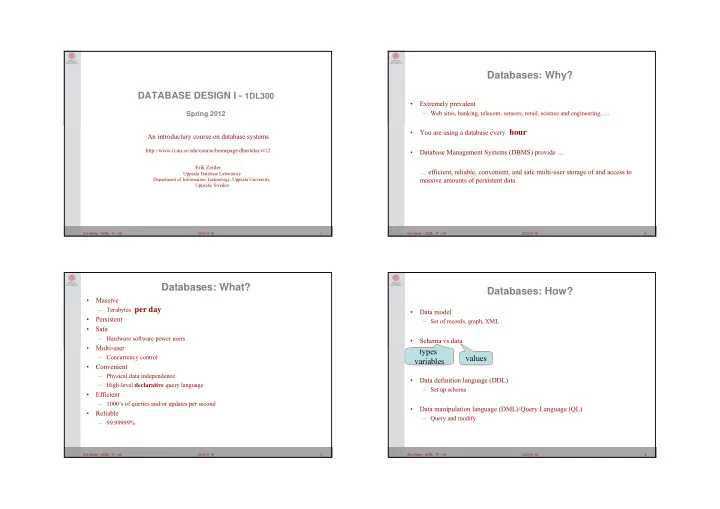
Databases: Why?

  • Extremely prevalent

– Web sites, banking, telecom, sensors, retail, science and engineering, …

  • You are using a database every day
  • Database Management Systems (DBMS) provide …

… efficient, reliable, convenient, and safe multi-user storage of and access to massive amounts of persistent data.

hour

2012-01-16 3 Erik Zeitler - UDBL - IT - UU

Databases: What?

  • Massive

– Terabytes

  • Persistent
  • Safe

– Hardware software power users

  • Multi-user

– Concurrency control

  • Convenient

– Physical data independence – High-level declarative query language

  • Efficient

– 1000’s of queries and/or updates per second

  • Reliable

– 99.99999%

per day

2012-01-16 4 Erik Zeitler - UDBL - IT - UU

Databases: How?

  • Data model

– Set of records, graph, XML

  • Schema vs data
  • Data definition language (DDL)

– Set up schema

  • Data manipulation language (DML)/Query Language (QL)

– Query and modify

types variables values

slide-2
SLIDE 2

2012-01-16 5 Erik Zeitler - UDBL - IT - UU

1DL300

Key DB people

  • DBMS implementer

– Builds system (works at Oracle, IBM, Microsoft, Uppsala University)

  • DB designer

– Establish schema

  • DB application developer

– Programs that operate on DB

  • DB Administrator (DBA)

– Operations & Maintenance – Tuning & Optimization

1DL400

2012-01-16 6 Erik Zeitler - UDBL - IT - UU

13 LECTURES

  • Course intro

– Overview of DB technology – DB terminology

  • ER-modeling
  • Relational model and relational

algebra

  • ER-to-relational mapping and

Normalization

  • SQL
  • Transactions, Concurrency control
  • Recovery techniques
  • Intro to storage and index structures

1DL300 in a nutshell

3 ASSIGNMENTS To be done in pairs:

  • 1. Normalization
  • 2. DB Design and ER modeling
  • 3. SQL in RDBMS

Queries and views JDBC API access to RDBMS

1 FINAL EXAM

  • Skrivsalen Mon March 5
  • No books allowed

2012-01-16 7 Erik Zeitler - UDBL - IT - UU

Personnel

Lecturers

  • Erik Zeitler (main teacher)

– room 1320

  • Silvia Stefanova

– room 1319

  • Anne Peters

– room 2005

Assistants

  • Mikael Lax
  • phone 471 7345
  • room 1306
  • Lars Melander
  • phone 471 1051
  • room 1316
  • Minpeng Zhu
  • phone 471 3155
  • room 1310

firstname.lastname@it.uu.se

2012-01-16 8 Erik Zeitler - UDBL - IT - UU

Friendly reminders from the Student Office

  • 1. Not admitted?
  • 1. Swedish students: Go to www.antagning.se 1DL300 sen anmälan
  • 2. Master students: Go to your study counsellor
  • 3. Exchange students: Ulrika Jaresund
  • 2. Make sure you are registered (registration deadline January 29)
  • 1. Studentportalen (all)
  • 2. Registered before, want to register again? Student Office it-kansli@it.uu.se (re-register)
  • 3. Master students: Study counsellor
  • 4. Exchange students: Ulrika Jaresund
  • 3. Want to quit the course?

– Inform the Student Office! (it-kansli@it.uu.se)

  • If less than 3 weeks have passed since the course started, the course registration will be
  • removed. After 3 weeks a "course intermission" will be reported to UPPDOK instead.
  • 4. Don’t forget to sign up for the final exam
slide-3
SLIDE 3

2012-01-16 9 Erik Zeitler - UDBL - IT - UU

Introduction to Database Terminology

Elmasri/Navathe chs 1-2 Padron-McCarthy/Risch ch 1 Erik Zeitler Department of Information Technology Uppsala University, Uppsala, Sweden

2012-01-16 10 Erik Zeitler - UDBL - IT - UU

The database market (Computer Sweden May 24, 2002)

2012-01-16 11 Erik Zeitler - UDBL - IT - UU

DBMS deployment plans (Gartner 2008)

2012-01-16 12 Erik Zeitler - UDBL - IT - UU

Outline of a database system

slide-4
SLIDE 4

2012-01-16 13 Erik Zeitler - UDBL - IT - UU

Database?

  • A database (DB) is a more or less well-organized collection of related data.
  • The information in a database . . .

– represents information within some sub-area of “reality” (i.e. objects, characteristics and relationships between objects) – is logically connected – has been organized for a specific group of users and applications

2012-01-16 14 Erik Zeitler - UDBL - IT - UU

Database management system?

  • A database management system (DBMS) is one (or several) program that

provides functionality for users to develop, use, and maintain a database.

  • Thus, a DBMS is a general software system for defining, populating (constructing),

manipulating and sharing databases for different types of applications.

  • Also supports protection (system and security) and maintenance to evolve the

system.

2012-01-16 15 Erik Zeitler - UDBL - IT - UU

Database system?

  • A database system consists of . . .

– the physical database (instance) – a database management system – one or several database languages (means for communicating with the database) – one or several application program(s)

  • A database system makes a simple and efficient manipulation of large data sets

possible.

  • The term DB can refer to both the content and to the system (the answer to this

ambiguity is governed by the context).

2012-01-16 16 Erik Zeitler - UDBL - IT - UU

Database vs files

  • DB in comparison to conventional file management:

– data model – data abstraction – meta-data – in catalog – program-data and program-operation independence – multiple views of data – sharing data – multiuser transactions – high-level language for managing data in the database

slide-5
SLIDE 5

2012-01-16 17 Erik Zeitler - UDBL - IT - UU

Advantages of using a database approach

  • Efficient search and access of large data sets
  • Controlling redundancy and inconsistency
  • Access control
  • Persistent storage
  • Indexes and query processing
  • Backup and recovery
  • Multiple user interfaces
  • Complex relationships
  • Integrity constraints
  • Active behaviour
  • Enforcing standards, reducing application development time, flexibility

to evolve system, up-to-date info

2012-01-16 18 Erik Zeitler - UDBL - IT - UU

Data model?

  • Every DB has a data model

– “hides” the physical representation of data

  • A data model is a formalism that defines

– a notation for describing data on an abstract level – a set of operations to manipulate data represented using the data model

  • Data models are used for data abstraction

– Enabling definition and manipulation of data on an abstract level.

2012-01-16 19 Erik Zeitler - UDBL - IT - UU

Data models - examples

  • Examples of representational (implementation) data models within the database

field are:

– Hierarchical (IMS) – Network (IDMS) – Relational (ORACLE, DB2, SQL Server, InterBase, Mimer) – Object-oriented (ObjectStore, Objectivity, Versant, Poet) – Object-relational (Informix, Odapter, DB2)

  • Conceptual data model

– ER-model - Entity-Relationship model – (not an implementation model since there are no operations defined for the notation)

2012-01-16 20 Erik Zeitler - UDBL - IT - UU

Meta-data, i.e. “data about data”

  • Information about which information that exists and about how/where data is

stored

– names and data types of data items – names and sizes of files – storage details of each file – mapping information among schemas – constraints

  • Meta-data is stored in a system catalog (alt. term data dictionary).
  • cf. variables

in a program

slide-6
SLIDE 6

2012-01-16 21 Erik Zeitler - UDBL - IT - UU

Schema and instance

  • To be able to separate data in the database and its description the terms

– database instance and – database schema are used.

  • The schema is created when a database is defined. A database schema is not

changed frequently.

  • The data in the database constitute an instance. Every change of data creates a new

instance of the database.

2012-01-16 22 Erik Zeitler - UDBL - IT - UU

Data independence

  • Reduces the connection between:

– the actual organization of data and – how the users/application programs process data (or “sees” data.)

  • Why?

– Data should be able to change without requiring a corresponding alteration of the application programs. – Different applications/users need different “views” of the same data.

2012-01-16 23 Erik Zeitler - UDBL - IT - UU

Data independence - how?

By introducing a multi-level architecture where each level represents one abstraction level

  • The three-schema architecture

– Introduced in 1971 – a.k.a. ANSI/SPARC architecture for databases – CODASYL Data Base Task Group.

  • It consists of 3 levels:

– Internal level – Conceptual level – External level

  • Each level introduces one abstraction layer and has a schema that describes how

representations should be mapped to the next lower abstraction level.

2012-01-16 24 Erik Zeitler - UDBL - IT - UU

Three-schema architecture

Conceptual schema

Database instance Database instance Internal level Conceptual level External level End users End users view1 view2 … … … viewn

Internal schema

physical logical

slide-7
SLIDE 7

2012-01-16 25 Erik Zeitler - UDBL - IT - UU

Logical database design

  • 1. Make an ER diagram
  • 2. Translate that ER diagram to a relational DB schema

ename EMPLOYEE salary WORKS_IN MANAGES DEPARTMENT dno dname SUPPLIER SUPPLIES ITEM CARRIES iname ino sname saddr INCLUDE price quantity ORDER

  • no

date PLACED_BY CUSTOMER cname caddr balance 1 N M N N N N M 1 1 1 1

  • Schemas for the entity types in the example above

EMPLOYEE(ENAME, SALARY, DEPT) DEPARTMENT(DNO, DNAME, MGR) SUPPLIER(SNAME, SADDR) ITEM(INO, INAME, DNO) ORDER(ONO, DATE, CUST) CUSTOMER(CNAME, CADDR, BALANCE)

  • Schemas for relationship types (M:N)

SUPPLIES(SNAME, INO, PRICE) INCLUDE(ONO, INO, QUANTITY)

2012-01-16 26 Erik Zeitler - UDBL - IT - UU

Internal, conceptual and external schemas

  • Internal schema: describes storage structures and access paths for the physical

database.

– Abstraction level: files, index files etc. – Is usually defined through the data definition language (DDL) of the DBMS.

  • Conceptual schema: an abstract description of the physical database.

– Constitute one, for all users, common basic model of the logical content of the database. – This abstraction level corresponds to “the real world”: object, characteristics, relationships between

  • bjects etc.

– The schema is created in the DDL according to a specific data model.

  • External schema (or views): a (restricted) view over the conceptual schema

– A typical DB has several users with varying needs, demands, access privileges etc. and external schemas describes different views of the conceptual database with respect to what the different user groups would like to/are allowed to se. – Some DBMS’s have a specific language for view definitions (else the DDL is used).

2012-01-16 27 Erik Zeitler - UDBL - IT - UU

An example database (Elmasri/Navathe Figure 1.2)

2012-01-16 28 Erik Zeitler - UDBL - IT - UU

Views - example (Elmasri/Navathe fig 1.4)

slide-8
SLIDE 8

2012-01-16 29 Erik Zeitler - UDBL - IT - UU

Possible data independence in the three-schema architecture

  • 1. Logical data independence

– The possibility to change the conceptual schema without influencing the external schemas (views).

  • e.g. add another field to a conceptual schema.
  • 2. Physical data independence

– The possibility to change the internal schema without influencing the conceptual schema..

  • the effects of a physical reorganization of the database, such as adding an access path, is

eliminated. Conceptual schema

view1 view2 … … … viewn

Internal schema

2012-01-16 30 Erik Zeitler - UDBL - IT - UU

Database languages

A generic term for a class of languages used for defining, communicating with or manipulating a database.

  • In conventional programming languages, declarations and program sentences is

implemented in one language.

  • A database language includes several different languages.

– Storage Definition Language (SDL) - internal schema – Data Definition Language (DDL) - conceptual schema – View Definition Language (VDL) - external schema – Data Manipulation Language (DML)

  • In the DDL the database administrator define internal + conceptual schema

→ database is designed. Subsequent schema modifications are also made in DDL.

  • DB users and application programs use DML to

– retrieve, add, remove, or alter the data in the database – the term Query Language is usually used as synonym to DML.

2012-01-16 31 Erik Zeitler - UDBL - IT - UU

Classification criteria for DBMSs

  • Type of data model

– hierarchical, network, relational, object-oriented, object-relational

  • Centralized vs. distributed DBMSs

– Homogeneous vs. heterogeneous DDBMSs – Multidatabase systems

  • Single-user vs. multi-user systems
  • General-purpose vs. special-purpose DBMSs

– specific applications such as airline reservation and phone directory systems.

  • Cost

2012-01-16 32 Erik Zeitler - UDBL - IT - UU

Physical two-tier client-server architecture

slide-9
SLIDE 9

2012-01-16 33 Erik Zeitler - UDBL - IT - UU

Logical three-tier client/server architecture

2012-01-16 34 Erik Zeitler - UDBL - IT - UU

DBMS archi- tecture