Database Management Course Content Systems Introduction - - PowerPoint PPT Presentation

database management course content systems
SMART_READER_LITE
LIVE PREVIEW

Database Management Course Content Systems Introduction - - PowerPoint PPT Presentation

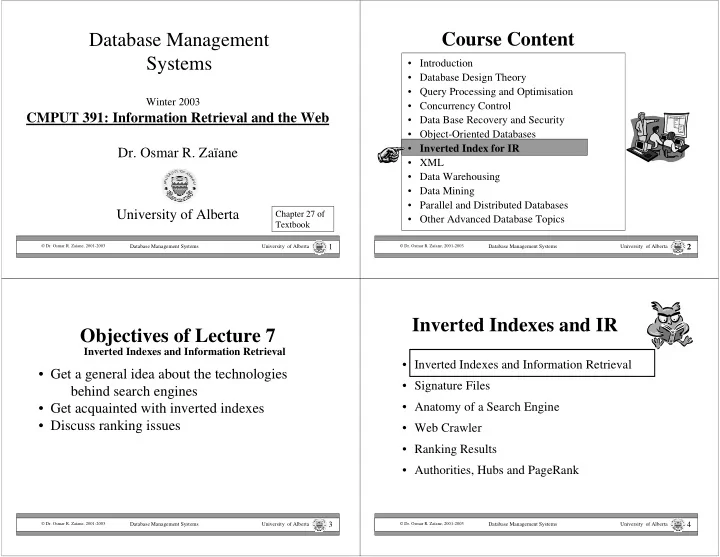
Database Management Course Content Systems Introduction Database Design Theory Query Processing and Optimisation Winter 2003 Concurrency Control CMPUT 391: Information Retrieval and the Web Data Base Recovery and


slide-1
SLIDE 1

Database Management Systems University of Alberta

 Dr. Osmar R. Zaïane, 2001-2003

1

Database Management Systems

  • Dr. Osmar R. Zaïane

University of Alberta

Winter 2003

CMPUT 391: Information Retrieval and the Web

Chapter 27 of Textbook

Database Management Systems University of Alberta

 Dr. Osmar R. Zaïane, 2001-2003

2 2

Course Content

  • Introduction
  • Database Design Theory
  • Query Processing and Optimisation
  • Concurrency Control
  • Data Base Recovery and Security
  • Object-Oriented Databases
  • Inverted Index for IR
  • XML
  • Data Warehousing
  • Data Mining
  • Parallel and Distributed Databases
  • Other Advanced Database Topics

Database Management Systems University of Alberta

 Dr. Osmar R. Zaïane, 2001-2003

3

Objectives of Lecture 7

  • Get a general idea about the technologies

behind search engines

  • Get acquainted with inverted indexes
  • Discuss ranking issues

Inverted Indexes and Information Retrieval

Database Management Systems University of Alberta

 Dr. Osmar R. Zaïane, 2001-2003

4

Inverted Indexes and IR

  • Inverted Indexes and Information Retrieval
  • Signature Files
  • Anatomy of a Search Engine
  • Web Crawler
  • Ranking Results
  • Authorities, Hubs and PageRank
slide-2
SLIDE 2

Database Management Systems University of Alberta

 Dr. Osmar R. Zaïane, 2001-2003

5

Everyday Activity

  • We use search engines whenever we look

for resources on the Internet

  • How do these search engines work?
  • How come they give different results

while the results come from the same Web?

  • The results are often very disappointing.

Why aren’t we satisfied?

Database Management Systems University of Alberta

 Dr. Osmar R. Zaïane, 2001-2003

6

Information Retrieval

  • Find resources (documents) that contain a

certain list of keywords

Find the pages where the phrase “alpha beta” occurs. Searching sequentially is too expensive. You would need an index to directly find the pages.

Database Management Systems University of Alberta

 Dr. Osmar R. Zaïane, 2001-2003

7

Creating an Index

documents index Document Di Di: wa, wb, wc… For each document D1: wa, wb, wc… D2: wa, wd, we… D3: wa, wb, wd… … Dn: wx, wy, wz… documents wa: D1, D2, D3 … wb: D1 , D3 … wc: D1, … wd: D2, D3, … … Inverted Index

Database Management Systems University of Alberta

 Dr. Osmar R. Zaïane, 2001-2003

8

Querying

wa: D1, D2, D3 … wb: D1 , D3 … wc: D1, … wd: D2, D3, … … Inverted Index wa: D1, D2, D3 … wb: D1 , D3 … wc: D1, … wd: D2, D3, … … Which document contains Wa and Wb? D1, D2, D3 … ∩ ∩ ∩ ∩ D1 , D3 … Which document contains Wa or Wb? D1, D2, D3 … ∪ ∪ ∪ ∪ D1 , D3 … Inverted Index

slide-3
SLIDE 3

Database Management Systems University of Alberta

 Dr. Osmar R. Zaïane, 2001-2003

9

Inverted Indexes and IR

  • Inverted Indexes and Information Retrieval
  • Signature Files
  • Anatomy of a Search Engine
  • Web Crawler
  • Ranking Results
  • Authorities, Hubs and PageRank

Database Management Systems University of Alberta

 Dr. Osmar R. Zaïane, 2001-2003

10

Indexing for Text Search

  • Text database: Collection of text documents
  • Important class of queries: Keyword searches

– Boolean queries: Query terms connected with AND, OR and NOT. Result is list of documents that satisfy the boolean expression. – Ranked queries: Result is list of documents ranked by their “relevance”. – IR: Precision (percentage of retrieved documents that are relevant) and recall (percentage of relevant

  • bjects that are retrieved)
  • Inverted indexes is not the only approach in IR.

Signature files are also used for document retrieval.

Database Management Systems University of Alberta

 Dr. Osmar R. Zaïane, 2001-2003

11

Signature Files

  • Index structure (the signature file) with one

data entry for each document

  • Hash function hashes words to bit-vector.
  • Data entry for a document (the signature of

the document) is the OR of all hashed words.

  • Signature S1 matches signature S2 if

S2&S1=S2

Database Management Systems University of Alberta

 Dr. Osmar R. Zaïane, 2001-2003

12

Signature Files: Query Evaluation

  • Boolean query consisting of conjunction of words:

– Generate query signature Sq – Scan signatures of all documents. – If signature S matches Sq, then retrieve document and check for false positives.

  • Boolean query consisting of disjunction of k

words:

– Generate k query signatures S1, …, Sk – Scan signature file to find documents whose signature matches any of S1, …, Sk – Check for false positives

slide-4
SLIDE 4

Database Management Systems University of Alberta

 Dr. Osmar R. Zaïane, 2001-2003

13

Signature Files: Example

Mobile agent Agent James Document 011 2 110 1 Signature RID 001 Mobile 100 James 010 Agent Hash Word

Database Management Systems University of Alberta

 Dr. Osmar R. Zaïane, 2001-2003

14

Inverted Indexes and IR

  • Inverted Indexes and Information Retrieval
  • Signature Files
  • Anatomy of a Search Engine
  • Web Crawler
  • Ranking Results
  • Authorities, Hubs and PageRank

Database Management Systems University of Alberta

 Dr. Osmar R. Zaïane, 2001-2003

15

Search Engine Components

  • A Search Engine has an interface to enter

queries

  • A search engine has access to an inverted

index already built

  • A search engine ranks the results found in

the index

Database Management Systems University of Alberta

 Dr. Osmar R. Zaïane, 2001-2003

16

A Search Engine Blocs

Interface User

Query/Results

Inverted Index Ranking Built off-line

slide-5
SLIDE 5

Database Management Systems University of Alberta

 Dr. Osmar R. Zaïane, 2001-2003

17

Inverted Indexes and IR

  • Inverted Indexes and Information Retrieval
  • Signature Files
  • Anatomy of a Search Engine
  • Web Crawler
  • Ranking Results
  • Authorities, Hubs and PageRank

Database Management Systems University of Alberta

 Dr. Osmar R. Zaïane, 2001-2003

18

Search Engine General Architecture

Crawler LTV LV LNV Parser and indexer Index Search Engine Page Page 1 2 3 4 3 4 5 6

Database Management Systems University of Alberta

 Dr. Osmar R. Zaïane, 2001-2003

19

Search Engines are not Enough

  • Most of the knowledge in the World-Wide

Web is buried inside documents.

  • Search engines (and crawlers) barely

scratch the surface of this knowledge by extracting keywords from web pages.

  • There is text mining, text summarization,

natural language statistical analysis, etc., but not the scope of this course.

Database Management Systems University of Alberta

 Dr. Osmar R. Zaïane, 2001-2003

20

Inverted Indexes and IR

  • Inverted Indexes and Information Retrieval
  • Signature Files
  • Anatomy of a Search Engine
  • Web Crawler
  • Ranking Results
  • Authorities, Hubs and PageRank
slide-6
SLIDE 6

Database Management Systems University of Alberta

 Dr. Osmar R. Zaïane, 2001-2003

21

Relevancy Ranking

  • Some search engine claim to have indexed

about one billion documents

  • Each search can yield a very large list of

“supposedly relevant” documents

  • Sifting through thousands of results is

tedious and not necessary

  • It is extremely important to rank the results

since most users will look mainly at the 10 to 20 first documents.

Database Management Systems University of Alberta

 Dr. Osmar R. Zaïane, 2001-2003

22

How do we Rank?

  • Each Search Engine uses a different ranking
  • function. Usually these ranking functions

are not disclosed. (similarity measure)

  • Parameters used in ranking:
  • Frequency of words
  • Location of words
  • Entirety of query
  • Size of document
  • Age of document
  • Existence in directory
  • Inward and outward Links
  • Metadata
  • Domain
  • And $$$$

Database Management Systems University of Alberta

 Dr. Osmar R. Zaïane, 2001-2003

23

Ontology for Search Results

  • There are still too many results in typical

search engine responses.

  • Reorganize results using a semantic hierarchy

(Zaïane et al. 2001).

WordNet

Semantic network Search result

Database Management Systems University of Alberta

 Dr. Osmar R. Zaïane, 2001-2003

24

slide-7
SLIDE 7

Database Management Systems University of Alberta

 Dr. Osmar R. Zaïane, 2001-2003

25

Inverted Indexes and IR

  • Inverted Indexes and Information Retrieval
  • Signature Files
  • Anatomy of a Search Engine
  • Web Crawler
  • Ranking Results
  • Authorities, Hubs and PageRank

Database Management Systems University of Alberta

 Dr. Osmar R. Zaïane, 2001-2003

26

  • Kleinberg’s HITS algorithm (1998) uses a simple

approach to finding quality documents and assumes that if document A has a hyperlink to document B, then the author of document A thinks that document B contains valuable information.

  • If A is seen to point to a lot of good documents,

then A’s opinion becomes more valuable and the fact that A points to B would suggest that B is a good document as well.

Hyperlink Induced Topic Search (HITS)

Database Management Systems University of Alberta

 Dr. Osmar R. Zaïane, 2001-2003

27

HITS algorithm applies two main steps.

  • A sampling component which constructs a

focused collection of thousand web pages likely to be rich in authorities.

  • A weight-propagation component, which

determines the numerical estimates of hub and authority weights by an iterative procedure.

General HITS Strategy

Database Management Systems University of Alberta

 Dr. Osmar R. Zaïane, 2001-2003

28

  • Starting from a user supplied query, HITS

assembles an initial set S of pages: The initial set of pages is called root set. These pages are then expanded to a larger root set T by adding any pages that are linked to or from any page in the initial set S.

Steps of HITS Algorithm

S

slide-8
SLIDE 8

Database Management Systems University of Alberta

 Dr. Osmar R. Zaïane, 2001-2003

29 Set S Set T

  • HITS then associates with each page p a hub

weight h(p) and an authority weight a(p), all initialized to one.

Database Management Systems University of Alberta

 Dr. Osmar R. Zaïane, 2001-2003

30

  • HITS then iteratively updates the hub and

authority weights of each page. Let p → q denote “page p has an hyperlink to page q”. HITS updates the hubs and authorities as follows:

a(p) = Σ h(q)

q→p

h(p) = Σ a(q)

p→q Good authorities are linked by good hubs Good hubs link to good authorities

Database Management Systems University of Alberta

 Dr. Osmar R. Zaïane, 2001-2003

31

Ranking Pages Based on Popularity

  • Page-rank method ( Brin and Page, 1998): Rank the "importance"
  • f Web pages, based on a model of a "random browser.“

– Initially used to select pages to revisit by crawler. – Ranks pages in Google’s search results.

  • In a simulated web crawl, following a random link of each visited

page may lead to the revisit of popular pages (pages often cited).

  • Brin and Page view Web searches as random walks to assign a

topic independent “rank” to each page on the world wide web, which can be used to reorder the output of a search engine.

  • The number of visits to each page is its PageRank. PageRank

estimates the visitation rate => popularity score.

Database Management Systems University of Alberta

 Dr. Osmar R. Zaïane, 2001-2003

32

Page Rank: A Citation Importance Ranking

  • Number of backpacks (~citations)

C A B B and C are backlinks of A

slide-9
SLIDE 9

Database Management Systems University of Alberta

 Dr. Osmar R. Zaïane, 2001-2003

33

Idealized PageRank Calculation

100 53 9 50

50 50 3

Database Management Systems University of Alberta

 Dr. Osmar R. Zaïane, 2001-2003

34

Each Page p has a number of links coming out of it C(p) (C for citation), and number of pages pointing at page p1, p2 ….., pn. PageRank of P is obtained by

ÿ ÿ

  • +

− =

=

n k k k

p C p PR d p PR

1

) ( ) ( ) 1 ( ) (

Database Management Systems University of Alberta

 Dr. Osmar R. Zaïane, 2001-2003

35

Summary

  • Searching for relevant documents sequentially in a large

collection of text documents is not a good solution.

  • An inverted index is an index containing the list of

documents per term. (documents containing the term)

  • A web search engine does not crawl the web at query time.

The Web is pre-indexed in an inverted index.

  • Automatic crawling of the Web starts from seeds. If

starting seeds are different, the resulting index is different.

  • Ranking results is an important operation for Search
  • engines. (only 20 to 30 first are usually seen).
  • There is still a great deal of research related to search the

Web