
SLIDE 1
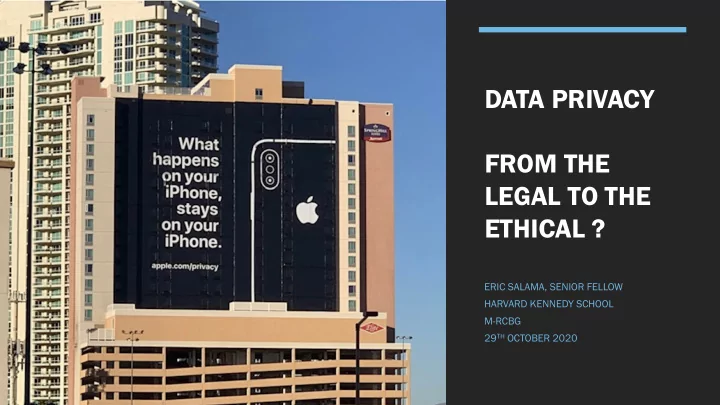
DATA PRIVACY FROM THE LEGAL TO THE ETHICAL ?
ERIC SALAMA, SENIOR FELLOW HARVARD KENNEDY SCHOOL M-RCBG 29TH OCTOBER 2020
DATA PRIVACY FROM THE LEGAL TO THE ETHICAL ? ERIC SALAMA, SENIOR - - PowerPoint PPT Presentation
DATA PRIVACY FROM THE LEGAL TO THE ETHICAL ? ERIC SALAMA, SENIOR FELLOW HARVARD KENNEDY SCHOOL M-RCBG 29 TH OCTOBER 2020 HOUSE REPORT SEES POOR STANDARDS OF DATA PRIVACY AS EVIDENCE OF MONOPOLY POWER In the absence of adequate privacy
ERIC SALAMA, SENIOR FELLOW HARVARD KENNEDY SCHOOL M-RCBG 29TH OCTOBER 2020
“In the absence of adequate privacy guardrails in the United States, the persistent collection and misuse of consumer data is an indicator of market power online…..As a result, consumers are forced to either use a service with poor privacy safeguards or forego the service altogether……. The best evidence
to which platforms have eroded consumer privacy without prompting a response from the market. As scholars have noted, a platform’s ability to maintain strong networks while degrading user privacy can reasonably be considered equivalent to a monopolist’s decision to increase prices or reduce product quality…….Additionally a dominant platform can use its market power to extract more data from users, undermining their privacy…. The opacity of data collection and use contributes to consumer confusion and the misperception that consumers do not care about their privacy—the so-called privacy paradox— simply because they use services that have become essential”
“Countless advertisers must pay a toll to
Google’s search advertising and general search text advertising monopolies; American consumers are forced to accept Google’s policies, privacy practices and use of personal data”
www.vespa.com
https://edition.cnn.com/
https://www.idownloadblog.com/
5 10 15 20 25 30 35 40 45 Make their social media accounts private so that they are only visible to family and friends Clear their cookie cache Turn off location tracking tools Use an adblocker Change their browser settings Change their cookie settings
68% of US adults would like to protect their data more but find it hard to do
% US adults who always
10 20 30 40 50 60 Have total control over personal data and how it is used Have some control over personal data and how it is used Have very little control over personal data and how it is used US UK Germany
Source : Salama Privacy Study Conducted by Morning Consult October 2020
10 20 30 40 50 60 Hospitals and schools Banks and credit card companies Internet and cable providers Government Loyalty card providers Mobile device manufacturers Ecommerce companies Social media companies
% who trust completely or a lot each of the following institutions to protect their data and use appropriately
US UK Germany
Source : Salama Privacy Study Conducted by Morning Consult October 2020
0% 20% 40% 60% 80% 100% US UK US UK 44 65 56 35 43 57 57 43
Chart Title
Would rather have government bodies have access to my data Would rather private companies have access to my data Give access to personal data to fight crime and terrorism Protect personal data whatever the costs
Source : Salama Privacy Study Conducted by Morning Consult October 2020
5 10 15 20 25 30 35 40 45 50 Journey data to help with Covid tracking Location data with police to improve public safety and response times Health activity data to facilitate research Journey movement data to help improve public transport Phone logs to decide where to locate free wifi Social media to help decide where to develop new schools and kids recreation facilities % UK adults willing to share their data with government and public institutions
Source : Salama Privacy Study Conducted by Morning Consult October 2020
Legislation in over 60 countries (eg GDPR, CCPA) has sought to give consumers control over use of their data
For practitioners, the legislation is not harmonised across countries and is ambiguous
The push for transparency and consumer control has not put consumers in control
Very few fines of any substance have been levied for violations of rules https://www.enforcementtracker.com/
“The commercial advantages and potential abuse
cohesive public oversight structure. Consumers today suffer from both a lack of control over how their data are used and an inability to take their data from platform to platform…. A new agency would be well positioned to balance privacy and competition”
Source : Salama Privacy Study Conducted by Morning Consult October 2020
5 10 15 20 25 30 35 40 Online retailer searches and purchases Web browsing behaviour Facebook/social media data Location data from your phone Health records US UK Germany
%
0% 10% 20% 30% 40% 50% 60% 70% 80% 90% 100% US UK Germany 46 53 52 54 47 48
Chart Title
Would rather have a free service and let personal data be used Would rather pay a small fee and have personal data be protected
Source : Salama Privacy Study Conducted by Morning Consult October 2020
% of US adults who are willing to pay to guarantee privacy of their data Mean monthly $ amount that people are willing to pay for these apps, excluding people who are not willing to pay anything 38 37 39 34 31 32 11 11 11 12 12 12 Source : Salama Privacy Study Conducted by Morning Consult October 2020
% of UK adults who are willing to pay to guarantee privacy of their data Mean monthly £ amount that people are willing to pay for these apps, excluding people who are not willing to pay anything 28 28 29 25 30 24 6 6 6 6 6 6 Source : Salama Privacy Study Conducted by Morning Consult October 2020
Companies such as www.infosum.com and www.glimpseprotocol.io working with publishers to facilitate the querying
Apple SKAdNetwork in IoS14
No personal identifiable information
Aggregated data provided on app installation as a result of seeing media
Google developments being planned
Eliminating use of 3rd party cookies
Turtledove (advertiser can serve ad based on an interest, but cannot combine that interest with info about person or page; website cannot learn about visitor ad interests -> people can find out what interest groups they are in + advertisers cannot learn browsing habits
FLoC (browser groups flocks of similar people, prevents individual tracking)
10 20 30 40 50 60 70 Prefer content to be free even if my personal data is used Companies using and sharing my data doesn’t really bother me When it comes to terrorism and crime, governments need to access our personal data to keep us safe Protecting privacy of my data is
I turn off ability of apps on my phone to track my location
% in US agreeing with the following statements
All adults Iphone users
% of US adults who agree that
Getting targeted ads in apps like You Tube, Facebook and Spotify is a small price to pay for being able to use for free I would rather pay for apps than get targeted ads
% of US adults who agree that when it comes to online services and content
I would rather have a free service and let my personal data be used I would rather pay a bit of money and have my data protected
Source : Salama Study Conducted by Morning Consult October 2020