Data Mining & Analytics Data Mining Reference Model Data - - PowerPoint PPT Presentation

data mining analytics
SMART_READER_LITE
LIVE PREVIEW

Data Mining & Analytics Data Mining Reference Model Data - - PowerPoint PPT Presentation

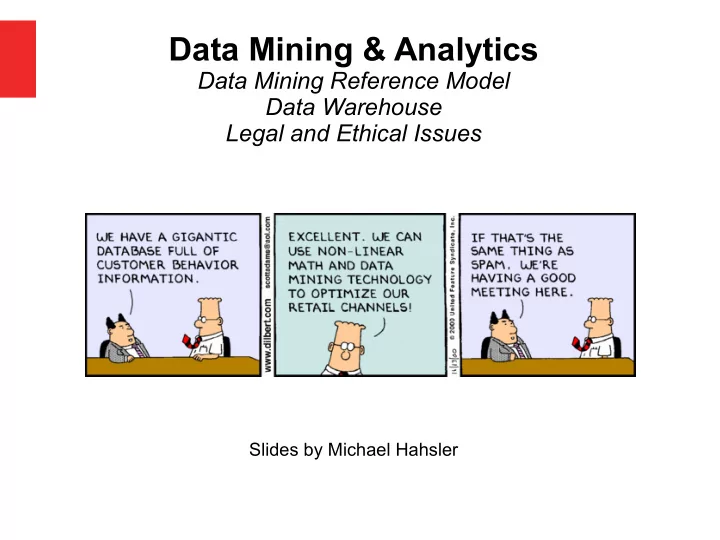
Data Mining & Analytics Data Mining Reference Model Data Warehouse Legal and Ethical Issues Slides by Michael Hahsler Data Mining & Analytics Analytics is the discovery and communication of meaningful patterns in data. Analytics

slide-1
SLIDE 1

Data Mining & Analytics

Data Mining Reference Model Data Warehouse Legal and Ethical Issues

Slides by Michael Hahsler

slide-2
SLIDE 2

Data Mining & Analytics

  • Analytics is the discovery and

communication of meaningful patterns in data.

  • Analytics relies on the

simultaneous application of statistics, computer programming and operations research to quantify performance.

  • Analytics often favors data

visualization to communicate insight.

[Wikipedia]

slide-3
SLIDE 3

Analytics and Visualization

  • Infoviz is a field by its own.
  • Napoleon's Army in Russia by Charles Minard (around 1850)
slide-4
SLIDE 4

Do you notice the slight flaw? Do you notice the slight flaw?

slide-5
SLIDE 5

Data Mining & Analytics

OR Data Mining / Stats Statistics OR Machine Learning DB / CS

slide-6
SLIDE 6

CRISP-DM Reference Model

  • Cross Industry Standard

Process for Data Mining

  • De facto standard for

conducting data mining and knowledge discovery projects.

  • Defines tasks and outputs.
  • Now developed by IBM as the

Analytics Solutions Unified Method for Data Mining/Predictive Analytics (ASUM-DM).

  • SAS has SEMMA and most

consulting companies use their own process.

slide-7
SLIDE 7

Tasks in the CRISP-DM Model

slide-8
SLIDE 8

Problem: Mining Point of Sale (POS) Data

slide-9
SLIDE 9

Problem: How is POS data stored?

  • Relational data base?
  • How do the tables look like?
  • Has every store/region its own

data base?

  • What if I want to know how many

units of product A were sold in the last three month in Texas?

  • This must be easier!
slide-10
SLIDE 10

Data Warehouse

slide-11
SLIDE 11

EL T: Extract, Transform and Load

  • Extracting data from outside sources
  • Transforming it to fit analytical needs. E.g.,

– Clean (missing data, wrong data) – Translate (1 → "female") – Join (from several sources) – Calculate and aggregate data

  • Loading it into the end target (data warehouse)
slide-12
SLIDE 12

Data Warehouse

  • Subject Oriented: Data warehouses are designed

to help you analyze data in a certain area (e.g., sales).

  • Integrated: Integrates data from disparate sources

into a consistent format.

  • Nonvolatile: Data in the data warehouse are never
  • verwritten or deleted.
  • Time Variant: they maintain both historical and

(nearly) current data.

slide-13
SLIDE 13

OLAP: OnLine Analytical Processing

Time Region Product Smartphones TX 2012

Operations:

  • Slice
  • Dice
  • Drill-down
  • Roll-up
  • Pivot

For fast operation OLAP requires a special database structure (Snow-flake scheme)

slide-14
SLIDE 14

Online Transcation Processing (OL TP) vs. Online Analytical Processing (OLAP)

OLTP OLAP users clerk, IT professional knowledge worker function day to day operations decision support DB design application-oriented subject-oriented data current, up-to-date detailed, flat relational isolated historical, summarized, multidimensional integrated, consolidated usage repetitive ad-hoc access read/write index/hash on prim. key lots of scans unit of work short, simple transaction complex query # records accessed tens millions #users thousands hundreds DB size 100MB-GB 100GB-TB metric transaction throughput query throughput, response

slide-15
SLIDE 15

Legal, Privacy and Security Issues

?

slide-16
SLIDE 16

Legal, Privacy and Security Issues

  • Are we allowed to collect the data?
  • Are we allowed to use the data?
  • Is privacy preserved in the process?
  • Is it ethical to use and act on the data?
  • Problem: Internet is global but legislation

is local!

slide-17
SLIDE 17

Legal, Privacy and Security Issues

Data-Gathering via Apps Presents a Gray Legal Area

By KEVIN J. O’BRIEN Published: October 28, 2012

BERLIN — Angry Birds, the top-selling paid mobile app for the iPhone in the United States and Europe, has been downloaded more than a billion times by devoted game players around the world, who

  • ften spend hours slinging squawking fowl at groups of egg-stealing

pigs. When Jason Hong, an associate professor at the Human-Computer Interaction Institute at Carnegie Mellon University, surveyed 40 users, all but two were unaware that the game was storing their locations so that they could later be the targets of ads....

slide-18
SLIDE 18
slide-19
SLIDE 19

Here is what the small print says...

Pokémon Go’s constant location tracking and camera access required

for gameplay, paired with its skyrocketing popularity, could provide data like no app before it. “Their privacy policy is vague,” Hong said. “I’d say deliberately vague, because of the lack of clarity on the business model.” ... The agreement says Pokémon Go collects data about its users as a “business asset.” This includes data used to personally identify players such as email addresses and other information pulled from Google and Facebook accounts players use to sign up for the game. If Niantic is ever sold, the agreement states, all that data can go to another company.

USA Today Network Josh Hafner, USA TODAY 2:38 p.m. EDT July 13, 2016