Data Description Data Description p SLIDES PREPARED SLIDES - - PDF document

data description data description p
SMART_READER_LITE
LIVE PREVIEW

Data Description Data Description p SLIDES PREPARED SLIDES - - PDF document

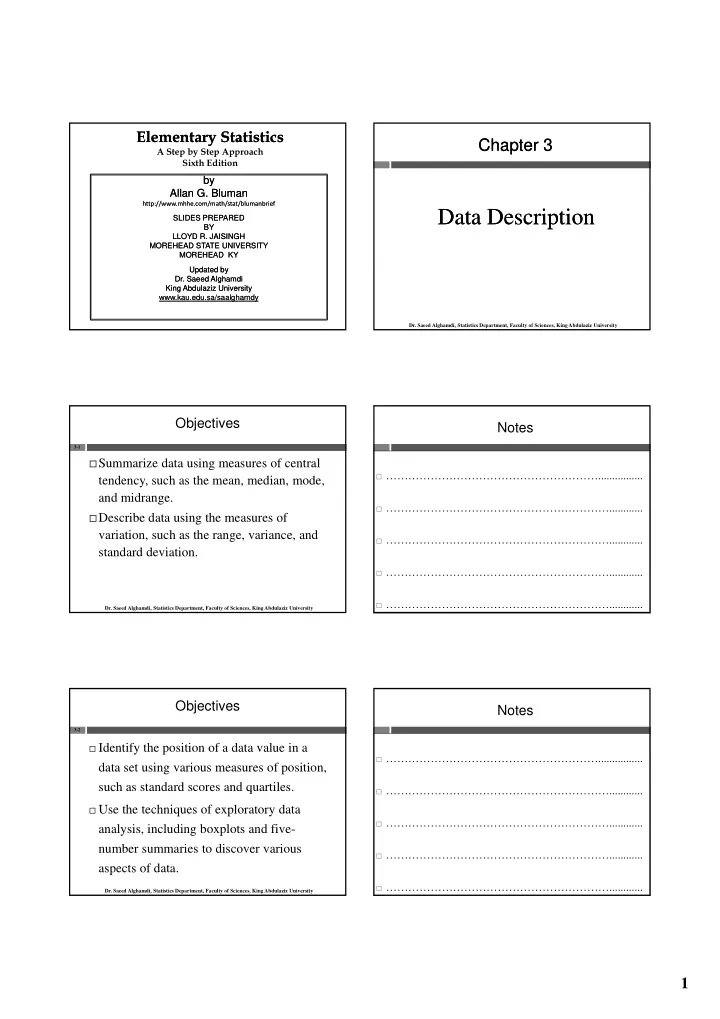
Elementary Statistics Elementary Statistics Chapter 3 Chapter 3 A Step by Step Approach Sixth Edition by by Allan G. Allan G. Bluman Bluman http://www.mhhe.com/math/stat/blumanbrief http://www.mhhe.com/math/stat/blumanbrief Data


slide-1
SLIDE 1

1

by by Allan G. Allan G. Bluman Bluman

http://www.mhhe.com/math/stat/blumanbrief http://www.mhhe.com/math/stat/blumanbrief

SLIDES PREPARED SLIDES PREPARED BY BY

Elementary Statistics Elementary Statistics

A Step by Step Approach Sixth Edition

BY BY LLOYD R. JAISINGH LLOYD R. JAISINGH MOREHEAD STATE UNIVERSITY MOREHEAD STATE UNIVERSITY MOREHEAD KY MOREHEAD KY Updated by Updated by Dr.

  • Dr. Saeed

Saeed Alghamdi Alghamdi King King Abdulaziz Abdulaziz University University www.kau.edu.sa/saalghamdy www.kau.edu.sa/saalghamdy

Chapter Chapter 3 3

Data Description Data Description p

  • Dr. Saeed Alghamdi, Statistics Department, Faculty of Sciences, King Abdulaziz University

3-1

Summarize data using measures of central

tendency, such as the mean, median, mode, and midrange.

Objectives

Describe data using the measures of

variation, such as the range, variance, and standard deviation.

  • Dr. Saeed Alghamdi, Statistics Department, Faculty of Sciences, King Abdulaziz University

Notes

…………………………………………………................ ……………………………………………………............ ……………………………………………………............ ……………………………………………………............ ……………………………………………………............

3-2

Identify the position of a data value in a

data set using various measures of position, such as standard scores and quartiles.

Objectives

q

Use the techniques of exploratory data

analysis, including boxplots and five- number summaries to discover various aspects of data.

  • Dr. Saeed Alghamdi, Statistics Department, Faculty of Sciences, King Abdulaziz University

Notes

…………………………………………………................ ……………………………………………………............ ……………………………………………………............ ……………………………………………………............ ……………………………………………………............

slide-2
SLIDE 2

2

Statistical methods can be used to summarize

data.

Measures of average are also called measures

f t l t d d i l d th

3-3

Introduction

  • f central tendency and include the mean,

median, mode, and midrange.

Measures that determine the spread of data

values are called measures of variation or measures of dispersion and include the range, variance, and standard deviation.

  • Dr. Saeed Alghamdi, Statistics Department, Faculty of Sciences, King Abdulaziz University

Notes

…………………………………………………................ ……………………………………………………............ ……………………………………………………............ ……………………………………………………............ ……………………………………………………............ Measures of position tell where a specific data value

falls within the data set or its relative position in comparison with other data values.

3-4

Introduction

The most common measures of position are

standard scores and quartiles.

The measures of central tendency, variation, and

position are part of what is called traditional statistics.

  • Dr. Saeed Alghamdi, Statistics Department, Faculty of Sciences, King Abdulaziz University

Notes

…………………………………………………................ ……………………………………………………............ ……………………………………………………............ ……………………………………………………............ ……………………………………………………............ Another type of statistics is called exploratory

data analysis which include the box plot and the five-number summary.

3-5

Introduction

A statistic is a characteristic or measure

  • btained by using the data values from a

sample.

A parameter is a characteristic or measure

  • btained by using all the data values for a

specific population.

  • Dr. Saeed Alghamdi, Statistics Department, Faculty of Sciences, King Abdulaziz University

Notes

…………………………………………………................ ……………………………………………………............ ……………………………………………………............ ……………………………………………………............ ……………………………………………………............

slide-3
SLIDE 3

3

The mean is the sum of the values divided by

the total number of values.

The Greek letter μ (mu) is used to represent

th l ti

3-6

Measures of Central Tendency

the population mean.

The symbol (“x-bar”) represents the sample

mean.

1 2

....

N

X X X X N N μ + + + = =

1 2

....

n

x x x x x n n + + + = =

x

  • Dr. Saeed Alghamdi, Statistics Department, Faculty of Sciences, King Abdulaziz University

Notes

…………………………………………………................ ……………………………………………………............ ……………………………………………………............ ……………………………………………………............ ……………………………………………………............

3-7

Measures of Central Tendency

Example: Suppose that the number of burglaries

reported for a specific year for nine communities are 61, 11, 1, 3, 2, 30, 18, 3, 7 Find the mean Find the mean. * See examples 3-1 and 3-2

X = x

n = 61 11 1 3 2 30 18 3 7 136 9 9 + + + + + + + + = = 15.1

  • Dr. Saeed Alghamdi, Statistics Department, Faculty of Sciences, King Abdulaziz University

Notes

…………………………………………………................ ……………………………………………………............ ……………………………………………………............ ……………………………………………………............ ……………………………………………………............ The median is the halfway point in a data set. The

symbol for the median is MD.

The median is found by arranging the data in order

and selecting the middle point.

3-8

Measures of Central Tendency

g p

Example: Suppose that the number of burglaries

reported for a specific year for nine communities are 61, 11, 1, 3, 2, 30, 18, 3, 7 Find the median. , So * See examples 3-4, 3-5, 3-6 and 3-8

MD: 1, 2, 3, 3, 7, 11, 18, 30, 61 MD= 7

  • Dr. Saeed Alghamdi, Statistics Department, Faculty of Sciences, King Abdulaziz University

Notes

…………………………………………………................ ……………………………………………………............ ……………………………………………………............ ……………………………………………………............ ……………………………………………………............

slide-4
SLIDE 4

4

The value that occurs most often in a data set is

called the mode.

A data set with one value that occurs with greatest

frequency is said to be unimodal.

3-9

Measures of Central Tendency

q y

A data set with two values that occur with greatest

frequency is said to be bimodal.

A data set with more than two values that occur

with greatest frequency is said to be multimodal.

When all the values in a data set occur with the

same frequency is said to have no mode.

  • Dr. Saeed Alghamdi, Statistics Department, Faculty of Sciences, King Abdulaziz University

Notes

…………………………………………………................ ……………………………………………………............ ……………………………………………………............ ……………………………………………………............ ……………………………………………………............ Example: Suppose that the number of burglaries

reported for a specific year for nine communities are 61, 11, 1, 3, 2, 30, 18, 3, 7 Find the mode

3-10

Measures of Central Tendency

Find the mode. * See examples 3-9, 3-10, 3-11 and 3-13

Mode = 3

  • Dr. Saeed Alghamdi, Statistics Department, Faculty of Sciences, King Abdulaziz University

Notes

…………………………………………………................ ……………………………………………………............ ……………………………………………………............ ……………………………………………………............ ……………………………………………………............ The midrange is a rough estimate of the middle and

defined as the sum of the lowest and highest values in a data set divided by 2. The symbol is MR.

3-11

Measures of Central Tendency

Example: Suppose that the number of burglaries

reported for a specific year for nine communities are 61, 11, 1, 3, 2, 30, 18, 3, 7 Find the midrange. * See examples 3-15 and 3-16

MR = 1 + 61 2 = 31

  • Dr. Saeed Alghamdi, Statistics Department, Faculty of Sciences, King Abdulaziz University

Notes

…………………………………………………................ ……………………………………………………............ ……………………………………………………............ ……………………………………………………............ ……………………………………………………............

slide-5
SLIDE 5

5

The weighted mean is used when the values in a

data set are not all equally represented.

The weighted mean of a variable

is found by multiplying each value by its corresponding

3-12

Measures of Central Tendency

X

multiplying each value by its corresponding weight and dividing the sum of the products by the sum of the weights.

Where are the weights for

1 1 2 2 1 2

... ...

n n w n

X w X w X w X w w w w w

x

+ + + ∑ = = + + + ∑

1 2

, , ...,

n

w w w

1 2

, , ...,

n

X X X

  • Dr. Saeed Alghamdi, Statistics Department, Faculty of Sciences, King Abdulaziz University

Notes

…………………………………………………................ ……………………………………………………............ ……………………………………………………............ ……………………………………………………............ ……………………………………………………............

Example: A student received 90 in English (3

credits), 70 in Statistics (3 credits), 80 in Biology (4 credits) and 60 in physical education (2 credits) find the student’s average

3-13

Measures of Central Tendency

education (2 credits), find the student s average grade. * See example 3-17

90 3 70 3 80 4 60 2 x = = 76.67 3 3 4 2

w

Xw w × + × + × + × = + + +

∑ ∑

  • Dr. Saeed Alghamdi, Statistics Department, Faculty of Sciences, King Abdulaziz University

Notes

…………………………………………………................ ……………………………………………………............ ……………………………………………………............ ……………………………………………………............ ……………………………………………………............ One computes the mean by using all the values

  • f a data and used in computing other statistics.

The mean varies less than the median or mode

3-14

Properties of Central Tendency Measures

when samples are taken from the same population and all three measures are computed for these samples.

The mean for the data set is unique, and not

necessarily one of the data values.

  • Dr. Saeed Alghamdi, Statistics Department, Faculty of Sciences, King Abdulaziz University

Notes

…………………………………………………................ ……………………………………………………............ ……………………………………………………............ ……………………………………………………............ ……………………………………………………............

slide-6
SLIDE 6

6

The mean cannot be computed for an open-

ended frequency distribution.

The mean is affected by extremely high or low

3-15

Properties of Central Tendency Measures

y y g values and may not be the appropriate average to use in these situations.

The median is used when one must find the

center or middle value of a data set.

  • Dr. Saeed Alghamdi, Statistics Department, Faculty of Sciences, King Abdulaziz University

Notes

…………………………………………………................ ……………………………………………………............ ……………………………………………………............ ……………………………………………………............ ……………………………………………………............

The median is used when one must

determine whether the data values fall into the upper half or lower half of the distribution

3-16

Properties of Central Tendency Measures

distribution.

The median is used to find the average of an

  • pen-ended distribution.

The median is affected less than the mean

by extremely high or extremely low values.

  • Dr. Saeed Alghamdi, Statistics Department, Faculty of Sciences, King Abdulaziz University

Notes

…………………………………………………................ ……………………………………………………............ ……………………………………………………............ ……………………………………………………............ ……………………………………………………............

The mode is used when the most typical case

is desired.

The mode is the easiest average to compute.

h d b d h h d

3-17

Properties of Central Tendency Measures

The mode can be used when the data are

nominal, such as religious preference or gender.

The mode is not always unique. A data set

can have more than one mode, or the mode may not exist for a data set.

  • Dr. Saeed Alghamdi, Statistics Department, Faculty of Sciences, King Abdulaziz University

Notes

…………………………………………………................ ……………………………………………………............ ……………………………………………………............ ……………………………………………………............ ……………………………………………………............

slide-7
SLIDE 7

7

The midrange is easy to compute. The midrange gives the midpoint. The midrange is affected by extremely high

3-18

Properties of Central Tendency Measures

The midrange is affected by extremely high

  • r low values in a data set.
  • Dr. Saeed Alghamdi, Statistics Department, Faculty of Sciences, King Abdulaziz University

Notes

…………………………………………………................ ……………………………………………………............ ……………………………………………………............ ……………………………………………………............ ……………………………………………………............

3-19

Distribution Shapes

In a positively skewed or right skewed distribution,

the majority of the data values fall to the left of the mean and cluster at the lower end of the distribution. mode<median<mean

  • Dr. Saeed Alghamdi, Statistics Department, Faculty of Sciences, King Abdulaziz University

Notes

…………………………………………………................ ……………………………………………………............ ……………………………………………………............ ……………………………………………………............ ……………………………………………………............

3-20

Distribution Shapes

In a symmetrical distribution, the data values are

evenly distributed on both sides of the mean. mean=median=mode

  • Dr. Saeed Alghamdi, Statistics Department, Faculty of Sciences, King Abdulaziz University

Notes

…………………………………………………................ ……………………………………………………............ ……………………………………………………............ ……………………………………………………............ ……………………………………………………............

slide-8
SLIDE 8

8

3-21

Distribution Shapes

In a negatively skewed or left skewed distribution,

the majority of the data values fall to the right of the mean and cluster at the upper end of the distribution. mean<median<mode

  • Dr. Saeed Alghamdi, Statistics Department, Faculty of Sciences, King Abdulaziz University

Notes

…………………………………………………................ ……………………………………………………............ ……………………………………………………............ ……………………………………………………............ ……………………………………………………............

The range is the highest value minus the lowest

value in a data set.

3-22

Measures of Variation

value Lowest value higest R − =

Example: Suppose that the number of burglaries

reported for a specific year for nine communities are 61, 11, 1, 3, 2, 30, 18, 3, 7 Find the range. * See examples 3-18, 3-19 and 3-20

61 1 60 R = − =

  • Dr. Saeed Alghamdi, Statistics Department, Faculty of Sciences, King Abdulaziz University

Notes

…………………………………………………................ ……………………………………………………............ ……………………………………………………............ ……………………………………………………............ ……………………………………………………............

3-23

Measures of Variation

The variance is the average of the squares of the

distance each value is from the mean. The symbol for the population variance is σ2.

The symbol for the sample variance is s2

( )

N x

− =

2 2

μ σ ( )

[ ]

1 1 ) (

2 2 2 2

− − = − − =

∑ ∑ ∑

n n x x n x x s

  • Dr. Saeed Alghamdi, Statistics Department, Faculty of Sciences, King Abdulaziz University

Notes

…………………………………………………................ ……………………………………………………............ ……………………………………………………............ ……………………………………………………............ ……………………………………………………............

slide-9
SLIDE 9

9

3-24

Measures of Variation

The standard deviation is the square root of the

  • variance. The symbol for the population standard

deviation is σ.

( )

2

The symbol for the sample standard deviation is s.

( )

N x

− = =

2 2

μ σ σ ( )

2 2 2 2

( ) 1 1 x x n x x s s n n ⎡ ⎤ − − ⎢ ⎥ ⎣ ⎦ = = = − −

∑ ∑ ∑

  • Dr. Saeed Alghamdi, Statistics Department, Faculty of Sciences, King Abdulaziz University

Notes

…………………………………………………................ ……………………………………………………............ ……………………………………………………............ ……………………………………………………............ ……………………………………………………............ Example: Suppose that the number of burglaries

reported for a specific year for nine communities are 61, 11, 1, 3, 2, 30, 18, 3, 7 Find the variance and the standard deviation

3-25

Measures of Variation

Find the variance and the standard deviation. & * See examples 3-21 and 3-23

( )

2 2 2

385.3611 1 x x n s n ⎡ ⎤ − ⎢ ⎥ ⎣ ⎦ = = −

∑ ∑

19.63062 s =

61 11 1 3 2 30 18 3 7 136 3721 121 1 9 4 900 324 9 49 5138

x

2

x ∑

  • Dr. Saeed Alghamdi, Statistics Department, Faculty of Sciences, King Abdulaziz University

Notes

…………………………………………………................ ……………………………………………………............ ……………………………………………………............ ……………………………………………………............ ……………………………………………………............ Variances and standard deviations can be used to

determine the spread of the data. If the variance or standard deviation is large, the data are more

3-26

Variance and Standard Deviation

  • dispersed. The information is useful in comparing

two or more data sets to determine which is more variable.

The measures of variance and standard deviation

are used to determine the consistency of a variable.

  • Dr. Saeed Alghamdi, Statistics Department, Faculty of Sciences, King Abdulaziz University

Notes

…………………………………………………................ ……………………………………………………............ ……………………………………………………............ ……………………………………………………............ ……………………………………………………............

slide-10
SLIDE 10

10

3-27

The variance and standard deviation are used to

determine the number of data values that fall within a specified interval in a distribution.

Variance and Standard Deviation

The variance and standard deviation are used quite

  • ften in inferential statistics.
  • Dr. Saeed Alghamdi, Statistics Department, Faculty of Sciences, King Abdulaziz University

Notes

…………………………………………………................ ……………………………………………………............ ……………………………………………………............ ……………………………………………………............ ……………………………………………………............

3-28

Measures of Variation

The coefficient of variation is the standard deviation

divided by the mean. The result is expressed as a percentage.

For populations For Samples

% 100 . μ σ = CVar

% 100 . x s CVar =

  • Dr. Saeed Alghamdi, Statistics Department, Faculty of Sciences, King Abdulaziz University

Notes

…………………………………………………................ ……………………………………………………............ ……………………………………………………............ ……………………………………………………............ ……………………………………………………............

3-29

Measures of Variation

The coefficient of variation is used to compare

standard deviations when the units are different for the two variables being compared.

Large coefficient of variation means large

variability.

  • Dr. Saeed Alghamdi, Statistics Department, Faculty of Sciences, King Abdulaziz University

Notes

…………………………………………………................ ……………………………………………………............ ……………………………………………………............ ……………………………………………………............ ……………………………………………………............

slide-11
SLIDE 11

11

3-30

Measures of Variation

Example: The average age of the employees at

certain company is 30 years with a standard deviation of 5 years ; the average salary of the $ employees is $40,000 with a standard deviation of $5000 . Which one has more variation age or income?

Hence, age is more variable than income

* See examples 3-25 and 3-26

( ) 16.67% CVar age = ( ) 12.5% CVar income =

  • Dr. Saeed Alghamdi, Statistics Department, Faculty of Sciences, King Abdulaziz University

Notes

…………………………………………………................ ……………………………………………………............ ……………………………………………………............ ……………………………………………………............ ……………………………………………………............

3-31

Measure of Position

A standard score or z score is used when

direct comparison of raw scores is impossible.

The z score represents the number of standard The z score represents the number of standard

deviations a data value falls above or below the mean.

s x x z − =

  • Dr. Saeed Alghamdi, Statistics Department, Faculty of Sciences, King Abdulaziz University

Notes

…………………………………………………................ ……………………………………………………............ ……………………………………………………............ ……………………………………………………............ ……………………………………………………............

3-32

Example: A student scored 65 on a statistics exam that had a mean of 50 and a standard deviation of 10. Compute the z-score. (65 50)/10 1 5

Measure of Position

z = (65 – 50)/10 = 1.5 That is, the score of 65 is 1.5 standard deviations above above the mean. Above Above -

  • since the z-score is positive.
  • Dr. Saeed Alghamdi, Statistics Department, Faculty of Sciences, King Abdulaziz University

Notes

…………………………………………………................ ……………………………………………………............ ……………………………………………………............ ……………………………………………………............ ……………………………………………………............

slide-12
SLIDE 12

12

Which of the following exam scores has a better relative position?

  • a. A score of
  • n an ex

42 = 39 a am with nd = 4 X s 42 – 39 3

Example:

Measure of Position

3-33

  • b. A score of
  • n an ex

76 = 71 am with and = 3 X s z = 4 = z = 76 – 71 3 = 4 5 3 So a score of has a better relative po 76 sition

* See examples 3-29 and 3-30

  • Dr. Saeed Alghamdi, Statistics Department, Faculty of Sciences, King Abdulaziz University

Notes

…………………………………………………................ ……………………………………………………............ ……………………………………………………............ ……………………………………………………............ ……………………………………………………............

3-34

Measures of Position

Quartiles divide the distribution into four groups,

denoted by Q1, Q2, Q3. Note that Q1 is the same as the 25th percentile; Q2 is the same as the 50th percentile or the median; and Q3 corresponds to the 75th percentile.

  • Dr. Saeed Alghamdi, Statistics Department, Faculty of Sciences, King Abdulaziz University

Notes

…………………………………………………................ ……………………………………………………............ ……………………………………………………............ ……………………………………………………............ ……………………………………………………............

3-35

  • Quartiles can be found as follow

1.

Arrange the data in order from lowest to highest.

2.

Find the median of the data values (Q2).

Measures of Position

(Q )

3.

Find the median of the data values that fall bellow Q2 (Q1).

4.

Find the median of the data values that fall above Q2 (Q3).

  • Dr. Saeed Alghamdi, Statistics Department, Faculty of Sciences, King Abdulaziz University

Notes

…………………………………………………................ ……………………………………………………............ ……………………………………………………............ ……………………………………………………............ ……………………………………………………............

slide-13
SLIDE 13

13

Example: Suppose that the number of burglaries

reported for a specific year for nine communities are 61, 11, 1, 3, 2, 30, 18, 3, 7 Find the first second and third quartile

3-36

Measures of Position

Find the first, second and third quartile. 1, 2, 3, 3, 7, 11, 18, 30, 61 * See example 3-36

1

2.5 Q =

2 7

Q =

3 24

Q =

  • Dr. Saeed Alghamdi, Statistics Department, Faculty of Sciences, King Abdulaziz University

Notes

…………………………………………………................ ……………………………………………………............ ……………………………………………………............ ……………………………………………………............ ……………………………………………………............

3-37

Outliers

An outlier is an extremely high or an extremely low data

value when compared with the rest of the data values.

Outliers can be identified as follows

  • 1. Arrange the data in order and find Q1 and Q3.
  • 2. Find the interquartile range: IQR=Q3-Q1.
  • 3. The values that are smaller than Q1-1.5(IQR) or larger

than Q3+1.5(IQR) are called outliers.

Outliers can be the result of measurement or

  • bservational error.
  • Dr. Saeed Alghamdi, Statistics Department, Faculty of Sciences, King Abdulaziz University

Notes

…………………………………………………................ ……………………………………………………............ ……………………………………………………............ ……………………………………………………............ ……………………………………………………............

3-38

Outliers

Example: Suppose that the number of burglaries

reported for a specific year for nine communities are 61, 11, 1, 3, 2, 30, 18, 3, 7 Find the outlier values if any.

So, Hence, 61 is an outlier value in this data.

* See example 3-37

1 3

2.5 and 24 24 2.5 21.5 Q Q IQR = = ⇒ = − =

3 1

1.5 24 1.5(21.5) 56.25 1.5 2.5 1.5(21.5) 29.75 Q IQR Q IQR + = + = − = − = −

  • Dr. Saeed Alghamdi, Statistics Department, Faculty of Sciences, King Abdulaziz University

Notes

…………………………………………………................ ……………………………………………………............ ……………………………………………………............ ……………………………………………………............ ……………………………………………………............

slide-14
SLIDE 14

14

3-39

Exploratory Data Analysis

The purpose of exploratory data analysis is to

examine data in order to find out what information can be discovered such the center and the spread.

Boxplots are graphical representations of a five-

number summary of a data set. The five specific values that make up a five-number summary are minimum, and maximum.

1 2 3

, , Q Q Q

  • Dr. Saeed Alghamdi, Statistics Department, Faculty of Sciences, King Abdulaziz University

Notes

…………………………………………………................ ……………………………………………………............ ……………………………………………………............ ……………………………………………………............ ……………………………………………………............

3-40

Exploratory Data Analysis

Example: Suppose that the number of burglaries

reported for a specific year for nine communities are 61, 11, 1, 3, 2, 30, 18, 3, 7 Construct a boxplot and comment on the skewness Construct a boxplot and comment on the skewness

  • f the data.

* See example 3-39

1 2 3

1, 2.5, 7, 24, 61 Min Q Q Q Max = = = = =

The distribution is positively skewed.

5 10 15 20 25 30 35 40 45 50 55 60 65

  • Dr. Saeed Alghamdi, Statistics Department, Faculty of Sciences, King Abdulaziz University

Notes

…………………………………………………................ ……………………………………………………............ ……………………………………………………............ ……………………………………………………............ ……………………………………………………............