{ Data, Databases, and the Extraction of Knowledge Rene T., - - PDF document

data databases and the extraction of knowledge ren e t
SMART_READER_LITE
LIVE PREVIEW

{ Data, Databases, and the Extraction of Knowledge Rene T., - - PDF document

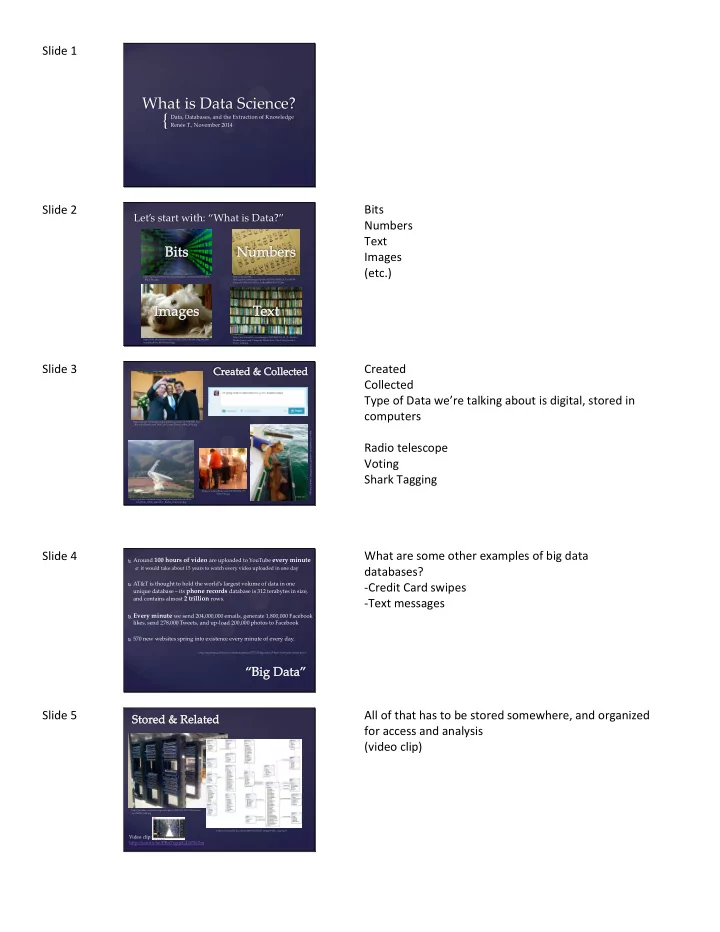
Slide 1 What is Data Science? { Data, Databases, and the Extraction of Knowledge Rene T., November 2014 Slide 2 Bits Lets s tart with: What is Data? Numbers Text Images (etc.)


slide-1
SLIDE 1

Slide 1

{

What is Data Science?

Data, Databases, and the Extraction of Knowledge Renée T., November 2014

Slide 2

Let’s start with: “What is Data?”

http://upload.wikimedia.org/wikipedia/commons/f/f0/DARPA _Big_Data.jpg https://encrypted- tbn2.gstatic.com/images?q=tbn:ANd9GcS9dKu3_Tzi-sWW- yAqee5y0EhuvoIZNSya_rAKnuBBd0JYxPX7pw http://fc01.deviantart.net/fs71/i/2012/326/3/4/cute_dog_by_tho masmeadows345-d5lsah9.jpg http://www.freefoto.com/images/1351/06/1351_06_2---Books-- Shakespeare-and-Company-Bookstore--The-Latin-Quarter-- Paris_web.jpg

Bits Numbers Text Images (etc.) Slide 3

https://c2.staticflickr.com/4/3273/3017878633_65beb1c7d6.jpg http://upload.wikimedia.org/wikipedia/commons/e/e4/Gr een_Bank_100m_diameter_Radio_Telescope.jpg https://c1.staticflickr.com/1/2/1349370_07 03fce74c.jpg http://upload.wikimedia.org/wikipedia/commons/9/96/Bill_Nye ,_Barack_Obama_and_Neil_deGrasse_Tyson_selfie_2014.jpg

Created Collected Type of Data we’re talking about is digital, stored in computers Radio telescope Voting Shark Tagging Slide 4

 Around 100 hours of video are uploaded to YouTube every minute  it would take about 15 years to watch every video uploaded in one day  AT&T is thought to hold the world’s largest volume of data in one

unique database – its phone records database is 312 terabytes in size, and contains almost 2 trillion rows.

 Every minute we send 204,000,000 emails, generate 1,800,000 Facebook

likes, send 278,000 Tweets, and up-load 200,000 photos to Facebook

 570 new websites spring into existence every minute of every day.

http://smartdatacollective.com/bernardmarr/277731/big-data-25-facts-everyone-needs-know

What are some other examples of big data databases?

  • Credit Card swipes
  • Text messages

Slide 5

http://pixabay.com/static/uploads/photo/2014/03/13/01/12/datacen ter-286386_640.jpg https://c2.staticflickr.com/2/1296/533233247_b6baa30fdb_z.jpg?zz=1

Video clip: http://youtu.be/PBx7rgqeGG8?t=2m

All of that has to be stored somewhere, and organized for access and analysis (video clip)

slide-2
SLIDE 2

Slide 6

http://upload.wikimedia.org/wikipedia/commons/1/1c/CMS_Higgs-event.jpg http://upload.wiki media.org/wikipedi a/commons/9/90/Ke ncf0618FacebookNe twork.jpg http://upload.wikimedia.org/wikipedia/commons/b/bf/USDA_Hardine ss_zone_map.jpg https://c1.staticflickr.com/3/2300/2596366618_2d6cb01735.jpg

Slide 7 What is a database? Slide 8 Database

[dey-tuh-beys] noun A comprehensive collection of related data

  • rganized for convenient access, generally in

a computer.

  • dictionary.com

I used a database to look up this definition! Slide 9 Types of Databases

http://www.oaddo.org

Relational Document Object-Oriented Graph Unstructured – text, audio, images Slide 10

Pretty much every website you interact with  Social Media  Banking  File Sharing  Search Engines You broadcast/generate data everywhere you go  Cell phones  Purchases  Driving (GPS)  Streaming music

Databases You Use

 Online Shopping  Course Registration/Canvas  Travel  Etc. etc. etc…..  Email  Posting status updates  Attending events  Etc. etc. etc…..

Social Media – posts, friends/follows, likes/favorites, location-tagged images Note: often other people generating this data about you (tags, mentions, etc.) Online Shopping – “other customers who purchased this also purchased….”, even just browsing the website, clicking, spending time on a page – usually all

  • f that data is tracked.

Ever noticed when you leave an online store, the items you looked at “follow” you around the internet via ads?

slide-3
SLIDE 3

Travel – purchase tickets, check in, post on social media, rental car with GPS, hotel rooms, credit card at restaurant, generating data everywhere you go

  • credit card fraud alerts when in new location

Cell phones constantly generating data – app usage, location, websites, alarms, games, photos, etc. Slide 11

https://www.google.com/maps/@38.8905569,-77.1721577,13z/data=!5m1!1e1 http://upload.wikimedia.org/wikipedia/commons/6/69/Netflix_logo.svg https://c2.staticflickr.com/4/3324/3507973704_563846fe14_z.jpg?zz=1

How is data collected about you used to help you?

Now that I’ve gotten you thinking about data, specifically YOUR data, let’s think about some ways in which having your data collected (and aggregated) can help you:

  • Navigation (Google Maps directions)
  • Recommendations (Yelp, Netflix)
  • Medical Diagnoses
  • Alerts

How are these generated? ALGORITHMS Downside

  • Some sites now charging different customers

different prices based on browsing history http://www.fastcoexist.com/3037888/where-and- how-youre-online-shopping-changes-the-prices-you- see?utm_source=facebook

  • Any data could be hacked (such as health or financial

records) and lead to loss of privacy. The more places it’s stored, the more vulnerable it is. Slide 12 Who builds these systems?

slide-4
SLIDE 4

Slide 13

Data Scientist

Computer Scientist

  • Data collection systems
  • Machine Learning

Algorithms

  • Interface Design
  • Design/Manage/Query

Databases

  • Data Aggregation
  • Data Mining

Mathematician

  • Statistical Models
  • Evaluation Metrics
  • Predictive Analytics
  • Data Visualizations

Business Person

  • Domain Expertise
  • Knowing what

questions to ask

  • Interpreting results for

business decisions

  • Presenting outcomes

Examples – not a complete definition, and not all simultaneously necessary skills

Who writes these algorithms?

  • Experts in Machine Learning – Computer Scientists –

Data Scientists! They’re often using statistical models. Who develops those?

  • Mathematicians – Statisticians – Data Scientists!

Why do they write them?

  • Sometimes altruistic or experimental, but usually to

make someone money! Who is using these results to make money?

  • Business People – Marketers – Data Scientists!

Note: you don’t have to be the expert in all of these areas Slide 14

http://static.squarespace.com/static/5150aec6e4b0e340ec52710a/t/51525c33e4b0b3e0d10 f77ab/1364352052403/Data_Science_VD.png?format=750w

Data Science Venn Diagram by Drew Conway

But let’s not get ahead of ourselves… back to the “data being stored and related” part Slide 15

No need to be a “unicorn”, but do need to know something about all of these areas, and become expert in some (Sound familiar, ISAT students?)

http://semanticommunity.info/@api/deki/files/27057/Figure1- 4.png?size=bestfit&width=484&height=541&revision=1 http://www.becomingadatascientist.com/wp- content/uploads/2014/06/DS_profile.png

From “Doing Data Science” by Cathy O’Neill & Rachel Schutt

Data Visualization Machine Learning Mathematics Statistics Computer Science Communication Domain Expertise Slide 16

 Statistician  Data Mining Specialist  Biostatistician  Social Science Researcher  Big Data Analyst  Spatial/GIS Analyst  Natural Language

Programmer

 Computational Physicist

Some other names for “Data Scientist”

 Pythonista  Financial Analyst  Recommendation System

Engineer

 Information Architect  Artificial Intelligence

Researcher

 Neuroscientist  Data Visualization Designer

Many data science jobs in financial industry (credit cards, investing) and marketing (ad serving) realm, however, that seems to be changing now that every company seems to be looking into whether they should have a data scientist on staff. Pick some areas you’re interested in, and search the internet for people in that area in data jobs. Also, there are now organizations like DataKind for data scientists and analysts to volunteer their time and skills to help solve problems in arenas outside their “day job” field, such as non-profits and cities.

slide-5
SLIDE 5

Slide 17 Data Science jobs pay an average of $118,000 per year

It is estimated that by 2018, US could have a shortage of 140,000+ people with advanced analytical skills & need 1.5M managers/analysts that can make decisions based on data analysis

Recently saw 2 jobs posted in Charlottesville: “Junior Data Scientist” w/2 years experience was over $70K, senior $120K – and that’s in small city! http://www.glassdoor.com/Salaries/data-scientist- salary-SRCH_KO0,14.htm Why data science jobs are in high demand http://www.extension.harvard.edu/hub/blog/extensi

  • n-blog/why-data-science-jobs-are-high-demand

Slide 18

 Also known as “knowledge discovery”  Goes beyond queries  Data Mining  Business Understanding  Data Understanding  Data Preparation  Modeling  Clustering  Classification  Regression  Evaluation  From “Data Science for

Business” by Provost & Fawcett

“Extraction of Knowledge”

Images from ODU ECE 607 Lecture Slides by Prof. Jiang Li

Clistering, Classification, Regression Slide 19

Video clip: Interview with Neha Kothari, LinkedIN Data Scientist http://youtu.be/8dxKe5cGHdA?t=17s

Data scientist video clip Slide 20 Data Science Example

 Kaggle competition hosted by UPenn and Mayo Clinic to

detect seizures in intracranial EEG recordings

https://www.kaggle.com/c/seizure-detection

Detailed walkthrough of a data science problem Check this next competition, ends 11/17: https://www.kaggle.com/c/seizure-prediction “For individuals with drug-resistant epilepsy, responsive neurostimulation systems hold promise for augmenting current therapies and transforming epilepsy care. Of the more than two million Americans who suffer from recurrent, spontaneous epileptic seizures, 500,000 continue to experience seizures despite multiple attempts to control the seizures with

  • medication. For these patients responsive

neurostimulation represents a possible therapy capable of aborting seizures before they affect a patient's normal activities.

slide-6
SLIDE 6

In order for a responsive neurostimulation device to successfully stop seizures, a seizure must be detected and electrical stimulation applied as early as possible. A seizure that builds and generalizes beyond its area

  • f origin will be very difficult to abort via
  • neurostimulation. Current seizure detection

algorithms in commercial responsive neurostimulation devices are tuned to be hypersensitive, and their high false positive rate results in unnecessary stimulation. In addition, physicians and researchers working in epilepsy must often review large quantities of continuous EEG data to identify seizures, which in some patients may be quite subtle. Automated algorithms to detect seizures in large EEG datasets with low false positive and false negative rates would greatly assist clinical care and basic research. “ Slide 21

 Current detection systems have high false positive rate, resulting

in unnecessary stimulation

 Need to rapidly and automatically detect onset of seizure  Data provided  Matrix of EEG sample values  Time duration latency (time before seizure)  Sampling frequency  Channels (electrodes)  Human and Canine Data  Latency only provided in “training” data because when taking

real-life data, you won’t know if or how long until seizure hits – that’s what you’re trying to predict

 This is an important point in predictive analytics!

“Future” data can’t be used to predict outcomes, but it can be used to determine what already-known data tends to correlate with it during the “training” of your model. Slide 22

 Competition winner Michael Hills published his method  FFT = Fast Fourier Transform

 Determines primary frequencies in

EEG sample

 Correlation Coefficient “r”  Eigenvalues – can think of this as a

scaling factor

 Put all these values into a

“Random Forest” classifier

 Ensemble learning method – combines results of many “weak” decision

trees, turns out to be better classifier than one “strong” decision tree

 Can now train a classifier for each patient  He wrote a computer program to help him experiment & quickly

validate result of each “brute force” approach, trying every technique he could find

 Used the same evaluation technique kaggle competition would use  Line of scikit-learn Python code for training winning submission:  RandomForestClassifier(n_estimators=3000, min_samples_split=1,

bootstrap=False, random_state=0)

http://en.wikipedia.org/wiki/Fast_Fourier_transform

https://www.kaggle.com/c/seizure- detection/forums/t/10111/required-model- documentation-and-code/52439 Correlation between EEG channels Michael Hills’ code is posted on GitHub His summary of winning approach: “Quickly summarising my model, for feature selection I used FFT 1-47Hz, concatenated with correlation coefficients (and their eigenvalues) of both the FFT output data, as well as the input time data. The data was then trained on per-patient Random Forest classifiers (3000 trees).” http://www.cip-labs.net/2013/01/17/introduction-to- random-forests/

slide-7
SLIDE 7

Slide 23

Kaggle’s evaluation method:

 Judged on the mean area under the ROC curve (AUC) of two predictions.

Receiver Operating Characteristic = true positive vs false positive.

1)

Predict the probability that a given clip is a seizure.

2)

Predict the probability that the clip is within the first 15 seconds its respective seizure (the technical term for time into the seizure is "latency").

The competition metric is the mean of these two AUCs:

 Michael Hills’ winning submission scored 0.963

 His model will label 963 of every 1000 true seizure clips as seizures  He won $5000 (much less than UPenn/Mayo would have had to pay a

Data Scientist to develop this as an employee or consultant!)

 Currently another similar contest posted w/$25,000 prize

Slide 24

My Machine Learning project

Code snippet using Random Forest Classifier Using JMU first-time donor (and non-donor) data from two previous years, could I classify who was likely to become a donor for the first time during the next year? Correctly classified 67% of first-time donors, got great feedback from professor, plan to continue the study for my masters program final project. You can read all about it on my blog! BecomingADataScientist.com

Slide 25 Other Examples

 Galaxy Classification using Convolutional

Neural Networks

http://benanne.github.io/2014/04/05/galaxy-zoo.html

 Choosing Facebook Audience for Content

Promotion using Random Forests

http://citizennet.com/blog/2012/11/10/random-forests- ensembles-and-performance-metrics/

 Predicting Wine Quality with Principal

Component Analysis

http://fastml.com/predicting-wine-quality/

 Readmission Risk Score to decide which

patients to give additional follow-up help at

  • Mt. Sinai hospital

http://www.technologyreview.com/news/518916/a- hospital-takes-its-own-big-data-medicine/

Note – in the last one they did a pilot study, and the extra care cut readmission rates in half Slide 26

Data Visualization Example

http://labs.strava.com/heatmap/#12/-78.90549/38.44669/blue/bike

This is called a “HeatMap” – other kinds of heatmaps, this one changes street color based on traffic volume What can we learn from this visualization of walking vs biking in Harrisonburg? What about in Massanutten? (Were all those people riding bikes up there? Using the app while skiing? -- Researched and found Shenandoah Valley Bicycle Coalition mountain biking trails http://appliedtrailsresearch.com/wp- content/uploads/2012/03/NutMap11_LoRes-1.pdf) Questions to ask: How was data collected? How many different people are represented? How is “scale” of color levels decided? Were “too fast” data points taken out? (people using app in car?) Do people respond differently to the blue version of the heatmap vs yellow version? Any privacy issues? (one version of app shows you “who you passed on the trail”) Lots to think about from this relatively simple example!

slide-8
SLIDE 8

Slide 27

?

This area looks a little “darker”. What can we conclude? Are the people that live here less active? Is there a smaller population?

  • reveal to show it is the Manassas-Centreville area in

Northern VA, which has many more people than Harrisonburg (probably just fewer people using app! Or maybe they’re working out inside. Maybe a bike club in Harrisonburg competes on the app or something to drive the numbers up. Or maybe there aren’t many people using it, so the “heavy” areas are just a couple users.) Slide 28

http://xkcd.com/1425/

Slide 29 How to get started So, hopefully I got some of you interested in Data, Databases and Data Science. If you want to learn more, or even consider doing this as a career, what can you do while you’re in college to get started? Slide 30

 Programming  Any language is good to

start with. Gain core understanding.

 Python or R data analysis

experience a plus

 Database design, SQL  Math  Calculus  Linear Algebra  Statistics (2 levels)  Advanced: Optimization /

Linear Programming

Recommended skills to pick up while at JMU

 Research and Analysis  Science involving data

collection and interpretation

 Working with “messy” real

life data

 Business Analytics  Data Mining  Others  Business / Communication  Graphic Design

Take classes on campus or online!

Did I have all of these when I graduated? No – had basic Stats & Calculus, basic VB programming, Database Design, ISAT projects But this is what I would have taken more of had I known about data science then. If you’re already well-versed in area, either get more advanced, or get more breadth (recommended). If you’re a math major, take a science research course. If you’re a CS major, take a business course. Etc. Didn’t have these great online courses when I was in school.

slide-9
SLIDE 9

Slide 31

 Doing Data Science by Cathy O’Neil* & Rachel Schutt  Data Science for Business by Forster Provost & Tom Fawcett  Data Smart by John Foreman* (uses Excel)  I’ll review other books as I read them:

http://www.becomingadatascientist.com/learning/

 Blogs & News Feeds (FlowingData.com is a good one to start with)  Twitter – look for curated lists of people to follow

https://twitter.com/BecomingDataSci/lists/women-in-data- science/members

Read, read, read

*on Twitter and willing to chat!

Here’s a blog post by Trey Causey with good info on getting started: http://treycausey.com/getting_started.html Interview with Jawbone Data Scientist Abe Gong about using Data Science to solve human problems: http://www.datascienceweekly.org/data-scientist- interviews/using-data-science-solve-human- problems-abe-gong-interview Slide 32

 Python Fundamentals – Codecademy http://www.codecademy.com/tracks/python  Machine Learning – Coursera / Stanford https://www.coursera.org/course/ml  Data Analyst Nanodegree – Udacity https://www.udacity.com/course/nd002

(includes Hadoop mini-course)

 Applied Data Mining and Statistical Learning – Penn State

https://onlinecourses.science.psu.edu/stat857/

 Pretty comprehensive list here: http://www.kdnuggets.com/education/online.html  TED talks on Data http://www.ted.com/search?q=data  Susan Etlinger* http://www.ted.com/talks/susan_etlinger_what_do_we_do_with_all_this_big_data  “Need to spend more time on critical thinking skills…[because we have

the] potential to make bad decisions far more quickly, efficiently, and with far greater impact than we did in the past.”

 “…we need to be clear about ..the methodologies that we use, …because if I

don't know what …questions you asked, I don't know what questions you didn't ask.”

Free Online Courses Also many universities are offering graduate-level Data Science programs now! (UVA on campus, Berkeley online, for instance) – not free, though! There is an “open source masters”: http://datasciencemasters.org/ (@clarecorthell also

  • n twitter)

Some machine learning Python libraries: http://scikit-learn.org/stable/ http://pybrain.org/pages/features More: http://dataaspirant.wordpress.com/2014/11/01/pyth

  • n-packages-for-

datamining/?utm_content=buffere2274&utm_mediu m=social&utm_source=twitter.com&utm_campaign= buffer I keep a list of courses I’m taking and have completed here: http://www.becomingadatascientist.com/learning/ Slide 33

 Volunteer to Analyze Data (DataKind)  Play with public data sets

 http://101.datascience.community/2014/10/17/data-sources-for-cool-data-

science-projects-part-1-guest-post/

 https://www.opensciencedatacloud.org/publicdata/  http://catalog.data.gov/dataset  https://archive.ics.uci.edu/ml/datasets.html?format=&task=clu&att=&area=&nu

mAtt=&numIns=&type=&sort=nameUp&view=table

 Data Science Competitions

(Kaggle also has “knowledge competitions” for learning)

Explore

slide-10
SLIDE 10

Slide 34

What some of my followers on Twitter wish they knew about data in college….

Link to question on twitter for all replies: https://twitter.com/BecomingDataSci/status/530214 823347228672 Slide 35 Questions?

Renee T.

[contact me via twitter or blog for email address] @becomingdatasci http://www.becomingadatascientist.com

BecomingADataScientist.com – contact me there! Leave a comment! 