
SLIDE 1
Dark Matter 1-ton Era
Cristiano Galbiati Princeton University
Milan Università degli Studi June 30, 2014
Dark Matter 1-ton Era Cristiano Galbiati Princeton University - - PowerPoint PPT Presentation
Dark Matter 1-ton Era Cristiano Galbiati Princeton University Milan Universit degli Studi June 30, 2014 Fuchs astro-ph/9812048 WMAP 2006 200 NGC 6530 v c (km/s) 150 100 dark halo disk 50 gas 0 0 5 10 15 20 r (kpc) Feng Has
Cristiano Galbiati Princeton University
Milan Università degli Studi June 30, 2014
200 150 100 50 5 10 15 20 NGC 6530 dark halo disk
vc (km/s)
r (kpc) gas
Fuchs astro-ph/9812048 WMAP 2006
Has gravitational interactions Is long lived Is cold Is not baryonic Feng
e,γ χ,n Attisha
1 10 100 1000 104 1050 1049 1048 1047 1046 1045 1044 1043 1042 1041 1040 1039 1014 1013 1012 1011 1010 109 108 107 106 105 104 103 WIMP Mass GeVc2 WIMPnucleon cross section cm2 WIMPnucleon cross section pb
(Green&ovals)&Asymmetric&DM&& (Violet&oval)&Magne7c&DM& (Blue&oval)&Extra&dimensions&& (Red&circle)&SUSY&MSSM& &&&&&MSSM:&Pure&Higgsino&& &&&&&MSSM:&A&funnel& &&&&&MSSM:&BinoEstop&coannihila7on& &&&&&MSSM:&BinoEsquark&coannihila7on& &
8B
Neutrinos Atmospheric and DSNB Neutrinos C D M S I I G e ( 2 9 ) X e n
1 ( 2 1 2 )
CRESST CoGeNT (2012) CDMS Si (2013)
EDELWEISS (2011)
DAMA
S I M P L E ( 2 1 2 ) Z E P L I N
I I ( 2 1 2 ) C O U P P ( 2 1 2 )
SuperCDMS Soudan Low Threshold XENON 10 S2 (2013) CDMS-II Ge Low Threshold (2011)
SuperCDMS Soudan X e n
1 T L Z L U X ( 2 1 3 ) D a r k S i d e G 2 D a r k S i d e 5 DEAP3600 P I C O 2 5
F 3 I PICO250-C3F8 SNOLAB SuperCDMS
7Be
Neutrinos
N EU T RIN O C OH ER EN T S CA T TE R ING N E UT R I N O C O HE REN T S C A T T E R IN G
CDMSlite (2013) SuperCDMS SNOLAB
Z-mediated scattering H
e d i a t e d s c a t t e r i n g Figueroa-Feliciano
Hugh Lippincott, Fermilab for the PICO Collaboration UCLA DM 2014
1
(temperature and pressure), bubble chambers are blind to electronic recoils (10-10 or better)
comparable to the critical bubble size
6
and 25 keV threshold
22
below observed rate in COUPP4
nuclear recoils but are clearly not WIMPs
them in detail
acoustic distribution and similar timing and spatial correlations to COUPP4 background for at least some fraction of events
27
S.&Moriyama& Kamioka&Observatory,& Ins=tute&for&Cosmic&Ray&Research,& The&University&of&Tokyo& 28th&Feb.&2014,&Dark&MaKer&2014,&UCLA&
&
– Dark&maKer:&elas=c,&inelas=c&129Xe,&superQWIMPs,&ALP,&HP,&…& – Solar&axions,&2νDEC,&SN,&and&other&unexpected&signal&
2&
From PMT handbook (HPK)
4&
Surface events can be identified and rejected effectively.
6&
BG generated position Hit position (photocathode) 2-2.5keVee 42yrs equiv. surface
– e&scat.&by&solar&pp&ν&~&10Q5/kg/keVee/d&!&irreducible& – 212Pb,&<0.3µBq/kg&~&10Q5/kg/keVee/d=dru&!&1/10& – 85Kr&(Qβ=687keV,&τ1/2=11yr),&1ppt&~10Q5dru&!&1/10& – 214Pb,&10mBq/kg&~&10Q4dru&!&<1/10&
7&
DM 100kg FV (800kg) 0.8mφ, 642 PMTs 2007- To discover DM
XMASS-II
DM, solar, ββ& 10ton FV Detailed study of DM pp solar ν& ββ ~30meV(IH)
XMASS-1.5
DM 1ton FV (5ton) 1.5mφ, ~1000 PMTs Requesting budget DM, pp solar ν ~10-46cm2 Annual/spectral info.
10&
Liquid Argon Ball for dark matter search
85 cm radius
No charge readout
Start of operation early 2014
3.6 tonnes of liquid Argon
acrylic ball
Excluding surface events
Scintillation only
photo-multiplier tubes
Feb 28th, 2014 2
Sited at SNOLAB
equivalent
Inside a water tank ~50cm of light guide acrylic and filler blocks Ultra-low radioactivity acrylic
Feb 28th, 2014 3
TPB wavelength shifter Acrylic vessel Filler block Acrylic light guide PMT Water Liquid Argon
Feb 28th, 2014 7
Nuclear Recoil Tagged AmBe source Background (
Background Rate/count Mitigation Neutron In 1t LAr < 2 pBq/kg < 0.06 count/year Shielding: 6000 mwe (SNOLAB), Active water shield, light guides and filler blocks Material selection & In 1t LAr < 2 pBq/kg < 0.06 count/year Pulse shape discrimination Material selection (for ) Radon In 1t LAr < 1.4 nBq/kg < 44 count/year* Material selection, SAES getter, cold charcoal radon trap * High energy events, not in ROI Surface In 1t LAr < 0.2 mBq/m2 < 0.6 count/year Material selection (acrylic), sanding of AV (1mm removal), fiducialization.
Feb 28th, 2014 11
Total of <0.6 events in ROI in 3 years for a spin-independent WIMP-nucleon cross section sensitivity of 10-46 cm2 at 100GeV. Assuming 8PE per keV
Nuclear Instruments and Methods in Physics Research A 568 (2006) 700–709
Time and space reconstruction in optical, non-imaging, scintillator-based particle detectors
aPhysics Department, Princeton University, Princeton, NJ 08544, USA
Received 22 April 2005; received in revised form 25 July 2006; accepted 29 July 2006 Available online 24 August 2006
ARTICLE IN PRESS
www.elsevier.com/locate/nima
Case Western Reserve University
1
1
signal, strong shielding of external backgrounds
distinguishes electron recoil backgrounds
photons
7
LUX
7
17
neutrons: λ ~10 cm
P(L) ∼ = L λ e− L
λ
PMT
Single, low-energy Compton scatter
300 kg LUX
fiducial
7 Ton LZ
pp solar ν
17
100 200 300 400 500 600 350 300 250 200 150 100 50 radius2 (cm2) drift time (µs)
cathode grid gate grid wall face wall corner
10 20 30 40 50 1 1.2 1.4 1.6 1.8 2 2.2 2.4 2.6 log10(S2b/S1) x,y,z corrected S1 x,y,z corrected (phe)
3 6 9 12 15 18 21 24 27 30 keVnr 1.3 1.8 3.5 4.6 5.9 7.1
keVee
within a few μDRU
defeat pp solar neutrino background
— Would enable simultaneous ßß-decay and DM search
32
32
events: Rejection factor ≥108 for >60 photoelectrons: proposed by Boulay & Hime, AstropartPhys 25, 176 (2006) demonstrated by WARP AstropartPhys 28, 495 (2008)
39Ar abatement factor ≥150
Beta/Gamma Nuclear Recoil
S1 [PE] 60 80 100 120 140 160 180 200 F90 0.1 0.2 0.3 0.4 0.5 0.6 0.7 0.8 0.9 1
total_s1_corr_f90_after_lsv_cuts_hist
Entries 2.119474e+07 Mean x 131.2 Mean y 0.3062 RMS x 40.52 RMS y 0.05257
100 200 300 400 500 600 700
total_s1_corr_f90_after_lsv_cuts_hist
Entries 2.119474e+07 Mean x 131.2 Mean y 0.3062 RMS x 40.52 RMS y 0.05257
50%
65% 80% 90%
70 PE~35 keVr 125 PE~57 keVr
as of May 24, 2014
(2014))
181301 (2012))
[GeV]
2
10 10
3
10 ]
2
[cm
10
10
10
10
Experimental limits DarkSide50 - 3 y DarkSide50 - 2.6 y Xenon100 LUX pMSSM (post LHC)
Threshold 35 keVr! Fiducial mass 44.1 kg (95%)! LY=8.0 PE/keVee @ null field! NR Quenching from SCENE! F90 acceptance energy dependent
total_s1_corr [PE] 80 100 120 140 160 180 200 total_f90 0.1 0.2 0.3 0.4 0.5 0.6 0.7 0.8 0.9 1
Entries 2.454012e+09 Mean x 141 Mean y 0.303 RMS x 34.93 RMS y 0.05026
10 1 10
2
10
3
10
4
10
5
10
Entries 2.454012e+09 Mean x 141 Mean y 0.303 RMS x 34.93 RMS y 0.05026
50% 65% 80% 90%
100 PE~47 keVr 120 PE~55 keVr
Full G2 statistics model based on DS-50 data
[GeV]
2
10 10
3
10
4
10 ]
2
[cm
10
10
10
10
10
10
Experimental limits DarkSide50 - 3 y (th 35) DarkSideG2 - 5 y (th 47) DarkSideG2 - 5 y (th 55)
24
Detector Element Electron Recoil Radiogenic Neutron Backgrounds Recoil Backgrounds After Cuts After Cuts and PSD Raw After Cuts and PSD
39Ar (<6.5 mBq/kg)
4.2⇥108
<0.1
– – R11065-G2 PMT’s 2.5⇥106
<0.01
280 0.05 Cryostat & Insulation 8.2⇥106
<0.01
580 0.05
222Rn and Daughters <1.7⇥105
⌧0.01
– – pp Solar Neutrinos 2.7⇥103
⌧0.01
– – Total
<0.1
0.1 TABLE II: A summary of the expected nuclear- and electron-recoil backgrounds depositing 55–240 keVr in a 18 tonne-year exposure of DarkSide-G2. We assume 39Ar at our measured upper limit [28]. For PMT’s, we use the expected background in the R11065-G2’s, based on measurements reported by Hamamatsu and
neutrons in 5 years.
25
Detector XENON100 LUX DEAP-1 DarkSide-50
222Rn Activity .21 µBq/kg [67] (15±2) µBq/kg [68] (16–26) µBq/kg [69] <0.85 µBq/kg
TABLE III: 222Rn activity in DarkSide-50, compared to similar xenon- and argon-based detectors. The DarkSide-50 analysis was performed with the delayed coincidence method first introduced for the CTF of Borexino [31] and then extended to noble liquid TPCs as described in [67–69]. Present sensitivity to 222Rn is limited by statistics, hence we quote the 90% C.L. upper limit.
Control of background from 222Rn will be among the decisive factors of success for G2 and G3 detectors, due to β/γ’s decays as well as α’s decays part of the 222Rn
Snowmass Cosmic Frontier), two orders of magnitude below current limits. DarkSide- G2 could tolerate much higher background due to better rejection.
!
DarkSide-50 demonstrated the capability of argon detectors to reach very low levels
the requirements for DarkSide-G2 and for LXe G2. It will not be as easy for the xenon based detectors due to the much higher LXe temperature.
Counts/10 p.e.
Liquid Argon TPC & Cryostat
4-m Diameter Liquid Scintillator Neutron Veto
10-m high 11-m Diameter Water Tank
Class 100 Clean Room Radon < 5mBq/m3
Outer Shell Notes
Fused Silica Plate ector Cu Field Cage
Fused Silica Plate w/ Gas Pocket 279 ea. 3"PMTs provide 48% cathold coverage two places, top & bottom Inner Shell
7Li(p,n) on thin LiF target to generate low energy, pulsed, monochromatic neutron beam Triple coincidence between pulse proton beam, LAr TPC, liquid scintillator detectors for detection of scattered neutrons SCENE
SCENE Recoil Energy [keV] 10 20 30 40 50 60 Kr(0V/cm)
83m
S1 Relative to 0.14 0.16 0.18 0.2 0.22 0.24 0.26 0.28 0.3 0.32 0 V/cm 100 V/cm 200 V/cm 300 V/cm 1000 V/cm
SCENE Recoil energy [keV] 10 20 30 40 50 60 S2 yield [PE/keV] 2 4 6 8 10 12 14 16 50 V/cm 100 V/cm 200 V/cm 300 V/cm 500 V/cm /keV]
1 2 3 4 5
SCENE Drift electric field [V/cm] 200 400 600 800 1000 S1 yield relative to 0 field 0.7 0.75 0.8 0.85 0.9 0.95 1 1.05 1.1 1.15 57.2 keV
d
ε Parallel to
d
ε Perpendicular to
NEST
construction of ton-scale detectors potentially very cheap. Very limited spectral sensitivity.
target ($5M/ton, need 20 tons for G3).
and G3 detectors still to be established. Funding for plant for extraction of underground argon at 100 kg/day rate received. Directionality?
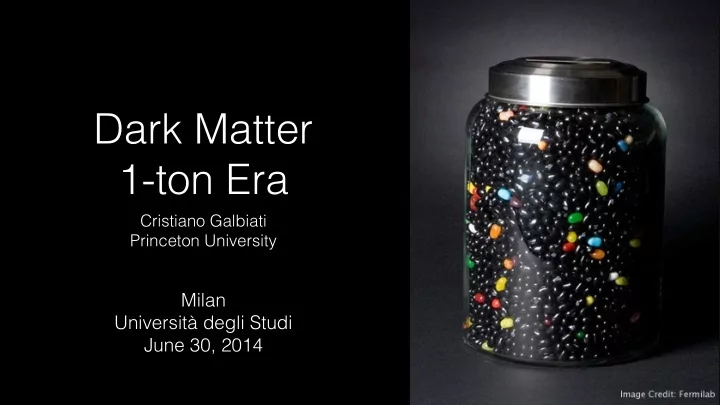
Like the jelly beans in this jar, the Universe is mostly dark: 96 percent consists of dark energy (about 70%) and dark matter (about 26%). Only about four percent (the same proportion as the lightly colored jelly beans) of the Universe - including the stars, planets and us - is made