
SLIDE 1
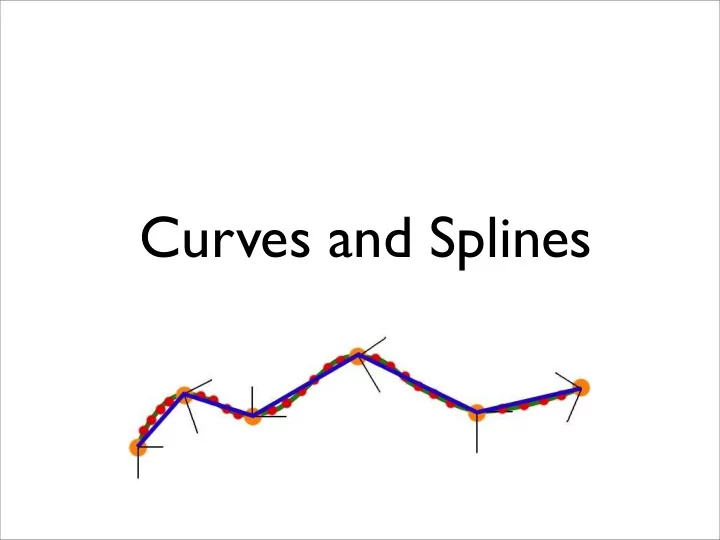
Curves and Splines Outline Hermite Splines Catmull-Rom Splines - - PowerPoint PPT Presentation
Curves and Splines Outline Hermite Splines Catmull-Rom Splines Bezier Curves Higher Continuity: Natural and B-Splines Drawing Splines Modeling Complex Shapes We want to build models of very complicated objects An
3
equation for a telephone, or a face?
using simple pieces
– polygons, parametric curves and surfaces, or implicit curves and surfaces – This lecture: parametric curves
4
modify)
5
– Easy to generate points – Must be a function: big limitation—vertical lines?
b mx y + =
x y
6
– Easy to generate points – Must be a function: big limitation—vertical lines?
b mx y + =
x y
+Easy to test if on the curve –Hard to generate points
2 2 2
= ! + r y x
x y
7
+ Easy to generate points – Must be a function: big limitation—vertical lines?
b mx y + =
x y
+Easy to test if on the curve –Hard to generate points
2 2 2
= ! + r y x
x y
+Easy to generate points
) sin , (cos ) , ( u u y x =
u=0 u=" " " "/2 u= " " " "
8
you along a given curve in xyz space.
given curve. Slow, fast, speed continuous or discontinuous, clockwise (CW) or CCW…
9
– called Lagrange Interpolation – result is a curve that is too wiggly, change to any control point affects entire curve (nonlocal) – this method is poor
– minimize the wiggles – high-degree polynomials are bad
Chalkboard
10
polynomials are used to interpolate (pass through) the control points
– piecewise definition gives local control
11
Continuous in position Continuous in position and tangent vector Continuous in position, tangent, and curvature
12
– Hermite Splines – Catmull-Rom Splines – Bezier Splines – Natural Cubic Splines – B-Splines – NURBS
7
That is, we want a way to specify the end points and the slope at the end points!
Po P1 P2
13
14
control matrix (what the user gets to pick) basis point that gets drawn
[ ]
! ! ! ! " # $ $ $ $ % & ! ! ! ! ! ! " # $ $ $ $ % & " " " " =
2 1 2 1 2 3
1 1 1 2 3 3 1 1 2 2 1 ) ( p p p p u u u u p
– basis matrix and meaning of control matrix change with the spline type
15
control matrix (what the user gets to pick) basis point that gets drawn
[ ]
! ! ! ! " # $ $ $ $ % & ! ! ! ! ! ! " # $ $ $ $ % & " " " " =
2 1 2 1 2 3
1 1 1 2 3 3 1 1 2 2 1 ) ( p p p p u u u u p ! ! ! ! " # $ $ $ $ % & ! ! ! ! ! ! ! " # $ $ $ $ $ % & " + " + " + " =
2 1 2 1 2 3 2 3 2 3 2 3
2 3 2 1 3 2 ) ( p p p p u u u u u u u u u u p
4 Basis Functions T
16
Every cubic Hermite spline is a linear combination (blend)
! ! ! ! " # $ $ $ $ % & ! ! ! ! ! ! ! " # $ $ $ $ $ % & " + " + " + " =
2 1 2 1 2 3 2 3 2 3 2 3
2 3 2 1 3 2 ) ( p p p p u u u u u u u u u u p
4 Basis Functions
Four Basis Functions for Hermite splines
T u
17
– each piece is specified by a cubic Hermite curve – just specify the position and tangent at each “joint” – the pieces fit together with matched positions and first derivatives – gives C1 continuity
knots or knot points
8
tangent vectors
in C1 continuity.
Po P1 P2 tangent at pi = s(pi+1 - pi-1)
18
assignment)
consecutive tangents to be collinear, to get C1
in C1 continuity.
19
control vector CR basis
spline coefficients
[ ]
! ! ! ! " # $ $ $ $ % & ! ! ! ! " # $ $ $ $ % & ! ! ! ! ! ! ! =
4 3 2 1 2 3
1 2 3 3 2 2 2 1 ) ( p p p p s s s s s s s s s s u u u u p
20
[ ] [
]
! ! ! ! " # $ $ $ $ % & ! ! ! ! " # $ $ $ $ % & ! ! ! ! ! ! ! =
4 4 4 3 3 3 2 2 2 1 1 1 2 3
1 2 3 3 2 2 2 1 z y x z y x z y x z y x s s s s s s s s s s u u u z y x
control vector CR basis
spline coefficients
9
tangent vectors
in C1 continuity.
10
control vector CR basis
[ ]
! ! ! ! " # $ $ $ $ % & ! ! ! ! " # $ $ $ $ % & ! ! ! ! ! ! ! =
4 3 2 1 2 3
1 2 3 3 2 2 2 1 ) ( p p p p s s s s s s s s s s u u u u p
11
– x(u) = axu3+bxu2+cxu+dx – y(u) = ayu3+byu2+cyu+dy – z(u) = azu3+bzu2+czu+dz
[ ] [
]
! ! ! ! " # $ $ $ $ % & =
z y x z y x z y x z y x
d d d c c c b b b a a a u u u u z u y u x 1 ) ( ) ( ) (
2 3
12
[ ] [
]
! ! ! ! " # $ $ $ $ % & ! ! ! ! " # $ $ $ $ % & ! ! ! ! ! ! ! =
4 4 4 3 3 3 2 2 2 1 1 1 2 3
1 2 3 3 2 2 2 1 ) ( ) ( ) ( z y x z y x z y x z y x s s s s s s s s s s u u u u z u y u x
control vector CR basis
13
– points P0 and P3 are on the curve: P(u=0) = P0, P(u=1) = P3 – points P1 and P2 are off the curve – P'(u=0) = 3(P1-P0), P'(u=1) = 3(P3 – P2)
– curve contained within convex hull of control points
14
[ ] [
]
! ! ! ! " # $ $ $ $ % & ! ! ! ! " # $ $ $ $ % & ! ! ! ! =
4 4 4 3 3 3 2 2 2 1 1 1 2 3
1 3 3 3 6 3 1 3 3 1 1 z y x z y x z y x z y x u u u z y x
Bezier basis Bezier control vector
15
Also known as the order 4, degree 3 Bernstein polynomials Nonnegative, sum to 1 The entire curve lies inside the polyhedron bounded by the control points
16
Continuous in position Continuous in position and tangent vector Continuous in position, tangent, and curvature
17
– Use higher degree polynomials degree 4 = quartic, degree 5 = quintic, … but these get computationally expensive, and sometimes wiggly – Give up local control natural cubic splines A change to any control point affects the entire curve – Give up interpolation cubic B-splines Curve goes near, but not through, the control points
18
Type Local Control Continuity Interpolation Hermite YES C1 YES Bezier YES C1 YES Catmull-Rom YES C1 YES Natural NO C2 YES B-Splines YES C2 NO
– Can’t get C2, interpolation and local control with cubics
19
resulting curves are called natural cubic splines
code.)
(solve tridiagonal linear system)
20
– the curve passes near the control points – best generated with interactive placement (because it’s
hard to guess where the curve will go)
compensation for loss of interpolation
21
pieces
! ! ! ! " # $ $ $ $ % & = ! ! ! ! " # $ $ $ $ % & ! ! ! ! =
! ! ! i i i i Bs Bs
P P P P G M
i
1 2 3
1 4 1 3 3 3 6 3 1 3 3 1 6 1
22
– Calculate the coefficients – For each cubic segment, vary u from 0 to 1 (fixed step size) – Plug in u value, matrix multiply to compute position on curve – Draw line segment from last position to current position
[ ] [
]
! ! ! ! " # $ $ $ $ % & ! ! ! ! " # $ $ $ $ % & ! ! ! ! ! ! ! =
4 4 4 3 3 3 2 2 2 1 1 1 2 3
1 2 3 3 2 2 2 1 z y x z y x z y x z y x s s s s s s s s s s u u u z y x
control vector CR basis
23
–Draws in even steps of u –Even steps of u ! ! ! ! even steps of x –Line length will vary over the curve –Want to bound line length
»too long: curve looks jagged »too short: curve is slow to draw
24
Subdivide(u0,u1,maxlinelength) umid = (u0 + u1)/2 x0 = P(u0) x1 = P(u1) if |x1 - x0| > maxlinelength Subdivide(u0,umid,maxlinelength) Subdivide(umid,u1,maxlinelength) else drawline(x0,x1)
– replace condition in “if” statement with straightness criterion – draws fewer lines in flatter regions of the curve
25
– piecewise cubic is generally sufficient – define conditions on the curves and their continuity
– basic curve properties (what are the conditions, controls, and properties for each spline type) – generic matrix formula for uniform cubic splines x(u) = uBG – given definition derive a basis matrix