Curriculum on Communications L2/B: Organizing Your Thoughts - - PowerPoint PPT Presentation

curriculum on
SMART_READER_LITE
LIVE PREVIEW

Curriculum on Communications L2/B: Organizing Your Thoughts - - PowerPoint PPT Presentation

California Cadet Corps Curriculum on Communications L2/B: Organizing Your Thoughts Organizing Your Thoughts Agenda B1. Public Speaking B2. Oral Presentation B3. Effective Writing B4. Creative Writing PUBLIC SPEAKING B1.


slide-1
SLIDE 1

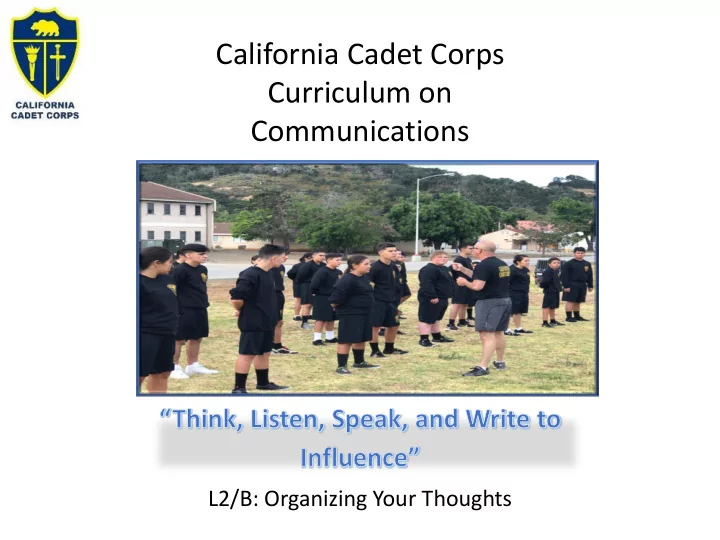
California Cadet Corps Curriculum on Communications

L2/B: Organizing Your Thoughts
slide-2
SLIDE 2

Organizing Your Thoughts Agenda

  • B1. Public Speaking
  • B2. Oral Presentation
  • B3. Effective Writing
  • B4. Creative Writing
slide-3
SLIDE 3

PUBLIC SPEAKING

  • B1. Understand the golden rules of public speaking
slide-4
SLIDE 4

Organizing Your Thoughts

Objectives

90% of Unit Cadets are able to prepare an oral presentation and are able to write effectively. 1. Understand the golden rules of public speaking 2. Know how to prepare an oral presentation 3. Know the components of effective writing 4. Define creative writing

Essential Question: What should be done in order to give a good public speech?

slide-5
SLIDE 5

Public Speaking

  • Five Golden Rules:

–Research the audience –Be prepared –Stay calm –Become a public speaking pro –Look for the lighthouses

slide-6
SLIDE 6

Research the audience

  • Learn about your audience
  • Understand your setting
  • Design your speech to your

audience’s level

slide-7
SLIDE 7

Be Prepared

  • Research your topic &

prepare

  • Practice, practice, practice
  • The more you prepare, the

better you’ll do

slide-8
SLIDE 8

Stay Calm

  • Relax!
  • Use calming techniques
  • Be comfortable with your

preparation

slide-9
SLIDE 9

Become a Public Speaking Pro

  • Practice as much as possible
  • Seek out public speaking
  • pportunities
  • Exercise and grow your skills
slide-10
SLIDE 10

Look for lighthouses

  • Lighthouses – people in your audience

who are:

– Engaged – Focused – Involved

  • Look for them & speak to them, they

will give you the energy you need to be confident!

slide-11
SLIDE 11

Check on learning

  • 1. Why research the audience?
  • 2. T/F? You should wait until the day of your

speech to practice.

  • 3. Relaxation techniques, like breathing

exercises, can help you stay _____.

  • 4. Why seek out public speaking opportunities?
  • 5. When giving a speech, who are “lighthouses”

in your audience?

slide-12
SLIDE 12

ORAL PRESENTATION

  • B2. Know how to prepare an oral presentation.
slide-13
SLIDE 13

Organizing Your Thoughts

Objectives

90% of Unit Cadets are able to prepare an oral presentation and are able to write effectively. 1. Understand the golden rules of public speaking 2. Know how to prepare an oral presentation 3. Know the components of effective writing 4. Define creative writing

Essential Question: Prepare an outline for an oral presentation.

slide-14
SLIDE 14

Oral Presentation Components

Introduction

  • Hook
  • Thesis
  • Forecast
  • Relation

Statement Body

  • Main

points

  • Facts

/support/arg uments Conclusion

  • Recap
  • Hook

Transition Transition

slide-15
SLIDE 15

Introduction

  • Hook: short, popping statement to

capture attention

  • Thesis: statement sentence, topic
  • Forecast: highlighting specific points

that will be covered in the body

  • Relation: statement or two that

shows audience how topic relates to them

slide-16
SLIDE 16

Transitions

Introduction

Transition: word or short phrase that tells the audience you’re moving on

Body

slide-17
SLIDE 17

Body

1.First point or main argument a.Signpost 2.Second point or supporting argument/fact a.Signpost 3.Third point or supporting argument/fact a.Transition

slide-18
SLIDE 18

Signposts

Body

First point/ main argument

Body

Sign post: word or short phrase between points

Body

Second point/ supporting argument

slide-19
SLIDE 19

Conclusion

  • Recap
  • Revisit your most important

points

  • Not the same as your forecast
  • What you want your audience

to maintain

  • Hook
  • Different than the one you

began with

slide-20
SLIDE 20

Leadership Application

  • Drill commands
  • Preparatory command (intro)
  • Command of execution (body)
  • Movement (conclusion)
  • Teach classes
  • Intro
  • Lesson (body)
  • Check on knowledge (conclusion)
  • Execute commands from superiors
  • Instruct task (intro)
  • Ensure understanding (body)
  • Supervise accomplishment (conclusion)
slide-21
SLIDE 21

Speech Outline Template

Intro 1) Hook – short, pop, shocking, related to the thesis 2) Thesis – tell the audience what the speech will be about 3) Forecast – highlight specific points that will be covered in the body 4) Relation – a statement or two that shows audience how the topic relates to them Transition – brief moving forward statement Body Point 1 – First point or main argument SP (signpost) – between points (ex. “And now…”) Point 2 – Second point or supporting argument/fact SP – (ex. “My last point will be…”) Point 3 – Third point or supporting argument/fact Transition – to end (ex. “Now that you know about ___________, let’s wrap this up”) Conclusion Recap – highlight most important points from speech Hook – different one. Short, brief, memorable

slide-22
SLIDE 22

Speech Outline Practicum

Create a simple

  • utline for a

speech about why it’s good to be a member of the Cadet Corps.

slide-23
SLIDE 23

Check on Learning

  • 1. The four parts of an Intro to a speech are:

a. b. c. d.

  • 2. The Body of a speech should have at least a

main point/argument and at least how many supporting arguments/facts?

  • 3. What should the Conclusion in a speech

include?

slide-24
SLIDE 24

EFFECTIVE WRITING

  • B3. Know the components of effective writing
slide-25
SLIDE 25

Organizing Your Thoughts

Objectives

90% of Unit Cadets are able to prepare an oral presentation and are able to write effectively. 1. Understand the golden rules of public speaking 2. Know how to prepare an oral presentation 3. Know the components of effective writing 4. Define creative writing

Essential Question: What are the four major components of an essay?

slide-26
SLIDE 26

Written Communication

  • Interlocked with modern

communication

  • Everyday life
  • Billboards
  • Email
  • Texting
  • Very important
  • Street signs
  • Resumes/Applications
slide-27
SLIDE 27

Electronic Communication

  • Texting

– Communication develops alongside technology – Simple & stream-lined – Always use proper courtesies – Same professionalism as in person

  • E-mail

– Should be similar to a letter – Can attach pertinent forms, documents, pictures – Clear documentation of communication – Clearly identify sender

slide-28
SLIDE 28

Social Media

  • Friends & funny videos but…
  • Maintain professional behavior
  • Posts are public information
  • Integrity!
slide-29
SLIDE 29

Letters

  • Technology = less letters
  • Still important
  • Generally 5 parts: greeting, intro, body,

conclusion, and signature

  • Templates in CR 1, Appendixes F-1 & F-2
slide-30
SLIDE 30

Essay Writing

  • Significant in school
  • Certain careers

– Research findings and analysis – Publishing work

  • 4 general components

– Thesis – Introduction – Body – Conclusion

slide-31
SLIDE 31

Motive & Idea

  • Evaluate the purpose of your essay
  • Research the topic
  • Search for adequate sources
  • Develop an original idea
slide-32
SLIDE 32

Thesis & Development

  • Thesis – a topic statement that holds

your essay together an binds your ideas

– Everything in your body and conclusion should serve to support your thesis

  • As you draft and edit, adapt your

thesis to ensure it maintains an accurate overview of your essay

slide-33
SLIDE 33

Tension & Structure

  • Tension – explanation of both sides
  • f the essay as an evaluation of the

claim, rather than a blatant ignorance of one side

  • Structure – the way that the essay is

arranged in order to properly accommodate the ideas presented

slide-34
SLIDE 34

Leadership Application

  • Warning Orders (WARNORDS)
  • Operations Plans (OPLANS)
  • Circulars
  • Memorandums
  • Regulations
slide-35
SLIDE 35

Check on Learning

  • 1. Name three forms of written communication.
  • 2. T/F? Electronic communication does not

require the same professionalism than an in- person interaction would.

  • 3. T/F? Social media reflects your personal

integrity.

  • 4. Name the 4 major components of an essay.
  • 5. Give an example of how written

communication is applied in leadership.

slide-36
SLIDE 36

CREATIVE WRITING

  • B4. Define creative writing
slide-37
SLIDE 37

Organizing Your Thoughts

Objectives

90% of Unit Cadets are able to prepare an oral presentation and are able to write effectively. 1. Understand the golden rules of public speaking 2. Know how to prepare an oral presentation 3. Know the components of effective writing 4. Define creative writing

Essential Question: What is creative writing?

slide-38
SLIDE 38

Creative Writing

  • Expression with the purpose of telling a

story

  • Fiction or non-fiction
  • Loose definition – usually a poem, movie,

play script, song, speech, personal essay, biography, or other expressive writing

  • In leadership, biographies and

autobiographies document the lives of great leaders in history

slide-39
SLIDE 39

Check on Learning

1. Describe in your own words what creative writing is. 2. Give an example of a type of creative writing.