John Squires, Rocky Mountain Research Station, Missoula, MT
Current Distribution, Status, and Threats of Canada Lynx in Montana - - PowerPoint PPT Presentation
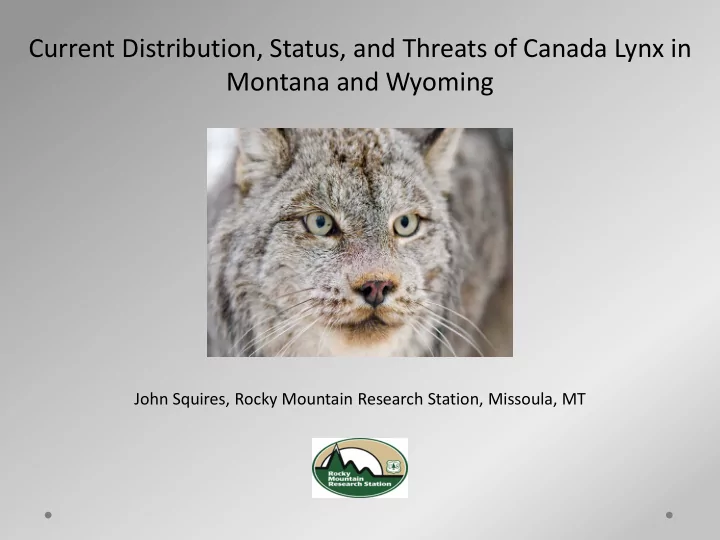
Current Distribution, Status, and Threats of Canada Lynx in Montana and Wyoming John Squires, Rocky Mountain Research Station, Missoula, MT Basis of Assessment - Montana: a) Lynx Research Program at RMRS initiated in 1998 b) Captured and
3
Basis of Assessment - Montana:
a) Lynx Research Program at RMRS initiated in 1998 b) Captured and collared 175 individuals c) Recorded 169,782 GPS and 3043 VHF locations that document lynx movements and resource- use d) Investigated the following topics regarding lynx in Montana:
4
Basis of Assessment:
- Resource selection
Squires, J. R, N. J. DeCesare, J. A. Kolbe, and L. F. Ruggiero. 2008. Hierarchical den selection of Canada lynx in western Montana. Journal of Wildlife Management 72:1497-1506. Squires, J. R., N. J. DeCesare, J. A. Kolbe, and L. F. Ruggiero. 2010. Seasonal Resource Selection of Canada Lynx in Managed Forests of the Northern Rocky Mountains. Journal of Wildlife Management 74:1648-1660.
- Prey Selection
Squires, J. R. and L. F. Ruggiero. 2007. Winter prey selection of Canada lynx in northwestern Montana. Journal of Wildlife Management 71:310- 315.
- Competition
Kolbe, J. A., J. R. Squires, D. H. Pletscher, and R. F. Ruggiero. 2007. The effect of snowmobile trails on coyote movements within lynx home
- ranges. Journal of Wildlife Management 71:1409-1418.
5
Basis of Assessment:
- Activity Patterns
Kolbe, J. A. and J. R. Squires. 2007. Circadian activity patterns of Canada lynx in western Montana. Journal of Wildlife Management 71:1607- 1611. Olson, L. E., J. R. Squires, N. J. DeCesare, J. A. Kolbe. 2011. Den use and activity patterns in female Canada lynx (Lynx canadensis) in the Northern Rocky Mountains. Northwest Science 85(3):455-462.
- Detection/Monitoring
Squires, J. R., K. S. McKelvey, L. F. Ruggiero. 2004. A snow-tracking protocol used to delineate local lynx, Lynx canadensis, distributions. Canadian Field-Naturalist 118:583-589. McKelvey, K. S., J. Von Kienast, K. B. Aubry, G. M. Koehler, B. T. Maletzke, J.
- R. Squires, E. L. Lindquist, S. Loch, M. K. Schwartz. 2006. DNA
analysis of hair and scat collected along snow tracks to document the presence of Canada lynx (Lynx canadensis). Wildlife Society Bulletin 34:451-455. Squires, J. R., L. E. Olson, D. L. Turner, N. J. DeCesare, and J. A. Kolbe. 2012. Estimating detection probability for Canada lynx using snow-track surveys in the Northern Rocky Mountains. Wildlife Biology 18:215- 224.
6
Basis of Assessment:
- Connectivity
Squires, J. R., Nicholas J. DeCesare, Lucretia E. Olson, Jay A. Kolbe, Mark Hebblewhite, and Sean A. Parks. 2013. Combining resource selection and movement behavior to predict corridors of Canada lynx at their southern range periphery. Biological Conservation 157:187–195.
7
Basis of Assessment - Wyoming:
a) Wyoming Game and Fish Department (WGF), in cooperation with the Shoshone National Forest (SNF), initiated lynx surveys during winter 1995/96
- no lynx detected on SNF
- Impetus for WGF to fund
additional surveys, trapping, and telemetry in the Wyoming Range b) During 1997-98, WGF searched approximately 2055 km
- f maintained snowmobile routes and 2400 km of non-
maintained trails for lynx tracks in 12 areas (Laurion and Oakleaf 1998) – 6 lynx tracks detected
8
Basis of Assessment - Wyoming:
c) During winter 1998-99, three general areas were
searched (Laurion and Oakleaf 1999) - 6 tracks located in Wyoming Range. d) RMRS, in cooperation with WGD, conducted lynx surveys in 2000, 2001, and 2002
- 2000 – Wyoming Range: 5 lynx tracks - kitten
and female
- 2001 – Wyoming Range: 5 lynx tracks
- 2002 – no detections
9
Basis of Assessment - Wyoming:
e) Yellowstone Park Lynx survey from 2001 – 2004 (1,143 km ski-
based snow tracks, 749 km snowmobile-based survey, 693 km aircraft survey, and 35 hair snare transects - 105-175 stations;
Murphy et al. 2006. Distribution of Canada Lynx in Yellowstone National Park. Northwest Science 80:199-206)
f) DNA confirmed detections of 3 lynx – 1 female, 1 female with male kitten, and 1 male. All detections on east side of Yellowstone Park – east shore Yellowstone Lake.
10
Basis of Assessment - Wyoming:
g) Endeavor Wildlife Research Foundation conducted track/DNA
surveys between 2004-2005 in southern GYA (Bridger-Teton
- Nat. Forest including Gros Ventre and Teton Wilderness areas) –
searched 4,320 miles and detected (DNA confirmed) 18 lynx
- tracks. Confirmed presence in Wyoming Range.
h) In 2008-2009, Endeavor Wildlife Research searched 2,854 miles for winter tracks throughout the GYA – documented 6 detections on Togwotee Pass, 2 possible detections in Yellowstone National Park, and 1 possible detection on the Beartooth Plateau.
11
Basis of Assessment – Wyoming (telemetry):
e) From 2006-2007, WGF collared 2 lynx (one male, 1 female) in
Wyoming Range – monitored throughout the year with conventional ground and aerial telemetry (1996 – 2001) – (N=219 locations – male, N = 212 - female) f) In 2000, female died. WGF asked RMRS to replace the collar on male with ARGOS (N = 258). Documented summer exploratory movements of male (1999 –2001) based on conventional and Argos telemetry (Squires and Oakleaf. 2005. Movements of a male Canada lynx crossing
the Greater Yellowstone Area, including highways. Northwest Science 79:196-201).
12
Status - Montana
13
Status - Montana
Litter size of lynx in western Montana, 1999 – 2007
Seeley Lake Purcell Mountains Combined Year Litters Kittens Kittens / litter Litters Kittens Kittens / litter Litters Kittens Kittens / litter 1999 2 4 2.00 2 4 2.00 2000 4 6 1.50 4 6 1.50 2001 3 8 2.67 3 8 2.67 2002 3 4 1.33 3 4 1.33 2003 5 14 2.80 5 14 2.80 2004 5 15 3.00 5 16 3.20 10 31 3.10 2005 5 12 2.40 6 19 3.17 11 31 2.82 2006 3 5 1.67 3 8 2.67 6 13 2.17 2007 3 7 2.33 8 22 2.75 11 29 2.64 MLE Mean 1 33 75 2.24 22 65 2.95 55 140 2.53 MLE Var 1 0.002 0.084 0.008 95% CI 2.21-2.27 2.67-3.23 2.51-2.55
14
Status - Montana
Proportion of successful adult Canada lynx
Seeley Lake (N=52 breeding-age females) Purcell Mountains (N=28) Combined (N = 80)
Year Females Females w kittens Prop Females Females w kittens Prop Females Females w kittens Prop 1999 4 2 0.50 4 2 0.50 2000 6 4 0.67 6 4 0.67 2001 9 3 0.33 9 3 0.33 2002 6 2 0.33 6 2 0.33 2003 5 3 0.60 5 3 0.60 2004 6 4 0.68 5 5 1.00 11 9 0.82 2005 6 5 0.83 7 7 1.00 13 12 0.92 2006 3 3 1.00 6 4 0.67 9 7 0.78 2007 3 3 1.00 10 7 0.70 13 10 0.77 MLE 1 Mean 0.61 0.83 0.67 MLE Var 1 0.01 0.01 0.02 95% CI 0.42-0.81 0.43-0.98 0.45-0.82
15
We estimated survival based on 125 lynx monitored monthly from 1999-2007 using a staggered entry design; we documented 2376 lynx-use months during this period.
16
Annual Survival Rate of female lynx on the Seeley Lake(1999-2007) and Purcell (2003-2007) Study Areas including a combined estimate.
Female Subadult Survival 1 Female Adult Survival 1
Seeley
Mean
0.515 0.747
Variance 0.014 0.003 95% CI 0.283 - 0.746 0.648 - 0.846
Purcells
Mean
0.683 0.846
Variance 0.017 0.004 95% CI 0.428 - 0.937 0.721 - 0.970
Combined
Mean
0.520 0.753
Variance 0.010 0.002 95% CI 0.322 - 0.718 0.659 - 0.847
17
Status - Montana
200 400 600 800 1000 1200 1400 1600 0.70 0.80 0.90 1.00 1.10 1.20 1.30 1.40 1.50 1.60 Lambda # of replicates Seeley Purcells Combined
Frequency distribution of λ values from 5000 replicates in which lynx vital rates were chosen from a uniform distribution bounded by their 95% confidence intervals
18
Status - Montana
200 400 600 800 1000 1200 1400 1600 0.70 0.80 0.90 1.00 1.10 1.20 1.30 1.40 1.50 1.60 Lambda # of replicates Seeley Purcells Combined
- Mean λ for Seeley Lake was 0.925 (95 % CI = 0.923 -
0.927) compared to 1.168 (95% CI = 1.165-1.171) in the Purcell Mountains
- Combined λ from both study areas was 0.973 (95% CI =
0.971-0.975)
19
Status - Montana
- Distribution in Montana remained generally
unchanged since the 2000 listing
- Understanding of distribution has been refined with
surveys conducted in Salish, Purcell, Seeley-Swan, Garnet and Bitterroot Mountains and northern GYA.
20
Status - Montana
21
Status - Montana
- Garnet Range has supported lynx populations since
the 1980s (research documented)
- It appears that lynx recently contracted from the
Garnet Range, Montana
22
Status - Montana
- RMRS surveyed 242 km of roads and trails for all
carnivores and an additional 220 km of lynx-only surveys in Garnets in 2002-03.
- Documented lynx (n = 37 detections ) in 4 of 12 pixels
searched . We detected 115 additional lynx tracks during lynx-only surveys that extended the spatial extent and intensity of our search.
23
Status - Montana
- In 2003, we expanded our effort and detected
lynx (n = 37) in Garnets in similar areas to those
- f 2002 in 4 of 16 pixels surveyed .
24
Survey pixels and snow-track survey routes were lynx were detected in the Garnet Range, Montana, 2002 and 2003.
25
All lynx tracks documented during snow-track surveys in the Garnet Range, Montana, winters 2002 and 2003.
26
27
Status - Montana
- In 2010, RMRS conducted follow-up surveys and
trapping in the Garnet Range.
- Captured only 2 males in the Garnets despite an
extensive trap effort - 1 individual was a recapture from 2007 and 1 new capture.
- In 2010, lynx restricted spatially in Garnet Range
28
Status - Montana
- Recent surveys (winter 2014-2015) that incorporated
track surveys and cameras failed to detect lynx in Garnet
29
Status - Montana
Purcell Mountains = 111 lynx Central = 187 Garnett = 22 Total = 320
30
Status - Montana
31
Status - Montana
- However, in lynx core-habitat near Seeley Lake, MT,
conservation land purchases increased protection across >100,000 acres of land.
33
Risk factors - Montana
Lynx use of burns by severity
1950
29, 777 a c re s
1960
17, 230 a c re s
1970
14, 112 a c re s
1980
307,310 a c re s
1990
143,123 a c re s
2000-2013
1,030,892 a c re s
40
Risk factors - Montana
- Lynx exhibit both positive and negative effects from
forest silviculture
- Habitat relationships vary dramatically across
contiguous US populations
Legend
= Open = Thin = Young Regenerating = Old Regenerating
= Mature Forest
Index of Connectivity (IC) of Mature Forest
1
IC = 0.09 IC = 0.48 IC = 0.81
Produce a Litter (Kosterman 2014) ?
Top Multivariate Model β SE 95% CI p-value Connectivity mature forest 4.560 1.5345 1.552, 7.568 0.003 Percent young forest 1.019 0.2614 0.507, 1.532 ≤0.001 Percent young forest2
- 0.029
0.0081 −0.045, −0.014 ≤0.001
Initial Litter Size
Top Multivariate Model: β SE 95% CI p-value Connectivity mature forest 0.959 0.3739 0.214, 1.705 0.013 Shape young forest −0.006 0.0011 −0.008, −0.003 ≤0.001
44
Status – Wyoming
- Documentation of lynx in GYA since early 1900’s
- Wyoming Range extending north to Togwotee Pass and east
side of Yellowstone Lake former range
45
46
47
Status – Wyoming
- 2010 surveys suggest the distribution of lynx in Wyoming
contracted since 1997-2005
- RMRS, in cooperation with WGF, attempted to capture lynx
but couldn’t locate “natives” only 2 individuals from Colorado
48
Status – Wyoming
49
Risk factors – Wyoming
- Fire impacts to Wyoming Range
- Habitat fragmentation of Wyoming Range
- Oil / gas development of lynx habitat in Wyoming Range
50
Status – Wyoming
51
Status – Wyoming
52
Issues and Conclusions
- Lynx in Montana and Wyoming (may be throughout the
continental US) persist as small populations consisting of relatively few individuals
- As such, have heightened risk to environmental and
demographic factors
53
Issues and Conclusions
- Lynx distribution in Montana is similar to 2000, but with
probably range contraction out of Garnet Range – cause of contraction unknown
- Small, relatively isolated populations may have persisted
for long periods (duration unknown) based on records and genetic sub-structuring – long-lived individuals (average = 8.6 years, many females > 10ys)
54
Issues and Conclusions
- In Wyoming, lynx had a record of occupancy and
distribution from 1997-2008 (??); documented since the turn of the century. Was the GYA a large enough “pool” for persistence?
- Limited data suggest that distribution in Wyoming
contracted or the population failed in approximately 2010
55
Issues and Conclusions
- Vital rates do not suggest cyclicity
How to rectify “waves,” observed vital rates, and fine-scale genetic substructuring?
56
Issues and Conclusions
- Increased fire intensity, frequency, and spatial extent in
northern montane forests is a “the” primary risk factor to lynx habitat in Montana and Wyoming
- Humility is warranted when discounting “small”
populations when challenged by environmental change
57
Current Research
- Remap of lynx habitat in Montana based on a revised RSF
based on new forest composition surface from remote sensing and other environmental covariates.
- Determining the trajectory of lynx habitat in Montana
relative to fire and forest management – MSU collaboration
- Formally evaluating how lynx respond to silvicultural
treatment by a retrospective analysis - management of patch-level mosaics
58
Current Research
- Evaluating how lynx and hares respond to fire across a
continuum of fire age and post-fire silvicultural treatment
- RMRS, in cooperation with the Bridger-Teton National
Forest and the National Carnivore program, is conducting a formalized survey of lynx in the GYA incorporating sight- mark recapture via cameras and winter backtracking. Genetics collected using 3 methods – on backtracks, snags
- n baited trees (at camera stations), and snow-level rub
pads.
Thank you
60