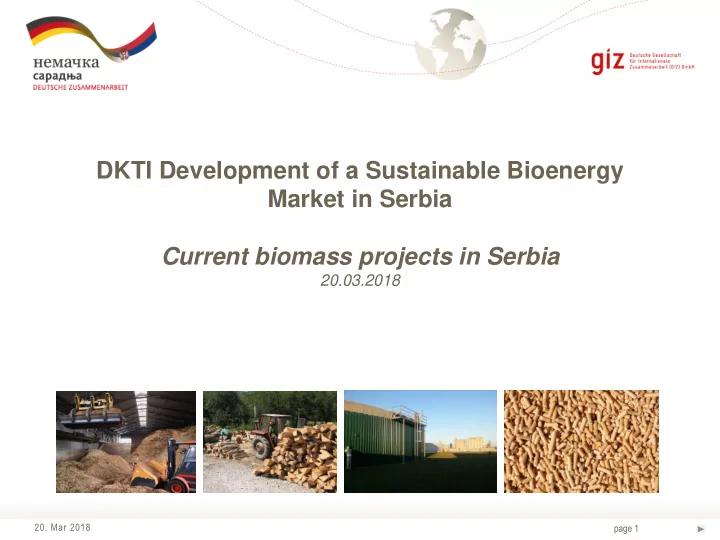
Current biomass projects in Serbia 20.03.2018 20. Mar 2018 page 1 - - PowerPoint PPT Presentation

current biomass projects in serbia
SMART_READER_LITE
LIVE PREVIEW

Current biomass projects in Serbia 20.03.2018 20. Mar 2018 page 1 - - PowerPoint PPT Presentation

DKTI Development of a Sustainable Bioenergy Market in Serbia Current biomass projects in Serbia 20.03.2018 20. Mar 2018 page 1 Facts about the GIZ DKTI programme Objective : To strengthen capacities and create an enabling environment for


slide-1
SLIDE 1

page 1

  • 20. Mar 2018

DKTI Development of a Sustainable Bioenergy Market in Serbia Current biomass projects in Serbia

20.03.2018

slide-2
SLIDE 2

page 2

  • 20. Mar 2018

Facts about the GIZ DKTI programme

Objective: To strengthen capacities and create an enabling environment for sustainable use of bioenergy in Serbia Funded by: German Federal Ministry for Economic Cooperation and Development (BMZ) under the German Climate Technology Initiative (DKTI) In Cooperation with: Public Investment Management Office Ministry of Agriculture, Forestry and Water Management Ministry of Mining and Energy Ministry of Environmental Protection Duration: January 2018 – December 2020 (2nd phase) (1st phase from 2013 till 2017)

Rainer Schellhaas

slide-3
SLIDE 3

page 3

  • 20. Mar 2018

Policy advice Project development Biomass supply KfW:

Advise to investments in district heating companies.

GIZ:

Support to the creation of a sustainable supply with bio- resources

Structure of the programme:

GIZ:

Support to harmonization of laws and regulations to EU standards Support to policy definition and strategy implementation

GIZ:

Advise to the implementation

  • f cost efficient

and innovative bioenergy projects Technology and knowlege transfer

Cross-cutting theme: Sustainability

   

KeepWarm GIZ:

Improvement of efficiency in district heating systems co-financed by EU under Horizon 2020 programme

Rainer Schellhaas

slide-4
SLIDE 4

page 4

  • 20. Mar 2018
  • Supporting political partners in realization of additional biomass

utilization projects as best practice examples

  • Building capacities to implement bioenergy projects at different

levels from implementing institutions to operators

  • Developing sustainable biomass utilization concepts customized

to the Serbian context, like BLTCs, utilization of roadside vegetation, wood processing residues etc.

  • Environmental aspects (reduction of emissions and ground water

pollution)

  • Rural economic development by creation of new local jobs along the

supply chains, in the biogas sector and supporting services

  • Macroeconomic effects on local income and trade balance

GIZ contribution to the development of the bioenergy market in Serbia in the medium term

Rainer Schellhaas

slide-5
SLIDE 5

page 5

  • 20. Mar 2018

Rainer Schellhaas

for district heating companies (DHC) to switch from fossil fuel to biomass

  • 18 active municipalities
  • first projects are going into realization in 2019
  • combined heat and power projects and heat only boilers
  • financed by KfW, commercial banks or private/PPP
  • utilisation of woody and agricultural biomass
  • Public Investment Management Office is requesting support for

additional DHCs

  • KfW offers 2nd tranche of credit for additional 15-20 DHCs
  • negotiations ongoing
  • additional pre-feasibility studies are planned

Development of sustainable supply chains

slide-6
SLIDE 6

page 6

  • 20. Mar 2018

Developing sustainable supply chains

location and development status

  • f DHCs to switch to biomass

start of construction in 2018/19?

KfW financed Valjevo, Mali Zvornik, Bajina Bašta, Priboj, Prijepolje, Nova Varoš, Novi Pazar, Majdanpek, Kladovo

start of construction in 2019

commercial credit or PPP Kruševac, Boljevac

start of construction in 2019

commercial credit, state fund or PPP Šabac, Knjaževac , Bor, Mionica, Svilajnac, Medvedja, Prokuplje, Smederevo

next potential DHCs

Vranje, Pirot, Gornji Milanovac, Senta

Rainer Schellhaas

slide-7
SLIDE 7

page 7

  • 20. Mar 2018

Rainer Schellhaas

for municipalities, schools and hospitals, partly with local heat network

  • 35 active municipalities
  • first projects are going into realization in 2018
  • most cases wood chip boilers
  • financed by state funds
  • Technical concepts published
  • ESCO-PPP-project realized

Fuel switch in public buildings

slide-8
SLIDE 8

page 8

  • 20. Mar 2018

Fuel switch in public buildings

location and development status

financed by state funds

start of construction in 2018

Priboj, Svilajnac, Despotovac, Mali Zvornik, Mionica, Arilje, Prijepolje, Nova Varos, Sokobanja

start of construction in 2019

Osečina, Pirot, Kosjeric, Losnica, Smederevo, Aleksinac, Senta, Valjevo, Surdulica, Vranje, Gornji Milanovac

start of construction in 2020

Lajkovac, Vrbas, Sremska Kamenica, Žagubina, Jagodina, Čačak, Vršac, Razanj, Velika Plana, Petrovac na Mlavi ….

Rainer Schellhaas

slide-9
SLIDE 9

page 9

  • 20. Mar 2018

Rainer Schellhaas

for farmers and cooperatives

  • 8 projects
  • 5 projects are realized
  • 3 in planning phase
  • Technical concepts published
  • support of Serbian Biogas association

Development of biogas projects

slide-10
SLIDE 10

page 10

  • 20. Mar 2018

Biogas projects

location and development status

financed by commercial banks

in operation

Sombor, Žabalj, Čestereg, Potaje, Aleksinac

start of operation 2019

Verušić, Selenča, Botoš (extension and heat usage),

Rainer Schellhaas

slide-11
SLIDE 11

page 11

  • 20. Mar 2018

Rainer Schellhaas

Further considerations

  • expected investments in the bioenergy arena is huge
  • up to 50 million EUR for biomass supply
  • up to 140 million EUR for district heating systems
  • 80-100 million EUR for biomass heating systems in public buildings
  • up to 80 million EUR for biogas plants
  • domestic mazut production will stop this year (July 2018)
  • restrictions following the EU directive on medium sized combustion

plant will hit most of industrial boiler, requiring desulphurization, DeNOx and dedusting equipment

slide-12
SLIDE 12

page 12

  • 20. Mar 2018

Rainer Schellhaas

well then, easy going ….. ?

slide-13
SLIDE 13

page 13

  • 20. Mar 2018

Rainer Schellhaas

How to proceed?

  • technical documentation for 9 DHCs in preparation
  • Europe-wide tender starting end of 2018
  • technical documentation for (some) public buildings available
  • technical concepts for local heat networks available
  • e.g. see GIZ website
  • an example …
slide-14
SLIDE 14

page 14

  • 20. Mar 2018

Implemented by:

Concept of the fuel switch to biomass in Mionica including economical evaluation and recommendations for district heating grid

slide-15
SLIDE 15

page 15

  • 20. Mar 2018

Implemented by:

Task of the study

Assignment of the study is to establish:

  • Technical concept for fuel switch to biomass heating for public buildings,

Phase I

  • Designing the system for future connection of residential buildings,

Phase II

  • Installation of a wood chip heating plant
  • Installation of distribution system including grid and substations
  • Reduction of CO2 emissions
slide-16
SLIDE 16

page 16

  • 20. Mar 2018

Implemented by:

Evaluation of current situation

Public buildings

  • Public buildings and buildings with public institutions of Mionica are

located around the town at a great distance.

  • Technical parameters of public buildings are:
  • heated area 13,426 m2
  • capacity 1,931 kW
slide-17
SLIDE 17

page 17

  • 20. Mar 2018

Implemented by:

Evaluation of current situation

Residential buildings

  • By type in Mionica there are residential buildings:
  • with more apartments
  • family houses
  • Reserve provided for residential buildings are:
  • heated area 12,917 m2
  • capacity 1,615 kW
slide-18
SLIDE 18

page 18

  • 20. Mar 2018

Implemented by:

Evaluation of current situation

Existing heating systems

Existing heating systems Crude oil boilers Coal boilers Electric boilers Local electric heaters

Public buildings Public and residential Public and residential Public and residential

slide-19
SLIDE 19

page 19

  • 20. Mar 2018

Implemented by:

Technical design concept

Heating plant - capacity

  • New heating plant contain biomass boiler assisted by the existing

boilers with fuel oil during periods of high consumption. This would reduce the investment costs

  • The existing boilers and their installation would be relocate from main

municipality building. The existing boilers with fuel oil have a power of 750 and 900 kW

Phase Biomass Oil Oil (kW) (kW) (kW) (kW) (kW) I 2.217 60% 1.400 750 900 3.050 I+II 4.071 60% 2.500 750 900 4.150 Calculate Heating Plant capacity participation biomass boiler Heating Plant capacity Capacity of boiler

slide-20
SLIDE 20

page 20

  • 20. Mar 2018

Implemented by:

Technical design concept

Heating plant - location

Location intended for the construction of new power plant located on cadastral plot 115/1 KO town Mionica, surface 1,950m2. The location is in the central town area and an existing access road.

slide-21
SLIDE 21

page 21

  • 20. Mar 2018

Implemented by:

Technical design concept

District heating network

  • Heating network is designed to connect
  • bjects in first and second phase, and to

enable the connection of new users. Since new users will later be added, pipe network is designed for larger capacity than needed in phase I and II

  • The network of pipes consists of pre-

insulated steel pipes that direct the flow at pre-prepared soil

  • Temperature regime of heating network is

110/70oC

slide-22
SLIDE 22

page 22

  • 20. Mar 2018

Implemented by:

Technical design concept

Heat substations

  • District heating transfer stations provide the link

between district heating suppliers and customers’ systems

  • Substations are designed for installation in areas

which are currently housing boiler rooms

  • The operating pressure in the primary part of the

substation will amount to a maximum of 6 bar and will correspond to the parameters of the heating network, while the temperature range will be 110/70℃ in the primary part and 80/60℃ in the secondary part

Danfoss substations

slide-23
SLIDE 23

page 23

  • 20. Mar 2018

Implemented by:

Preliminary investment analysis

Three scenarios In order to find the best solutions and determine the viability of the investment, the preliminary cost analysis consists of three scenarios: Scenario 1; Scenario is conditioned by the assumption that there is a heating grid on which the related facilities of public administration of the municipality Mionica are connected to. Scenario 2; Scenario includes the construction of the heating grid that would be dimensioned only for public administration of the municipality Mionica (Phase I). Scenario 3; This scenario includes the construction of the heating grid that would have been dimensioned for connection of public administration

  • f the municipality Mionica and subsequent connection of residential and

commercial buildings (Phase I + II).

slide-24
SLIDE 24

page 24

  • 20. Mar 2018

Implemented by:

Preliminary investment analysis

Preliminary cost investment by scenarios Investment expenses would include the purchase of equipment and boilers, necessary civil works, mechanical works and electrical works on the construction of a new boiler, the heating grid, the relocation of the existing boiler with fuel oil, and connecting objects to a new distribution system. Investment costs by scenario (€) 1. SCENARIO 1 285.000 2. SCENARIO 2 725.400 3. SCENARIO 3 905.400

slide-25
SLIDE 25

page 25

  • 20. Mar 2018

Implemented by:

Preliminary financial analysis

  • Cost estimate is for the period of 20 years
  • Annual costs include costs for biomass, heavy fuel oil, ashes, electricity,

water, labor costs, maintenance, insurance, depreciation

  • Scenario 3 is different from the scenarios 1 and 2, due to the larger heating

capacity which users of district heating systems have

  • It is expected that the connection of facilities in Phase II (residential

buildings) will be achieved in a period of 7 years. In the first year since of project it is not expected to join any object. It is expected that the largest number of buildings is connected in the fourth and fifth year of the commencement of work

slide-26
SLIDE 26

page 26

  • 20. Mar 2018

Implemented by:

Preliminary financial analysis

Overview of investments and costs according to the scenario

Existing systems New biomass system a b c d=(b-c) e d+e-a Scenario 1 285.000 1.421.360 957.336 672.336 Scenario 2 725.400 1.969.735 408.962

  • 316.438

Scenario 3 905.400 2.955.617

  • 576.921

1.547.741 65.420 Investnent Total operating and fuel costs for 2.378.696 Saving Earnings from Phase II Total For period of 20 years

slide-27
SLIDE 27

page 27

  • 20. Mar 2018

Implemented by:

Preliminary financial analysis

  • Within the scenario 3, financial benefits are savings from replacing the

existing fuel and sales of thermal energy to future users

  • After the construction of the distribution of heating systems,

assumption is that the price of heating unit will remain the same as the current price for a residential area that is heated by coal furnace

  • Scenario 3 assumes that in the period of 7 years all objects from the

phase II will be connected, which would create additional financial income

  • The advantage of this scenario is that the municipality formed a

sustainable infrastructure system for district heating, which increases the quality of life and a creates a positive effect on the environment.

(€/m2a) Coal Heavy fuel Resident space 7,24 9,96 Buisniess space 10,85 16,42

slide-28
SLIDE 28

page 28

  • 20. Mar 2018

Implemented by:

Project evaluation

  • Based on the analysis of three proposed scenarios, the construction of

a biomass boiler and district heating system would be justified under the condition that with the connection of public facilities make the connection

  • f a large number of residential and commercial buildings possible in the

shortest time frame.

SCENARIO 3 - Unit cost heat energy

Unit Value The investment value - Capex € 905.400 Annual production of heat energy (first year of operation) MWh / a 1.931 Total heat production (20 years) MWh 75.365 The operation value (20 years) - Opex € 2.955.617 LUC - Levelized Unit Costs € / MWh 51,2

slide-29
SLIDE 29

page 29

  • 20. Mar 2018

Implemented by:

Conclusion

  • Scenario 1: This scenario assumes that there is heating grid only for

public buildings (Phase 1). Scenario 1 shows that the switch fuel to biomass generate financial savings

  • Scenario 2: This scenario considers the construction of the biomass

boiler and heating grid, only for public institutions of Mionica. Considering that public institutions are located in buildings spread throughout the town, the construction of a biomass boiler and pipe systems for district heating needs of public institutions is financially unsustainable because of the large investment costs

  • Scenario 3 with the construction of a biomass boiler and pipe

systems for district heating and dimensioned for future connection

  • f residential buildings, is the only viable solution to reduce the

costs of heating public institutions. This investment is the largest but the connection of new users has made additional financial profit that this system has made sustainable.

slide-30
SLIDE 30

page 30

  • 20. Mar 2018

Rainer Schellhaas

slide-31
SLIDE 31

page 31

  • 20. Mar 2018

Rainer Schellhaas

How to proceed?

  • technical documentation for 9 DHCs in preparation
  • Europe-wide tender starting end of 2018
  • technical documentation for (some) public buildings available
  • technical concepts for local heat networks available
  • e.g. see GIZ website
  • contacting TOPS (association of district heating companies in

Serbia)

  • contacting Serbian Biogas association
slide-32
SLIDE 32

page 32

  • 20. Mar 2018

As a public-benefit federal enterprise service provider with worldwide operations in the field of international cooperation for sustainable development, GIZ works together with its partners to develop effective and sustainable solutions. Publisher: Deutsche Gesellschaft für Internationale Zusammenarbeit (GIZ) GmbH Registered Offices: Bonn and Eschborn, Germany DKTI Programme – Development of a Sustainable Bioenergy Market in Serbia Bože Jankovića 39 11000 Belgrade Serbia Rainer Schellhaas Component Leader Biomass Supply rainer.schellhaas@giz.de www.bioenergy-serbia.rs

In Cooperation with

Public Investment Management Office Ministry of Agriculture, Forestry and Water Management Ministry of Mining and Energy Ministry of Environmental Protection