
SLIDE 1
Cultural Humility vs. Cultural Competence; Do You Know Me?
Developed and Facilitated by: Earl Greene, M.A., CAMS-1/Fellow Community Development Specialists Finger Lakes Prevention Resource Center Rochester, NY
Cultural Humility vs. Cultural Competence; Do You Know Me? - - PowerPoint PPT Presentation
Cultural Humility vs. Cultural Competence; Do You Know Me? Developed and Facilitated by: Earl Greene, M.A., CAMS-1/Fellow Community Development Specialists Finger Lakes Prevention Resource Center Rochester, NY Some Exercises in Self
Developed and Facilitated by: Earl Greene, M.A., CAMS-1/Fellow Community Development Specialists Finger Lakes Prevention Resource Center Rochester, NY
Identify your own cultural and family beliefs and values. Define your own personal culture/identity: ethnicity, age, experience, education, socio-economic status, gender, sexual orientation, religion… Are you aware of your personal biases and assumptions about people with different values than yours? Challenge yourself in identifying your own values as the “norm.” Describe a time when you became aware of being different from other people.
Culture refers to integrated patterns of human behavior that include the language, thoughts, communications, actions, customs, beliefs, values, and institutions of racial, ethnic, religious, or social groups. Cultural and Linguistic Competence is a set of congruent behaviors, attitudes, and policies that come together in a system, agency, or among professionals that enables effective work in cross-cultural situations. Competence implies having the capacity to function effectively as an individual and an organization within the context of the cultural beliefs, behaviors, and needs presented by consumers and their communities.
Resource: U.S. Department of Health and Human Services, Office of Minority Health (Adapted from Cross, 1989).
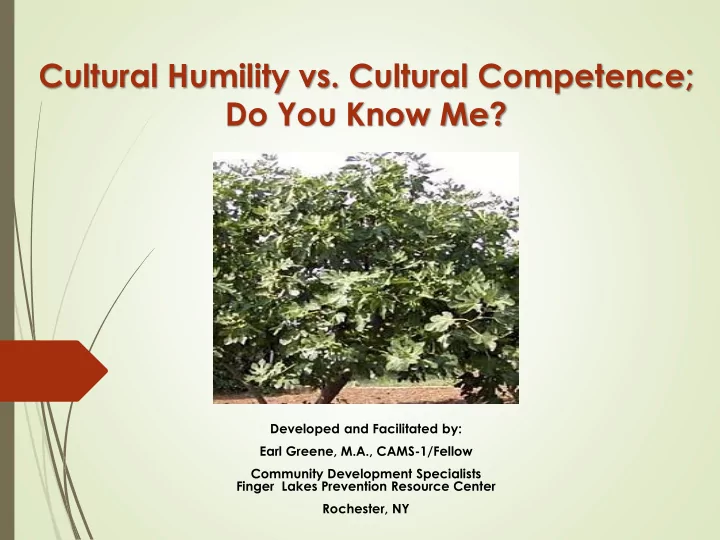
“Actually, the most important part of culture … Is that which is hidden and internal, but which governs the behavior encounter.” ---- Hall 1976 Consider the Fig Tree Fig trees blooms 3 seasons out of the year & Requires personal Interaction.
Coalitions need to be able to use their knowledge in a helping, culturally supportive manner. Unfortunately, how we respond is often a gray area of practice: what does it mean to “demonstrate competence in engaging and mobilizing our community? The SPF also asks us to engage with respect for individual
knowledge regarding different races, gender expression, age, and the like, in a way that meets the needs of the individual communities? Cultural competency begins with having knowledge of different cultures or aspects of social diversity. However, knowledge alone is not enough.
(Ortega & Coulborn Faller, 2011)
Geographic Location * Urban * Rural * Suburban * Non-Native * Language * Multilingual * Limited English Proficiency * Education * GED/High School Diploma * B.A./M.A./Prof. Degree * Student * Mentor * Profession * Homemaker * Environmentalist * Immigrant Status * Class * First Generation * Employment Status * Socioeconomic Status * Black * African American * Latino/a * Hispanic * Indigenous * Native American * First Nation * Asian * Pacific Islander * White * Multi-race * Multi-ethnic * Ethnicity * Nationality * Tribal Identity * Female * Male * Man * Woman * Genderqueer * Lesbian * Gay * Bisexual * Transgender * Queer * Heterosexual * Spouse * Single * OTHER * Unmarried * Widowed * Divorced * Married * Partner * Polyamorous * Personality Type * Introvert * Extrovert * Radical * Liberal * Conservative * Political Party * Indigenous Religion * Muslim * Christian * Catholic * Jewish * Buddhist * Polytheistic * Pagan * Agnostic * Atheist * Wiccan * Smoker * Vegan * Vegetarian * Age * Height * Weight * Body Type * Parent/Child Deceased * Matriarch * Patriarch * Mother * Father * Daughter * Son * Grandparent * Great-Grandparent * Sibling * Adopted * Foster * Step * Substance Abuse * Learning Disability * Physical Disability * Survivor/Surviving Illness * Social Challenge * Emotional Challenge * Mental Health Condition * Behavioral Challenge * Developmental Disability * Survivor/Surviving Abuse * Military * Veteran * Law Enforcement * Probationer * Parolee * Unapologetic