CSE 341 : Programming Languages Lets fix the fact that our only - - PowerPoint PPT Presentation

cse 341 programming languages
SMART_READER_LITE
LIVE PREVIEW

CSE 341 : Programming Languages Lets fix the fact that our only - - PowerPoint PPT Presentation

Useful examples CSE 341 : Programming Languages Lets fix the fact that our only example datatype so far was silly Lecture 5 Enumerations, including carrying other data More Datatypes and Pattern Matching datatype suit = Club |


slide-1
SLIDE 1

CSE 341 : Programming Languages

Lecture 5 More Datatypes and Pattern Matching Zach Tatlock Spring 2014 Useful examples

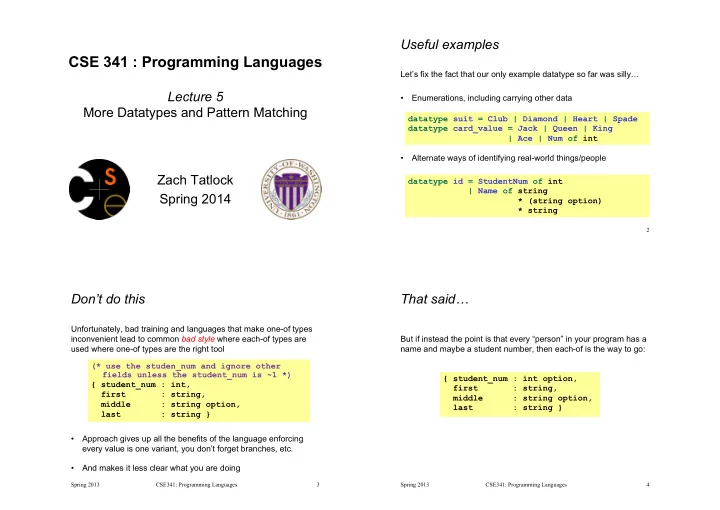
Let’s fix the fact that our only example datatype so far was silly…

  • Enumerations, including carrying other data
  • Alternate ways of identifying real-world things/people

2

datatype suit = Club | Diamond | Heart | Spade datatype card_value = Jack | Queen | King | Ace | Num of int datatype id = StudentNum of int | Name of string * (string option) * string

Don’t do this

Unfortunately, bad training and languages that make one-of types inconvenient lead to common bad style where each-of types are used where one-of types are the right tool

  • Approach gives up all the benefits of the language enforcing

every value is one variant, you don’t forget branches, etc.

  • And makes it less clear what you are doing

Spring 2013 3 CSE341: Programming Languages

(* use the studen_num and ignore other fields unless the student_num is ~1 *) { student_num : int, first : string, middle : string option, last : string }

That said…

But if instead the point is that every “person” in your program has a name and maybe a student number, then each-of is the way to go:

Spring 2013 4 CSE341: Programming Languages

{ student_num : int option, first : string, middle : string option, last : string }

slide-2
SLIDE 2

Expression Trees

A more exciting (?) example of a datatype, using self-reference An expression in ML of type exp: How to picture the resulting value in your head:

Spring 2013 5 CSE341: Programming Languages

datatype exp = Constant of int | Negate of exp | Add of exp * exp | Multiply of exp * exp Add (Constant (10+9), Negate (Constant 4)) Add Constant 19 Negate Constant 4

Recursion

Not surprising: Functions over recursive datatypes are usually recursive

Spring 2013 6 CSE341: Programming Languages

fun eval e = case e of Constant i => i | Negate e2 => ~ (eval e2) | Add(e1,e2) => (eval e1) + (eval e2) | Multiply(e1,e2) => (eval e1) * (eval e2)

Putting it together

Let’s define max_constant : exp -> int Good example of combining several topics as we program: – Case expressions – Local helper functions – Avoiding repeated recursion – Simpler solution by using library functions See the .sml file…

Spring 2013 7 CSE341: Programming Languages

datatype exp = Constant of int | Negate of exp | Add of exp * exp | Multiply of exp * exp

Careful definitions

When a language construct is “new and strange,” there is more reason to define the evaluation rules precisely… … so let’s review datatype bindings and case expressions “so far” – Extensions to come but won’t invalidate the “so far”

Spring 2013 8 CSE341: Programming Languages

slide-3
SLIDE 3

Datatype bindings

Adds type t and constructors Ci of type ti->t – Ci v is a value, i.e., the result “includes the tag” Omit “of t” for constructors that are just tags, no underlying data – Such a Ci is a value of type t Given an expression of type t, use case expressions to: – See which variant (tag) it has – Extract underlying data once you know which variant

Spring 2013 9 CSE341: Programming Languages

datatype t = C1 of t1 | C2 of t2 | … | Cn of tn

Datatype bindings

  • As usual, can use a case expressions anywhere an expression goes

– Does not need to be whole function body, but often is

  • Evaluate e to a value, call it v
  • If pi is the first pattern to match v, then result is evaluation of ei in

environment “extended by the match”

  • Pattern Ci(x1,…,xn) matches value Ci(v1,…,vn) and extends

the environment with x1 to v1 … xn to vn – For “no data” constructors, pattern Ci matches value Ci

Spring 2013 10 CSE341: Programming Languages

case e of p1 => e1 | p2 => e2 | … | pn => en

Recursive datatypes

Datatype bindings can describe recursive structures – Have seen arithmetic expressions – Now, linked lists:

Spring 2013 11 CSE341: Programming Languages

datatype my_int_list = Empty | Cons of int * my_int_list val x = Cons(4,Cons(23,Cons(2008,Empty))) fun append_my_list (xs,ys) = case xs of Empty => ys | Cons(x,xs’) => Cons(x, append_my_list(xs’,ys))

Options are datatypes

Options are just a predefined datatype binding – NONE and SOME are constructors, not just functions – So use pattern-matching not isSome and valOf

Spring 2013 12 CSE341: Programming Languages

fun inc_or_zero intoption = case intoption of NONE => 0 | SOME i => i+1

slide-4
SLIDE 4

Lists are datatypes

Do not use hd, tl, or null either – [] and :: are constructors too – (strange syntax, particularly infix)

Spring 2013 13 CSE341: Programming Languages

fun sum_list xs = case xs of [] => 0 | x::xs’ => x + sum_list xs’ fun append (xs,ys) = case xs of [] => ys | x::xs’ => x :: append(xs’,ys)

Why pattern-matching

  • Pattern-matching is better for options and lists for the same

reasons as for all datatypes – No missing cases, no exceptions for wrong variant, etc.

  • We just learned the other way first for pedagogy

– Do not use isSome, valOf, null, hd, tl on Homework 2

  • So why are null, tl, etc. predefined?

– For passing as arguments to other functions (next week) – Because sometimes they are convenient – But not a big deal: could define them yourself

Spring 2013 14 CSE341: Programming Languages

Excitement ahead…

Learn some deep truths about “what is really going on” – Using much more syntactic sugar than we realized

  • Every val-binding and function-binding uses pattern-matching
  • Every function in ML takes exactly one argument

First need to extend our definition of pattern-matching…

Spring 2013 15 CSE341: Programming Languages

Each-of types

So far have used pattern-matching for one of types because we needed a way to access the values Pattern matching also works for records and tuples: – The pattern (x1,…,xn) matches the tuple value (v1,…,vn) – The pattern {f1=x1, …, fn=xn} matches the record value {f1=v1, …, fn=vn} (and fields can be reordered)

Spring 2013 16 CSE341: Programming Languages

slide-5
SLIDE 5

Example

This is poor style, but based on what I told you so far, the only way to use patterns – Works but poor style to have one-branch cases

Spring 2013 17 CSE341: Programming Languages

fun sum_triple triple = case triple of (x, y, z) => x + y + z fun full_name r = case r of {first=x, middle=y, last=z} => x ^ " " ^ y ^ " " ^ z

Val-binding patterns

  • New feature: A val-binding can use a pattern, not just a variable

– (Turns out variables are just one kind of pattern, so we just told you a half-truth in Lecture 1)

  • Great for getting (all) pieces out of an each-of type

– Can also get only parts out (not shown here)

  • Usually poor style to put a constructor pattern in a val-binding

– Tests for the one variant and raises an exception if a different one is there (like hd, tl, and valOf)

Spring 2013 18 CSE341: Programming Languages

val p = e

Better example

This is okay style – Though we will improve it again next – Semantically identical to one-branch case expressions

Spring 2013 19 CSE341: Programming Languages

fun sum_triple triple = let val (x, y, z) = triple in x + y + z end fun full_name r = let val {first=x, middle=y, last=z} = r in x ^ " " ^ y ^ " " ^ z end

Function-argument patterns

A function argument can also be a pattern – Match against the argument in a function call Examples (great style!):

Spring 2013 20 CSE341: Programming Languages

fun f p = e fun sum_triple (x, y, z) = x + y + z fun full_name {first=x, middle=y, last=z} = x ^ " " ^ y ^ " " ^ z

slide-6
SLIDE 6

A new way to go

  • For Homework 2:

– Do not use the # character – Do not need to write down any explicit types

Spring 2013 21 CSE341: Programming Languages

Hmm

A function that takes one triple of type int*int*int and returns an int that is their sum:

Spring 2013 22 CSE341: Programming Languages

A function that takes three int arguments and returns an int that is their sum fun sum_triple (x, y, z) = x + y + z fun sum_triple (x, y, z) = x + y + z See the difference? (Me neither.) J

The truth about functions

  • In ML, every function takes exactly one argument (*)
  • What we call multi-argument functions are just functions taking
  • ne tuple argument, implemented with a tuple pattern in the

function binding – Elegant and flexible language design

  • Enables cute and useful things you cannot do in Java, e.g.,

* “Zero arguments” is the unit pattern () matching the unit value ()

Spring 2013 23 CSE341: Programming Languages

fun rotate_left (x, y, z) = (y, z, x) fun rotate_right t = rotate_left(rotate_left t)