CSE 311: Foundations of Computing Subset Construction Fall 2013 - - PowerPoint PPT Presentation

cse 311 foundations of computing subset construction
SMART_READER_LITE
LIVE PREVIEW

CSE 311: Foundations of Computing Subset Construction Fall 2013 - - PowerPoint PPT Presentation

CSE 311: Foundations of Computing Subset Construction Fall 2013 Subset construction: NFA to DFA Lecture 25: Non-regularity and limits of FSMs 0,1 0 a,b a 1 0 1 1 1 b c 0 b c 1 0 0 0


slide-1
SLIDE 1

CSE 311: Foundations of Computing

Fall 2013

Lecture 25: Non-regularity and limits of FSMs

Subset Construction

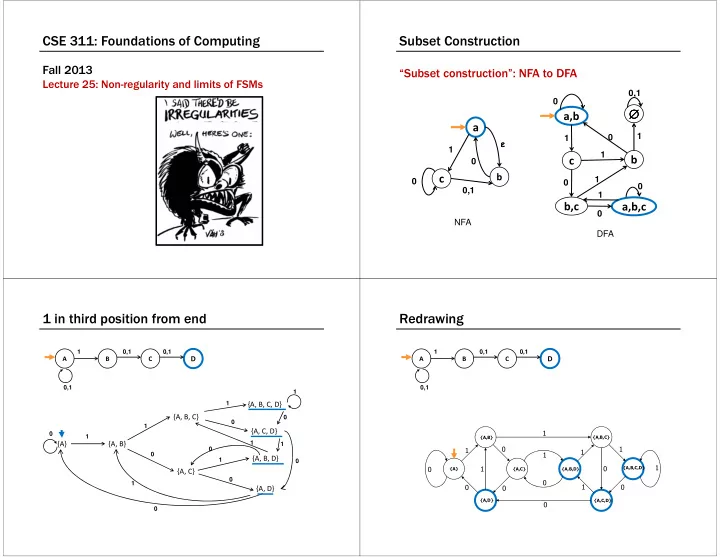
“Subset construction”: NFA to DFA c a

b

ɛ ɛ ɛ ɛ 0,1 1 NFA

a,b

DFA

c

1

b b,c

1

a,b,c ∅ ∅ ∅ ∅

1 0,1 1 1

1 in third position from end

A C

D

B

0,1 0,1 1 0,1

{A} {A, B} {A, B, C} {A, C} {A, B, C, D} {A, C, D} {A, B, D} {A, D}

1 1 1 1 1 1 1 1

Redrawing

{A,B} {A,B,C} {A,B,C,D} {A,C,D} {A,B,D} {A,C} {A} {A,D}

1 1 1 1 1 1 1 1 A C

D

B

0,1 0,1 1 0,1

slide-2
SLIDE 2

DFAs ≡ Regular expressions

We have shown how to build an optimal DFA for every regular expression

– Build NFA – Convert NFA to DFA using subset construction – Minimize resulting DFA

Theorem: A language is recognized by a DFA if and

  • nly if it has a regular expression

We show the other direction of the proof at the end

  • f these lecture slides

Languages and Machines!

All

Context-Free Regular Finite

{001, 10, 12} 0* DFA NFA Regex

Languages and Machines!

All

Context-Free Regular Finite

{001, 10, 12} 0* DFA NFA Regex Warmup: Warmup: Warmup: Warmup: All finite languages are regular.

DFAs Recognize Any Finite Language

slide-3
SLIDE 3

Languages and Machines!

All

Context-Free Regular Finite

{001, 10, 12} 0* DFA NFA Regex Warmup 2: Warmup 2: Warmup 2: Warmup 2: Surprising example here

An Interesting Infinite Regular Language

L = {x x x x∊ ∊ ∊ ∊ { { { {0, 1} } } }*

* * *:

: : : x x x x has an equal number of substrings 01 and 10}. L is infinite. L is regular.

Languages and Machines!

All

Context-Free Regular Finite

0* DFA NFA Regex ??? Main Event: Main Event: Main Event: Main Event: Prove there is a context-free language that isn’t regular. {001, 10, 12}

Irregular Language!

B = {binary palindromes} can’t be recognized by any DFA

Why is this language not regular? Intuition (NOT A PROOF!): Q Q Q Q: What would a DFA need to keep track of to decide the language? A A A A: It would need to keep track of the “first part” of the input in order to check the second part against it …but there are an infinite # of possible first parts and we

  • nly have finitely many states.

How do we prove it?

slide-4
SLIDE 4

B = {binary palindromes} can’t be recognized by any DFA Consider the infinite set of strings S={1, 01, 001, 0001, 00001, ...} = {0n1 : n ≥ 0} That’s a nice set of first parts to have to remember but how can we argue that a DFA does the wrong thing for B?

  • Show that some x

x x x ∈ B and some y ∉ B both must end up at the same state of the DFA That state can’t be

  • a final state since then y is accepted: error on y
  • a non-final state since then x is rejected: error on x

B = {binary palindromes} can’t be recognized by any DFA Consider the infinite set of strings S={1, 01, 001, 0001, 00001, ...} = {0n1 : n ≥ 0}

Suppose we are given an arbitrary DFA M M M M.

  • Goal: Show that some x

x x x ∈ B B B B and some y y y y ∉ B B B B both must end up at the same state of M M M M Since S S S S is infinite we know that two different strings in S S S S must land in the same state of M M M M, call them 0 0i1 1 1 1 and 0 0j

j j j1

1 1 1 for i≠j.

  • That also must be true for 0

0 i1z 1z 1z 1z and 0 0j1z 1z 1z 1z for any z z z z ∈ {0 0,1 1 1 1}* ! ! ! ! In particular, with z z z z=0 0i we get that 0 0i10 10 10 10i and 0 0j10 10 10 10i end up at the same state of M M M

  • M. Since 0

0i10 10 10 10i ∈ B B B B and 0 0j10 10 10 10i ∉ B B B B (because i≠j) M does not recognize B B B

  • B. ∴ no DFA can recognize B

B B B.

0i1 ? 0j1

Showing a Language L is not regular

1. Find an infinite set S S S S={s s s s0

0,s

s s s1

1 1 1,...,s

s s sn

n n n,...} of string prefixes that you

think will need to be remembered separately 2. “Let M M M M be an arbitrary DFA. Since S S S S is infinite and M M M M is finite state there must be two strings s s s si

i i i and s

s s sj

j j j in S

S S S for some i i i i ≠j j j j that end up at the same state of M M M M.” Note: You don’t get to choose which two strings s s s si

i i i and s

s s sj

j j j

3. Find a string t t t t (typically depending on s s s si

i i i and/or s

s s sj

j j j) such that

s s s si

i i it

t t t is in L L L L, and or s s s si

i i it

t t t is not in L L L L, and s s s sj

j j jt

t t t is not in L L L L s s s sj

j j jt

t t t is in L L L L 4. “Since s s s si

i i i and s

s s sj

j j j both end up at the same state of M

M M M, and we appended the same string t t t t, both s s s si

i i it

t t t and s s s sj

j j jt

t t t end at the same state of M. M. M.

  • M. Since s

s s si

i i it

t t t ∈ L L L L and s s s sj

j j jt

t t t ∉ L, L, L, L, M M M M does not recognize L L L L.” 5. “Since M M M M was arbitrary, no DFA recognizes L L L L.”

A={01 ∶ ≥ 0} cannot be recognized by any DFA

slide-5
SLIDE 5

Another Irregular Language Example

L = {x x x x∊ ∊ ∊ ∊ { { { {0, 1,2} } } }*

* * *:

: : : x x x x has an equal number of substrings 01 and 10}.

Intuition: Need to remember difference in # of 01 01 01 01 or 10 10 10 10 substrings seen, but only hard to do if these are separated by 2 2 2 2’s.

  • 1. Let S

S S S={ε, 012, 012012, 012012012, ...} = {(012)n : n ∊ ℕ}

  • 2. Let M

M M M be an arbitrary DFA. Since S S S S is infinite and M M M M is finite state there must be two strings (012) i

i i i and (012) j j j j for some i ≠ j that end

up at the same state of M M M M.

  • 3. Consider appending string t

t t t = (102) i

i i i to each of these strings.

to each of these strings. to each of these strings. to each of these strings.

Then (012)i

i i i (102) i i i i ∈

∈ ∈ ∈ L L L L but (012) j

j j j (102) i i i i ∉

∉ ∉ ∉ L L L L since i ≠ j

  • 4. So (012) i

i i i (102) i i i i and (012) j j j j (102) i i i i end up at the same state of M

M M M since (012) i

i i i and (012) j j j j do. Since (012) i i i i (102)i i i i ∈

∈ ∈ ∈ L L L L and (012) j

j j j (102)i i i i ∉

∉ ∉ ∉ L L L L, M M M M does not recognize L L L L.

  • 5. Since M

M M M was arbitrary, no DFA recognizes L L L L.

DFAs ≡ Regular expressions

Theorem: A language is recognized by a DFA if and

  • nly if it has a regular expression

Proof: Last class: RegExp → NFA → DFA Now: NFA → RegExp Enough since every DFA is also an NFA.

Generalized NFAs

  • Like NFAs but allow

– Parallel edges – Regular Expressions as edge labels

NFAs already have edges labeled ɛ ɛ ɛ ɛ or a

  • An edge labeled by A

A A A can be followed by reading a string of input chars that is in the language represented by A A A A

  • A string x is accepted iff there is a path from start

to final state labeled by a regular expression whose language contains x

Starting from an NFA

Add new start state and final state ɛ ɛ ɛ ɛ ɛ ɛ ɛ ɛ ɛ ɛ ɛ ɛ A Then eliminate original states one by one, keeping the same language, until it looks like: Final regular expression will be A A A A

slide-6
SLIDE 6

Only two simplification rules

  • Rule 1

Rule 1 Rule 1 Rule 1: For any two states q1 and q2 with parallel edges (possibly q1=q2), replace

  • Rule 2

Rule 2 Rule 2 Rule 2: Eliminate non-start/final state q3 by replacing all for every pair of states q1, q2 (even if q1=q2)

q1 q2 A B

by

A⋃

⋃ ⋃ ⋃B

q1 q2 A B C AB*C q1 q3 q2 q1 q2

by

Converting an NFA to a regular expression

Consider the DFA for the mod 3 sum – Accept strings from {0,1,2}* where the digits mod 3 sum of the digits is 0

t0 t2 t1

1 1 1 2 2 2

splicing out a node

Label edges with regular expressions

t0 t2 t1

1 1 1 2 2 2

t0→t1→t0 : 10*2 t0→t1→t2 : 10*1 t2→t1→t0 : 20*2 t2→t1→t2 : 20*1

s ɛ ɛ ɛ ɛ f ɛ ɛ ɛ ɛ

Finite automaton without t1

t0 t2

R1

R1: 0 ∪ 10*2 R2: 2 ∪ 10*1 R3: 1 ∪ 20*2 R4: 0 ∪ 20*1 R5: R1 ∪ R2R4*R3

R4 R2 R3

t0

R5

Final regular expression: (0 ∪ 10*2 ∪ (2 ∪ 10*1)(0 ∪ 20*1)*(1 ∪ 20*2))*

f ɛ ɛ ɛ ɛ s ɛ ɛ ɛ ɛ f ɛ ɛ ɛ ɛ s ɛ ɛ ɛ ɛ