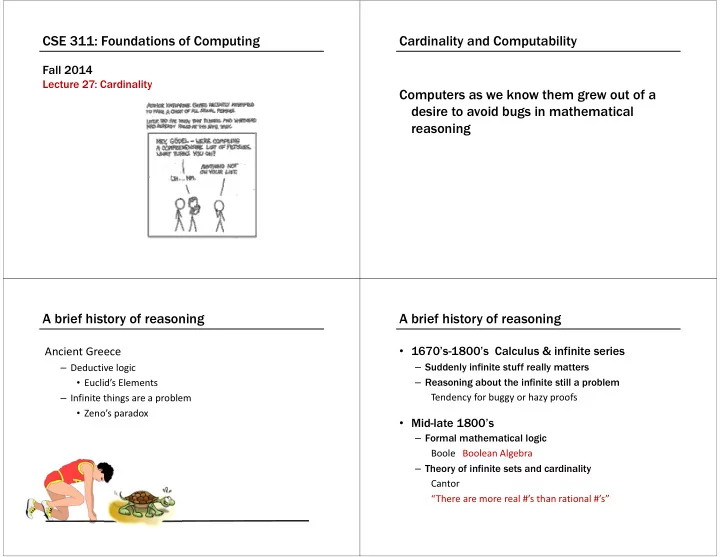
SLIDE 1 CSE 311: Foundations of Computing
Fall 2014
Lecture 27: Cardinality
Cardinality and Computability Computers as we know them grew out of a desire to avoid bugs in mathematical reasoning A brief history of reasoning
Ancient Greece
– Deductive logic
– Infinite things are a problem
- Zeno’s paradox
- A brief history of reasoning
- 1670’s-1800’s Calculus & infinite series
– Suddenly infinite stuff really matters – Reasoning about the infinite still a problem Tendency for buggy or hazy proofs
– Formal mathematical logic Boole Boolean Algebra – Theory of infinite sets and cardinality Cantor “There are more real #’s than rational #’s”
SLIDE 2 A brief history of reasoning
–Hilbert's famous speech outlines goal: mechanize all of mathematics 23 problems
–Gödel, Turing show that Hilbert’s program is impossible.
Gödel’s Incompleteness Theorem Undecidability of the Halting Problem
Both use ideas from Cantor’s proof about reals & rationals
Starting with Cantor
– If S is finite, we already defined |S| to be the number of elements in S. – What if S is infinite? Are all of these sets the same size?
Natural numbers ℕ Even natural numbers Integers ℤ Rational numbers ℚ Real numbers ℝ
Cardinality Definition: Two sets A and B are the same size (same cardinality) iff there is a 1-1 and
Also applies to infinite sets
a b c d e 1 2 3 4 5 6 f
Cardinality
- The natural numbers and even natural
numbers have the same cardinality: 0 1 2 3 4 5 6 7 8 9 10 ... 0 2 4 6 8 10 12 14 16 18 20 ... n is matched with 2n
SLIDE 3 Countability Definition: A set is countable iff it is the same size as some subset of the natural numbers Equivalent: A set S is countable iff there is an
Equivalent: A set S is countable iff we can write S={s1, s2, s3, ...} The set of all integers is countable
Is the set of positive rational numbers countable?
- We can’t do the same thing we did for the
integers
– Between any two rational numbers there are an infinite number of others The set of positive rational numbers is countable
1/1 1/2 1/3 1/4 1/5 1/6 1/7 1/8 ... 2/1 2/2 2/3 2/4 2/5 2/6 2/7 2/8 ... 3/1 3/2 3/3 3/4 3/5 3/6 3/7 3/8 ... 4/1 4/2 4/3 4/4 4/5 4/6 4/7 4/8 ... 5/1 5/2 5/3 5/4 5/5 5/6 5/7 ... 6/1 6/2 6/3 6/4 6/5 6/6 ... 7/1 7/2 7/3 7/4 7/5 .... ... ... ... ... ...
SLIDE 4
1/1 1/2 1/3 1/4 1/5 1/6 1/7 1/8 ... 2/1 2/2 2/3 2/4 2/5 2/6 2/7 2/8 ... 3/1 3/2 3/3 3/4 3/5 3/6 3/7 3/8 ... 4/1 4/2 4/3 4/4 4/5 4/6 4/7 4/8 ... 5/1 5/2 5/3 5/4 5/5 5/6 5/7 ... 6/1 6/2 6/3 6/4 6/5 6/6 ... 7/1 7/2 7/3 7/4 7/5 .... ... ... ... ... ...
The set of positive rational numbers is countable The set of positive rational numbers is countable ℚ
+ = {1/1, 2/1,1/2, 3/1,2/2,1/3,
4/1,2/3,3/2,1/4, 5/1,4/2,3/3,2/4,1/5, ...}
List elements in order of
– numerator+denominator – breaking ties according to denominator
Only k numbers have total of k+1
Technique is called “dovetailing”
The Positive Rationals are Countable: Another Way
public static rational o2o(nat n) { Set<Rational> used = new HashSet<Rational>(); nat i = 0; while (answer == null) { for (nat numer=1; ; numer++) { for (nat denom=1; denom <= numer; denom++) { Rational r = new Rational(numer, denom); if (!used.contains(r) && used.size() == i) { return new Rational(numer, denom); } else if (!used.contains(r)) { used.add(r); i++; } } } }
Claim: Σ* is countable for every finite Σ
SLIDE 5 The set of all Java programs is countable Georg Cantor
- Set theory
- Cardinality
- Continuum hypothesis
Georg Cantor
He spent the last 30 years of his life battling depression, living often in “sanatoriums” (psychiatric hospitals)
Cantor’s revolutionary ideas were not accepted by the mathematical establishment. Poincaré referred to them as a “grave disease infecting mathematics.” Kronecker fought to keep Cantor’s papers out of his journals.
What about the real numbers? Q: Is every set is countable? A: Theorem [Cantor] The set of real numbers (even just between 0 and 1) is NOT countable Proof is by contradiction using a new method called diagonalization
SLIDE 6 Proof by Contradiction
- Suppose that ℝ[0,1) is countable
- Then there is some listing of all elements
ℝ[0,1) = { r1, r2, r3, r4, ... }
- We will prove that in such a listing there
must be at least one missing element which contradicts statement “ℝ[0,1) is countable”
- The missing element will be found by
looking at the decimal expansions of r1, r2, r3, r4, ... Real Numbers between 0 and 1: ℝ[0,1)
- Every number between 0 and 1 has an
infinite decimal expansion: 1/2 = 0.50000000000000000000000... 1/3 = 0.33333333333333333333333... 1/7 = 0.14285714285714285714285... π -3 = 0.14159265358979323846264... 1/5 = 0.19999999999999999999999... = 0.20000000000000000000000... Representations of real numbers as decimals Representation is unique except for the cases that decimal ends in all 0’s or all 9’s.
x = 0.19999999999999999999999... 10x =1.9999999999999999999999... 9x=1.8 so x=0.200000000000000000... Won’t allow the representations ending in all 9’s All other representations give different elements of ℝ[0,1)
Supposed listing of ℝ[0,1)
1 2 3 4 5 6 7 8 9 ... r1 0. 5 ... ... r2 0. 3 3 3 3 3 3 3 3 ... ... r3 0. 1 4 2 8 5 7 1 4 ... ... r4 0. 1 4 1 5 9 2 6 5 ... ... r5 0. 1 2 1 2 2 1 2 2 ... ... r6 0. 2 5 ... ... r7 0. 7 1 8 2 8 1 8 2 ... ... r8 0. 6 1 8 3 3 9 4 ... ... ... .... ... .... .... ... ... ... ... ... ...
SLIDE 7
Supposed listing of ℝ[0,1)
1 2 3 4 5 6 7 8 9 ... r1 0.
5
... ... r2 0. 3
3
3 3 3 3 3 3 ... ... r3 0. 1 4
2
8 5 7 1 4 ... ... r4 0. 1 4 1
5
9 2 6 5 ... ... r5 0. 1 2 1 2
2
1 2 2 ... ... r6 0. 2 5 ... ... r7 0. 7 1 8 2 8 1
8
2 ... ... r8 0. 6 1 8 3 3 9
4
... ... ... .... ... .... .... ... ... ... ... ... ...
1 5 5 1 5 5 5 5
...
Flipped Diagonal
1 2 3 4 5 6 7 8 9 ... r1 0.
5
... ... r2 0. 3
3
3 3 3 3 3 3 ... ... r3 0. 1 4
2
8 5 7 1 4 ... ... r4 0. 1 4 1
5
9 2 6 5 ... ... r5 0. 1 2 1 2
2
1 2 2 ... ... r6 0. 2 5 ... ... r7 0. 7 1 8 2 8 1
8
2 ... ... r8 0. 6 1 8 3 3 9
4
... ... ... .... ... .... .... ... ... ... ... ... ... Flipping Rule: If digit is 5, make it 1 If digit is not 5, make it 5
Flipped Diagonal Number D
1 2 3 4 5 6 7 8 9 ...
D = 0. 1 5 5 1 5 5 5 5
...
But for all n, we have D≠rn since they differ on nth digit (which is not 9)
⇒ list was incomplete ⇒ ℝ[0,1) is not countable
D is in ℝ[0,1) the set of all functions f : ℕ→{0,1,...,9} is not countable
SLIDE 8 non-computable functions
– The set of all (Java) programs is countable – The set of all functions f : ℕ→{0,1,...,9} is not countable
– There must be some function f : ℕ→{0,1,...,9} that is not computable by any program! Back to the Halting Problem
- Suppose that there is a program H that computes the
answer to the Halting Problem
- We will build a table with a row for each program (just
like we did for uncountability of reals)
- If the supposed program H exists then the D program
we constructed as before will exist and so have a row in the table
- We will see that D must have entries like the “flipped
diagonal”
– D can’t possibly be in the table. – Only assumption was that H exists. That must be false.
<P1> <P2> <P3> <P4> <P5> <P6> ....
Some possible inputs x P1 P2 P3 P4 P5 P6 P7 P8 P9 . . 0 1 1 0 1 1 1 0 0 0 1 ... 1 1 0 1 0 1 1 0 1 1 1 ... 1 0 1 0 0 0 0 0 0 0 1 ... 0 1 1 0 1 0 1 1 0 1 0 ... 0 1 1 1 1 1 1 0 0 0 1 ... 1 1 0 0 0 1 1 0 1 1 1 ... 1 0 1 1 0 0 0 0 0 0 1 ... 0 1 1 1 1 0 1 1 0 1 0 ... . . . . . . . . . . . . . . . . . . . . . . . .
(P,x) entry is 1 if program P halts on input x and 0 if it runs forever <P1> <P2> <P3> <P4> <P5> <P6> ....
Some possible inputs x P1 P2 P3 P4 P5 P6 P7 P8 P9 . . 1 1 0 1 1 1 0 0 0 1 ... 1 1 0 1 0 1 1 0 1 1 1 ... 1 0 1 0 0 0 0 0 0 0 1 ... 0 1 1 1 0 1 1 0 1 0 ... 0 1 1 1 1 1 1 0 0 0 1 ... 1 1 0 0 0 1 1 0 1 1 1 ... 1 0 1 1 0 0 0 0 0 0 1 ... 0 1 1 1 1 0 1 1 0 1 0 ... . . . . . . . . . . . . . . . . . . . . . . . .
(P,x) entry is 1 if program P halts on input x and 0 if it runs forever
SLIDE 9 recall: code for D assuming subroutine H that solves the halting problem
– if H(x,x)==true then
- while (true); /* loop forever */
– else
- return; /* do nothing and halt */
– endif
<P1> <P2> <P3> <P4> <P5> <P6> ....
Some possible inputs x P1 P2 P3 P4 P5 P6 P7 P8 P9 . . 1 1 0 1 1 1 0 0 0 1 ... 1 1 0 1 0 1 1 0 1 1 1 ... 1 0 1 0 0 0 0 0 0 0 1 ... 0 1 1 1 0 1 1 0 1 0 ... 0 1 1 1 1 1 1 0 0 0 1 ... 1 1 0 0 0 1 1 0 1 1 1 ... 1 0 1 1 0 0 0 0 0 0 1 ... 0 1 1 1 1 0 1 1 0 1 0 ... . . . . . . . . . . . . . . . . . . . . . . . .
(P,x) entry is 1 if program P halts on input x and 0 if it runs forever
D behaves like flipped diagonal 1 1 1 recall: code for D assuming subroutine H that solves the halting problem
– if H(x,x)==true then
- while (true); /* loop forever */
– else
- return; /* do nothing and halt */
– endif
- If D existed it would have a row different from every
row of the table – D can’t be a program so H cannot exist!