CSCI-2325 Functional Programming with Haskell Mohammad T . Irfan - - PDF document

csci 2325 functional programming
SMART_READER_LITE
LIVE PREVIEW

CSCI-2325 Functional Programming with Haskell Mohammad T . Irfan - - PDF document

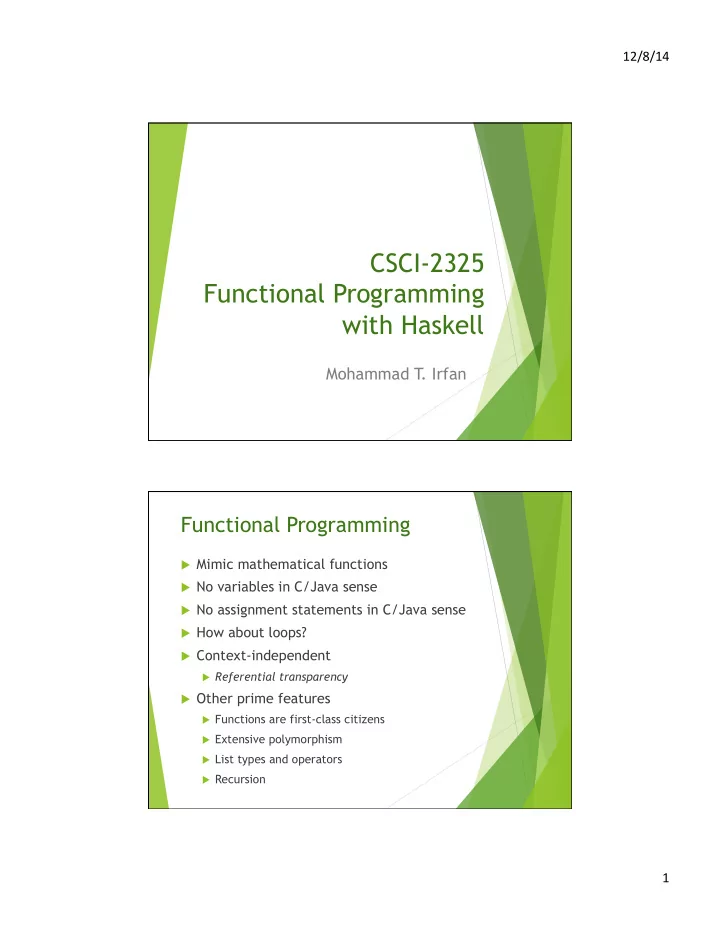
12/8/14 CSCI-2325 Functional Programming with Haskell Mohammad T . Irfan Functional Programming u Mimic mathematical functions u No variables in C/Java sense u No assignment statements in C/Java sense u How about loops? u


slide-1
SLIDE 1

12/8/14 ¡ 1 ¡

CSCI-2325 Functional Programming with Haskell

Mohammad T . Irfan

Functional Programming

u Mimic mathematical functions u No variables in C/Java sense u No assignment statements in C/Java sense u How about loops? u Context-independent

u Referential transparency

u Other prime features

u Functions are first-class citizens u Extensive polymorphism u List types and operators u Recursion

slide-2
SLIDE 2

12/8/14 ¡ 2 ¡

Functional Programming “Backus’s apology for creating FORTRAN”

Interesting facts: LISP and LISP Machine

John McCarthy LISP(1960) Knight machine (1980s)

slide-3
SLIDE 3

12/8/14 ¡ 3 ¡

Theoretical foundation: λ calculus

u Optional reading

u Scott’s section 11.2.4* (on Blackboard)

u Alonzo Church (1941) u λ expression u Reductions u Example

u λx . x * x * x u Evaluation: (λx . x * x * x) 2 produces 8

Haskell

slide-4
SLIDE 4

12/8/14 ¡ 4 ¡

Resources

u Installation

u http://www.haskell.org/platform/

u Haskell (GHCi) commands

u http://www.haskell.org/ghc/docs/7.4.1/html/

users_guide/ghci-commands.html

u Learning

u Best book: Miran Lipovaca’s Learn You a Haskell

for Great Good!

u http://learnyouahaskell.com/ (free online version)

u Useful how-to page

u http://www.haskell.org/haskellwiki/Category:How_to

u Other resources:

http://www.haskell.org/haskellwiki/Learning_Haskell

slide-5
SLIDE 5

12/8/14 ¡ 5 ¡

Haskell Warm-up exercises

Elementary functions

u Make a myFunctions.hs file and define the

following functions in it

u doubleMe x = x + x u addSquares x y = x*x + y*y

u Using the terminal go to the folder of that .hs

file

u Execute this command: ghci u Load the .hs file

u :load myFunctions.hs (or, :l myFunctions.hs)

u Use your functions

u addSquares 5 10

u If you change the .hs file => Execute :r to reload

slide-6
SLIDE 6

12/8/14 ¡ 6 ¡

Announcement

u Extension for Rails project

u Due this Friday

u Haskell and Prolog assignments

u Both due on December 19

if-then-else

u Indentation is important

if boolean then expr1 else expr2

u Same line is fine

if boolean then expr1 else expr2

u else is a must! Following doesn’t make sense:

u let x = if a then b

u Nested if? Yes! u Close alternative to if-then-else

u “guard” – not exactly the same

slide-7
SLIDE 7

12/8/14 ¡ 7 ¡

Input and output

u Problem: Guess a number

guessNumber num = do putStrLn "Enter your guess:" guess <- getLine -- binds the input to guess if read guess < num then do putStrLn "Too low!" guessNumber num else if read guess > num then do putStrLn "Too high!" guessNumber num else do putStrLn "You Win!"

Problem: calculate factorial of n Version 1 – note indentation

factorialV1 n = if n == 0 then 1 else if n > 0 then n * factorialV1(n-1) else 0

slide-8
SLIDE 8

12/8/14 ¡ 8 ¡

Factorial Version 2 – using guard

u factorial n

| n == 0 = 1 | n > 0 = n * factorial (n-1)

  • - why not factorial n – 1 ?

u Try this: factorial 100

Guard

fib n | n == 0 = 1 | n == 1 = 1 | n > 1 = fib (n-1) + fib (n-2) | otherwise = 0

u Can you solve it using if-then-else?

Problem: n-th Fibonacci number

Alias for True

slide-9
SLIDE 9

12/8/14 ¡ 9 ¡

List

u Want: evens = [0, 2, 4, 6, 8, 10] u In terminal (ghci)

u let evens = [0, 2 .. 10] u evens = [2*x | x <- [0..5] ]

u Infinite list

u let allEvens = [0, 2 ..]

Are these assignment statements?

Anatomy of a list

u Two parts

u head u List of the remaining elements (AKA tail)

u Functions head and tail return these

u head evens u tail evens

u Joining head and tail by : operator

u 0 : [2, 4 .. 10] will give [0, 2, 4, 6, 8, 10]

u Reference

u http://www.haskell.org/haskellwiki/How_to_work_on_lists

slide-10
SLIDE 10

12/8/14 ¡ 10 ¡

Problem: sort a list (low to high)

sort [] = [] sort (head:remainingList) = sort [b | b <- remainingList, b < head] ++ [head] ++ sort [b | b <- remainingList, b >= head]

Empty list List generator

More list examples

u Example: Factors of a number n

u factors n = [f | f <- [1 .. n], mod n f

== 0] u Example: Compute ALL prime numbers!

u primes = primeGen' [2 ..]

where primeGen' (p:xs) = p : primeGen' [q | q <- xs, mod q p /= 0] u Getting the first 10 prime numbers

u take 10 primes u Side note: This is not really the sieve of Eratosthenes

http://www.cs.hmc.edu/~oneill/papers/Sieve-JFP .pdf

Lazy evaluation

slide-11
SLIDE 11

12/8/14 ¡ 11 ¡

Problem solving using Haskell Main ingredient: recurrence relation

u Recursive sum

u recSum [] = 0

recSum (x:xs) = x + recSum xs u Built-in function that does the above: sum

u sum [1 .. 5]

u Similar built-in function: product

u factorial n = product [1 .. n]

Higher-order function/ curried function

u One function can be a

parameter of another functions

u One function can return

another function

Haskell Curry

slide-12
SLIDE 12

12/8/14 ¡ 12 ¡

Higher-order function/ curried function

u In GHCI command area:

let fun3 x y z = x+y-z -- 3 param function fun3 1 2 3 – outputs 0

u This is how Haskell deals with the fun3 function:

let fun2 = fun3 1 -- 2 param function let fun1 = fun2 2 -- 1 param function fun1 3 -- outputs 0

Comment

n-queens problem

queens n = solve n where solve k | k <= 0 = [ [] ] | otherwise = [ h:partial | partial <- solve (k-1), h <- [0..(n-1)], safe h partial] safe h partial = and [ not (checks h partial i) | i <- [0..(length partial - 1)]] checks h partial i = h == partial!!i || abs(h - partial!!i) == i+1

slide-13
SLIDE 13

12/8/14 ¡ 13 ¡

3 most useful built-in functions

  • 1. map function list

u map ( > 0) [2, -50, 100] -- à [True, False, True]

u Equivalent: [ x > 0 | x <- [2, -50, 100] ]

u map (`mod` 2) [13, 14, 15] -- à [1, 0, 1]

  • 2. filter predicate/condition list

u Examples u Sorting function (from last class)

qsort [] = [] qsort (x:xs) = qsort (filter (< x) xs) ++ [x] ++ qsort (filter (>= x) xs) qsort [b| b<-xs, b<x] Difference between map and filter?

  • 3. Fold: produces single value from a list

(From Haskell.org)

u foldl f z [] = z

foldl f z (x:xs) = foldl f (f z x) xs

u foldr f z [] = z

foldr f z (x:xs) = f x (foldr f z xs)

u Example

u foldl (-) 1 [2, 3, 4] u foldr (-) 1 [2, 3, 4] u anyTrue = foldr (||) False [True, True ..] u anyTrue = foldl (||) False [True, True ..]

Accumulator! Binary function

slide-14
SLIDE 14

12/8/14 ¡ 14 ¡

Problem: Evaluate Polish prefix expression

u 10 + (15 – 5) * 4

u + 10 * - 15 5 4

u 10 + 15 – 5 * 4

u + 10 - 15 * 5 4

u Input: String (list of characters) of Polish prefix

expression

u Output: Value of expression u Solution

u Reverse the expr u Traverse it from left to right u Stack operations (implement by a list: head is TOS)

u If the current string is an operator, pop the top two

  • perands and push the result of applying the operator

foldl

Solution

evaluate expr = head(foldl stackOperation []

  • (reverse(words(expr))))

where stackOperation (x:y:xs) curString | curString == "+" = (x+y):xs

  • | curString == "-" = (x-y):xs
  • | curString == "*" = (x*y):xs

stackOperation xs curString = read curString:xs

slide-15
SLIDE 15

12/8/14 ¡ 15 ¡

Alternative solution

evaluatePrefix expr = head ( foldl f [] ( reverse (words expr) )

  • )

where f (x:y:ys) "*" = (x*y):ys

  • f (x:y:ys) "+" = (x+y):ys
  • f (x:y:ys) "-" = (x-y):ys
  • f xs str = read str:xs