CS70: Lecture 2. Outline. Quick Background and Notation. Direct - - PowerPoint PPT Presentation

cs70 lecture 2 outline quick background and notation
SMART_READER_LITE
LIVE PREVIEW

CS70: Lecture 2. Outline. Quick Background and Notation. Direct - - PowerPoint PPT Presentation

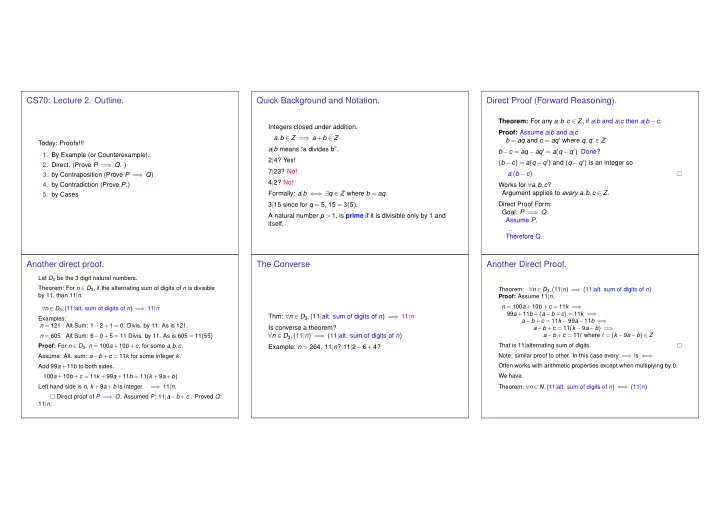
CS70: Lecture 2. Outline. Quick Background and Notation. Direct Proof (Forward Reasoning). Theorem: For any a , b , c Z , if a | b and a | c then a | b c . Integers closed under addition. Proof: Assume a | b and a | c a , b Z = a


slide-1
SLIDE 1

CS70: Lecture 2. Outline.

Today: Proofs!!!

  • 1. By Example (or Counterexample).
  • 2. Direct. (Prove P =

⇒ Q. )

  • 3. by Contraposition (Prove P =

⇒ Q)

  • 4. by Contradiction (Prove P.)
  • 5. by Cases

Quick Background and Notation.

Integers closed under addition. a,b ∈ Z = ⇒ a+b ∈ Z a|b means “a divides b”. 2|4? Yes! 7|23? No! 4|2? No! Formally: a|b ⇐ ⇒ ∃q ∈ Z where b = aq. 3|15 since for q = 5, 15 = 3(5). A natural number p > 1, is prime if it is divisible only by 1 and itself.

Direct Proof (Forward Reasoning).

Theorem: For any a,b,c ∈ Z, if a|b and a|c then a|b −c. Proof: Assume a|b and a|c b = aq and c = aq′ where q,q′ ∈ Z b −c = aq −aq′ = a(q −q′) Done? (b −c) = a(q −q′) and (q −q′) is an integer so a|(b −c) Works for ∀a,b,c? Argument applies to every a,b,c ∈ Z. Direct Proof Form: Goal: P = ⇒ Q Assume P. ... Therefore Q.

Another direct proof.

Let D3 be the 3 digit natural numbers. Theorem: For n ∈ D3, if the alternating sum of digits of n is divisible by 11, than 11|n. ∀n ∈ D3,(11|alt. sum of digits of n) = ⇒ 11|n Examples: n = 121 Alt Sum: 1−2+1 = 0. Divis. by 11. As is 121. n = 605 Alt Sum: 6−0+5 = 11 Divis. by 11. As is 605 = 11(55) Proof: For n ∈ D3, n = 100a+10b +c, for some a,b,c. Assume: Alt. sum: a−b +c = 11k for some integer k. Add 99a+11b to both sides. 100a+10b +c = 11k +99a+11b = 11(k +9a+b) Left hand side is n, k +9a+b is integer. = ⇒ 11|n. Direct proof of P = ⇒ Q: Assumed P: 11|a−b +c . Proved Q: 11|n.

The Converse

Thm: ∀n ∈ D3,(11|alt. sum of digits of n) = ⇒ 11|n Is converse a theorem? ∀n ∈ D3,(11|n) = ⇒ (11|alt. sum of digits of n) Example: n = 264. 11|n? 11|2−6+4?

Another Direct Proof.

Theorem: ∀n ∈ D3,(11|n) = ⇒ (11|alt. sum of digits of n) Proof: Assume 11|n. n = 100a+10b +c = 11k = ⇒ 99a+11b +(a−b +c) = 11k = ⇒ a−b +c = 11k −99a−11b = ⇒ a−b +c = 11(k −9a−b) = ⇒ a−b +c = 11ℓ where ℓ = (k −9a−b) ∈ Z That is 11|alternating sum of digits. Note: similar proof to other. In this case every = ⇒ is ⇐ ⇒ Often works with arithmetic properties except when multiplying by 0. We have. Theorem: ∀n ∈ N,(11|alt. sum of digits of n) ⇐ ⇒ (11|n)

slide-2
SLIDE 2

Proof by Contraposition

Thm: For n ∈ Z + and d|n. If n is odd then d is odd. n = 2k +1 what do we know about d? What to do?

Goal: Prove P = ⇒ Q. Assume ¬Q ...and prove ¬P. Conclusion: ¬Q = ⇒ ¬P equivalent to P = ⇒ Q.

Proof: Assume ¬Q: d is even. d = 2k. d|n so we have n = qd = q(2k) = 2(kq) n is even. ¬P

Another Contrapostion...

Lemma: For every n in N, n2 is even = ⇒ n is even. (P = ⇒ Q) n2 is even, n2 = 2k, ... √ 2k even? Proof by contraposition: (P = ⇒ Q) ≡ (¬Q = ⇒ ¬P) P = ’n2 is even.’ ........... ¬P = ’n2 is odd’ Q = ’n is even’ ........... ¬Q = ’n is odd’ Prove ¬Q = ⇒ ¬P: n is odd = ⇒ n2 is odd. n = 2k +1 n2 = 4k2 +4k +1 = 2(2k +k)+1. n2 = 2l +1 where l is a natural number.. ... and n2 is odd! ¬Q = ⇒ ¬P so P = ⇒ Q and ...

Proof by Contradiction

Theorem: √ 2 is irrational. Must show: For every a,b ∈ Z, ( a

b)2 = 2.

A simple property (equality) should always “not” hold. Proof by contradiction: Theorem: P. ¬P = ⇒ P1 ··· = ⇒ R ¬P = ⇒ P1 ··· = ⇒ ¬R ¬P = ⇒ False Contrapositive: True = ⇒ P. Theorem P is proven.

Contradiction

Theorem: √ 2 is irrational. Assume ¬P: √ 2 = a/b for a,b ∈ Z. Reduced form: a and b have no common factors. √ 2b = a 2b2 = a2 = 4k2 a2 is even = ⇒ a is even. a = 2k for some integer k b2 = 2k2 b2 is even = ⇒ b is even. a and b have a common factor. Contradiction.

Proof by contradiction: example

Theorem: There are infinitely many primes. Proof:

◮ Assume finitely many primes: p1,...,pk. ◮ Consider

q = p1 ×p2 ×···pk +1.

◮ q cannot be one of the primes as it is larger than any pi. ◮ q has prime divisor p (”p > 1” = R ) which is one of pi. ◮ p divides both x = p1 ·p2 ···pk and q, and divides q −x, ◮ =

⇒ p|q −x = ⇒ p ≤ q −x = 1.

◮ so p ≤ 1. (Contradicts R.)

The original assumption that “the theorem is false” is false, thus the theorem is proven.

Product of first k primes..

Did we prove?

◮ “The product of the first k primes plus 1 is prime.” ◮ No. ◮ The chain of reasoning started with a false statement.

Consider example..

◮ 2×3×5×7×11×13+1 = 30031 = 59×509 ◮ There is a prime in between 13 and q = 30031 that divides

q.

◮ Proof assumed no primes in between.

slide-3
SLIDE 3

Proof by cases. (“divide-and-conquer” strategy)

Theorem: x5 −x +1 = 0 has no solution in the rationals. Proof: First a lemma... Lemma: If x is a solution to x5 −x +1 = 0 and x = a/b for a,b ∈ Z, then both a and b are even. Reduced form a

b: a and b can’t both be even! + Lemma

= ⇒ no rational solution. Proof of lemma: Assume a solution of the form a/b. a b 5 −a/b +1 = 0 multiply by b5, a5 −ab4 +b5 = 0 Case 1: a odd, b odd: odd - odd +odd = even. Not possible. Case 2: a even, b odd: even - even +odd = even. Not possible. Case 3: a odd, b even: odd - even +even = even. Not possible. Case 4: a even, b even: even - even +even = even. Possible. The fourth case is the only one possible, so the lemma follows.

Proof by cases.

Theorem: There exist irrational x and y such that xy is rational. Let x = y = √ 2. Case 1: xy = √ 2

√ 2 is rational. Done!

Case2: √ 2

√ 2 is irrational. ◮ New values: x =

√ 2

√ 2, y =

√ 2.

xy = √ 2

√ 2√ 2

= √ 2

√ 2∗ √ 2 =

√ 2

2 = 2.

Thus, in this case, we have irrational x and y with a rational xy (i.e., 2). One of the cases is true so theorem holds. Question: Which case holds? Don’t know!!!

Be careful.

Theorem: 3 = 4 Proof: Assume 3 = 4. Start with 12 = 12. Divide one side by 3 and the other by 4 to get 4 = 3. By commutativity theorem holds. Don’t assume what you want to prove! Theorem: 1 = 2 Proof: For x = y, we have (x2 −xy) = x2 −y2 x(x −y) = (x +y)(x −y) x = (x +y) x = 2x 1 = 2 Dividing by zero is no good. Also: Multiplying inequalities by a negative. P = ⇒ Q does not mean Q = ⇒ P.

Summary

Direct Proof: To Prove: P = ⇒ Q. Assume P. reason forward, Prove Q. By Contraposition: To Prove: P = ⇒ Q Assume ¬Q. Prove ¬P. By Contradiction: To Prove: P Assume ¬P. Prove False . By Cases: informal. Universal: show that statement holds in all cases. Existence: used cases where one is true. Either √ 2 and √ 2 worked.

  • r

√ 2 and √ 2

√ 2 worked.

Careful when proving! Don’t assume the theorem. Divide by zero. Watch converse. ...