CS61A Lecture #38: Conclusion Announcements: Homework 11 will be - - PowerPoint PPT Presentation

cs61a lecture 38 conclusion
SMART_READER_LITE
LIVE PREVIEW

CS61A Lecture #38: Conclusion Announcements: Homework 11 will be - - PowerPoint PPT Presentation

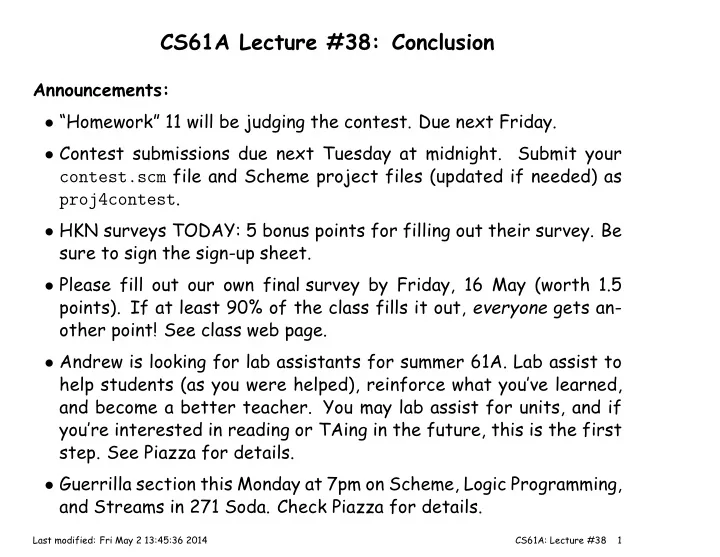
CS61A Lecture #38: Conclusion Announcements: Homework 11 will be judging the contest. Due next Friday. Contest submissions due next Tuesday at midnight. Submit your contest.scm file and Scheme project files (updated if needed) as


slide-1
SLIDE 1

CS61A Lecture #38: Conclusion

Announcements:

  • “Homework” 11 will be judging the contest. Due next Friday.
  • Contest submissions due next Tuesday at midnight.

Submit your

contest.scm file and Scheme project files (updated if needed) as proj4contest.

  • HKN surveys TODAY: 5 bonus points for filling out their survey. Be

sure to sign the sign-up sheet.

  • Please fill out our own final survey by Friday, 16 May (worth 1.5

points). If at least 90% of the class fills it out, everyone gets an-

  • ther point! See class web page.
  • Andrew is looking for lab assistants for summer 61A. Lab assist to

help students (as you were helped), reinforce what you’ve learned, and become a better teacher. You may lab assist for units, and if you’re interested in reading or TAing in the future, this is the first

  • step. See Piazza for details.
  • Guerrilla section this Monday at 7pm on Scheme, Logic Programming,

and Streams in 271 Soda. Check Piazza for details.

Last modified: Fri May 2 13:45:36 2014 CS61A: Lecture #38 1

slide-2
SLIDE 2

A Summary of Topics

  • Programming primitives
  • Derived programming structures
  • Programming-language concepts, design, and implementation
  • Programming “Paradigms”
  • Software engineering
  • Analysis
  • Side excursions
  • What’s Next?

Last modified: Fri May 2 13:45:36 2014 CS61A: Lecture #38 2

slide-3
SLIDE 3

Programming Primitives

  • Recursion: the all-encompassing repetitive construct; recursive think-

ing

  • Pairs: A universal data-structuring tool.
  • Functions as data values, functions on functions
  • Exceptions: Dealing with errors.
  • Classes.

Last modified: Fri May 2 13:45:36 2014 CS61A: Lecture #38 3

slide-4
SLIDE 4

Derived Programming Structures

  • Can build almost anything from primitives.
  • Although Python also has specialized implementations of some im-

portant data structures.

  • Sequences:

– Lists: traversals, searching, inserting, deleting (destructive and non-destructive) – Trees: traversals, binary search trees, constructing, inserting, deleting

  • Maps.
  • Sequences: creating, traversing, searching,
  • Iterators, generators.
  • Trees: uses, traversing, and searching.

Last modified: Fri May 2 13:45:36 2014 CS61A: Lecture #38 4

slide-5
SLIDE 5

Programming-Language Concepts, Design, Implementation

  • Python was developed largely as a teaching language, and is simpler

in many ways than other “production” languages. . .

  • And yet, it is a good deal more powerful (as measured by work done

per line of code) than these same languages.

  • Still, as you’ve seen, there are problems, too: dynamic vs. static

discovery of errors.

  • Big item: scope (what instance of what definition applies to evalu-

ation of an identifier). This is what environment diagrams are in- tended to model. – Alternative: dynamic scoping.

  • Implementing a language [CS164]:

– Interpreters – Trees as an intermediate language – Relationship of run-time environment representation to scope rules. – “Little” languages as a programming tool

Last modified: Fri May 2 13:45:36 2014 CS61A: Lecture #38 5

slide-6
SLIDE 6

Paradigms

  • Functional programming: expressions, not statements; no side-effects;

use of higher-order functions.

  • Streams
  • Data-directed and object-oriented programming

– Organize program around types of data, not functions – Inheritance – Interface vs. implementation

  • Rule-based programming (Prolog)

– Declarative rather than imperative – Rule → action idea. – Logic programming:

∗ Pattern matching, pattern variables as a programming tool ∗ Declarative and imperative interpretation ∗ Application to parsing

Last modified: Fri May 2 13:45:36 2014 CS61A: Lecture #38 6

slide-7
SLIDE 7

Software Engineering

  • Biggest ideas: Abstraction, separation of concerns
  • Specification of a program vs. its implementation

– Syntactic spec (header) vs. semantic spec (comment). – Example of multiple implementations for the same abstract be- havior

  • Testing: for every program, there is a test.

– In “Extreme Programming” there is a test for every module.

  • Software engineering implicit in all our software courses, explicit in

CS169.

Last modified: Fri May 2 13:45:36 2014 CS61A: Lecture #38 7

slide-8
SLIDE 8

Analysis

  • What we can measure when we measure speed:

– Raw time. – Counts of selected representative operations. – Symbolic expressions of running time. – Best/worst case.

  • Application of asymptotic notation (Θ(·), etc.) to summarizing sym-

bolic time measurements concisely.

Last modified: Fri May 2 13:45:36 2014 CS61A: Lecture #38 8

slide-9
SLIDE 9

Important Side Excursions

  • User Interfaces: there are principles behind making computers us-

able.

  • Cryptography:

– protecting integrity, privacy, and authenticity of data. – Symmetric (DES, Enigma) and asymmetric (public-key) methods.

  • Computatbility [CS172]: Some functions cannot be computed. Prob-

lems that are “near” such functions cannot be computed quickly.

Last modified: Fri May 2 13:45:36 2014 CS61A: Lecture #38 9

slide-10
SLIDE 10

What’s Next (Course-Wise)?

  • CS61B: (conventional) data structures and languages
  • CS61C: computing hardware as programmers see it.
  • CS170, CS172, CS174: “Theory”—analysis and construction of al-

gorithms, theoretical models of computation, use of probabilistic algorithms and analysis.

  • CS161: Security
  • CS162: Operating systems.
  • CS164: Implementation of programming languages.
  • CS160, CS169: User interfaces, software engineering.
  • CS188: Artificial intelligence.
  • CS184: Graphics.
  • CS186: Databases.

Last modified: Fri May 2 13:45:36 2014 CS61A: Lecture #38 10

slide-11
SLIDE 11

What’s Next (Course-Wise) (II)

  • CS189: Machine Learning.
  • CS191: Quantum Computing.
  • EE C125: Robotics
  • EECS C149: Embedded Systems.
  • CS 150: Digital Systems Design
  • CS 176: Computational Biology
  • CS194: Special topics.

(E.g.) parallel software; computer anima- tion; data science; networks, crowds, and markets; cell phones as a computing platform.

  • Plus graduate courses on these subjects and more.
  • And please don’t forget CS199 and research projects.

Last modified: Fri May 2 13:45:36 2014 CS61A: Lecture #38 11

slide-12
SLIDE 12

What’s Next (Otherwise)?

  • Programming contests.
  • The open-source world: Go out and build something!
  • And above all: Have Fun!

Last modified: Fri May 2 13:45:36 2014 CS61A: Lecture #38 12