
SLIDE 1
CS535 Big Data 3/9/2020 Week 8-A Sangmi Lee Pallickara http://www.cs.colostate.edu/~cs535 Spring 2020 Colorado State University, page 1
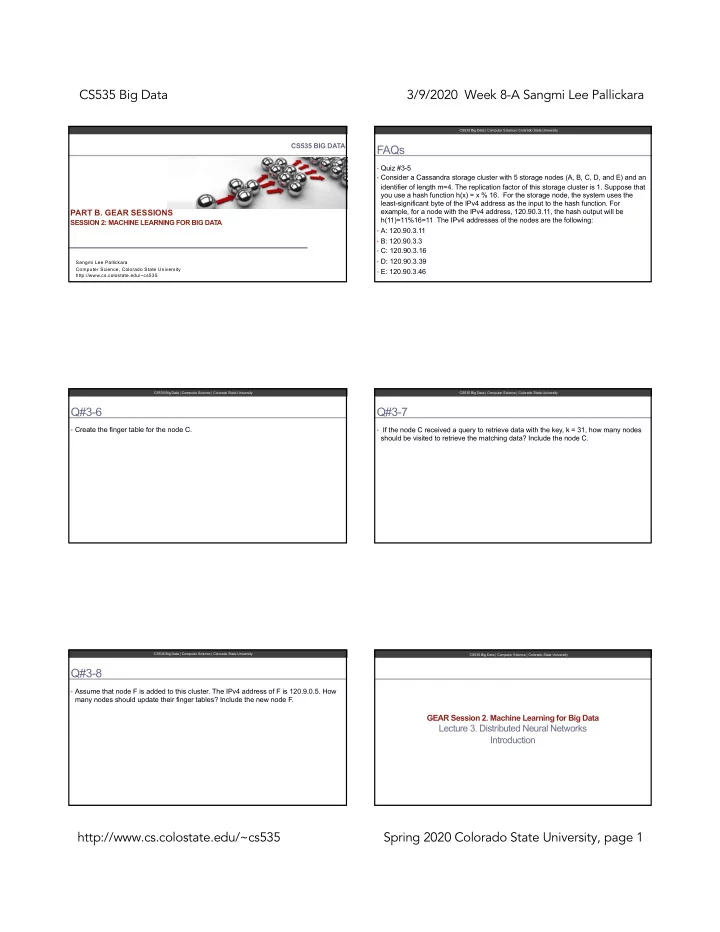
CS535 BIG DATA
PART B. GEAR SESSIONS
SESSION 2: MACHINE LEARNING FOR BIG DATA
Sangmi Lee Pallickara Computer Science, Colorado State University http://www.cs.colostate.edu/~cs535
FAQs
- Quiz #3-5
- Consider a Cassandra storage cluster with 5 storage nodes (A, B, C, D, and E) and an
identifier of length m=4. The replication factor of this storage cluster is 1. Suppose that you use a hash function h(x) = x % 16. For the storage node, the system uses the least-significant byte of the IPv4 address as the input to the hash function. For example, for a node with the IPv4 address, 120.90.3.11, the hash output will be h(11)=11%16=11 The IPv4 addresses of the nodes are the following:
- A: 120.90.3.11
- B: 120.90.3.3
- C: 120.90.3.16
- D: 120.90.3.39
- E: 120.90.3.46
CS535 Big Data | Computer Science | Colorado State University
Q#3-6
- Create the finger table for the node C.
CS535 Big Data | Computer Science | Colorado State University
Q#3-7
- If the node C received a query to retrieve data with the key, k = 31, how many nodes
should be visited to retrieve the matching data? Include the node C.
CS535 Big Data | Computer Science | Colorado State University
Q#3-8
- Assume that node F is added to this cluster. The IPv4 address of F is 120.9.0.5. How
many nodes should update their finger tables? Include the new node F.
CS535 Big Data | Computer Science | Colorado State University
GEAR Session 2. Machine Learning for Big Data
Lecture 3. Distributed Neural Networks Introduction
CS535 Big Data | Computer Science | Colorado State University