CS453 Intro and PA1 1 operator < If statement Low level - - PowerPoint PPT Presentation

cs453 intro and pa1 1
SMART_READER_LITE
LIVE PREVIEW

CS453 Intro and PA1 1 operator < If statement Low level - - PowerPoint PPT Presentation

Plan for today Call expression Translating program features to the Tree IR ... this . otherFunc(y,f)... This time: call expressions less than operator if statement while statements Lvalues versus rvalues CS453 Lecture More


slide-1
SLIDE 1

CS453 Intro and PA1 1

CS453 Lecture More tranlation to Tree IR 1

Plan for today

Translating program features to the Tree IR

This time:

– call expressions – less than operator – if statement – while statements

Lvalues versus rvalues

CS453 Lecture More tranlation to Tree IR 2

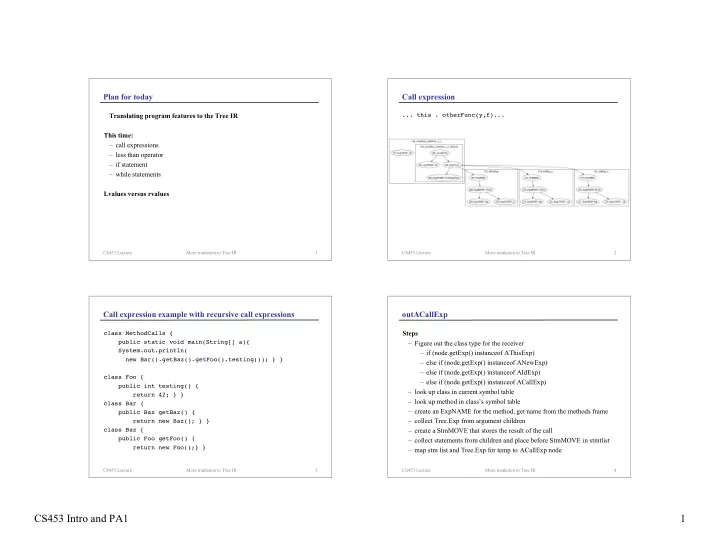
Call expression

... this . otherFunc(y,f)...

CS453 Lecture More tranlation to Tree IR 3

Call expression example with recursive call expressions

class MethodCalls { public static void main(String[] a){ System.out.println( new Bar().getBaz().getFoo().testing()); } } class Foo { public int testing() { return 42; } } class Bar { public Baz getBaz() { return new Baz(); } } class Baz { public Foo getFoo() { return new Foo();} }

CS453 Lecture More tranlation to Tree IR 4

  • utACallExp

Steps

– Figure out the class type for the receiver – if (node.getExp() instanceof AThisExp) – else if (node.getExp() instanceof ANewExp) – else if (node.getExp() instanceof AIdExp) – else if (node.getExp() instanceof ACallExp) – look up class in current symbol table – look up method in class’s symbol table – create an ExpNAME for the method, get name from the methods frame – collect Tree.Exp from argument children – create a StmMOVE that stores the result of the call – collect statements from children and place before StmMOVE in stmtlist – map stm list and Tree.Exp for temp to ACallExp node

slide-2
SLIDE 2

CS453 Intro and PA1 2

CS453 Lecture More tranlation to Tree IR 5

  • perator <

Low level pseudocode for result of translation

if (lhs < rhs) goto truebody else goto falsebody falsebody: temp = 0 goto endif truebody: temp = 1 goto endif endif:

Tree.Exp for ALTExp node

– ExpTEMP( Temp instance for temp )

CS453 Lecture More tranlation to Tree IR 6

If statement

Low level pseudocode for result of translation

if (test == true) goto truebody else goto falsebody falsebody: ... goto endif truebody: ... goto endif endif:

Tree.Exp for AIfStatement node

– none, AIfStatement is a statement

CS453 Lecture More tranlation to Tree IR 7

while statement

Low level pseudocode for result of translation

loop: if (test != true) goto endloop else goto body body: ... goto loop

Tree.Exp for AWhileStatement node

– none, AWhileStatement is a statement

CS453 Lecture More tranlation to Tree IR 8

StmCJUMP

public class StmCJUMP extends Stm { public int relop; public Exp left, right; public Label iftrue, iffalse; public StmCJUMP(int rel, Exp l, Exp r, Label t,

Label f) {

... } public final static int EQ=0, NE=1, LT=2, GT=3, ...

slide-3
SLIDE 3

CS453 Intro and PA1 3

CS453 Lecture More tranlation to Tree IR 9

Tree intermediate representation

ExpCONST(int i) - The integer constant i ExpNAME(Label n) - Constant address. Corresponds to label in assembly. ExpTEMP(Temp t) - Temporary t. “Infinite” Temps in Tree IR. ExpBINOP(int binop, Exp left, Exp right) - left binop right ExpMEM(Exp exp) - If left child of move, then store into address calculated by exp.

Otherwise, fetch value at address calculated by exp.

ExpCALL(Exp func, List<Exp> args) - evaluate func to find func address, then

evaluate args left to right.

StmMOVE(Temp t, e) - Eval e and put result in t. StmMOVE(ExpMEM(e1), e2) - Eval e2 and store into address e1. StmEXP(Exp e) - Eval e and ignore result StmJUMP(Label targ) - Transfer control to given label. StmCJUMP(int rel, Exp l, Exp r, Label t, Label f) - if l rel r then goto t else goto f StmLABEL(Label l) - Label in assembly.

CS453 Lecture More tranlation to Tree IR 10

Lvalues versus Rvalues

Lvalue – “result of an expression that can occur on the left of an assignment statement” – examples: *(&a), b.membervar, p->membervar

Rvalue

– an expression whose result can only appear as a subexpression or on the rhs of a statement – examples: &a, 3*4, new Foo()

Why?

– explains compiler errors you might see in the future, e.g. non-lvalue assignment – x+3 = 5 – 4 = 5 – emphasizes the difference between equality in math and assignment in programming languages – think about where values are stored during the progression of a program – this is why the lhs of a StmMOVE must be an ExpMEM or ExpTEMP – what if we could pass around user defined types (not just references to them)?