CS3431 Description: Envision a database Database Systems I - - PDF document

cs3431
SMART_READER_LITE
LIVE PREVIEW

CS3431 Description: Envision a database Database Systems I - - PDF document

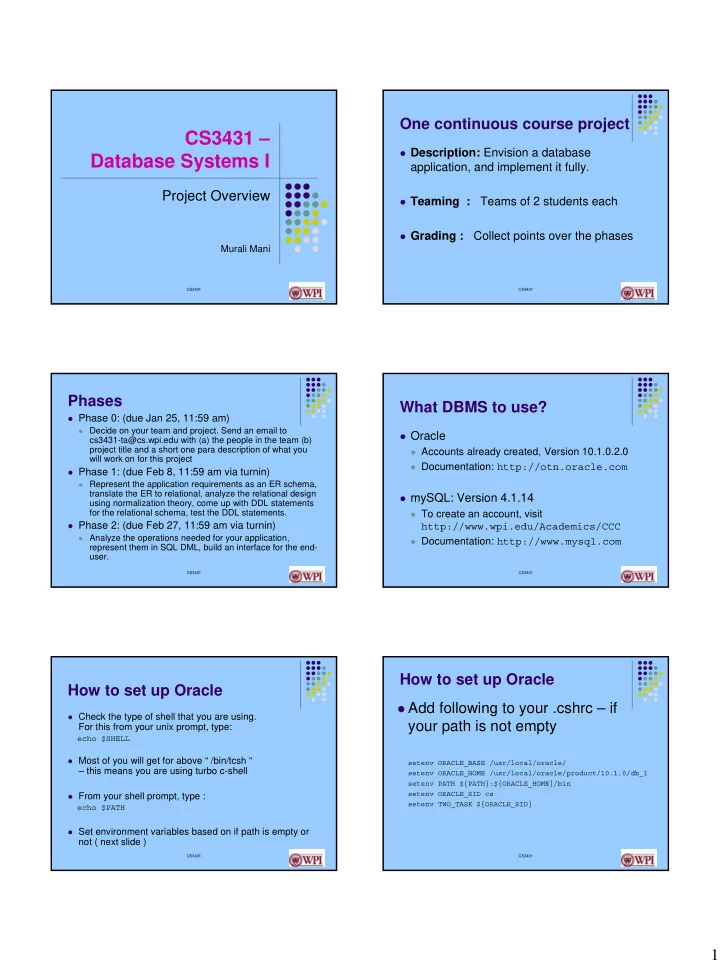
One continuous course project CS3431 Description: Envision a database Database Systems I application, and implement it fully. Project Overview Teaming : Teams of 2 students each Grading : Collect points over the phases Murali


slide-1
SLIDE 1

1

CS3431 1

CS3431 – Database Systems I

Project Overview

Murali Mani

CS3431 2

One continuous course project

Description: Envision a database

application, and implement it fully.

Teaming :

Teams of 2 students each

Grading :

Collect points over the phases

CS3431 3

Phases

Phase 0: (due Jan 25, 11:59 am)

Decide on your team and project. Send an email to

cs3431-ta@cs.wpi.edu with (a) the people in the team (b) project title and a short one para description of what you will work on for this project

Phase 1: (due Feb 8, 11:59 am via turnin)

Represent the application requirements as an ER schema,

translate the ER to relational, analyze the relational design using normalization theory, come up with DDL statements for the relational schema, test the DDL statements.

Phase 2: (due Feb 27, 11:59 am via turnin)

Analyze the operations needed for your application,

represent them in SQL DML, build an interface for the end- user.

CS3431 4

What DBMS to use?

Oracle

Accounts already created, Version 10.1.0.2.0 Documentation: http://otn.oracle.com

mySQL: Version 4.1.14

To create an account, visit

http://www.wpi.edu/Academics/CCC

Documentation: http://www.mysql.com

CS3431 5

How to set up Oracle

Check the type of shell that you are using.

For this from your unix prompt, type:

echo $SHELL

Most of you will get for above “ /bin/tcsh “

– this means you are using turbo c-shell

From your shell prompt, type :

echo $PATH

Set environment variables based on if path is empty or

not ( next slide )

CS3431 6

How to set up Oracle

Add following to your .cshrc – if

your path is not empty

setenv ORACLE_BASE /usr/local/oracle/ setenv ORACLE_HOME /usr/local/oracle/product/10.1.0/db_1 setenv PATH ${PATH}:${ORACLE_HOME}/bin setenv ORACLE_SID cs setenv TWO_TASK ${ORACLE_SID}

slide-2
SLIDE 2

2

CS3431 7

How to set up Oracle (contd…)

Add to .cshrc – if your path is empty setenv PATH .

setenv ORACLE_BASE /usr/local/oracle setenv ORACLE_HOME /usr/local/oracle/product/10.1.0/db_1 setenv PATH ${PATH}:${ORACLE_HOME}/bin setenv ORACLE_SID cs setenv TWO_TASK ${ORACLE_SID}

CS3431 8

How to set up Oracle (contd…)

After editing file .cshrc Please run :

source ~/.cshrc

CS3431 9

Problems while setting up Oracle

Important – Set up Oracle immediately and

see that it is working

Many of you will run into problems, typically

due to simple typos

If you have identified a project partner, start

working with him/her on this !

CS3431 10

Oracle introduction

Connecting

sqlplus <userName>/<passwd> For example,

  • sqlplus myname/myname

Change passwd using password command You will end up submitting your passwd; therefore

don’t use password that you use for other purposes.

CS3431 11

Oracle useful commands

These commands can be executed from the SQL shell

SELECT * FROM cat; -- lists tables you have created SELECT table_name FROM user_tables; -- as above. DESCRIBE <tableName>; -- describes the schema for the table with name tableName help index; -- shows list of help topics; help start; -- illustrates how to use command start exit; -- exit from the SQL shell

CS3431 12

Using Oracle from Windows

Multiple ways:

Use aquastudio software from aquafold.com. connect

to --

server: oracle.wpi.edu port: 1521 (this is the default) SID: cs

Download oracle client for windows. Connect using

sqlplus client or other tools:

sqlplus rundenst/rundenst@//oracle.wpi.edu:1521/cs.wpi.edu

slide-3
SLIDE 3

3

CS3431 13

MySQL introduction

Connecting

mysql -h<host> -u<user> -p<passwd>

<dbname>

Useful commands

show tables; describe <tableName>; exit; Look at manual for other commands.

CS3431 14

Working with the Data Server

CS3431 15

Testing that you are set

CREATE TABLE student(sNum INTEGER,sName VARCHAR (30));

  • - creates table student

with two columns

INSERT INTO student VALUES (1, ‘Joe’);

  • - insert one row into the student table

SELECT * FROM student;

  • - select all rows from student table

DELETE FROM student;

  • - delete all rows in the student table

DROP TABLE student;

  • - drop student table

Purge recyclebin;

  • - purge recyclebin tables that get created.

CS3431 16

Running scripts in SQLPlus

To enter OS environment, use sqlplus command:

Host

Now you can execute OS commands, like : cd.. , exit , etc.

Create a file in your file system in the current directory called

createTable.sql

  • @createTable -- executes the script
  • start createTable -- also executes the script

If you want to save your output to a file (similar to script in Unix)

  • spool <fileName>
  • <executeCmds...>
  • spool off;

CS3431 17

Loading data from a text file

  • CREATE TABLE myTable1 (a int, b int);

Create data file, say: sample.dat Put data into the file : 1,11 2,22 3,33 4,44

CS3431 18

Loading from text file (Contd)

Create control file, say load.ctl LOAD DATA INFILE sample.dat INTO TABLE myTable1 FIELDS TERMINATED BY ‘,’ (a,b) Invoke SQL Loader (from your UNIX shell):

  • $ sqlldr <user/password> control=load.ctl
slide-4
SLIDE 4

4

CS3431 19

Building Interfaces

Call Level Interface

Perl – to build web interfaces JDBC – Java, servlets etc

Embedded SQL

C API (Pro*C) C++API (Pro*C++) Java API (SQLJ) [ Oracle ]

CS3431 20

Get Started Now …

Pick project partner (feel free to use mywpi to

recruit partner)

Jointly toss around ideas about cool project Try out basics – to assure you have access

to oracle (or mysql)