CS32 Final Practice 1. A palindrome is a word, phrase or sequence - - PDF document

cs32 final practice
SMART_READER_LITE
LIVE PREVIEW

CS32 Final Practice 1. A palindrome is a word, phrase or sequence - - PDF document

CS32 Final Practice 1. A palindrome is a word, phrase or sequence that reads the same backward as forward, e.g., "Bob", or "A man, a plan, a canal: Panama". Using a stack, write a function that takes a string, which consists


slide-1
SLIDE 1

CS32 Final Practice

  • 1. A palindrome is a word, phrase or sequence that reads the same backward as forward,

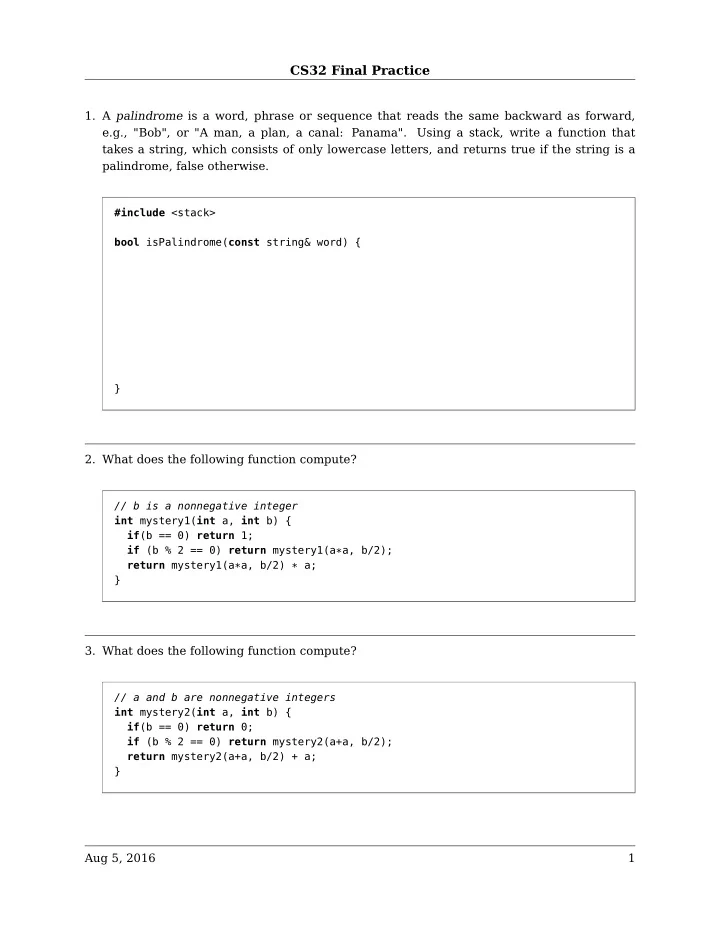
e.g., "Bob", or "A man, a plan, a canal: Panama". Using a stack, write a function that takes a string, which consists of only lowercase letters, and returns true if the string is a palindrome, false otherwise.

#include <stack> bool isPalindrome(const string& word) { }

  • 2. What does the following function compute?

// b is a nonnegative integer int mystery1(int a, int b) { if(b == 0) return 1; if (b % 2 == 0) return mystery1(a*a, b/2); return mystery1(a*a, b/2) * a; }

  • 3. What does the following function compute?

// a and b are nonnegative integers int mystery2(int a, int b) { if(b == 0) return 0; if (b % 2 == 0) return mystery2(a+a, b/2); return mystery2(a+a, b/2) + a; }

Aug 5, 2016 1

slide-2
SLIDE 2

CS32 Final Practice

  • 4. Write a recursive function that takes an array of integers and its size as inputs, and prints

its elements in reverse order, e.g., given the array 1 5 4 7 , it should print 7 4 5 1 .

void printInReverseOrder(const int array[], int size) { }

  • 5. Draw a binary search tree with height 2 whose in-order traversal prints the nodes in the

following order (there may be more than one such tree):

2, 3, 4, 5, 6, 8.

After that, state the outputs of post-order and pre-order traversals of this tree. Aug 5, 2016 2

slide-3
SLIDE 3

CS32 Final Practice

  • 6. Consider a full binary tree, where each internal node has exactly two children. An internal

node N is called leftist iff both subtrees rooted at the children of N are leftist and the smallest element in the left subtree of N is bigger than the biggest element in the right subtree of N. A leaf node is called leftist by default. A full binary tree is leftist iff each of its nodes is leftist. Write a recursive function that takes a non-empty full binary tree, and returns true if the tree is leftist. You may need to define auxiliary functions.

struct Node { int data; Node* left; Node* right; }; bool isLeftist(const Node* node) { //node is non-empty }

Aug 5, 2016 3