CS 251 Fall 2019 CS 251 Fall 2019 PL = P rogramming L anguage - - PowerPoint PPT Presentation

cs 251 fall 2019 cs 251 fall 2019 pl p rogramming l
SMART_READER_LITE
LIVE PREVIEW

CS 251 Fall 2019 CS 251 Fall 2019 PL = P rogramming L anguage - - PowerPoint PPT Presentation

CS 251 Fall 2019 CS 251 Fall 2019 PL = P rogramming L anguage Principles of Programming Languages Principles of Programming Languages Ben Wood Ben Wood 1. What is a PL? 2. What goes into PL design? The Plan 3. How is a PL defined? 4.


slide-1
SLIDE 1

CS 251 Fall 2019 Principles of Programming Languages

Ben Wood

λ

CS 251 Fall 2019

Principles of Programming Languages

Ben Wood

λ

https://cs.wellesley.edu/~cs251/f19/

The Plan

Plan 1

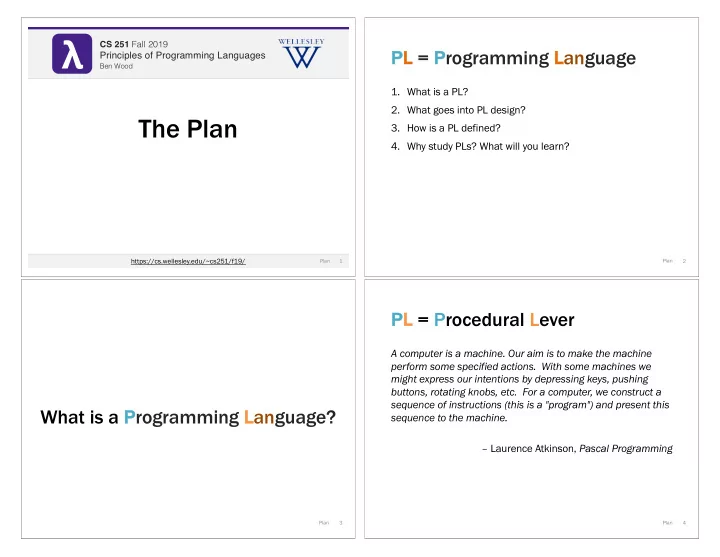
PL = Programming Language

  • 1. What is a PL?
  • 2. What goes into PL design?
  • 3. How is a PL defined?
  • 4. Why study PLs? What will you learn?

Plan 2 Plan 3

What is a Programming Language? PL = Procedural Lever

A computer is a machine. Our aim is to make the machine perform some specified actions. With some machines we might express our intentions by depressing keys, pushing buttons, rotating knobs, etc. For a computer, we construct a sequence of instructions (this is a "program") and present this sequence to the machine. – Laurence Atkinson, Pascal Programming

Plan 4

slide-2
SLIDE 2

PL = Presentation of Logic

… a computer language is not just a way of getting a computer to perform operations but rather that it is a novel formal medium for expressing ideas about methodology. Thus, programs must be written for people to read, and only incidentally for machines to execute. – Harold Abelson and Gerald J. Sussman, Structure and Interpretation of Computer Programs

Plan 5

PL = Problem-solving Lens

A good programming language is a conceptual universe for thinking about programming. A language that doesn't affect the way you think about programming is not worth knowing. – Alan Perlis

Plan 6

PL

Co Contract / A / API

PL = Precise Laws

Plan 7

Determine what and how abstractions can be expressed and manipulated.

Im Implementer / / Des Designer ner Us User / Client

Big idea #1: Abstraction

  • - Wellesley CS 111

Enable precise manual and automated reasoning about properties of programs.

PL PL PL PL PL PL PL PL PL PL PL PL PL PL PL

Plan 8

What goes into PL design?

slide-3
SLIDE 3

PL design: application / purpose

General computation Domain-specific computation Motivating application

Plan 9

Python

FORTRAN

C/C++ Java

Rac Racket

ML

Haskell CommonLisp

Perl Ruby

JavaScript

Sc Scala C# C# Rust IDL

CSS

PostScript

HT HTML

OpenGL

LaTeX Excel

Matlab

R

Digital Amati JINJA

D3 D3.js jQ jQuery

Computability

Tu Turing-co comple lete = equivalent to key models of computation

– Tu Turing machine (CS 235) – (L (Lambda) ) λ-ca calcu culus (CS 251) – …

Ch Church-Tu Turing thesis: Turing-complete = computable ⇒ All Turing-complete PLs (roughly, general-purpose PLs or just "PLs") – have "same" computational "power"; and – can express all possible computations; but

  • the ease, concision, elegance, clarity, modularity, abstractness, efficiency, style,
  • f these computations may vary radically across such languages.

Plan 10

PL design: goals/values

PL design affects goals/values for programs:

– Correctness, Reliability, Security – Clarity, Explainability, Learnability, Analyzability, Audibility – Fairness, Privacy – Maintainability, Extensibility – Efficiency (of programs, programmers), Optimizability – Creativity, Expressivity, Flexibility – …

Plan 11

"Programming paradigms"

  • Im

Imperative: execute step-by-step statements to change mutable state. Lens: statements, execution, mutation, side effects.

  • Fu

Functional: compose functions over immutable data. Lens: expressions, evaluation, results, composition.

  • Ob

Object-or

  • riented: pass (typically imperative) messages

between objects. Lens: behaviors, methods, encapsulation, extension.

  • De

Deduc ductive: query over declarative relationships. Lens: relations, implications, constraints, satisfiability.

  • Plenty

ty more… Imprecisely defined, overlapping. Most PLs blend a few.

Plan 12

slide-4
SLIDE 4

Quicksort

Plan 13 void qsort(int a[], int lo, int hi) { int h, l, p, t; if (lo < hi) { l = lo; h = hi; p = a[hi]; do { while ((l < h) && (a[l] <= p)) l = l+1; while ((h > l) && (a[h] >= p)) h = h-1; if (l < h) { t = a[l]; a[l] = a[h]; a[h] = t; } } while (l < h); a[hi] = a[l]; a[l] = p; qsort( a, lo, l-1 ); qsort( a, l+1, hi ); } }

Imperative Style (C; Java would be similar) Fu Functional Style (SML)

fun qsort [] = [] | qsort (x::xs) = let (lt, ge) = List.partition (fn n => n < x) xs in (qsort lt) @ (x :: (qsort ge)) end

PL design: dimensions

  • Fi

First-class va values: What can be named, passed as an argument, returned as a result, stored in a data structure?

  • Na

Naming: Do variables/parameters name expressions, values, or storage cells? How are names declared, referenced, scoped?

  • St

State: What is mutable or immutable?

  • Co

Control: Conditionals, pattern matching, loops, exception handling, continuations, parallelism, concurrency?

  • Da

Data: Products (arrays, tuples, records, maps), sums (options,

  • ne-ofs, variants), objects with behavior?
  • Ty

Types: Static? Dynamic? Polymorphic? Abstract? First-class?

Plan 14 Plan 15

How is a PL defined? Defining a programming language

Sy Syntax: fo form of a PL

– Structure of programs: symbols and grammar – Concrete syntax vs. abstract syntax trees (ASTs)

Se Semantics: me meaning of a PL

– Dy Dynamic Semantics: Behavior, actions, results of programs wh when evaluated.

  • Ev

Evaluati tion rules es: What is the result or effect of evaluating each language construct? How are these composed? – St Static Semantics: Properties of programs determined wi without evaluation.

  • Sc

Scope rules: to which declaration may a variable reference refer?

  • Ty

Type rules: is a program well-typed (and therefore legal)?

Plan 16

slide-5
SLIDE 5

Syntax (form) vs. Semantics (meaning)

Fu Furiously sleep ideas green colorless. Color Colorle less g green i ideas s sle leep f furiou

  • usly

ly. Li Little br brown rabbi abbits sleep soundly.

Plan 17

Concrete syntax: absolute value function

Lo Logo: to abs :n ifelse :n < 0 [output (0 - :n)] [output :n] end JS JS: function abs(n) {if (n<0) return -n; else return n;} Ja Java: static int abs(int n) {if (n<0) return -n; else return n;} Py Python: Ap App Invent ntor: def abs(n): if n < 0: return -n else: return n Ra Racket: (define abs (lambda (n) (if (< n 0) (- n) n))) Po PostScript: /abs {dup 0 lt {0 swap sub} if} def Fo Forth: : abs dup 0 < if 0 swap - then ;

Plan 18

Abstract Syntax Tree (AST): absolute value function

Plan 19

varref return n return intlit relationalExpression varref n conditionalStatement functionDeclaration abs n condition else then body params name name name arithmeticExpression value subtract varref n name value intlit lessThan value

  • p

e r a t

  • r
  • perand1
  • perand2

This AST abstracts the concrete syntax for the Logo, JavaScript, and Python definitions. The

  • ther definitions would have

different ASTs.

  • perand1
  • perand2
  • p

e r a t

  • r

Dynamic semantics examples

What is the meaning of the following expression?

(1 + 11) * 10

What is printed by the following program?

a = 1; b = a + 20; print(b); a = 300; print(b); count = 0; fun inc() { count = count + 1; return count; } fun dbl(ignore, x) { return x + x; } print(dbl(inc(), inc());

Plan 20

slide-6
SLIDE 6

Static semantics example: type checking

Plan 21

Which of the following Java examples can be well-typed (i.e., pass the type checker)? How do you know? What assumptions are you making?

2 * (3 + 4) 2 < (3 + 4) 2 < True if (a < b) { c = a + b; } else { c = a * b; } if (a) { c = a + b; } else { c = a * b; } if (a < b) { c = a + b; } else { c = a > b; } public boolean f(int i, boolean b) { return b && (i > 0); } public int g(int i, boolean b) { return i * (b ? 1 : -1); } public int p(int w) { if (w > 0) { return 2*w; } } public int q(int x) { return x > 0; } public int r(int y) { return g(y, y>0); } public boolean s(int z) { return f(z); } A B C D E F G H I J K L

Static semantics example: termination checking

Plan 22

Which of these Python programs has inputs for which it does not terminate (runs forever)?

def f(x): return x+1 def g(x): while True: pass return x def h2(x): if x <= 0: return x else: return h2(x+1) def h(x): while x > 0: x = x+1 return x def g2(x): return g2(x) def collatz(x): while x != 1: if (x % 2) == 0: x = x/2 else: x = 3*x + 1 return 1

Static semantics

Properties of programs determined wi without evaluation.

– Sc Scope: To which declarations do variable references refer? – Ty Types: What are the types of entities in the program? – …

Go Goal: Accept only (and all) sa safe programs free of various problems.

Will any evaluation of this program ever:

– reference a nonexistent variable? – index outside an array's bounds? dereference null? divide by zero? – apply an array operation to an integer? – coordinate concurrency unsafely? – access a given object again? surpass a given memory budget? – leak sensitive information over the network? – ... not terminate (run forever)? reach a given point in the program? – …

Re Reality: Most useful static semantics questions for Turing-complete languages are unco uncomput utab able! (Rice's Theorem, CS 235)

Plan 23

PL implementation

PLs are implemented by me metaprograms ms, programs in an implementation language that manipulate programs in a source language.

  • An in

interpreter ev evaluates a program in the source language.

A pr processor is an interpreter implemented in physical hardware.

  • A co

compiler tr translates a program in the source language to a program in a target language.

  • An em

embed edding de defines the features of the source (a.k.a. guest) language directly as data structures, functions, macros, or other features of a host language.

Plan 24

slide-7
SLIDE 7

Program analysis

Automated reasoning about program properties

But isn't that uncomputable?

Pr Prog

  • gram analysis: effective solutions to unsolvable problems™

– Conservative static analysis – Dynamic analysis – Hybrid analysis – Extend the language to make more explicit – Static semantics = integrate language and analysis

Plan 25 Plan 26

Why study PLs? What will you learn? Why study PLs?

Be Be a more effective pr programmer and compu puter scientist:

– Leverage powerful features, idioms, and tools. – Think critically about PL design trade-offs and their implications for your values. – Learn, evaluate, compare, choose languages. – Communicate technical ideas, problems, and solutions precisely.

Ap Approach ch problem-so solvin ing as s a la language desig igner / pr program analyst:

– Problem-solving = designing the language of your problem and its solutions. – You may not design a general-purpose PL, but you will design a DSL. – API and library design = language design = DSL.

Br Broad active area of research:

– Invent better general-purpose programming tools, features, analyses. – Apply PL mindset to broader problem domains and applications, e.g.:

  • Analyze/enforce fairness/non-bias, privacy, security properties.
  • High-performance/high-assurance DSLs for machine learning, graphics, Uis, data science.
  • Model and control biochemical systems.
  • Automated verification of website accessibility compliance.
  • Support large-scale systems programming or specialized hardware.

Plan 27

Plan

1. 1. Ho How to Program

– Topics: syntax, dynamic semantics, functional programming – Lens: Racket

2. 2. Wh What's in a Type

– Topics: static types, data, patterns, abstractions – Lens: Standard ML

3. 3. Wh When Things Happen

– Topics: evaluation order, parallelism, concurrency – Lens: Standard ML/Manticore?, Java, …

4. 4. Wh Why a Broader PL Mindset

– Topics: problem decomposition, deductive programming, program analysis, DSLs – Lens: Racket, Standard ML, Java, Prolog/Datalog, …

Expect some adjustments.

Plan 28

Metaprogramming

slide-8
SLIDE 8

Administrivia

Ev Everything is here: ht https://cs.wellesley.edu/~c ~cs25 251/ 1/

– Material posted ahead of class meetings.

  • PYO: Print your own if you like taking notes on slide copies.

– First assignment out soon, due in a week. – New space: SCI L037 CS Systems Lab, mo mostly finished…

  • Expect a couple hiccups as we iron out a few things.
  • Potential experiments with class format dependent on these.

– Expect assignments to require:

  • deep thought, sometimes to discover a surprisingly concise solution;
  • independently extending / learning ideas beyond lecture coverage.

Learning is an adventure in an unknown land. Explore and experiment!

– Enjoying PLs? Reading group forming soon…

Plan 29