CS 251 Fall 2019 CS 251 Fall 2019 OO essence: Principles of - - PowerPoint PPT Presentation

cs 251 fall 2019 cs 251 fall 2019 oo essence principles
SMART_READER_LITE
LIVE PREVIEW

CS 251 Fall 2019 CS 251 Fall 2019 OO essence: Principles of - - PowerPoint PPT Presentation

CS 251 Fall 2019 CS 251 Fall 2019 OO essence: Principles of Programming Languages Principles of Programming Languages Ben Wood Ben Wood Program design principles? Subtyping Objects model state/behavior of real-world


slide-1
SLIDE 1

CS 251 Fall 2019 Principles of Programming Languages

Ben Wood

λ

CS 251 Fall 2019

Principles of Programming Languages

Ben Wood

λ

https://cs.wellesley.edu/~cs251/f19/

Subtyping and Substitutivity

1 Subtyping

OO essence:

  • Program design principles?

– Objects model state/behavior of real-world entities/concepts? Kinda – Organization by classification and encapsulation – Reuse via implicit extensibility

  • Key semantics:

– Late binding / dynamic dispatch – Su Substitutability and subtyping – Inheritance or delegation

Will contrast function-oriented principles/semantics later.

Subtyping 2

Subtyping and substitutability

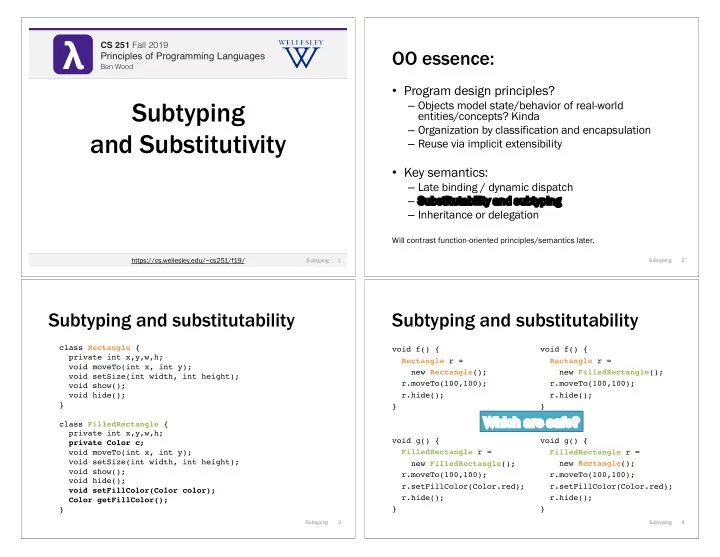
class Rectangle { private int x,y,w,h; void moveTo(int x, int y); void setSize(int width, int height); void show(); void hide(); } class FilledRectangle { private int x,y,w,h; private Color c; void moveTo(int x, int y); void setSize(int width, int height); void show(); void hide(); void setFillColor(Color color); Color getFillColor(); }

Subtyping 3

Subtyping and substitutability

void f() { Rectangle r = new Rectangle(); r.moveTo(100,100); r.hide(); } void g() { FilledRectangle r = new FilledRectangle(); r.moveTo(100,100); r.setFillColor(Color.red); r.hide(); } void f() { Rectangle r = new FilledRectangle(); r.moveTo(100,100); r.hide(); } void g() { FilledRectangle r = new Rectangle(); r.moveTo(100,100); r.setFillColor(Color.red); r.hide(); }

Wh Which are e safe? e?

Subtyping 4

slide-2
SLIDE 2

Subtyping: broad definitions

Jo Job of type system: If If a program type-checks, th then evaluation of the program never applies an operation to an incompatible value. Ne New type relation: T <: U "Type T is a subtype of type U." Sound on

  • nly if all operations that are valid on values of type U

are also valid on values of type T. Ne New type-ch checki cking rule le: If If e : T and T <: U th then e : U. Principle: substitutability.

5 Subtyping

Type variable instantiation is NO NOT subtyping.

Parametric polymorphism ≠ subtype polymorphism map : ('a -> 'b) -> 'a list -> 'b list f : int -> int xs : int list (map f xs) : int list ß type-check

type variable instantiation: 'a = int, 'b = int ML ML has no su subtyping

Subtyping 6

A made-up language for subtyping data

  • Can cover most core subtyping ideas by

considering re records wi with mutable fields

  • Make up our own syntax

– ML records, no subtyping or field-mutation – Racket and Smalltalk: no static type system – Java is verbose

7 Subtyping

Mutable Records (made-up lang.)

(half like ML, half like Java)

Record cr creat ation (field names and contents): Evaluate all ei, make a record Record field acce access: Evaluate e to record v with an f field, get contents of f field Record field up update Evaluate e1 to a record v1 and e2 to a value v2; Change v1's f field (which must exist) to v2; Return v2

Subtyping 8

{f1=e1, f2=e2, …, fn=en}

e.f e1.f = e2

slide-3
SLIDE 3

A Basic Type System

Re Record ty types: fields a record has, type for each field Ty Type-ch check ecking expressions:

  • If e1 : t1, …, en : tn

then {f1=e1,…,fn=en} : {f1:t1,…,fn:tn}

  • If e : {…,f:t,…}

then e.f : t

  • If e1 : {…,f:t,…} and e2 : t,

then e1.f = e2 : t

9

{f1:t1, f2:t2, …, fn:tn}

Subtyping

Type system is so sound (safe).

Does this program type check? Can it ever try to access a non-existent field?

10

fun distToOrigin (p:{x:real,y:real}) = Math.sqrt(p.x*p.x + p.y*p.y) val p : {x:real,y:real} = {x=3.0, y=4.0} val five : real = distToOrigin(p)

Subtyping

Type system is so sound (safe).

Does this program type check? Can it ever try to access a non-existent field?

11

fun distToOrigin (p:{x:real,y:real}) = Math.sqrt(p.x*p.x + p.y*p.y) val c : {x:real,y:real,color:string} = {x=3.0, y=4.0, color="green"} val five : real = distToOrigin(c)

But type system is (too?) conservative.

Subtyping

Why not allow extra fields?

Na Natural idea of related types: if expression has type {f1 : t1, f2 : t2, ..., fn : tn} Then it also can have a type with a subset of those fields.

12

fun distToOrigin (p:{x:real,y:real}) = … fun makePurple (p:{color:string}) = p.color = "purple" val c :{x:real,y:real,color:string} = {x=3.0, y=4.0, color="green"} val _ = distToOrigin(c) val _ = makePurple(c)

Subtyping

slide-4
SLIDE 4

Changing the type system

So Soluti ution: n: 2 additions, no changes

– su subtypi ping rel relation: t1 <: t2 "t1 is a subtype of t2" – ne new ty typing ng ru rule: If e : t1 and t1 <: t2, then (also) e : t2

No Now def efine e t1 <: t2

13 Subtyping

4 reasonable subtyping rules

Pr Princ nciple: su substitutability If t1 <: t2, then values of type t1 must be usable in every way values of type t2 are. 1. 1. “Wi Width” subtyping: A supertype can have a subset of fields with the same types. 2. 2. “P “Permutation” ” su subtyping: A supertype can have the same set of fields with the same types in a different order. 3. 3. Tr Transitivity: If t1 <: t2 and t2 <: t3, then t1 <: t3. 4. 4. Re Reflex exivity: Every type is a subtype of itself: t <: t

May seem unnecessary, but simplifies other rules in large languages

14 Subtyping

Depth subtyping?

Does this currently type-check? Does it ever try to use non-existent fields? How could we change the type system to allow it? Should we?

15

fun circleY (c:{center:{x:real,y:real}, r:real}) = c.center.y val sphere:{center:{x:real,y:real,z:real}, r:real} = {center={x=3.0,y=4.0,z=0.0}, r=1.0} val _ = circleY(sphere)

Subtyping

Depth subtyping?

Ty Type checks only if: {center:{x:real,y:real,z:real}, r:real} <: {center:{x:real,y:real}, r:real}

16

fun circleY (c:{center:{x:real,y:real}, r:real}) = c.center.y val sphere:{center:{x:real,y:real,z:real}, r:real} = {center={x=3.0,y=4.0,z=0.0}, r=1.0} val _ = circleY(sphere)

Subtyping

slide-5
SLIDE 5

Adding depth subtyping

Ne New subt btyping ru rule: If ta <: tb, then {f1:t1, …, f:ta, …, fn:tn} <: {f1:t1, …, f:tb, …, fn:tn} Does it type-check now?

17

fun circleY (c:{center:{x:real,y:real}, r:real}) = c.center.y val sphere:{center:{x:real,y:real,z:real}, r:real} = {center={x=3.0,y=4.0,z=0.0}, r=1.0} val _ = circleY(sphere)

Subtyping

St Stop!

We added a new subtyping rule to make type system more flexible. Bu But is it sound? Does it allow any program that accesses non- existent fields?

18 Subtyping

Mutation strikes again

19

fun setToOrigin (c:{center:{x:real,y:real}, r:real})= c.center = {x=0.0, y=0.0} val sphere:{center:{x:real,y:real,z:real}, r:real} = {center={x=3.0, y=4.0, z=0.0}, r=1.0} val _ = setToOrigin(sphere) val _ = sphere.center.z (* kaboom! (no z field) *)

Subtyping

Moral of the story

In a language with records/objects with mu mutable fields, de dept pth subtypi ping is uns unsound und. Su Subtyping ca canno nnot t allow ch changi nging ng th the typ type of mu mutable fields. If fields are im immutable, then de dept pth subtypi ping is sound! Choose at most two of three:

– mutability – depth subtyping – soundness

20 Subtyping

slide-6
SLIDE 6

Subtyping mistakes: Java (really)

if t1 <: t2, then t1[] <: t2[]

"Covariant array subtyping"

21

class Point { … } class ColorPoint extends Point { … } … void replaceFirst(Point[] pts) { pts[0] = new Point(3,4); } String m2(int x) { ColorPoint[] cpts = new ColorPoint[x]; for(int i=0; i < x; i++) cpts[i] = new ColorPoint(0,0,"green"); replaceFirst(cpts); return cpts[0].color; }

Subtyping

!!! !!!

What???

Wh Why allow it?

Object[] System.arrayCopy(Object[] src) {…} Seemed especially important before generics

Wh What goes wrong? "F "Fix:" :" dynamic checking on every non-primitive array store.

22

ArrayStoreException

Subtyping

!!! !!!

From Bill Joy (Sun Cofounder)

Date: Fri, 09 Oct 1998 09:41:05 -0600 From: bill joy Subject: …[discussion about java genericity] actually, java array covariance was done for less noble reasons …: it made some generic "bcopy" (memory copy) and like operations much easier to write... I proposed to take this out in 95, but it was too late (...). i think it is unfortunate that it wasn't taken out... it would have made adding genericity later much cleaner, and [array covariance] doesn't pay for its complexity today. wnj

Subtyping 23

!!! !!!

Hypothetical:

Allow subclass C to change type of field from superclass in scope of C

– To unrelated type – To supertype of field's original type – To subtype of field's original type

Which ones go wrong?

24 Subtyping

!!! !!!

slide-7
SLIDE 7

null -- the "billion-dollar mistake"

Chose subtyping flexibility over safety

– null has no fields or methods – Java and C# static type systems let it have an any

  • bject type

– Evaluating e in e.f or e.m(…) could always produce a value without f or m! – Run-time checks and errors... that should be static type errors.

ML gets this right:

  • ptions make potential lack of thing explicit.

– Many languages finally moving this direction.

Subtyping 25

  • - C. A. R. Hoare

!!! !!!

NullPointerException

Function/method subtyping: boring part

Point getLocation() { return new ColorPoint(0.0, 0.0, "red"); } void plot(Point p) {…} … plot(new ColorPoint(1.0,2.0,"red")); ColorPoint findRedDot() {…} … Point p = findRedDot();

26

✓ ✓ ✓

Subtyping

Function/method subtyping: interesting part

When is one function type a subtype of another?

– Fo For higher-or

  • rde

der function

  • ns:

If a function expects an argument of type t1->t2, can you pass a function of type t3->t4 instead? – Fo For overriding: If a superclass has a method of type t1->t2, can you override it with a method of type t3->t4? – See Subtype.java.

27 Subtyping

Function/method subtyping

Ar Argument types are co contravariant.

  • >

Re Return types are co covariant.

28

supertype subtype

ColorPoint -> ColorPoint Point -> Point Point -> ColorPoint ColorPoint -> Point

< : <: <: <:

Subtyping

slide-8
SLIDE 8

How special is this?

Is this co contravariant (like arguments) or co covariant?

– Cov

  • variant: method in subclass can use subclass fields

and methods not defined in superclass! – Sound: calls always use “whole object” for this

29

class A { int m() { return 0; } } class B extends A { int x; int m() { return this.x; } }

B <: A ✓ A.this <: B.this ? B <: A ⇒ B.this <: A.this ✓

Subtyping

Remember!

If t3 <: t1 and t2 <: t4, then t1->t2 <: t3->t4 No Non-ne negotiable: Function/method subtyping is:

– contravariant in the argument – covariant in the result

30 Subtyping