
SLIDE 1
Hard Problems
- Some problems are hard to solve.
No polynomial time algorithm is known. E.g., NP-hard problems such as machine scheduling, bin packing, 0/1 knapsack.
- Is this necessarily bad?
- Data encryption relies on difficult to solve
problems.
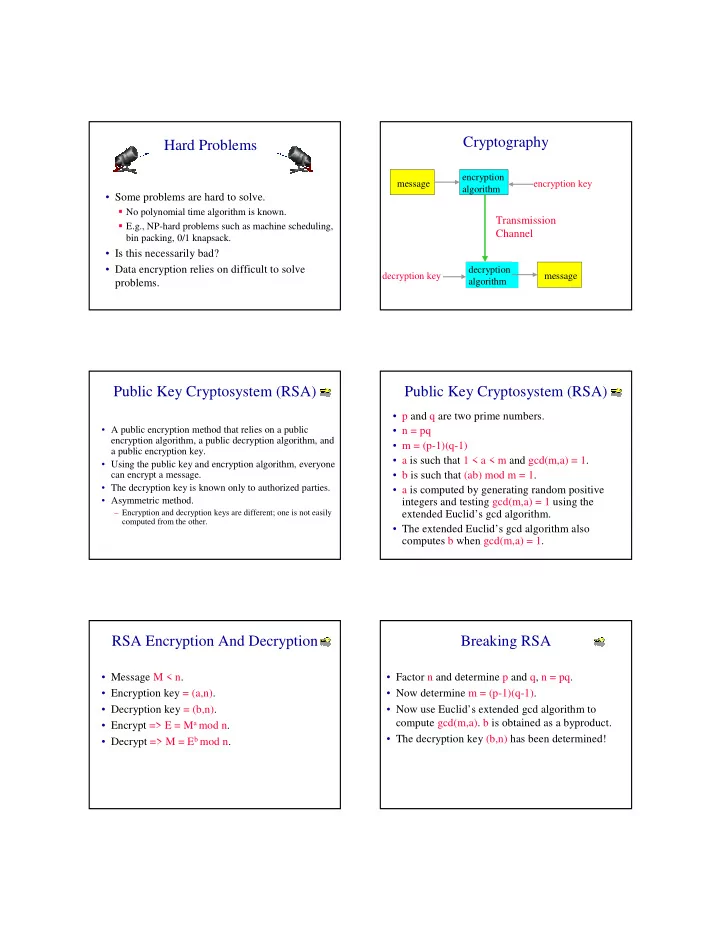
Cryptography
decryption algorithm encryption algorithm message message
Transmission Channel
encryption key decryption key
Public Key Cryptosystem (RSA)
- A public encryption method that relies on a public
encryption algorithm, a public decryption algorithm, and a public encryption key.
- Using the public key and encryption algorithm, everyone
can encrypt a message.
- The decryption key is known only to authorized parties.
- Asymmetric method.
– Encryption and decryption keys are different; one is not easily computed from the other.
Public Key Cryptosystem (RSA)
- p and q are two prime numbers.
- n = pq
- m = (p-1)(q-1)
- a is such that 1 < a < m and gcd(m,a) = 1.
- b is such that (ab) mod m = 1.
- a is computed by generating random positive
integers and testing gcd(m,a) = 1 using the extended Euclid’s gcd algorithm.
- The extended Euclid’s gcd algorithm also
computes b when gcd(m,a) = 1.
RSA Encryption And Decryption
- Message M < n.
- Encryption key = (a,n).
- Decryption key = (b,n).
- Encrypt => E = Ma mod n.
- Decrypt => M = Eb mod n.
Breaking RSA
- Factor n and determine p and q, n = pq.
- Now determine m = (p-1)(q-1).
- Now use Euclid’s extended gcd algorithm to
compute gcd(m,a). b is obtained as a byproduct.
- The decryption key (b,n) has been determined!