Cryptography Hard Problems encryption message encryption key - - PDF document

cryptography hard problems
SMART_READER_LITE
LIVE PREVIEW

Cryptography Hard Problems encryption message encryption key - - PDF document

Cryptography Hard Problems encryption message encryption key algorithm Some problems are hard to solve. No polynomial time algorithm is known. Transmission E.g., NP-hard problems such as machine scheduling, Channel bin packing,


slide-1
SLIDE 1

Hard Problems

  • Some problems are hard to solve.

No polynomial time algorithm is known. E.g., NP-hard problems such as machine scheduling, bin packing, 0/1 knapsack.

  • Is this necessarily bad?
  • Data encryption relies on difficult to solve

problems.

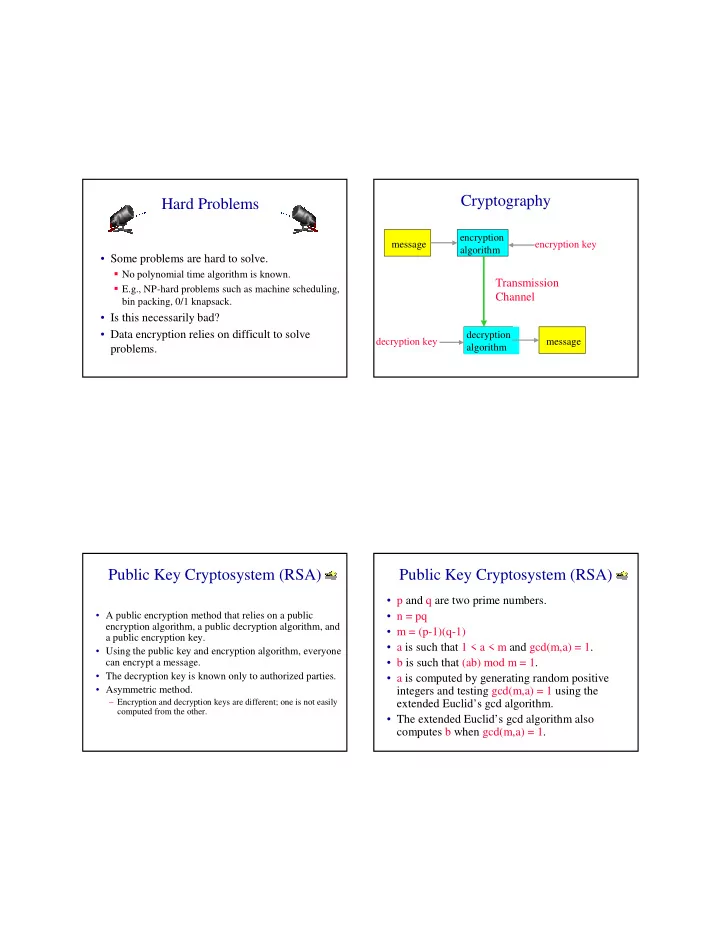
Cryptography

decryption algorithm encryption algorithm message message

Transmission Channel

encryption key decryption key

Public Key Cryptosystem (RSA)

  • A public encryption method that relies on a public

encryption algorithm, a public decryption algorithm, and a public encryption key.

  • Using the public key and encryption algorithm, everyone

can encrypt a message.

  • The decryption key is known only to authorized parties.
  • Asymmetric method.

– Encryption and decryption keys are different; one is not easily computed from the other.

Public Key Cryptosystem (RSA)

  • p and q are two prime numbers.
  • n = pq
  • m = (p-1)(q-1)
  • a is such that 1 < a < m and gcd(m,a) = 1.
  • b is such that (ab) mod m = 1.
  • a is computed by generating random positive

integers and testing gcd(m,a) = 1 using the extended Euclid’s gcd algorithm.

  • The extended Euclid’s gcd algorithm also

computes b when gcd(m,a) = 1.

slide-2
SLIDE 2

RSA Encryption And Decryption

  • Message M < n.
  • Encryption key = (a,n).
  • Decryption key = (b,n).
  • Encrypt => E = Ma mod n.
  • Decrypt => M = Eb mod n.

Breaking RSA

  • Factor n and determine p and q, n = pq.
  • Now determine m = (p-1)(q-1).
  • Now use Euclid’s extended gcd algorithm to

compute gcd(m,a). b is obtained as a byproduct.

  • The decryption key (b,n) has been determined!

Security Of RSA

  • Relies on the fact that prime factorization is

computationally very hard.

  • Let q be the number of bits in the binary

representation of n.

  • No algorithm, polynomial in q, is known to find

the prime factors of n.

  • Try to find the factors of a 100 bit number.

Elliptic Curve Cryptography (ECC)

  • Asymmetric Encryption Method

– Encryption and decryption keys are different; one is not easily computed from the other.

  • Relies on difficulty of computing the discrete

logarithm problem for the group of an elliptic curve over some finite field.

– Galois field of size a power of 2. – Integers modulo a prime.

  • 1024-bit RSA ~ 200-bit ECC (cracking difficulty).
  • Faster to compute than RSA?
slide-3
SLIDE 3

Data Encryption Standard

  • Used for password encryption.
  • Encryption and decryption keys are the same,

and are secret.

  • Relies on the computational difficulty of the

satisfiability problem.

  • The satisfiability problem is NP-hard.

Satisfiability Problem

  • The permissible values of a boolean variable

are true and false.

  • The complement of a boolean variable x is

denoted x.

  • A literal is a boolean variable or the

complement of a boolean variable.

  • A clause is the logical or of two or more

literals.

  • Let x1, x2, x3, …, xn be n boolean variables.

Satisfiability Problem

  • Example clauses:

x1+ x2 + x3 x4+ x7 + x8 x3+ x7 + x9 + x15 x2+ x5

  • A boolean formula (in conjunctive normal form

CNF) is the logical and of m clauses.

  • F = C1C2C3…Cm

Satisfiability Problem

  • F = (x1+ x2 + x3)( x4+ x7 + x8)(x2+ x5)
  • F is true when x1, x2, and x4 (for e.g.) are true.
slide-4
SLIDE 4

Satisfiability Problem

  • A boolean formula is satisfiable iff there is at

least one truth assignment to its variables for which the formula evaluates to true.

  • Determining whether a boolean formula in CNF

is satisfiable is NP-hard.

  • Problem is solvable in polynomial time when

no clause has more than 2 literals.

  • Remains NP-hard even when no clause has

more than 3 literals.

Other Problems

  • Partition

Partition n positive integers s1, s2, s3, …, sn into two groups A and B such that the sum of the numbers in each group is the same. [9, 4, 6, 3, 5, 1,8] A = [9, 4, 5] and B = [6, 3, 1, 8]

  • NP-hard.

Subset Sum Problem

  • Does any subset of n positive integers s1, s2,

s3, …, sn have a sum exactly equal to c?

  • [9, 4, 6, 3, 5, 1,8] and c = 18
  • A = [9, 4, 5]
  • NP-hard.

Traveling Salesperson Problem (TSP)

  • Let G be a weighted directed graph.
  • A tour in G is a cycle that includes every vertex
  • f the graph.
  • TSP => Find a tour of shortest length.
  • Problem is NP-hard.
slide-5
SLIDE 5

Applications Of TSP

Home city Visit city

Applications Of TSP

  • Each vertex represents a city that is in Joe’s

sales district.

  • The weight on edge (u,v) is the time it takes

Joe to travel from city u to city v.

  • Once a month, Joe leaves his home city, visits

all cities in his district, and returns home.

  • The total time he spends on this tour of his

district is the travel time plus the time spent at the cities.

  • To minimize total time, Joe must use a

shortest-length tour.

Applications Of TSP

  • Tennis practice.
  • Start with a basket of approximately 200 tennis

balls.

  • When balls are depleted, we have 200 balls lying
  • n and around the court.
  • The balls are to be picked up by a robot (more

realistically, the tennis player).

  • The robot starts from its station visits each ball

exactly once (i.e., picks up each ball) and returns to its station.

Applications Of TSP

Robot Station

slide-6
SLIDE 6

Applications Of TSP

  • 201 vertex TSP.
  • 200 tennis balls and robot station are the

vertices.

  • Complete directed graph.
  • Length of an edge (u,v) is the distance between

the two objects represented by vertices u and v.

  • Shortest-length tour minimzes ball pick up time.
  • Actually, we may want to minimize the sum of

the time needed to compute a tour and the time spent picking up balls using the computed tour.

Applications Of TSP

  • Manufacturing.
  • A robot arm is used to drill n holes in a metal

sheet. n+1 vertex TSP.

Robot Station

n-Queens Problem

A queen that is placed on an n x n chessboard, may attack any piece placed in the same column, row, or diagonal.

8x8 Chessboard

n-Queens Problem

Can n queens be placed on an n x n chessboard so that no queen may attack another queen?

4x4

slide-7
SLIDE 7

n-Queens Problem

8x8

Difficult Problems

  • Many require you to find either a subset or

permutation that satisfies some constraints and (possibly also) optimizes some

  • bjective function.
  • May be solved by organizing the solution

space into a tree and systematically searching this tree for the answer.

Subset Problems

  • Solution requires you to find a subset of n

elements.

  • The subset must satisfy some constraints and

possibly optimize some objective function.

  • Examples.

Partition. Subset sum. 0/1 Knapsack. Satisfiability (find subset of variables to be set to true so that formula evaluates to true). Scheduling 2 machines. Packing 2 bins.

Permutation Problems

  • Solution requires you to find a permutation of n

elements.

  • The permutation must satisfy some constraints and

possibly optimize some objective function.

  • Examples.

TSP. n-queens.

Each queen must be placed in a different row and different column. Let queen i be the queen that is going to be placed in row i. Let ci be the column in which queen i is placed. c1, c2, c3, …, cn is a permutation of [1,2,3, …, n] such that no two queens attack.

slide-8
SLIDE 8

Solution Space

  • Set that includes at least one solution to the

problem.

  • Subset problem.

n = 2, {00, 01, 10, 11} n = 3, {000, 001, 010, 100, 011, 101, 110, 111}

  • Solution space for subset problem has 2n members.
  • Nonsystematic search of the space for the answer

takes O(p2n) time, where p is the time needed to evaluate each member of the solution space.

Solution Space

  • Permutation problem.

n = 2, {12, 21} n = 3, {123, 132, 213, 231, 312, 321}

  • Solution space for a permutation problem has n!

members.

  • Nonsystematic search of the space for the answer

takes O(pn!) time, where p is the time needed to evaluate a member of the solution space.