Cross-lingual Distributional Profiles of Concepts for Measuring - - PowerPoint PPT Presentation
Cross-lingual Distributional Profiles of Concepts for Measuring Semantic Distance Saif Mohammad, Iryna Gurevych, Graeme Hirst, and Torsten Zesch University of Toronto & Darmstadt University of Technology Semantic distance SALSA DANCE
Semantic distance
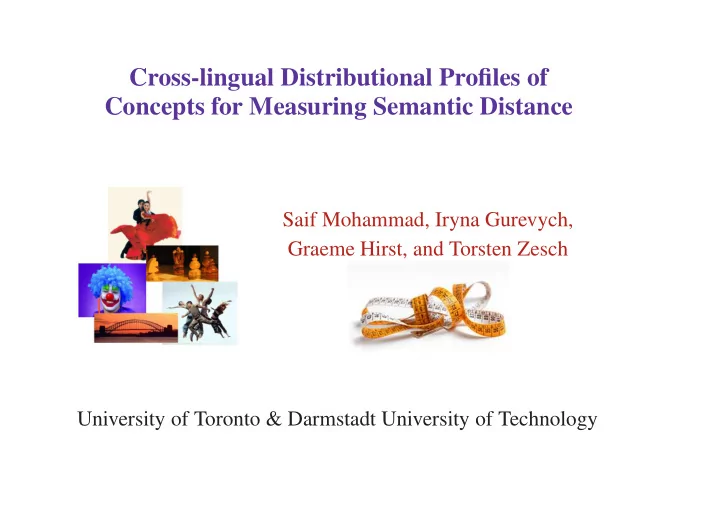
SALSA DANCE CLOWN BRIDGE
A measure of how close or distant two units of language are in terms of their meaning
Cross-lingual DPCs for measuring semantic distance. Saif Mohammad, Iryna Gurevych, Graeme Hirst, and Torsten Zesch. 2
Knowledge source–based semantic measures
- Structure of a network or resource
The nodes represent senses or concepts Examples: Resnik (1995), Jiang and Conrath (1997)
- Drawbacks
Resource bottleneck Not easily domain-adaptable Accuracy on pairs other than noun–noun is poor Relatedness estimation is poor Cross-lingual DPCs for measuring semantic distance. Saif Mohammad, Iryna Gurevych, Graeme Hirst, and Torsten Zesch. 3
Corpus-based distributional measures
- Words in similar contexts are close.
Distributional profile (DP) of a word: strength of
association of the word with co-occurring words in text
Cross-lingual DPCs for measuring semantic distance. Saif Mohammad, Iryna Gurevych, Graeme Hirst, and Torsten Zesch. 4
Example DPs of words
DP of star star: space 0.21, movie 0.16, famous 0.15, light 0.12, constellation 0.11, heat 0.08, rich 0.07, hydrogen 0.07, . . . DP of fusion fusion: heat 0.16, hydrogen 0.16, energy 0.13, bomb 0.09, light 0.09, space 0.04, . . .
Cross-lingual DPCs for measuring semantic distance. Saif Mohammad, Iryna Gurevych, Graeme Hirst, and Torsten Zesch. 5
Example DPs of words
DP of star star: space 0.21, movie 0.16, famous 0.15, light 0.12, constellation 0.11, heat 0.08, rich 0.07, hydrogen 0.07, . . . DP of fusion fusion: heat 0.16, hydrogen 0.16, energy 0.13, bomb 0.09, light 0.09, space 0.04, . . .
Cross-lingual DPCs for measuring semantic distance. Saif Mohammad, Iryna Gurevych, Graeme Hirst, and Torsten Zesch. 6
Corpus-based distributional measures
- Words in similar contexts are close.
Distributional profile (DP) of a word: strength of
association of the word with co-occurring words (text)
Distributional measure: distance between DPs
Cosine, Lin, α-skew divergence
- Drawbacks
Poor accuracy (albeit higher coverage) Conflation of word senses Cross-lingual DPCs for measuring semantic distance. Saif Mohammad, Iryna Gurevych, Graeme Hirst, and Torsten Zesch. 7
Problem with distributional word-distance measures
DP of star star: space 0.21, movie 0.16, famous 0.15, light 0.12, constellation 0.11, heat 0.08, rich 0.07, hydrogen 0.07, . . . DP of fusion fusion: heat 0.16, hydrogen 0.16, energy 0.13, bomb 0.09, light 0.09, space 0.04, . . .
Cross-lingual DPCs for measuring semantic distance. Saif Mohammad, Iryna Gurevych, Graeme Hirst, and Torsten Zesch. 8
Problem with distributional word-distance measures
DP of star star: space 0.21, movie 0.16, famous 0.15, light 0.12, constellation 0.11, heat 0.08, rich 0.07, hydrogen 0.07, . . . DP of fusion fusion: heat 0.16, hydrogen 0.16, energy 0.13, bomb 0.09, light 0.09, space 0.04, . . . Word sense ambiguity reduces accuracy of distance measures
Cross-lingual DPCs for measuring semantic distance. Saif Mohammad, Iryna Gurevych, Graeme Hirst, and Torsten Zesch. 9
Shared limitations
- Precomputing all distances is computationally expensive
WordNet-based measures:
117,000×117,000 sense–sense distance matrix
Distributional measures:
100,000×100,000 word–word distance matrix
- Monolingual
Cross-lingual DPCs for measuring semantic distance. Saif Mohammad, Iryna Gurevych, Graeme Hirst, and Torsten Zesch. 10
Our hybrid approach
(Mohammad and Hirst, EMNLP-2006)
- Combines a knowledge source with text
- Profiles concepts (rather than words)
- Uses thesaurus categories as concepts/coarse-grained
senses
Most published thesauri: around 1000 categories Concept–concept distance matrix: only 1000×1000
- Capable of giving both similarity and relatedness values
Cross-lingual DPCs for measuring semantic distance. Saif Mohammad, Iryna Gurevych, Graeme Hirst, and Torsten Zesch. 11
Distributional profiles of concepts
DPs of the concepts referred to by star: DP of ‘celestial body’ ‘celestial body’ (celestial body, sun, . . . ): space 0.36, light 0.27, constellation 0.11, hydrogen 0.07, . . . DP of ‘celebrity’ ‘celebrity’ (celebrity, hero, . . . ): famous 0.24, movie 0.14, rich 0.14, fan 0.10, . . .
Cross-lingual DPCs for measuring semantic distance. Saif Mohammad, Iryna Gurevych, Graeme Hirst, and Torsten Zesch. 12
Distance: star and fusion
First, consider the ‘celebrity’ sense of star: DP of ‘celebrity’ ‘celebrity’star: famous 0.24, movie 0.14, rich 0.14, fan 0.10, . . . DP of ‘fusion’ ‘fusion’: heat 0.16, hydrogen 0.16, energy 0.13, bomb 0.09, light 0.09, space 0.04, . . . Distributionally NOT close
Cross-lingual DPCs for measuring semantic distance. Saif Mohammad, Iryna Gurevych, Graeme Hirst, and Torsten Zesch. 13
Distance: star and fusion
Then, consider the ‘celestial body’ sense of star: DP of ‘celestial body’ ‘celestial body’: space 0.21, light 0.12, constellation 0.11, heat 0.08, hydrogen 0.07, . . . DP of ‘fusion’ ‘fusion’: heat 0.16, hydrogen 0.16, energy 0.13, bomb 0.09, light 0.09, space 0.04, . . . Distributionally close Word sense ambiguity NOT a problem
Cross-lingual DPCs for measuring semantic distance. Saif Mohammad, Iryna Gurevych, Graeme Hirst, and Torsten Zesch. 14
Our previous results
(Mohammad and Hirst, EMNLP-2006)
- Concept-distance better than word-distance
- Combining text and a knowledge source gives higher
accuracies
Cross-lingual DPCs for measuring semantic distance. Saif Mohammad, Iryna Gurevych, Graeme Hirst, and Torsten Zesch. 15
- But. . .
Application of distance algorithms in most languages is hindered by a lack of high-quality linguistic resources.
Cross-lingual DPCs for measuring semantic distance. Saif Mohammad, Iryna Gurevych, Graeme Hirst, and Torsten Zesch. 16
So: Make it cross-lingual
- A new way of determining distance in a resource-poor
language
By combining its text with a thesaurus from a (possibly
resource-rich) language
- Largely eliminates the knowledge-source bottleneck
Using a bilingual lexicon and a bootstrapping algorithm
- Without relying on parallel corpora or sense-annotated
data
- Experiments: German as a “resource-poor” language
Cross-lingual DPCs for measuring semantic distance. Saif Mohammad, Iryna Gurevych, Graeme Hirst, and Torsten Zesch. 17
Distance: German concepts
bilingual lexicon
BEOLINGUS
German text
(
taz ( English thesaurus (Macquarie )
)
) bootstrapping algorithm
English–German distributional profiles of concepts
Cross-lingual DPCs for measuring semantic distance. Saif Mohammad, Iryna Gurevych, Graeme Hirst, and Torsten Zesch. 18
Cross-lingual links
judiciary celebrity river financial
Stern Bank
} wde
cen
German words wde
Cross-lingual DPCs for measuring semantic distance. Saif Mohammad, Iryna Gurevych, Graeme Hirst, and Torsten Zesch. 19
Cross-lingual links
judiciary
star
celebrity river financial
Stern Bank bank bench
} }
wde wen cen
German words wde English translations wen (German–English lexicon)
Cross-lingual DPCs for measuring semantic distance. Saif Mohammad, Iryna Gurevych, Graeme Hirst, and Torsten Zesch. 20
Cross-lingual links
judiciary
star
celestial body celebrity bank river institution financial
}
Stern Bank bank bench
furniture } }
wde wen cen
German words wde English translations wen (German–English lexicon) English concepts cen (English thesaurus)
Cross-lingual DPCs for measuring semantic distance. Saif Mohammad, Iryna Gurevych, Graeme Hirst, and Torsten Zesch. 21
Dealing with ambiguity
judiciary
star
celestial body celebrity bank river institution financial
}
Stern Bank bank bench
furniture } }
wde wen cen
The concepts of ‘celebrity’ and ‘judiciary’ are semantically unrelated to Stern and Bank, respectively.
Cross-lingual DPCs for measuring semantic distance. Saif Mohammad, Iryna Gurevych, Graeme Hirst, and Torsten Zesch. 22
Losing the English words
judiciary
star
celestial body celebrity bank river institution financial
}
Stern Bank bank bench
furniture } }
wde wen cen
Cross-lingual DPCs for measuring semantic distance. Saif Mohammad, Iryna Gurevych, Graeme Hirst, and Torsten Zesch. 23
Losing the English words
judiciary celestial body celebrity bank river institution financial
}
Stern Bank
furniture } wde
cen
Cross-lingual candidate senses of German words Stern and Bank
Cross-lingual DPCs for measuring semantic distance. Saif Mohammad, Iryna Gurevych, Graeme Hirst, and Torsten Zesch. 24
Cross-lingual DPCs
Cross-lingual DPs of the concepts referred to by star: Cross-lingual DP of ‘celestial body’ ‘celestial body’ (celestial body, sun, . . . ): Raum 0.36, Licht 0.27, Konstellation 0.11, . . . Cross-lingual DP of ‘celebrity’ ‘celebrity’ (celebrity, hero, . . . ): ber¨ uhmt 0.24, Film 0.14, reich 0.14, . . .
Cross-lingual DPCs for measuring semantic distance. Saif Mohammad, Iryna Gurevych, Graeme Hirst, and Torsten Zesch. 25
Creating cross-lingual DPCs
Cross-lingual word–category co-occurrence matrix (WCCM) cen
1
cen
2
... cen
j
... wde
1
m11 m12 ... m1j ... wde
2
m21 m22 ... m2j ... . . . . . . . . . ... . . . . . . wde
i
mi1 mi2 ... mij ... . . . . . . . . . ... . . . ...
- WCCM: German words vs. English categories
- Cell mij: number of times word wi co-occurs with a word
having c j as one of its cross-lingual candidate senses
Cross-lingual DPCs for measuring semantic distance. Saif Mohammad, Iryna Gurevych, Graeme Hirst, and Torsten Zesch. 26
First pass
Raum Stern
CELESTIAL BODY CELEBRITY
- Cell (Raum, CELESTIAL BODY) incremented
- Cell (Raum, CELEBRITY) incremented
Cross-lingual DPCs for measuring semantic distance. Saif Mohammad, Iryna Gurevych, Graeme Hirst, and Torsten Zesch. 27
First pass (continued)
Raum
........
X
CELESTIAL BODY
X: Stern, Sonne, Himmelsk¨
- rper, Morgensonne, Konstellation
Cross-lingual DPCs for measuring semantic distance. Saif Mohammad, Iryna Gurevych, Graeme Hirst, and Torsten Zesch. 28
Cross-lingual matrix
CELESTIAL
cen
1
cen
2
...
BODY
... wde
1
m11 m12 ... m1j ... wde
2
m21 m22 ... m2j ... . . . . . . . . . ... . . . . . . Raum mi1 mi2 ... mij ... . . . . . . . . . ... . . . ...
Cross-lingual DPCs for measuring semantic distance. Saif Mohammad, Iryna Gurevych, Graeme Hirst, and Torsten Zesch. 29
Evidence for the senses
Raum Stern
CELESTIAL BODY CELEBRITY
SoA SoA
Cross-lingual DPCs for measuring semantic distance. Saif Mohammad, Iryna Gurevych, Graeme Hirst, and Torsten Zesch. 30
Second pass
Raum Stern
CELESTIAL BODY CELEBRITY
SoA SoA
- Cell (Raum, CELESTIAL BODY) incremented
- New, more accurate, bootstrapped WCCM
Word sense dominance
(Mohammad and Hirst, EACL-2006)
Cross-lingual DPCs for measuring semantic distance. Saif Mohammad, Iryna Gurevych, Graeme Hirst, and Torsten Zesch. 31
Cross-lingual DPCs
Cross-lingual DPs of the concepts referred to by star: Cross-lingual DP of ‘celestial body’ ‘celestial body’ (celestial body, sun, . . . ): Raum 0.36, Licht 0.27, Konstellation 0.11, . . . Cross-lingual DP of ‘celebrity’ ‘celebrity’ (celebrity, hero, . . . ): ber¨ uhmt 0.24, Film 0.14, reich 0.14, . . .
Cross-lingual DPCs for measuring semantic distance. Saif Mohammad, Iryna Gurevych, Graeme Hirst, and Torsten Zesch. 32
Measures we used
Cross-lingual and hybrid
- Distributional measures
α-skew divergence Cosine Jensen-Shannon divergence Lin’s distributional measure Cross-lingual DPCs for measuring semantic distance. Saif Mohammad, Iryna Gurevych, Graeme Hirst, and Torsten Zesch. 33
Comparison measures
Monolingual and GermaNet-based
- Lesk-like measures (Gurevych, 2005):
Hypernym pseudo-gloss Radial pseudo-gloss
- Information content measures
(Budanitsky and Hirst, 2006):
Jiang and Conrath’s WordNet measure Lin’s WordNet measure Resnik’s WordNet measure Cross-lingual DPCs for measuring semantic distance. Saif Mohammad, Iryna Gurevych, Graeme Hirst, and Torsten Zesch. 34
Evaluation
- 1. Rank closeness of word pairs
Dataset # pairs PoS Relations Scores # subjects Correlation Gur65 65 N classical {0,1,2,3,4} 24 .810 Gur350 350 N, V, A both {0,1,2,3,4} 8 .690
- Automatic measures rank word pairs
From near-synonyms to unrelated
- Correlation with human ranking
Spearman’s rank order correlation (ρ) Pearson’s correlation coefficient (r) Cross-lingual DPCs for measuring semantic distance. Saif Mohammad, Iryna Gurevych, Graeme Hirst, and Torsten Zesch. 35
Evaluation
Correlation with ranked word pairs
0,2 0,4 0,6 0,8 1 r rho r rho Gur65 Gur350
dataset and correlation measure correlation
monolingual (baseline) cross-lingual
Cross-lingual DPCs for measuring semantic distance. Saif Mohammad, Iryna Gurevych, Graeme Hirst, and Torsten Zesch. 36
Evaluation
- 2. Solve word choice problems
1008 Reader’s Digest questions:
Duplikat (duplicate)
- a. Einzelst¨
uck (single copy)
- b. Doppelkinn (double chin)
- c. Nachbildung (replica)
- d. Zweitschrift (copy)
Cross-lingual DPCs for measuring semantic distance. Saif Mohammad, Iryna Gurevych, Graeme Hirst, and Torsten Zesch. 37
Evaluation
Solving word-choice problems
0,2 0,4 0,6 0,8 P R F
monolingual (baseline) cross-lingual
Cross-lingual DPCs for measuring semantic distance. Saif Mohammad, Iryna Gurevych, Graeme Hirst, and Torsten Zesch. 38
Unsupervised Na¨ ıve Bayes word sense classifier
- Estimated probabilities from the cross-lingual DPCs
- Took part in SemEval-07’s:
Multilingual Chinese–English Lexical Sample Task
- Placed clear first among unsupervised systems
Cross-lingual DPCs for measuring semantic distance. Saif Mohammad, Iryna Gurevych, Graeme Hirst, and Torsten Zesch. 39
Summary
- Algorithm to determine semantic distance in resource-
poor languages
Combine its text with a thesaurus in another language
- Bilingual lexicon and a bootstrapping algorithm
- NO sense-annotated data or parallel corpora
- Evaluated on word pair ranking and word choice problems
Compared with best monolingual approaches Cross-lingual DPCs for measuring semantic distance. Saif Mohammad, Iryna Gurevych, Graeme Hirst, and Torsten Zesch. 40
Conclusions
- State-of-the-art accuracies can be achieved even for
languages poor in linguistic resources.
Improvement even over established resources Superior coverage (despite the bilingual lexicon step)
- Cross-lingual DPCs allow for a seamless and largely
loss-free transition from words in one language to a concepts in another.
Machine translation, multi-lingual document cluster-
ing, multilingual information retrieval,. . .
Cross-lingual DPCs for measuring semantic distance. Saif Mohammad, Iryna Gurevych, Graeme Hirst, and Torsten Zesch. 41
Future work
- Using Wikipedia instead of a published thesaurus
- Adding cross-lingual semantic distance as a feature to an
MT system
- Determining cognates using semantic distance between
words in different languages
- Cross-lingual document clustering
- Cross-lingual information retrieval
- Cross-lingual document summarization
Cross-lingual DPCs for measuring semantic distance. Saif Mohammad, Iryna Gurevych, Graeme Hirst, and Torsten Zesch. 42
Capturing DPCs
- Method
Direct: sense-annotated data Alternative: Mohammad and Hirst (EACL-2006)
- Combining raw text and a knowledge source
- Sense inventory
Published thesaurus Cross-lingual DPCs for measuring semantic distance. Saif Mohammad, Iryna Gurevych, Graeme Hirst, and Torsten Zesch. 43
Published Thesauri
- E.g., Roget’s (English), Macquarie (English),
Cilin (Chinese), Bunrui Goi Hyou (Japanese)
- Vocabulary divided into about 1000 categories
Words in a category are closely related. A category can be thought of as a very coarse-grained
concept (Yarowsky, 1992).
- Represents senses of the words in it
- One word, more than one category
bark in ANIMAL NOISES and MEMBRANE. Cross-lingual DPCs for measuring semantic distance. Saif Mohammad, Iryna Gurevych, Graeme Hirst, and Torsten Zesch. 44
Precomputing Distances
Distributional word–word distance matrix ≈ 100,000 × 100,000 w1 ... wj ... w1 m11 ... m1j ... . . . . . . ... . . . ... wi mi1 ... mij ... . . . . . . . . . . . . ... WordNet-based concept-concept distance matrix ≈ 75,000 × 75,000 c1 ... c j ... c1 m11 ... m1j ... . . . . . . ... . . . ... ci mi1 ... mij ... . . . . . . . . . . . . ...
Cross-lingual DPCs for measuring semantic distance. Saif Mohammad, Iryna Gurevych, Graeme Hirst, and Torsten Zesch. 45
Why a Thesaurus?
- Computational ease: concept–concept distance matrix is
much smaller (roughly .01%).
- Coarse senses: WordNet is much too fine grained.
- Availability: Thesauri are available in many languages.
- Words for a sense: Each sense can be represented
unambiguously with a set of (possibly ambiguous) words.
Cross-lingual DPCs for measuring semantic distance. Saif Mohammad, Iryna Gurevych, Graeme Hirst, and Torsten Zesch. 46
Concept-Distance Approach
film
THIN MEMBRANE MOTION PICTURE CELESTIAL BODY CELEBRITY
star
distance(star, film) = min
- distance(CELEBRITY, MOTION PICTURE),
distance(CELEBRITY, THIN MEMBRANE), distance(CELESTIAL BODY, MOTION PICTURE), distance(CELESTIAL BODY, THIN MEMBRANE)
- Cross-lingual DPCs for measuring semantic distance. Saif Mohammad, Iryna Gurevych, Graeme Hirst, and Torsten Zesch.
47