SLIDE 1
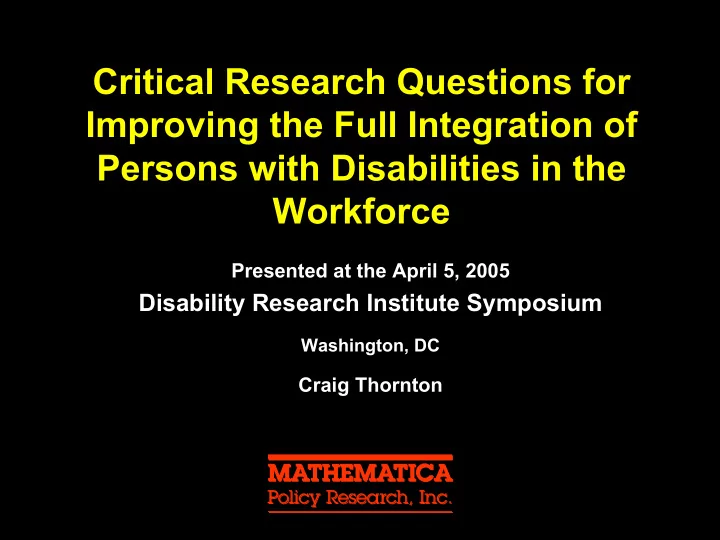
Critical Research Questions for Improving the Full Integration of Persons with Disabilities in the Workforce
Presented at the April 5, 2005
Disability Research Institute Symposium
Washington, DC
Craig Thornton
SLIDE 2
Research Focus
All people with impairments or chronic
illnesses who are limited in age-appropriate activities
Working–age adults Youth
and
Beneficiaries of disability insurance
programs, particularly SSDI and SSI
SLIDE 3
Understanding Beneficiaries
Go beyond simple counts and demographics Examine the 4 Es:
Employment Experience Education Expectations
SLIDE 4
Why Would They Change Their Lives?
Leaving the rolls is a major life change Where do beneficiaries turn for guidance and
information?
What criteria are important in their
decisions?
How can policies help them to understand or
improve their options?
SLIDE 5 Why Did They Apply for Benefits?
What options did they see at the time of
application?
Why do some people with similar
impairments choose not to apply?
How can public policy effectively provide
SLIDE 6
Understanding Employers
What do they look for in an employee? How do they make hiring and retention
decisions?
What interventions would increase employer
willingness and ability to hire/retain workers with disabilities?
SLIDE 7 Methodology Matters
Identify valid comparison groups Consistently measure outcomes for treatment
and comparison groups
Study enough people to produce clear findings Study people long enough to observe
SLIDE 8 Effect on Employment Rates (STETS Demonstration) 41
43
New York Difference Control Group Treatment Group Site
SLIDE 9 Effect on Employment Rates (STETS Demonstration) 23 18 41
11 32 43
New York Difference Control Group Treatment Group Site
SLIDE 10
- Ave. Monthly Earnings for TETD Dem
- nstration
Participants and Nonparticipants
0.00 20.00 40.00 60.00 80.00 100.00 120.00 140.00 160.00 180.00 200.00 1 13 25 37 49 61 73 85
Months Pre- and Post- Random ization A v e r a g e M
th ly E a r n in g
Control Treatment Elig . Nonparticipant
SLIDE 11
SSA Employment Program Paradoxes
1.
The programs promote employment for people who have gone to great lengths to prove they cannot work.
2.
To promote equity, programs must be very large, but may actually serve only a few beneficiaries.
SLIDE 12 Citations
Kerachsky, Stuart et al. , Stuart et al. “ “Impacts of Transitional Impacts of Transitional Employment for Mentally Retarded Young Adults: Employment for Mentally Retarded Young Adults: Results of the STETS Demonstration. Results of the STETS Demonstration.” ” New York: New York: MDRC, April 1985. MDRC, April 1985.
- Decker, Paul and Craig Thornton.
Decker, Paul and Craig Thornton. “ “The Long Term The Long Term Effects of Transitional Employment Services. Effects of Transitional Employment Services.” ” Social Social Security Bulletin Security Bulletin, , vol vol 58, no 4 (Winter) 1995. 58, no 4 (Winter) 1995.