
SLIDE 1
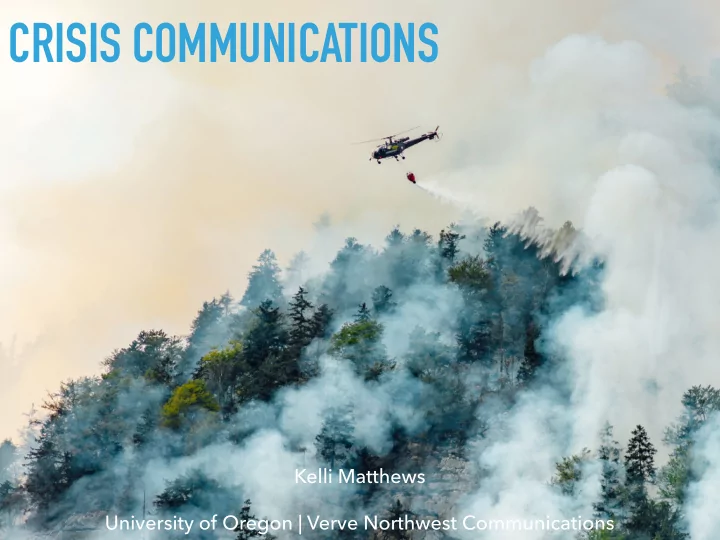
CRISIS COMMUNICATIONS
Kelli Matthews University of Oregon | Verve Northwest Communications
CRISIS COMMUNICATIONS Kelli Matthews University of Oregon | Verve - - PowerPoint PPT Presentation
CRISIS COMMUNICATIONS Kelli Matthews University of Oregon | Verve Northwest Communications WHAT IS A CRISIS? WHAT ARE THE STAGES OF CRISIS? HOW CAN AN ORGANIZATION BE CRISIS READY? WHAT IS EFFECTIVE CRISIS COMMUNICATIONS? WHAT
CRISIS COMMUNICATIONS
Kelli Matthews University of Oregon | Verve Northwest Communications
WHAT’S A CRISIS?
“… a significant business disruption which stimulates extensive news media coverage. The resulting public scrutiny will affect the organization’s normal
a political, legal, financial and governmental impact on its business.”
CREEPING CRISES SLOW-BURN CRISES SUDDEN CRISES
Most of what we call natural disasters (tornadoes, droughts, hurricanes) are indeed natural, though human contributions may increase their likelihood or intensity. But they aren’t disasters—they’re
where no one lives, it isn’t a disaster; it’s weather. A disaster is when a natural hazard meets a human population. And often, that intersection is far from natural.
HURRICANE KATRINA
TEXT
STAGES OF CRISIS
▸ Pre-Crisis/Planning ▸ Crisis ▸ Continuing Crisis ▸ Post-crisis
PRE-CRISIS
▸ Crisis Forecasting ▸ Vulnerability Audit ▸ Crisis Planning ▸ Media Training
WHAT KIND OF “WORST CASE SCENARIO” SHOULD (OR DOES) YOUR ORGANIZATION PLAN FOR?
Confidential interviews of people at all levels of the
Looking for: potentially harmful trends, significant inconsistencies between answers, nonverbal cues, consensus of opinion regarding certain types of crises. Allows you to anticipate actual crisis scenarios.
DENIAL AIN’T JUST A RIVER IN EGYPT…
▸ Outright denial ▸ Minimization ▸ Idealization ▸ Power ▸ Projection ▸ Intellectualization ▸ Compartmentalization
BUILD A CRISIS TEAM. MAKE SURE THEY’RE PREPARED, TRAINED & EMPOWERED
THE 8 PEOPLE YOU NEED ON YOUR CRISIS TEAM
Local Government Manager Emergency Manager/ Director Comms Director Director of Information Services Public Health Manager/ Director Director of Public Works Fire & Police Chiefs Planning Director
YOUR CRISIS TEAM: INCIDENT COMMAND STRUCTURE
Incident commander Incident containment Victim assistance Family Assistance Employee Assistance Communications
Recommends level of response Dispatches to the incident site Liaise with
hospitals, etc. Contacts WFF and Chaplains
Assess state of employees and ensure info needs are met
Provide comm. advice & counsel Activates/directs CMT Coordinates with
Confirms emergency contacts and next
Coordinates with law enforcement for next of kin notification Issues pre- authorized statement assuring support
Activates pre- authorized statement Develops & adjusts ops strategy Relays info to IC
Coordinates arrangements for return of deceased
Assigns family liaisons
Briefs employees within two hours
Coordinates with chiefs to gather info; prep statements
Ensures coordination “On the ground” lead Coordinates with support
Assign one family liaison to each for assistance Coordinates on- site counseling or
Preps spokespeople for interviews CMT: crisis management team. IC: Incident Commander. InCon: Incident Command. WFF= Wildland Firefighter
A WORD ABOUT ELECTED OFFICIALS
▸ Provide training about
their role, the manager’s role, the overall structure
center.
▸ Develop a system to keep
councilors and commissioners informed.
“No matter how much you plan, the unexpected is going to happen. You plan so that you can manage the unexpected. There’s not going to be a blueprint for it.” Harold Dominguez, City Manager, Longmont, Colorado
PREPARE MATERIALS AHEAD OF TIME
CONTAINMENT INVOLVEMENT OF REGULATORS INVESTIGATION CONFIRMATION
Staff Responds Staff Responds with Manager Guidance Manager Gets Involved Directly Create Content (Media, Social, Web) if
Manager Responds. Executive Team Notified. Create Content, Provide Subsequent Monitoring Executive Team Responds. Frequent Communication Through all Channels. Heavy Monitoring
1. Choice 2. Certainty 3. Urgency 4. Cost 5. Continuity 6. Outcomes
ACKNOWLEDGE FIGHT FIRE WITH WATER BE GENUINE TAKE RESPONSIBILITY
A K A , S T E A L I N G T H U N D E R
TELL IT FIRST. TELL IT FAST. TELL THEM WHAT YOU’RE GOING TO DO ABOUT IT.
What happened How do you feel about it What are you doing about it Guidance to media
BE GENUINE. BE COMPASSIONATE. BE SORRY.
HOW DOES SOCIAL MEDIA CONTRIBUTE TO A CRISIS?
▸Wind ▸Fuel ▸Direction
WHAT ROLE, SOCIAL MEDIA?
▸ Disseminate Information ▸ Relieve media queries (via
phone)
▸ Thought leadership ▸ Humanize & personalize ▸ Provide company’s point of
view
▸ Create outlet for advocacy
(if appropriate)
THE REALITY OF CRISES TODAY
▸ Erupt with unprecedented speed ▸ People have an insatiable thirst for news ▸ Anyone can break news ▸ Porous boundaries between social &
mainstream media
CONTINUING CRISIS
▸ Chronic Stage ▸ Ongoing Management
“The immediate crisis moment may last twenty-four hours and then you’ve got a period of four to five days cleaning up. Once that emotion dies down, you can lose sight that this thing is here to stay for months if not a couple of years. You must remind the organization that this is a long-term event and that we cannot let up; we have to remain focused.” Dan Paranick, City Manager, Ventura, California
RESOLUTION STAGE RETURNING TO NORMAL ASSESSMENT PREVENTATIVE PLANNING
“THIS IS EASY TO SAY AND CHANCES ARE IF, GOD FORBID, YOU ARE FACED WITH THE SAME TYPE OF CHALLENGE, YOU’RE NOT GOING TO TAKE THIS ADVICE. YOU MUST FIND A WAY TO TAKE CARE OF YOURSELF…”
Tim Gleason, City Administrator, Gleason, Illinois
TAKE CARE OF YOURSELF & YOUR EMPLOYEES
KELLI MATTHEWS KELLI@VERVENORTHWEST.COM @KMATTHEW (TWITTER)