Creating In Silico Interactomes Creating In Silico Interactomes - - PowerPoint PPT Presentation

creating in silico interactomes creating in silico
SMART_READER_LITE
LIVE PREVIEW

Creating In Silico Interactomes Creating In Silico Interactomes - - PowerPoint PPT Presentation

Creating In Silico Interactomes Creating In Silico Interactomes Tony Chiang Denise Scholtens Robert Gentleman Objectives Objectives Define interactomes Biological and in silico Describe the process of construction

slide-1
SLIDE 1

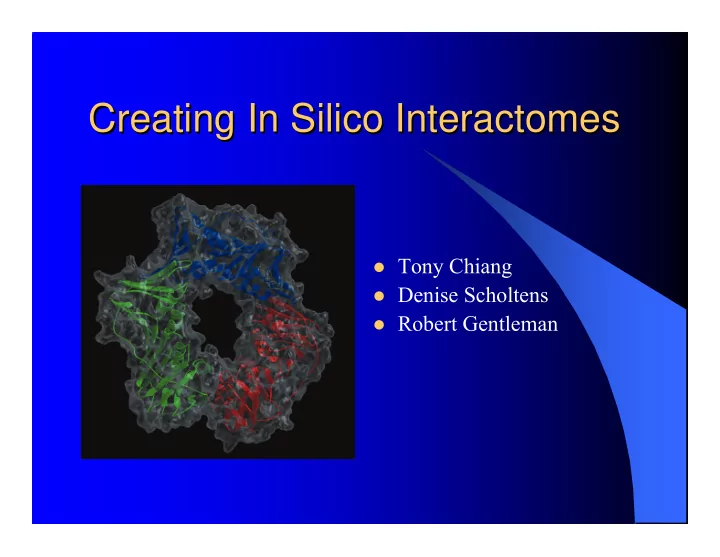
Creating In Silico Interactomes Creating In Silico Interactomes

Tony Chiang Denise Scholtens Robert Gentleman

slide-2
SLIDE 2

Objectives Objectives

Define interactomes

– Biological and in silico

Describe the process of construction Relate the data structure

– How this structure is comprehensive to detailing the data – Why this structure is good for some statistical modeling

Simple examples in using the interactome Future Work

slide-3
SLIDE 3

Introduction and Background Introduction and Background

Basic Terminology

– Protein Complex

Group of 2 or more associated proteins Conduct some biological process

– Protein Complex Interactome

Coordinated set of protein complexes Specific to each cell or tissue type Variable over environmental conditions

slide-4
SLIDE 4

Graph Theoretic Representation Graph Theoretic Representation

Hyper-graph

– Generalization of ordinary graph

Vertex set, V, is the collection of unique proteins

– Let |V| = n

Hyper-edge, E, is the collection of unique protein complexes

– Then |E| ≤ 2n - (n+1)

Interactome ↔ Hyper-graph

– Most protein complex identification experiments

  • ccur in some biological interactome
slide-5
SLIDE 5

In Silico Interactome In Silico Interactome

Collection of estimated protein complexes

representing an in silico model organism

– The ISI is a simulated organism with which we can conduct computational experiments

ISI is modeled after biological interactomes Storage of the ISI

– Incidence Matrix Representation of the Hyper-Graph

Rows indexed by the vertices (expressed proteins) Columns indexed by the hyper-edges (complexes) Incidence is equivalent to membership

slide-6
SLIDE 6

Interactome Interactome to Incidence Matrix to Incidence Matrix

2 4 2 3 1

Complex1 Complex2 Protein1 1 Protein2 1 1 Protein3 1 Protein4 1

slide-7
SLIDE 7

Why hyper Why hyper-

  • graph representation

graph representation

The hyper-graph representation encapsulates more information than a graph representation. We look at the example of PP2A I, II, III By example, we show why protein-protein interaction graphs and co-membership graphs cannot incorporate protein membership information

slide-8
SLIDE 8

RST1 PHP21 TDP3 CDC55 Php22 RST1 PHP21 TDP3 CDC55 Php22 Protein-Protein Direct Interaction Graph Protein- Protein Complex Co-Membership Graph Neither graph can determine Protein Complex Membership

slide-9
SLIDE 9

RTS1 PHP22 CDC55 PHP21 TDP3 A Hyper-Graph (Forgive me) details protein membership, co-membership, but not interaction data

slide-10
SLIDE 10

Constructing the ISI Constructing the ISI

Presently, the simulated model organism is

based on Saccharomyces cerevisiae

Constructing the in silico interactome

– Collecting protein complex composition data

Gene Ontology MIPS High Through-Put Affinity Purification - Mass

Spectrometric Experimentation

– Protein Complex Estimation via apComplex

slide-11
SLIDE 11

ISI ISI -

  • Limitations

Limitations

Comprehensive

– It does not contain an exhaustive list of all protein complexes since it reflects known biology

Definitive

– It contains mostly estimated protein complexes via both low and high through-put technologies

Meant to replace experimental de novo research

– It cannot give insight to unknown biological complexes and interactomes

slide-12
SLIDE 12

ISI ISI -

  • Benefits

Benefits

Dynamic

– It can be updated and modified as new data is discovered and old data is revised

Simplified

– Redundancies from different data sources can be eliminated as well as irrelevant protein complexes

Versatile

– An ISI can be modeled after any organism from yeast to mice to men

slide-13
SLIDE 13

Why build Why build in in silico silico interactomes interactomes

Reasons to build valid in silico interactomes:

– Provides one single data structure with which to conduct in silico experiments – Provides tool with which simulated wet-lab experiments can be conducted – Use in the generation of multiple data sets – Develop tools and strategy for small scale experiments – Study of perturbation in networks – Effects of varying sampling paradigms on large, non- random networks

slide-14
SLIDE 14

GO MIPS Gavin Ho Krogan In Silico Interactome Computational Statistics Integrating Data and Deriving Statistics

slide-15
SLIDE 15

In In Silico Interactome Silico Interactome for Yeast for Yeast -

  • ScISI

ScISI

Computational parsing data from GO and MIPS

– Term mining

[Cc]omplex Suffix “-ase” (e.g. RNA polymerase II) Suffix “-some” (e.g. ribosome)

Manual parsing resultant protein complexes Collecting estimates from apComplex

– Experiments

Gavin et al. (2002, 2006*) Ho et al. (2002) Krogan et al. (2004)

slide-16
SLIDE 16

ScISI ScISI -

  • a model example

a model example

In silico S. cerevisiae

– 1661 unique expressed proteins – 734 distinct protein complexes

Basic statistical profile

– Complex

Cardinality range = [2,57] Median cardinality = 4 Mean cardinality = 5.98

– Protein

Membership range = [1,31] Median membership = 1 Mean membership = 2.64

slide-17
SLIDE 17

In In Silico Silico experiments on ScISI experiments on ScISI

Determining protein complex structures

– Let A be the incidence matrix of ScISI

Then [AAT]ij counts the number of complexes to

which protein i and protein j belong, that is how many complexes these two proteins share co- membership

– Transformation gives a measure of protein affiliation but not direct binary interaction

slide-18
SLIDE 18

Graphical representation of in Graphical representation of in silico silico experiments experiments

We make use of the equivalence of hyper-graphs

to bi-partite graph

– Equivalence is determined by letting the set of hyper- edges be the second set of nodes.

The operation AAT is a contraction on the protein

complex nodes of the bi-partite graph

– This process takes us from protein complex membership to protein-protein complex co- membership

slide-19
SLIDE 19

1 2 3 4 B C A 4 3 2 1 Bi-partite Graph: Protein Complex Membership Ordinary Graph: Protein-Protein Complex Co - Membership

slide-20
SLIDE 20

Where to from here? Where to from here?

Let’s re-iterate the 5 reasons to build valid in

silico interactomes:

– Provides tool with which simulated wet-lab experiments can be conducted – Use in the generation of multiple data sets – Develop tools and strategy for small scale experiments – Study of perturbation in networks – Effects of varying sampling paradigms on large, non- random networks

All 5 of which are still open ended…

slide-21
SLIDE 21

Future Direction Future Direction

An interesting question…

– Many of the protein complexes are estimates

  • btained from Affinity Purification - Mass

Spectrometry experiments – Can we validate these estimates?

Each interactome built needs to be validated before

conducting computational experiments

– We present two different methods to validate the interactomes.

slide-22
SLIDE 22

Validating ISI Validating ISI

Using direct binary interaction data to verify

protein complex composition

– Necessary and sufficient condition is that induced interaction graph be connected on the sub-set of proteins in each protein complex

Hard to verify

– Binary interaction data is sparse – Error Rates are extremely high – There is a need to decipher between true negative interactions between two proteins and un-tested interactions between two proteins – Induced interaction graph is almost always dis- connected

slide-23
SLIDE 23

Validating ISI Validating ISI

Simulation Models

– Simulate the AP-MS technology and derive data-sets on which we can apply estimation algorithm. – Determine how effective estimation algorithm based on statistical significance – Compare with other estimation algorithms