CPI < 1 Pipelined CPUs may have multiple execution units of - - PDF document

cpi 1
SMART_READER_LITE
LIVE PREVIEW

CPI < 1 Pipelined CPUs may have multiple execution units of - - PDF document


slide-1
SLIDE 1

1

  • 06 Performance optimization

06.03 Multiple-issue processors

  • CPI < 1
  • Superscalar
  • VLIW
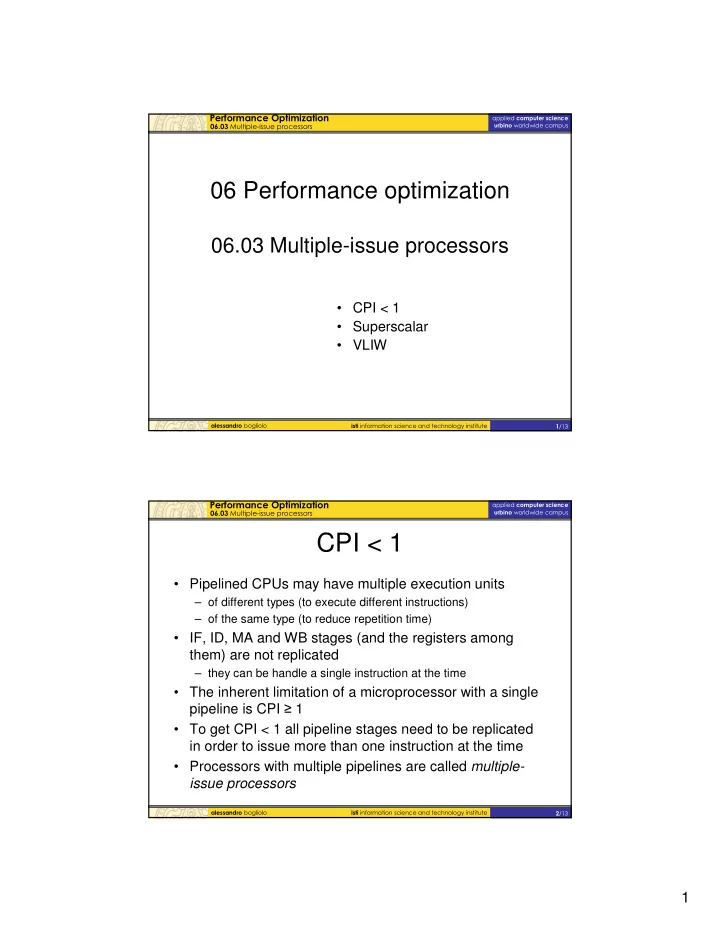
  • Pipelined CPUs may have multiple execution units

– of different types (to execute different instructions) – of the same type (to reduce repetition time)

  • IF, ID, MA and WB stages (and the registers among

them) are not replicated

– they can be handle a single instruction at the time

  • The inherent limitation of a microprocessor with a single

pipeline is CPI 1

  • To get CPI < 1 all pipeline stages need to be replicated

in order to issue more than one instruction at the time

  • Processors with multiple pipelines are called multiple-

issue processors

CPI < 1

slide-2
SLIDE 2

2

  • Contain N parallel pipelines
  • Read sequential code and issue up to N instructions at

the same time

  • The instructions issued at the same time must:

– be independent from each other – have sufficient resources available

  • The ideal CPI is 1/N
  • If an instruction (say, instrk) cannot be issued together

with the previous ones, the previous ones are issues together and instrk is issued at the subsequent clock cycle, possibly together with some subsequent instructions

Superscalar processors

  • N=3
  • Variable issuing rate
  • CPI > 1/N

Superscalar processors

(example)

instr1 IF ID EX MA WB instr2 IF ID EX MA WB instr3 IF ID EX MA WB instr4 IF ID EX MA WB instr5 IF ID EX MA WB instr6 IF ID EX MA WB instr7 IF ID EX MA WB instr8 IF ID EX MA WB instr9 IF ID EX MA WB instr10 IF ID EX MA WB instr11 IF ID EX MA WB instr12 IF ID EX MA WB … … … … … …

Instr6 depends

  • n instr4 or instr5

Instr10 depends

  • n instr9
slide-3
SLIDE 3

3

  • In a superscalar processor, different pipelines may be

devoted to different types of instructions

– e.g., an integer pipeline (for integer/logic operation, memory accesses and branches), and a floating-point pipeline (for floating point operations)

  • All pipelines are stalled together
  • Different pipelines may have different latencies, but they

need to have the same repetition time

  • To fully exploit the parallel pipelines, their instructions

should appear at similar rates

Superscalar processors

(dedicated pipelines)

  • Assumptions:

– N=2 – One integer pipeline (Int) – One floating-point pipeline (FP) (ADDD has latency 3) – FP and Int do not share registers. – Decisions on parallel issuing can be taken based only

  • n the OpCode.

Superscalar DLX

slide-4
SLIDE 4

4

  • Superscalar DLX

Int FP Loop: LD F0, 0(R1) LD F4, -8(R1) LD F6, -16(R1) ADDD F0, F0, F2 LD F8, -24(R1) ADDD F4, F4, F2 LD F10, -32(R1) ADDD F6, F6, F2 SD 0(R1), F0 ADDD F8, F8, F2 SD

  • 8(R1), F4

ADDD F10, F10, F2 SD

  • 16(R1), F6

SD

  • 24(R1), F8

SD

  • 32(R1), F10

SUBI R1, R1, #40 BNEZ R1, Loop LD F0, 0(R1) LD F4, -8(R1) LD F6, -16(R1) ADDD F0, F0, F2 LD F8, -24(R1) ADDD F4, F4, F2 LD F10, -32(R1) ADDD F6, F6, F2 SD 0(R1), F0 ADDD F8, F8, F2 SD

  • 8(R1), F4

ADDD F10, F10, F2 SD

  • 16(R1), F6

SD

  • 24(R1), F8

SD

  • 32(R1), F10

SUBI R1, R1, #40 BNEZ R1, Loop

  • Superscalar DLX

LD F0, 0(R1) LD F4, -8(R1) LD F6, -16(R1) ADDD F0, F0, F2 LD F8, -24(R1) ADDD F4, F4, F2 SUBI R1, R1, #40 ADDD F6, F6, F2 SD 0(R1), F0 ADDD F8, F8, F2 SD 32(R1), F4 SD 24(R1), F6 SD 16(R1), F8 SD 8(R1), F10 BNEZ R1, Loop Int FP Loop: LD F0, 0(R1) LD F4, -8(R1) LD F6, -16(R1) ADDD F0, F0, F2 LD F8, -24(R1) ADDD F4, F4, F2 SUBI R1, R1, #32 ADDD F6, F6, F2 SD 32(R1), F0 ADDD F8, F8, F2 SD 24(R1), F4 SD 16(R1), F6 SD 8(R1), F8 BNEZ R1, Loop

slide-5
SLIDE 5

5

  • Superscalar processors

performance evaluation

  • Assumptions:

– static scheduling – sequential code available

  • Parse the code sequentially
  • Group together contiguous instructions that are not

conflicting

– Determine the parallel instruction count (PIC)

  • Insert stalls according to worst-case latency and

repetition time

– Determine the number of stall cycles (SC)

CPUT = (PIC+SC)Tclk > IC/N * Tclk

  • VLIW processors
  • N (from 5 to 30) parallel pipelines
  • Parallel code
  • Very long instruction words (VLIW)

– Each instruction is obtained by concatenating the instructions for all the pipelines – Up 1000 bits per instruction

  • Static issuing, static scheduling
  • Instruction-level parallelism decided at compile-time
  • VLIW processors have simpler control units than

superscalar processors

slide-6
SLIDE 6

6

  • VLIW DLX
  • Assumptions:

– N=5 – 2 floating-point pipelines (FP) – 2 memory access pipelines (MEM) – 1 pipeline for branches and integer/logic operations (INT/BRANCH)

  • VLIW DLX

MEM1 MEM2 FP1 FP2 INT/BRANCH Loop: LD F0, 0(R1) LD F4, -8(R1) LD F6, -16(R1) LD F8, -24(R1) LD F10, -32(R1) LD F12, -40(R1) ADDD F0, F0, F2 ADDD F4, F4, F2 LD F14, -48(R1) ADDD F6, F6, F2 ADDD F8, F8, F2 ADDD F10, F10, F2 ADDD F12, F12, F2 SUBI R1, R1, #56 SD 56(R1), F0 SD 48(R1), F4 ADDD F14, F14, F2 SD 40(R1), F6 SD 32(R1), F8 SD 24(R1), F10 SD 16(R1), F12 SD 8(r1), F14 BNEZ R1, Loop

slide-7
SLIDE 7

7

  • VLIW processors

performance evaluation

  • Evaluating the performance of a VLIW processor starting from a

sequential code is non-trivial since the compiler can perform static

  • ptimization

– Assuming the sequential code is optimized, proceed as for a superscalar processor to determine the parallel instruction count (PIC)

  • r VLIW count (VLIWC)
  • Evaluating the performance of a VLIW processor starting from VLIW

code is much simpler

– Compute the number of VLIW instructions (VLIWC)

  • Insert stalls according to worst-case latency and repetition time

– Determine the number of stall cycles (SC)

  • Assuming that all instructions have CPI=1:

CPUT = (VLIWC+SC)Tclk > IC/N * Tclk