Course Leaf Curriculum Management (CIM) August 22, 2017 Barbara - - PowerPoint PPT Presentation

course leaf curriculum management cim
SMART_READER_LITE
LIVE PREVIEW

Course Leaf Curriculum Management (CIM) August 22, 2017 Barbara - - PowerPoint PPT Presentation

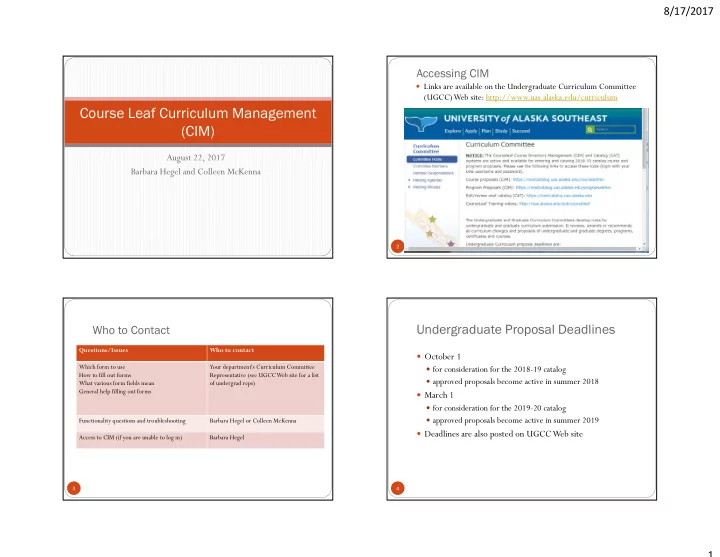
8/17/2017 Accessing CIM Links are available on the Undergraduate Curriculum Committee (UGCC) Web site: http://www.uas.alaska.edu/curriculum Course Leaf Curriculum Management (CIM) August 22, 2017 Barbara Hegel and Colleen McKenna 2


slide-1
SLIDE 1

8/17/2017 1

August 22, 2017 Barbara Hegel and Colleen McKenna

Course Leaf Curriculum Management (CIM)

Accessing CIM

2

 Links are available on the Undergraduate Curriculum Committee

(UGCC) Web site: http://www.uas.alaska.edu/curriculum

Who to Contact

3

Questions/Issues Who to contact Which form to use How to fill out forms What various form fields mean General help filling out forms Your department's Curriculum Committee Representative (see UGCC Web site for a list

  • f undergrad reps)

Functionality questions and troubleshooting Barbara Hegel or Colleen McKenna Access to CIM (if you are unable to log in) Barbara Hegel

Undergraduate Proposal Deadlines

4

 October 1

 for consideration for the 2018-19 catalog  approved proposals become active in summer 2018

 March 1

 for consideration for the 2019-20 catalog  approved proposals become active in summer 2019

 Deadlines are also posted on UGCC Web site

slide-2
SLIDE 2

8/17/2017 2 Two Main Types of Proposals

5

 Program

 New Programs  Edit Existing Programs

 Course

 New Course  Edit Existing Courses

Proposing a New Program…

6

Program Proposal Form

7

 Boxes with a red outline indicate required fields  Arrows indicate a drop down list of options  For campus you can select one, two or all three.

Large Text Areas

8

 Areas designed for larger amounts of text allow you to copy-paste text from MS

Word into the area.

 Avoid pasting in highly formatted text, such as tables (use toolbar within the

text area for more complex formatting).

 Blue circles with ? are help bubbles:

slide-3
SLIDE 3

8/17/2017 3 Entering Program Outcomes

9

 Enter one program outcome (and its assessment) per text box  Use the green (+) to add boxes  Use the red (x) to delete boxes

ADD A SCREENSHOT EXAMPLE THAT SHOWS MULTIPLE PROGRAM OUTCOMES

Sample:

Attaching Files

10

 Bottom of form has links to upload attachments, such as PAR form or

supplemental files.

 Link to a blank BOR PAR form is in the help bubble  Adobe Flash 10 required to upload files

Saving for Later / Starting the Workflow

11

Options at bottom of screen allow you to:

 Cancel everything you've done in this work session  Save Changes so you can continue working on it later  Start Workflow to pass it along to the next person (or

group) in the review process

Editing an Existing Program

12

 Similar to proposing a new program, but you have to find the

existing program first

 Use the Program Proposals (CIM) link to access the Program

Admin area

slide-4
SLIDE 4

8/17/2017 4 Searching for an Existing Program

13

 Search function allows you to use a wildcard (*) to locate key words, departments, titles etc.  Click on the name of the program you want to edit, and click "Edit Program"  Form prepopulated with existing data

Adding a New Course

14

 CIM form functionalities, searching, etc. are similar to adding a

new program – this section will focus on the differences

 Use the Course Proposals (CIM) link to access the Course Admin

area

Adding a New Course

15

 Proposer's name and contact info goes at the top  The category you choose determines the workflow and fields that will display  Category C option is not available when entering a new course, as new courses

cannot be category C

 Remember to use the help bubbles if you're not sure how to complete a field

Other Course Fields

16

 Some text boxes have character limits

slide-5
SLIDE 5

8/17/2017 5 Student Learning Outcomes

17

 Like program outcomes, each student learning outcome must

each be entered into its own text box

 Use the green plus sign to add text boxes for additional SLOs

Sample:

Grading Criteria and Course Topics

18

 Use the green plus signs to add additional rows for grading criteria

and course topics

 In course topics, all hours must be filled in, even if it’s a zero (Ex.

If no lab, enter 0 lab hours)

Attachments

19

 Course syllabus must be attached to a new course proposal

(although CIM is not yet requiring it). New courses will not be reviewed without a syllabus.

Viewing or Editing an Existing Course

20

 To View or Edit a course, find it first, as with a program  Then click the course title in the list

slide-6
SLIDE 6

8/17/2017 6

Viewing a Course

 From there, you can browse through the course information (see

the next few slides)

 Note: if the course wasn't originally submitted in CIM, certain

fields will not be populated, such as SLOs

Viewing a Course (continued)

22

Viewing a Course (continued)

23

Viewing a Course (continued)

24

slide-7
SLIDE 7

8/17/2017 7 Editing an Existing Course

25

 Find the existing course  Click the course title in the list  Click "Course Change Proposal"

Editing an Existing Course

26

 Course opens with existing data pre-populated  Enter the proposer's name and the correct category

After Editing is Complete

27

 Click Start Workflow to pass it along to the next

person (or group) in the review process

 An email will be sent to the next reviewer  Any reviewer can return the proposal using the

"Rollback" feature (comments must be added)

Reviewer Email

28

slide-8
SLIDE 8

8/17/2017 8

Viewing Changes (for Approvers)

29

 Deleted text will show in red strikethrough font  Added text will show in green bold font

Reviewer Comments

30

 Comments will show at the bottom as "Rollbacks"

Workflow

31

 This shows the workflow is in progress as the Humanities Chair has it in their queue.  The chair can return the proposal asking for clarification or additional information.  The workflow indicates where a proposal is.

Contacts

32

Barbara A. Hegel, Registrar bahegel@alaska.edu Colleen McKenna, UGCC Chair cjmckenna@alaska.edu