
SLIDE 1
c o u n t i n g p r i n c i p l e s a n d p e r m u t a t i o n s
MDM4U: Mathematics of Data Management
Counting Basics
Counting Principles
- J. Garvin
Slide 1/18
c o u n t i n g p r i n c i p l e s a n d p e r m u t a t i o n s
Counting Principles
On a basic level, this course deals with counting. All probability concepts are based on the number of ways in which an event can occur. One way to count things is to enumerate them, by listing all possible options.
Example
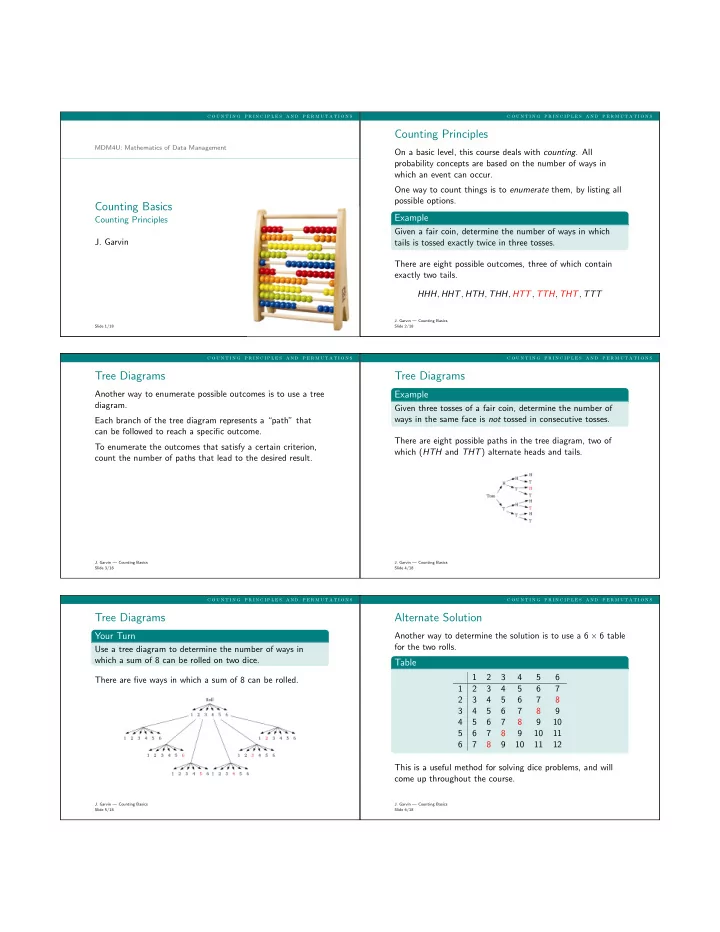
Given a fair coin, determine the number of ways in which tails is tossed exactly twice in three tosses. There are eight possible outcomes, three of which contain exactly two tails. HHH, HHT, HTH, THH, HTT, TTH, THT, TTT
- J. Garvin — Counting Basics
Slide 2/18
c o u n t i n g p r i n c i p l e s a n d p e r m u t a t i o n s
Tree Diagrams
Another way to enumerate possible outcomes is to use a tree diagram. Each branch of the tree diagram represents a “path” that can be followed to reach a specific outcome. To enumerate the outcomes that satisfy a certain criterion, count the number of paths that lead to the desired result.
- J. Garvin — Counting Basics
Slide 3/18
c o u n t i n g p r i n c i p l e s a n d p e r m u t a t i o n s
Tree Diagrams
Example
Given three tosses of a fair coin, determine the number of ways in the same face is not tossed in consecutive tosses. There are eight possible paths in the tree diagram, two of which (HTH and THT) alternate heads and tails.
- J. Garvin — Counting Basics
Slide 4/18
c o u n t i n g p r i n c i p l e s a n d p e r m u t a t i o n s
Tree Diagrams
Your Turn
Use a tree diagram to determine the number of ways in which a sum of 8 can be rolled on two dice. There are five ways in which a sum of 8 can be rolled.
- J. Garvin — Counting Basics
Slide 5/18
c o u n t i n g p r i n c i p l e s a n d p e r m u t a t i o n s
Alternate Solution
Another way to determine the solution is to use a 6 × 6 table for the two rolls.
Table
1 2 3 4 5 6 1 2 3 4 5 6 7 2 3 4 5 6 7 8 3 4 5 6 7 8 9 4 5 6 7 8 9 10 5 6 7 8 9 10 11 6 7 8 9 10 11 12 This is a useful method for solving dice problems, and will come up throughout the course.
- J. Garvin — Counting Basics
Slide 6/18