Counting Seneca only North or East at each intersection. Marion 1 - - PowerPoint PPT Presentation

counting
SMART_READER_LITE
LIVE PREVIEW

Counting Seneca only North or East at each intersection. Marion 1 - - PowerPoint PPT Presentation

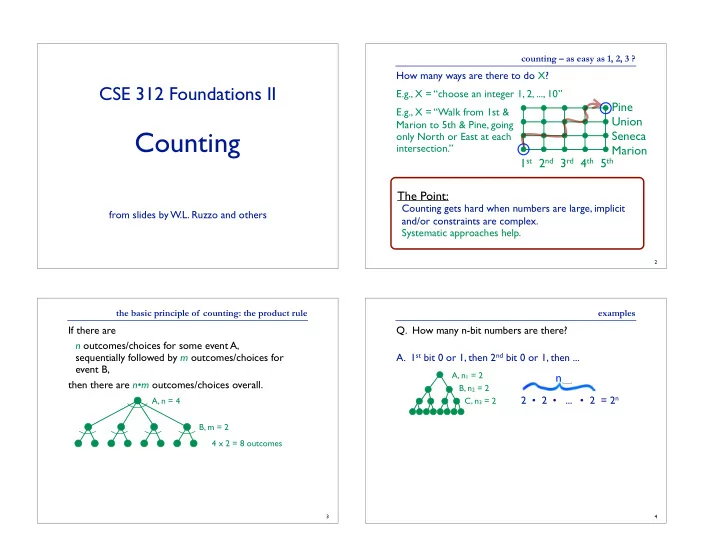
counting as easy as 1, 2, 3 ? How many ways are there to do X? CSE 312 Foundations II E.g., X = choose an integer 1, 2, ..., 10 Pine E.g., X = Walk from 1st & Union Marion to 5th & Pine, going


slide-1
SLIDE 1

CSE 312 Foundations II

Counting

from slides by W.L. Ruzzo and others How many ways are there to do X? E.g., X = “choose an integer 1, 2, ..., 10” E.g., X = “Walk from 1st & 
 Marion to 5th & Pine, going 


  • nly North or East at each 


intersection.”

counting – as easy as 1, 2, 3 ?

The Point:

Counting gets hard when numbers are large, implicit and/or constraints are complex. Systematic approaches help.

2

Pine Union Seneca Marion 1st 2nd 3rd 4th 5th

If there are n outcomes/choices for some event A, 
 sequentially followed by m outcomes/choices for event B, then there are n•m outcomes/choices overall.

the basic principle of counting: the product rule

A, n = 4 B, m = 2 4 x 2 = 8 outcomes

3

  • Q. How many n-bit numbers are there?

  • A. 1st bit 0 or 1, then 2nd bit 0 or 1, then ...


examples

4

A, n1 = 2 B, n2 = 2 C, n3 = 2

n

2 • 2 • ... • 2 = 2n

slide-2
SLIDE 2
  • Q. How many subsets of a set of size n are there?

  • A. 1st member in or out; 2nd member in or out,... ⇒ 2n

examples

5

Tip: Visualize an order in which decisions are being made

  • Q. How many 4-character passwords are there, if each

character must be one of a, b, ..., z, 0, 1, ..., 9 ?


  • A. 36 • 36 • 36 • 36 = 1,679,616 ≈ 1.7 million


  • Q. Ditto, but no character may be repeated?

  • A. 36 • 35 • 34 • 33 = 1,413,720 ≈ 1.4 million


examples

6

permutations

  • Q. How many 


arrangements of n distinct 
 items are possible?


n choices for 1st (n-1) choices for 2nd (n-2) choices for 3rd ... ... 1 choices for last

7

n • (n-1) • (n-2) • ... • 1 = n! (n factorial) A.

examples

  • Q. How many permutations of 


DAWGY are there?

  • A. 5! = 120

  • Q. How many of DAGGY? 

  • A. 5!/2! = 60 

  • Q. How many of GODOGGY ?

A.

DAG1G2Y = DAG2G1Y ADG1YG2 = ADG2YG1 ...

7! 3!2!1!1! = 420

8

slide-3
SLIDE 3

combinations

Q. Your elf-lord avatar can carry 3 objects chosen from

  • 1. sword
  • 2. knife
  • 3. staff
  • 4. water jug
  • 5. iPad w/magic WiFi

How many ways can you equip him/her?

9

  • rdered ways in which to pick objects

but picking abc is equiv to acb, and bca, and ...

Combinations: number of ways to choose r unordered things from n distinct things “n choose r” aka binomial coefficients Important special case: how many (unordered) pairs from n objects

combinations

10

combinations: examples

  • Q. How many different poker hands are possible (i.e., 


5 cards chosen from a deck of 52 distinct possibilities)? A.

  • Q. 10 people meet at a party. If everyone shakes hands

with everyone else, how many handshakes happen? A.

11

Combinations: number of ways to choose r unordered things from n distinct things “n choose r” aka binomial coefficients Many Identities. E.g.:

combinations

← by symmetry of definition ← first object either in or out;
 disjoint cases add

12

← by definition + algebra

slide-4
SLIDE 4

Combinatorial argument: Let S be a set of objects. Show how to count the set one way —> N Show how to count the set another way —> M Conclude that N=M

the binomial theorem

proof 1: induction ... proof 2: counting – (x+y) • (x+y) • (x+y) • ... • (x+y)

pick either x or y from each factor

How many ways did you get exactly k x’s?

14

Proof:

another identity w/ binomial coefficients

15

another binomial theorem question

16

coefficient of y3 in (7x + 3y)5 ? Relevant term: ✓5 2 ◆ (7x)2(3y)3 Coefficient: ✓5 2 ◆ (7x)233

slide-5
SLIDE 5

another general counting rule: inclusion-exclusion

A B

If two sets or events A and B are 
 disjoint, aka mutually exclusive, then 
 |A∪B| = |A| + |B|

A B

More generally, for two sets or events A and B, whether or not they are disjoint, 
 |A∪B| = |A| + |B| - |A∩B|

inclusion-exclusion

inclusion-exclusion in general

A B A B C

|A∪B| = 
 |A|+|B|-|A∩B| |A∪B∪C| = 
 |A| + |B| + |C|


  • |B∩C| - |A∩C| - |A∩B|


+ |A∩B∩C| General: + singles - pairs + triples - quads + ...

example

19 Notation: “AB” means “A and B”

more counting: the pigeonhole principle

slide-6
SLIDE 6

If there are n pigeons in k holes and n > k, then some hole contains more than one pigeon. More precisely, some hole contains at least⎡n/k⎤pigeons. To solve a pigeonhole principle problem:

  • 1. Define the pigeons
  • 2. Define the pigeonholes
  • 3. Define the mapping of pigeons to pigeonholes

pigeonhole principle

21

If there are n pigeons in k holes and n > k, then some hole contains more than one pigeon. More precisely, some hole contains at least⎡n/k⎤pigeons. There are two people in London who have the same number of hairs on their head. Typical head ~ 150,000 hairs Londoners have between 0 and 999,999 hairs on their head. Since there are more than 1,000,000 people in London…

pigeonhole principle

22

Hairs on head

Pigeons: People in London > 1 million i-th pigeonhole: i hairs on head (# pigeonholes 1 million) pigeon —> pigeonhole: a person goes in i-th pigeonhole if that person has i hairs on his/her head.

23

pigeonhole principle

Another example: 25 fleas sit on a 5 x 5 checkerboard, one per square. At the stroke of noon, all jump across an edge (not a corner) of their square to an adjacent square. Two must end up in the same square. Why?

24

slide-7
SLIDE 7

Fleas on checkerboard

13 red squares, 12 black squares Pigeons: fleas on red squares Pigeonholes: black squares Pigeon -> pigeonhole: red square flea maps to black square it jumps to.

25

summary

Product Rule: ni outcomes for Ai: ∏i ni in total (tree diagram) Permutations:

  • rdered lists of n objects, no repeats: n(n-1)...1 = n!
  • rdered lists of r objects from n, no repeats: n!/(n-r)!

Combinations: “n choose r,” aka binomial coefficients, 
 unordered lists of r objects from n Binomial Theorem: Inclusion-Exclusion: |A∪B| = |A| + |B| - |A∩B| Pigeonhole Principle

26