
SLIDE 1
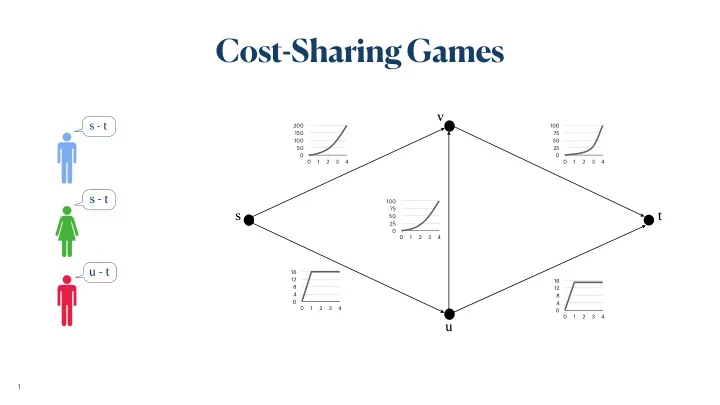
Cost-Sharing Games
1
s v u t
50 100 150 200 1 2 3 4 4 8 12 16 1 2 3 4 25 50 75 100 1 2 3 4 25 50 75 100 1 2 3 4 4 8 12 16 1 2 3 4
u - t s - t
s - t
Cost-Sharing Games v s - t 200 100 150 75 100 50 50 25 0 - - PowerPoint PPT Presentation
Cost-Sharing Games v s - t 200 100 150 75 100 50 50 25 0 0 0 1 2 3 4 0 1 2 3 4 s - t 100 75 s t 50 25 0 0 1 2 3 4 u - t 16 12 16 8 12 4 8 0 4 0 1 2 3 4 0 0 1 2 3 4 u 1 Cost-Sharing Games
1
s v u t
50 100 150 200 1 2 3 4 4 8 12 16 1 2 3 4 25 50 75 100 1 2 3 4 25 50 75 100 1 2 3 4 4 8 12 16 1 2 3 4
u - t s - t
s - t
2
3
4
Series-Parallel Graphs
(symmetric)
Directed Acyclic Graphs
(symmetric)
PoA = 2 + ε n > 1 → PoA = 1 + ε
PoA = 1
→ PoA = Ω(n)
→ PoA = Ω( n)
Budget Balance Overcharging
PoA = 1
→ PoA = Ω(n)
→ PoA > 1.18
Budget Balance Overcharging
Incremental protocol [Moulin ’99] Generalization of the protocol for parallel links [Christodoulou et al. ’17] With overcharging