
SLIDE 1
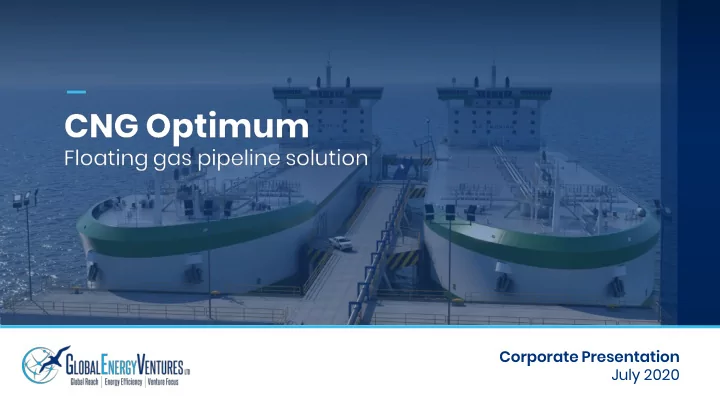
Corporate Presentation July 2020 Important Notice and Disclaimer - - PowerPoint PPT Presentation
Corporate Presentation July 2020 Important Notice and Disclaimer This presentation and these materials (together the Presentation) have been prepared by Global Energy Ventures Limited ABN 53 109 213 470 (ASX:GEV) (GEV) as a summary of
This presentation and these materials (together the “Presentation”) have been prepared by Global Energy Ventures Limited ABN 53 109 213 470 (ASX:GEV) (“GEV”) as a summary of GEV’s operations and results for the purposes of a presentation to existing or potential investors in GEV. By participating in this Presentation or reviewing or retaining these materials, you acknowledge and represent that you have read, understood and accepted the terms of this Important Notice and Disclaimer. This Presentation should be read in conjunction with GEV’s 31 December 2019 Half Year Report lodged with the Australian Securities Exchange (“ASX”) on 26 February 2020, GEV’s 2019 Annual Report lodged with the ASX on 2 September 2019, and other periodic and continuous disclosure announcements that have been lodged by GEV with the ASX. This Presentation may contain forward looking statements concerning projected costs, approval timelines, construction timelines, earnings, revenue, growth, outlook or other matters (“Projections”). Any such Projections are based on assumptions which may differ materially from the actual circumstances which may arise and actual results may vary materially from Projections. You should not place undue reliance on any Projections, which are based only on current expectations and the information available to GEV. The expectations reflected in such Projections are currently considered by GEV to be reasonable, but they may be affected by a range of variables that could cause actual results or trends to differ materially, including but not limited to: price and currency fluctuations, the ability to obtain reliable gas supply, gas reserve estimates, the ability to locate markets for CNG, fluctuations in gas and CNG prices, project site latent conditions, approvals and cost estimates, development progress, operating results, legislative, fiscal and regulatory developments, and economic and financial markets conditions, including availability of financing. GEV undertakes no obligation to update any Projections for events or circumstances that occur subsequent to the date of this Presentation or to keep current any of the information provided, except to the extent required by law. This Presentation is not a disclosure document, is for information purposes only, should not be used as the basis for making investment decisions or other decisions in relation to GEV or its securities, and does not constitute an offer to issue, or arrange to issue, securities or other financial products. This Presentation has been prepared without taking into account the investment objectives, financial situation or particular needs of any particular person. You should consult your own advisors as to legal, tax, financial and related matters and conduct your own investigations, enquiries and analysis concerning any transaction or investment or other decision in relation to GEV. This Presentation, including opinions set out in it, is based on information compiled or prepared by GEV from sources believed to be reliable, although such information has not been verified in all instances. GEV has no obligation to tell recipients if it becomes aware of any inaccuracy in or omission from the information in this Presentation. No representation or warranty, express or implied, is made as to the fairness, accuracy, completeness or correctness of the information, opinions or conclusions contained in this Presentation. To the maximum extent permitted by law, none of GEV, its directors, employees, advisors or agents, nor any other person, accepts any liability, including without limitation any liability arising out of fault or negligence, for any loss arising from the use of the information contained in this Presentation. In particular, no representation or warranty, express or implied, is given as to the accuracy, completeness, likelihood of achievement or reasonableness of any forecasts, Projections or prospects referred to in this Presentation. No distribution in United States or other jurisdictions outside Australia This Presentation does not constitute an offer or recommendation to purchase or sell any securities in any jurisdiction, nor an invitation to apply for such securities in any jurisdiction, and will not form part of any contract for the acquisition of securities in GEV. This Presentation does not constitute an offer to sell, or a solicitation of an offer to buy, securities in the United States. Any securities described in this Presentation have not been, and will not be, registered under the US Securities Act of 1933, as amended (“Securities Act”) or the securities laws of any state or other jurisdiction of the United States and may not be
securities laws. This Presentation may not be released to US wire services or distributed in the United States. The distribution of this Presentation in other jurisdictions outside Australia may also be restricted by law and any such restrictions should be observed. Any failure to comply with such restrictions may constitute a violation of applicable securities laws. By accepting this Presentation you represent and warrant that you are entitled to receive such Presentation in accordance with applicable laws. Non-IFRS S Financ ncial Information This Presentation may use non-IFRS financial information. Non-IFRS measures have not been subject to audit or review. Certain of these measures may not be comparable to similarly titled measures of other companies and should not be construed as an alternative to other financial measures determined in accordance with Australian accounting standards. $ refers to Australian Dollars unless otherwise indicated. This presentation was authorised for release on 22 July 2020 by the Board of Global Energy Ventures Ltd.
gev.com 2
Notes: 1. Listed Options GEVOA, expiry 26 May 2023, exercise $0.12
Ordinary Shares on Issue (GEV) 386.7m (75%) Market Capitalisation at $0.07/share (22 July 2020) A$27m Cash Balance (30 June 2020) A$3.14m Listed Options on Issue (GEVOA) 1 96.7m (19%) Performance Shares 3 14.0m (3%) Performance Rights 2 16.5m (3%) Fully Diluted Shares 513.9m (100%) Regal Funds Management Pty Ltd 5.8% Maurice Brand 5.8% Board and Management 17.5% Top 20 shareholders 4 41.7% Top 50 shareholders 4 61.5%
gev.com 3
Board & Management Team
Maurice Brand
Executive Chairman & Chief Executive Officer Ownership: 22.3M shares
Garry Triglavcanin
Executive Director & Chief Development Officer Ownership: 11.9M shares
Martin Carolan
Executive Director, Corporate & Finance Ownership: 10.9M shares
Thomas Soderberg
Non-Executive Director Ownership: 2M shares
Paul Garner
Non-Executive Director Ownership: 10.5M shares
John Fitzpatrick
Chief Technical Officer GEV Canada Ownership: 0.9M shares
David Stenning
Chief Operating Officer, GEV Canada Ownership: 0.8M shares
Experienced team in value creation and
1 MARINE CNG TRANSPORTATION SERVICE
The marine CNG transportation of gas from point A to point B via GEV’s CNG 200 Optimum
2
COMMERCIALISING ASSOCIATED GAS
In many oil fields, the associated gas is not monetised due to either pipeline or LNG solutions not being commercially viable. Such oil fields are usually located offshore with associated gas typically re-injected. (i.e. Pre-Salt Brazil)
3
DEVELOPING STRANDED GAS FIELDS
Numerous discovered gas fields remain uncommercial due to their limited gas resource size and/or distance to market. Typically these are offshore fields with neither pipeline or FLNG offering a commercial solution. (i.e. South East Asia)
4
DISPLACING LIQUID FUELS USED IN SMALL-SCALE POWER
Expensive liquid fuel (oil) remains the only choice for power generation in many places around the world with limitations by scale, remote location, or access to alternative fuels (gas). (i.e. Central America & Caribbean)
Single transport fee based on volume, distance, continuous or interruptible Build/own/operate the CNG supply chain to deliver 15-20yr bankable fixed cash flows
gev.com 4
Economic advantages of CNG Optimum up to a distance of 1,500 N Miles
Re-Gas Fee Shipping Fee Shipping Unloading & Import
CNG Optimum Value Chain – Single Transport Fee (“Pipe-to-Pipe”)
Liquefaction Fee Compression & Loading
Floating LNG Value Chain – Multiple Fees Gas Supply “Pipe” Gas Sales “Pipe”
Compression and decompression are significantly cheaper than liquefaction and regasification (circa 1/10th). Offsetting lower infrastructure is a higher cost of CNG ships on a volume transported basis. Further the distance the greater the cost of CNG transport than LNG. CNG best suited to regional markets and complementary to LNG trade where distances are large.
Compression, Loading 20% 20% Unloading 5% 5% Transport 75%
CNG
> Ship ipyard constructio ion > Ships can be re-deploye yed > Reduced investment risk > Low Low-cost financing for ships
Liquefaction, Storage, , Loading 60% Unloading, , Storage 30% Transport 10%
LNG
> Majority y of investment in facilities > History y of cost overruns > LNG G ships benefit from history y
budget
Source: GEV
gev.com 5
200 MMscf Net Sales Volume 3,600 psi Operating Pressure X80/ERW Pipe Grade & Weld Type 20” Pipe Diameter 100m Individual Pipe Length 130km Total Length of Pipes
Gas containment system integrated into the ship design. Long horizontally stacked pipe minimises connections and optimises the gas containment system. Optimum IP overcomes the gas storage pipes rubbing together in a marine environment.
OPTIMUM STORAGE SYSTEM
190m Length 17.0m Depth 31.8m Breadth 9.4m Full Load Draft 47,500 mt Displacement 14 knots Service Speed
CNG SHIP
gev.com 6
Design upgrade includes
1960 | Bottle Ship 1998 | Coselle 2016 | Construction of 25MMscf ship
diameter pipe.
200 MMscf
CNG OPTIMUM
BOTTLE SHIP JAYANTI BARUNA, INDONESIA, 2016
25 MMscf
Capacity Port to Port
Offshore Loading
January 2019
Approval from American Bureau of Shipping (ABS) for CNG Optimum ship construction.
July 2019
Shipyard Letter of Intent (LOI) with Yantai CIMC Raffles Offshore
> Ship construction cost US$135-140 million per ship. > Construction schedule 30 months. > 4 ship firm + 4 ship option. > Progress to binding Engineering, Procurement, Construction (EPC) contract.
October 2019
Strategic Alliance Agreement (SAA) with CIMC Raffles and CIMC ENRIC. EPC Contracts for the construction and commissioning of all CNG Facilities and Shipbuilding to implement an integrated “EPC Wrap”. Significantly mitigates CNG project execution risk, such as delivery and pricing, to assist in the financing of future projects.
February 2020
Clarksons Platou appointed Financial Advisor
America can Bureau Shipping Ship Classification & Approvals SeaQu Quest Marine Technical Advisor CIMC Raffles Shipyard CIMC ENRIC CNG Engineering Clarksons Platou Ship Broker & Financial Advisor
gev.com 7
History of building the only CNG ship, together with integration of the full CNG supply chain and facilities Investment grade shipyard with the backing of CIMC Group Scale of operations to support a multiple ship order for multiple CNG projects Strong track record in successful EPC delivery
Expertise to provide EPC services for all key components of a marine CNG project development including gas pipelines, compression facilities, CNG ship loading and receiving terminals and CNG ships 2018
Completed prototype testing and shortlist of preferred shipyards.
With Support From Shipping & Loading Engineering
Note 1 : Letter of Intent (LOI) with CIMC Raffles valid through to 30 December 2020. Further information is available on CIMC Group upon request.
gev.com 8
Marine CNG has <50% of the carbon footprint of LNG
decompression
Fugitive Emissions: CNG does not “boil off”, it is a closed
which is a potent GHG Gas consumed as fuel for “full cycle” CNG: 4% to 7% LNG: 11% to 14%
CNG PROJECT
200MMscf/d (~1.5 mtpa) Internal Use CO2e t pa
Compression/Loading 1.5% 87,300 Shipping (regional) 2.5% 145,500 Decompression/Unloading 0.2% 11,600 Target: 4.2% 244,400
Fugitive emissions: negligible Source: CNG fuel consumption figures based on internal GEV modelling
LNG PROJECT
~1.5 mtpa (200MMscf/d) Internal Use CO2e t pa Liquefaction/Loading 9.6% 561,300 Shipping (regional) 1.3% 74,700 Unloading/Regasification 2.1% 122,400 Target: 13.0% 758,400
Fugitive emissions: depends on treatment of BOG Source: Worley Parsons Greenhouse Gas Emissions Study (https://www.abc.net.au/cm/lb/4421188/data/greenhouse-gas-emissions- study-of-australian-csg-to-lng-data.pdf)
> Marine CNG’s carbon footprint is expected to be at least 50% lower than that of LNG for the full cycle > Marine CNG is expected to have an internal gas usage of 4 -7%, compared to 11-14% for the full LNG supply chain > Illustrative Example: “LNG: liquefaction-shipping-regasification” versus “CNG: compression-shipping- decompression”
miles (regional).
Low development costs support a portfolio approach to CNG project development. Mitigates against binary nature of large single energy infrastructure projects.
commercialisation strategy.
as well as the proximity of such gas to large onshore gas markets.
development Santos Basin oil field.
› Management of oil and gas reservoir › Reduction in capex for reinjection wells › Revenue from gas sales › Ready market for gas › Reduced environmental impacts
Offshore Brazil Pre-salt
export facility from the US Gulf of Mexico.
gas to regional markets that include: Mexico, Central America, and the Caribbean.
removes considerable capital, permitting and development timeline.
equivalent).
markets, with limited options for pipeline and/or LNG supply.
Coast LNG.
Offshore US Gulf of Mexico
gev.com 9
Source: GEV
CNG Optimum launch into Brazil July 2019 with the appointment of GAIA as Country Associate to jointly develop CNG projects and leverage local expertise, understanding of regulatory framework and industry relationships. Advancing discussionswith multiple operators who are developing Pre-Salt projects in Santos & Campos Basins and seeking a gas commercialisation strategy for their own FID decisions in 2020 and 2021. Target projects considering re-injection as a development
First CNG Commercialisation Study completed for an in-development field with first production targeted for
review for a decision expected in the September 2020 Quarter. Brazil market is a multi-project opportunity for CNG Optimum given 14 confirmed projects moving through various stages of development.
gev.com 10
1. Santos and Campos Basins are prolific hydrocarbon producing regions with significant volumes of associated gas.
with CNG Optimum construction schedule.
field blocks recently secured through bidding rounds.
requiring long lead time & billion dollar plus investments.
and availability of infrastructure.
timelines, enhance project economics and mitigate potential reservoir risks associated with reinjection.
Companies Libra** Entorno de Sapinhoa Norte de Carcara Sul de Gato do Mato Alto de Cabo Frio Central Alto de Cabo Frio Oeste Peroba Tres Marias Uirapuru Dois Irmaos Saturno Tita Pau-Brasil Sudoestede Tartaruga Verde BP 50% 40% 30% 50* Chevron 30% 50% CNODC 20% CNOOC 10% 20% 30% CNPC 10% Ecopetrol 30% 20% ExxonMobil 40% 28% 64% Petrobras *40% *45% 50*% *40% *30% *30% *45% 100% * Petrogal 20% 14% QPI 25% 36% Repsol Sinopec 25% Shell 20% 30% 50*% *55% 40% 50%* Equinor *40% 28% 25% Total 20% 20% Source: PPSA, 2018 * Operator ** In Production Source: ANP, 2019
IOC’s developing Pre-Salt projects Brazilian Pre-Salt presents a unique and attractive gas supply dynamic ideally suited to CNG Optimum
2,00 1,50 1,00 0,50 0,00
Oil production (million barrels/day)
0,02 0,04 0,01 0,10 0,31 0,55 0,79 0,91 1,07 1,35 2,09 2028 2027 2026 2025 2024 2023 2022 2021 2020 2019 2018
An investment of ~US$150 Billion across 14 new Pre-Salt developments, will add 2 million bbl oil per day & 24 million m3 gas per day
24 million m3 gas per day
Equivalent to 650MMscf/d 01 Equivalent to 16 CNG Optimum ship potential 02
gev.com 11
Bolivian gas imports reduced with LNG imports the current source to fill the gap. New offshore developments targeting to come on stream by 2024 to 2030. Limited offshore infrastructure capacity for new production to supply the market. New offshore pipelines are proposed for construction given growth aspirations in gas volumes, with lead times up to 10 years forecast.
Natural gas demand continues to outpace available domestic supply given current infrastructure capacity constraints and uncertainly on timelines for new offshore pipelines
GEV targeting CNG Optimum
gev.com 12
> Delivered Commercialisation Plan in early April 2020 (500+ pages) > Plan is to advance a marine CNG solution for the export and commercialisation of associated gas produced at the Pre-salt field, where the operator is an O&G major. The outcome will be to provide the operator with sufficient confidence in the technical viability and commercial value of the CNG solution to warrant Concept Selection > Gas is compressed on FPSO and sent via transfer line to the dual STL loading system > Fleet of up to 5 ships to match the gas export design rate. Dual loading systems and redundancy in ship fleet required to satisfy continuous operating reliability > Base design CNG Optimum ship upgraded to include DP2 & STL loading capability (increases cost of base ship) > Gas is delivered to a dedicated CNG unloading facility. > Proposal is for a 20+ year charter
Indicative Project Timeline
> April-2020: Commercialisation Study Completed > Q3-2020: Concept Selection > 2021: Awarding of contracts > 2024: First oil and gas production
13
gev.com 13
The ability of the proposed export solution to load, store, transport and unload the gas specification provided, by maintaining the gas in single phase throughout each of these processes.
2
GEV considers the proposed CNG ship fleet provides the FPSO, with a reliable, available and maintainable solution for continuous gas export.
The ability to commence first gas exports in Q4, 2024. Gas exports with a fleet of CNG ships can eliminate the timing barriers that exist for pipelines in Brazil and could be implemented in parallel with the upstream project schedule.
The commercial model to be reviewed includes competitive charter rates for the proposed fleet of CNG ships.
4 3 1
Successfully addressed the key requirements put forward by the operator and awaiting the outcome of an internal review – expected within Q3 2020 gev.com 14
Development of an offshore export site as a CNG project to transport US gas to regional markets that include Mexico, Central America, and the Caribbean. Access to existing network of pipelines serving multiple gas producers in the Gulf of Mexico. Reduced costs during development phase and ultimate capital costs of the project.
› US gas production growth to ~85 Bcf/d provides an infinite supply of gas. › Long-term forecast Henry Hub price range of USD 2.50 to 3.00/MMBtu provides global competitive gas supply. › Access to multiple gas suppliers delivering a Henry Hub indexed price. › Under-utilised infrastructure in place accelerates development timetable. › US provides low country risk, supports GEV financing activities. › Defined and timely approvals process to align with criteria for Financial Close. › Access to a deep pool of investors for debt and equity. › End user gas markets with no or minimal competition for CNG supply (i.e. pipelines or Mid-Scale LNG). › End user markets carry some credit/political risk; however this presents the opportunity for CNG and why LNG scale/pricing has not always been achieved. › Marine CNG is targeting ~50% lower FOB 1 prices than US Gulf Coast LNG export projects.
Notes: 1. FOB defined as “Free on Board”, being the cost of gas plus transporting the gas to the loading terminal and loading the gas onto the ship. The buyer (i.e., ship) is assumed to be responsible for port fees and the cost of shipping the gas to market.
gev.com 15
Source: GEV
CNG export facility directly adjacent to existing pipeline infrastructure with capacity up to 400MMscf/day. Installation of 2 stage compression facilities, first stage compression adjacent to onshore Port Sulphur Booster Station with the second stage on the proposed offshore platform. Key Terms secured for transporting up to 400MMscf/d of gas to the export facility. Advancing discussions with gas supply partners to supply required volumes referenced/indexed to Henry Hub pricing. Engineering, Environmental and Legal consultants engaged to provide schedules and costs required to lodge and received necessary permits. Initial marketing study completed for several regional markets within 1,500 nautical miles of the CNG Export Terminal.
gev.com 16
~ 60km Pipeline
Source: GEV
gev.com
17 > Regional markets for marine CNG transport are those areas that are unable to secure satisfactory long-term gas volumes at commercially viable prices via pipeline or LNG deliveries. > Need to displace high cost liquid fuels. > Compliance with environmental carbon emission targets. > CNG export supply chain developed over multiple stages of 100MMscf/d. > Aligns with market growth expectations in Mexico, Caribbean and Central America. > Markets without pipelines in place or no LNG import facilities. > Incremental growth avoids the challenges of LNG development. > Increments of 100MMscf/d are financially viable (i.e. increase CNG Optimum fleet as required). > Discussions underway with multiple locations and parties to secure gas
a 15 year term.
Multiple markets within economic range for CNG Optimum (1,500 n.miles) Floating regional pipeline solution that scales to match growth in markets Marine CNG provides an alternative to small to medium regional gas markets, with limited
gev.com 18
Notes: 1. Henry Hub (HH) pricing of US$1.75/MMBtu as at 14 July 2020. 2. Similar pipeline transportation charges assumed for both the CNG/LNG, plus internal gas consumption (1.5% CNG compared to 10% assumed for liquefaction). 3. Cost to build, own and operate the CNG/LNG facilities, excludes port fees assumed payable by the ship operator. 4. Based on GEV internal modelling, 20 year term / 400MMscf/d capacity. Final project capital and operating cost subject to further engineering work. 5. US$2.50 / MMBtu liquefaction fee assumed based on publicly reported numbers for contract capacity (e.g. Cheniere Energy), ranging from $2.25 to $3.50/MMBtu. 6. GEV internal analysis (refer to Slide 8).
CNG Optimum FOB pricing targeted to be ~50% below that of LNG CNG Optimum ex-GOM US Gulf Coast LNG Henry Hub (as of 14 July 2020) 1 $1.75 USD/MMBtu $1.75 USD/MMBtu + Pipeline Fee + Internal Gas Usage 2 $0.20 USD/MMBtu $0.35 USD/MMBtu + Compression / Liquefaction (FOB) 3
4 $0.40 USD/MMBtu 5 $2.50 USD/MMBtu
FOB Gas Export “Target” Prices $2.35 USD/MMBtu $4.60 USD/MMBtu
Marine CNG is targeting ~50% lower FOB prices than US Gulf Coast LNG export projects.
CNG Optimum ex-GOM US Gulf Coast LNG Internal Gas Use (compression/liquefaction) 1.5% ~ 10% Environmental Footprint < 10 acres > 100 acres Staff Required < 30 > 100 CO2e Emissions 6 (based on 200 MMscf/d) 244,400 t pa 758,400 t pa Permitting (Greenfield) < 3yrs > 4yrs Significantly smaller environmental footprint that enables a project to scale to match gas markets Material reduction in CO2 emissions to attract “environmental and social governance” funding alternatives
> Development work to date indicates the proposed US CNG Export Facility can deliver an export project with a significant reduction to FOB pricing compared to US Gulf Coast LNG export projects. > Environmental footprint of CNG Optimum easier to permit, reduces emissions, while scalable to match regional markets.
Illustrative Example: 20yr CNG export project at 400MMscf/d (3.0 mtpa LNG equivalent) vs a US Gulf Coast LNG export project.
All technical and safety approvals completed for CNG Optimum ship > ready to be commercialized. Portfolio of global projects eliminates binary
demonstrates growth potential for CNG
multiple opportunities within each region. Shipyard LOI and Strategic Alliance with CIMC Raffles confirms CNG Optimum ready for construction with financing risks mitigated through an integrated “EPC Wrap” available and the appoint of financial advisors.
1 4 2 3 5 7 6
Project economics confirm CNG Optimum a commercial alternative to Pipelines or LNG. Opportunities for future ownership in stranded gas resources suitable for a CNG solution. Projects with infrastructure returns providing fixed long-term project cash flows. Experienced team in value creation and
shareholders. gev.com 19
For more information visit:
@GEVmarineCNG +61 8 9322 6955 5 Ord St, West Perth, 6005
gev.com
Martin Carolan Executive Director mcarolan@gev.com +61 404 809 019
20