Corporate Presentation February 2017 Crescent Point Energy is one of - - PowerPoint PPT Presentation

corporate presentation february 2017
SMART_READER_LITE
LIVE PREVIEW

Corporate Presentation February 2017 Crescent Point Energy is one of - - PowerPoint PPT Presentation

Crescent Point Energy Corporate Presentation February 2017 Crescent Point Energy is one of Canadas largest light and medium oil producers, based in Calgary, Alberta. 1 The Company is focused on growing its significant resource base in the


slide-1
SLIDE 1

1

Corporate Presentation February 2017

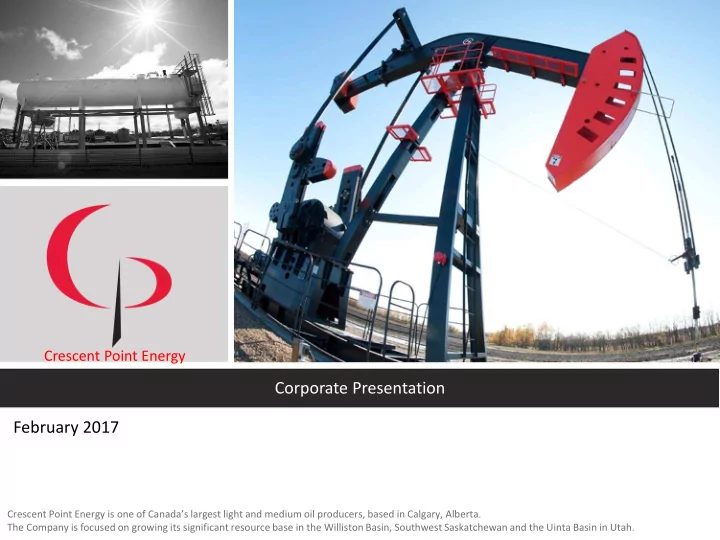
Crescent Point Energy is one of Canada’s largest light and medium oil producers, based in Calgary, Alberta. The Company is focused on growing its significant resource base in the Williston Basin, Southwest Saskatchewan and the Uinta Basin in Utah.

Crescent Point Energy

slide-2
SLIDE 2

This presentation contains "forward-looking statements" within the meaning of applicable securities legislation, such as section 27A of the Securities Act of 1933 and section 21E of the Securities Exchange Act of 1934, including estimates of future production, cash flows and reserves, business plans for drilling and exploration, the estimated amounts and timing of capital expenditures, the assumptions upon which estimates are based and related sensitivity analyses, and other expectations, beliefs, plans, objectives, assumptions or statements about future events or performance (often, but not always, using words or phrases such as "expects" or "does not expect", "is expected", "anticipates" or "does not anticipate", "plans", "estimated" or "intends", or stating that certain actions, events or results “may", "could", "would", "might" or "will" be taken, occur or be achieved). In particular, this presentation contains forward-looking statements pertaining to the following: estimates of 2017 average and exit production and capital expenditures and expected 2017 decline rates; the Corporation’s plan to test the new Injection Control Device waterflood technology system in the first half of 2017 with production data expected in the second half of 2017; expected percentage change in organic production growth; plans to test and advance new technologies; plans to expand upon new play development by advancing the horizontal drilling program in the Uinta Basin and accelerating Flat Lake development; target increase in corporate drilling inventory; plans to explore further asset disposition opportunities to fund the additional growth program; debt reduction; continued focus on risk management and improved investor communication; expected 2017 production growth including the opportunity for additional upside; expected 2017 capital expenditures; expected total payout ratio with U.S. WTI prices and expected flexibility to increase capital budget and growth targets at higher oil prices; the Corporation’s business strategy to develop and enhance assets, acquire and manage risk; expected impact of the Corporation’s hedging program on adjusted funds flow volatility and dividend and capital spending stability; estimated years of drilling inventory; expected well payouts; estimated number of wells in 2017 drill program and percentage of 2017 capital expenditures budget; plans to expand in Viewfield Bakken and Flat Lake; the expected focus on efficiency gains in Flat Lake; the expected focus on building off success of recent down-spacing program and increasing efficiencies through pad drilling in North Dakota; plans to optimize the stage/tonnage during completions and add new infrastructure in Shaunavon to accommodate future growth plans; expected Lower Shaunavon 30+ Stage completion outperformance; plans to increase well density; testing of extended reach horizontal wells and implementing closeable sliding sleeves in Viking; expected scalability across multiple zones and increased efficiencies; expected horizontal type curve economics in the Castle Peak Zone; the 2017 budget risk factor; the expected focus on increasing the efficiency of waterflood by testing new multiple-stage segregated strings technology for field-wide implementation and expecting production results by the second half of 2017; 2017 free cash flow as a percentage of enterprise value; estimated adjusted funds flow for every WTI US$1/bbl increase; 2017 Viewfield Bakken Land position; 2017 Viewfield Bakken capital expenditures versus adjusted funds flow from operations; targeted recovery rate on primary in Viewfield Bakken; secondary waterflood development plans for Viewfield Bakken, including targeted recovery rate and F&D and the expected implementation of waterflood technology to enhance production and recovery rates; confirmation of no material near-term debt maturities along with 2019 renewal date for bank credit facilities; expected exit production per share growth; planned 2017 governance engagements; targeting events with investment community; planned conferences and investor road shows; planned hiring to add bench strength and expected board changes in 2017-2019. Statements relating to "reserves" are deemed to be forward-looking statements, as they involve the implied assessment, based on certain estimates and assumptions, that the reserves described exist in the quantities predicted

  • r estimated and that the reserves can be profitably produced in the future. There are numerous uncertainties inherent in estimating crude oil, natural gas and NGL reserves and the future cash flow attributed to such reserves.

The reserve and associated cash flows therefrom are based upon a number of variable factors and assumptions, such as historical production from the properties, production rates, ultimate reserve recovery, timing and amount

  • f capital expenditures, marketability of oil and natural gas, royalty rates, the assumed effects of regulation by governmental agencies and future operating expenses, all of which may vary materially. Actual reserve values may

be greater than or less than the estimates provided herein. Unless otherwise noted, reserves referenced herein are given as at December 31, 2016. Also, estimates of reserves and future net revenue for individual properties may not reflect the same confidence level as estimates and future net revenue for all properties due to the effect of aggregation. With respect to disclosure contained herein regarding resources other than reserves, there is uncertainty that it will be commercially viable to produce any portion of the resources. All required reserve information for the Company is contained in its Annual Information Form for the year ended December 31, 2016, which is accessible at www.sedar.com. All forward-looking statements are based on Crescent Point’s beliefs and assumptions based on information available at the time the assumption was made. The material assumptions are disclosed in the presentation, in the Management’s Discussion and Analysis for the year ended December 31, 2016 under the headings, “Capital Expenditures”, “Liquidity and Capital Resources”, “Critical Accounting Estimates”, “Risk Factors”, “Changes in Accounting Policies” and “Outlook”. Crescent Point believes that the expectations reflected in these forward-looking statements are reasonable but no assurance can be given that these expectations will prove to be correct and such forward-looking statements included in this presentation should not be unduly relied upon. By their nature, such forward-looking statements are subject to a number of risks, uncertainties and assumptions, which could cause actual results or other expectations to differ materially from those anticipated, expressed or implied by such statements, including those material risks discussed in the Company’s Annual Information Form and Form 40-F under “Risk Factors” and our Management’s Discussion and Analysis for the year ended December 31, 2016, under the headings “Risk Factors” and “Forward-Looking Information”, and risk factors described in other documents we file from time to time with securities regulatory authorities, all of which are available on SEDAR or sedar.com, EDGAR or www.sec.gov and Crescent Point Energy’s website as www.crescentpointenergy.com. In addition, risk factors include: financial risk of marketing reserves at an acceptable price given market conditions; volatility in market prices for oil and natural gas; delays in business operations; pipeline restrictions; blowouts; the risk of carrying out operations with minimal environmental impact; industry conditions including changes in laws and regulations including the adoption of new environmental laws and regulations and changes in how they are interpreted and enforced; uncertainties associated with estimating oil and natural gas reserves; economic risk of finding and producing reserves at a reasonable cost; uncertainties associated with partner plans and approvals;

  • perational matters related to non-operated properties; increased competition for, among other things, capital, acquisitions of reserves and undeveloped lands; competition for and availability of qualified personnel or

management; incorrect assessments of the value of acquisitions and exploration and development programs; unexpected geological, technical, drilling, construction and processing problems; availability of insurance; fluctuations in foreign exchange and interest rates; stock market volatility; failure to realize the anticipated benefits of acquisitions; general economic, market and business conditions; uncertainties associated with regulatory approvals; uncertainty of government policy changes; uncertainties associated with credit facilities and counterparty credit risk; and changes in income tax laws, tax laws, crown royalty rates and incentive programs relating to the oil and gas industry. These risks and uncertainties could cause actual results or other expectations to differ materially from those anticipated, expressed or implied by such statements. The impact of any one risk, uncertainty or factor on a particular forward-looking statement is not determinable with certainty as these are interdependent. Except as required by law, Crescent Point assumes no obligation to update forward-looking statements should circumstances or management's estimates or opinions change. Certain information contained herein has been prepared by third-party sources. The information provided herein has not been independently audited or verified by the Company. Any “financial outlook” or “future oriented financial information” in this presentation, as defined by applicable securities legislation, has been approved by management of Crescent Point. Such financial outlook or future

  • riented financial information is provided for the purpose of providing information about management’s current expectations and plans relating to the future. Readers are cautioned that reliance on such information

may not be appropriate for other purposes.

FORWARD-LOOKING STATEMENTS

2
slide-3
SLIDE 3

HIGH-QUALITY, LOW-COST PRODUCER: CPG (TSX AND NYSE)

3

2017 Average Production

172,000 boe/d (~89% liquids)

2017 Exit Production

183,000 boe/d (~89% liquids)

2017 Capital Expenditures

$1.45 billion

Market Capitalization

$8.9 billion2

Net Debt

$3.7 billion

Enterprise Value

$12.6 billion

2016 Funds Flow per Share

$3.03

Dividend (Yield)

$0.03 per month (2.2%)2

Proved + Probable Reserves

958 mmboe (~15 years RLI) 3 4

Drilling Inventory

~8,085 locations (~12 years)4 5

Expected 2017 Decline Rate

28%

2017 production, capital expenditures and expected decline rate are based on guidance as of December 2016. Net debt as of December 31, 2016. Funds flow represents funds flow from operations.

Strategic Asset Base

Largest Canadian producer in Williston Basin (Top 5 including US producers)1

Operational Execution

~644 million boe of organic reserves additions. Have never missed a production target

Scalability in High-Netback Plays

Top-quartile netbacks supported by low well costs and quick payouts1

Pioneers in Tight Rock Waterflood

Bakken waterflood is the largest tight oil pool under commercial waterflood in North America1

Experienced Operator

#1 driller in Canada (Based on metres and # of wells drilled) 1

SEE FOOTNOTES INCLUDED IN THE BACK AS ENDNOTES.

slide-4
SLIDE 4

2016 HIGHLIGHTS – EXCEEDED GUIDANCE

4

SEE “DEFINITIONS / NON-GAAP FINANCIAL MEASURES” FOR DETAILS ON OOIP DEFINITION. SEE FOOTNOTES INCLUDED IN THE BACK AS ENDNOTES.

  • Annual production of 167,764 boe/d (ahead of guidance with capital expenditures in line with budget)
  • Lowered operating costs per boe (down 8% vs initial 2016 budget)
  • Continued to reduce capital costs per well (down ~40% since year-end 2014)
  • Strong operational execution
  • Added ~1,000 high-quality drilling locations through new play development, step-out drilling and acquisitions6
  • Improved average drilling days in both the Williston Basin and Shaunavon resource play by 11% since 2015
  • Success in new play development
  • Advanced Uinta geological knowledge and identified ~120 net horizontal locations within the Castle Peak zone7
  • Expanded economic boundaries of Flat Lake resource play
  • Developed highly economic Flake Lake conventional play (Ratcliffe)
  • Strong initial pilot results from Injection Control Device (ICD) waterflood technology system
  • Encouraging early results with 3x the amount of water injectivity compared to prior technology
  • Continuing to test ICD technology in H1 2017 with production data expected by H2 2017
  • Strengthened balance sheet with equity offering for gross proceeds of ~$650 million
  • Lowered net debt to funds flow from operations ratio by more than 0.5x
  • Spent less than funds flow from operations – 89% total payout ratio in 2016
slide-5
SLIDE 5

0% 5% 10% 15% 20% 25% 5 10 15 20 25 2013 2014 2015 2016 Cumulative 2P Waterflood Reserves (mmboe) % of Organic 2P Reserves Attributed to Waterflood

2016 RESERVES GROWTH & LOW F&D COSTS OF $7.02 PER BOE

5

Organic Reserves Growth and Recycle Ratio

2P Reserves (MMboe) Recycle Ratio

0.0x 1.0x 2.0x 3.0x 4.0x

200 400 600 800 2010 2011 2012 2013 2014 2015 2016

Cumulative Technical Reserve Additions (MMboe) Recycle Ratio (2P incl. change in FDC)

MMboe % of 2P Reserves

Independently Evaluated Corporate Waterflood Reserves

  • Added 2P reserves of 84.2 MMboe
  • Replaced 137% of 2016 production
  • 2P F&D costs (including changes in FDC)
  • f $7.02 per boe
  • ~30% improvement versus 2015
  • 3.2x recycle ratio
  • Highlights management’s capital

allocation decisions and low cost, high netback asset base

  • New play development in Flat Lake and

Uinta Basin support long-term organic reserves growth

  • 10.5 MMboe of waterflood reserves
  • Fourth consecutive year of

waterflood reserves additions

  • >23 MMboe of waterflood

reserves additions since 2013

“2P” Reserves is defined as Proved plus Probable reserves. “FDC” is defined as future development capital. “F&D” costs is defined as Finding and Development costs.

~644 million boe of

  • rganic reserves

additions to date

slide-6
SLIDE 6

2017 FOCUS: ORGANIC GROWTH AND NEW PLAY DEVELOPMENT

6

ORGANIC GROWTH AND OPERATIONAL EXECUTION

  • Execute organic production growth of 10% (2016 to 2017 exit)
  • Expand on recent new play development
  • Advance horizontal drilling program in Uinta Basin including

continued delineation of new zones

  • Accelerate Flat Lake development through continued expansion of

the economic boundaries of the resource play

  • Advance new technologies including the ICD waterflood system
  • Focus on increasing corporate drilling inventory through a successful

step-out and down-spacing program

  • Review asset disposition opportunities of non-core assets with funds

redeployed for additional growth and/or debt reduction

  • Continue to appropriately manage risk including ongoing hedging and

maintaining financial flexibility

  • Enhancing investor communication
slide-7
SLIDE 7

2017 CAPITAL BUDGET AND PRODUCTION GROWTH

All figures are approximate.

  • Opportunity for additional upside as 2017 production guidance assumes conservative risking in new play

developments (i.e. Flat Lake step-out drilling, Uinta horizontals, etc.)

  • 2017 capital expenditures of $1.45 billion includes previous increase to assumed costs of 5%
  • Total payout ratio of 91% at US WTI prices of $55 for 2017
  • Flexibility to increase capital budget and growth targets at higher oil prices

8 167,000 >170,000 183,000

2016 Exit Q1 2017 2017 Exit

2017 Production Growth

Production (boe/d)

E

7

slide-8
SLIDE 8

8

  • Proven Management Team • Excellent Balance Sheet • High-Quality Asset Base

BUSINESS STRATEGY AND 2017 PRIORITIES

8

2017 Priorities

  • Execute organic exit production growth of 10%
  • Advance resource plays including new play

development in Flat Lake and Uinta Basin

  • Continue to test ICD waterflood system
  • Review non-core asset disposition opportunities
  • Target new play advancement through a

successful step-out and down-spacing program

  • Ongoing disciplined hedging program
  • Maintain balance sheet strength with significant

financial flexibility

Develop and Enhance

  • Increase recovery factors through infill drilling, waterflood
  • ptimization and improved technology

Acquire

  • Focus on high-quality, large resource-in-place pools with

production and reserves upside

Manage Risk

  • Maintain strong balance sheet, significant unutilized bank

line capacity and 3 ½-year hedging program

slide-9
SLIDE 9

COMMODITY HEDGING STRATEGY

As of February 20, 2017. Floor hedge price is calculated using the forward strip for the 3-way collar hedges. Floor hedge price of 3-way collar hedges are subject to change based on forward market prices. 2017 percentage hedged figures based on 2017 annual average oil production guidance. 2018 percentage hedged figures based on 2017 exit guidance of 183,000 boe/d 9

Oil Hedge volume (bbl/d) $ CAD

  • Added approximately 12 million barrels of oil to hedging program since Q3 2016
  • Active hedging program reduces funds flow volatility and provides greater stability to

dividends and capital spending 42% H1 2017 35% H2 2017 12% H1 2018

$50.00 $60.00 $70.00 $80.00 $90.00 10,000 20,000 30,000 40,000 50,000 60,000 Q1 17 Q2 17 Q3 17 Q4 17 Q1 18 Q2 18 Swaps 3-Way Collars Floor Hedge Price (3-way collars at market price)

slide-10
SLIDE 10

FOCUSED GROWTH: LARGE UNDEVELOPED RESOURCE BASE

10

AB SK ND UT

Williams Divide Burke McKenzie Mountrail Dunn

Uinta Basin

  • ~12,500 boe/d – expect 50% growth in 2017
  • 18% of 2017 capital expenditures budget
  • Third largest producer and most active driller in 2016
  • Highest number of zones tested to date horizontally

SW Saskatchewan

  • ~39,000 boe/d – expect 10% growth in 2017
  • 25% of 2017 capital expenditures budget
  • Largest producer in the Shaunavon resource play1
  • Operating largest waterflood program

Williston Basin

  • ~102,500 boe/d – expect 5% growth in 2017
  • 51% of 2017 capital expenditures budget
  • Largest Canadian producer and among top

five within the Williston basin1

  • Operating largest waterflood program1
  • > 23 billion barrels of OOIP (3% recovered to date) • >12 years of drilling inventory

SEE “DEFINITIONS / NON-GAAP FINANCIAL MEASURES” FOR DETAILS ON OOIP DEFINITION.

slide-11
SLIDE 11

SIGNIFICANT GROWTH POTENTIAL SUPPORTED BY STRONG WELL ECONOMICS

11

FOOTNOTES INCLUDED IN THE BACK AS ENDNOTES

2017 Drilling Program Supported by Quick Payouts ~1 year

  • r less

~1 to 2 years >2 years

Williston Basin: Viewfield Bakken Williston Basin: Flat Lake Uinta Basin: Recent horizontal wells Williston Basin: SE SK Conventional SW Saskatchewan: Shaunavon SW Saskatchewan: Viking Other: Swan Hills Williston Basin: North Dakota

Well Payouts

Flat Pricing assumption: US $55.00 WTI / 0.75 CAD/USD fx

Independent Ranking of North American Light/Medium Oil Plays

(Based on Internal Rates of Return at US $50 WTI)

Sourced from Scotiabank GBM September 2016 “The Playbook”. CPG Shaunavon IRR is an average of the Upper and Lower zones

1st 3rd 4th 6th 10th SE Sask Conventional Tower Montney Viewfield Bakken SK Viking Gordondale Montney Shaunavon Karnes Trough Eagle Ford Ferguson Bakken/Exshaw Karr Dunvegan Flat Lake East Pembina Cardium Fort Berthold Bakken/Three Forks Permian Midland STACK Maramec/Woodford Permian Regan/Upton SCOOP Woodford

~80% of 2017 drilling budget expected to payout in 2 years or less

slide-12
SLIDE 12

12

Viewfield Bakken Flat Lake

Williams Divide Burke McKenzie Mountrail Dunn

2016 Exit Production (boe/d) ~102,500 2017 Exit Production (boe/d) ~108,000 (↑5%) Net Acres ~2.3 million OOIP (barrels) >8.5 billion Recovery to Date 3.3% Drilling Inventory (net locations)9 3,470 2017 Net Drill Program ~350 % of 2017 Capital Expenditures Budget 51% Q4 2016 Average Netback ($CAD/boe) ~$29.00 2017E Decline Rate ~29% 100 200 300 400 500 1-Jan-15 1-Mar-15 1-May-15 1-Jul-15 1-Sep-15 1-Nov-15 1-Jan-16 1-Mar-16 1-May-16 1-Jul-16 1-Sep-16 1-Nov-16 1-Jan-17 Cumulative Oil (Mbbl)

Flat Lake Step-Out Well Success

Actual Cumulative Oil (Mbbl) Expected Cumulative Oil (Mbbl)

Outperforming expected type wells by ~30%

WILLISTON BASIN

  • Largest and longest producing resource play within the company
  • Generates significant cash flow in excess of its capital expenditures

(~$0.5 billion expected in 2017 @ US$55 WTI)

  • Focused on infill development, secondary waterflood recovery and the potential

expansion of the play’s economic boundary

Viewfield Bakken

  • Focus in 2017 is to build off success of recent down-spacing program and to

increase efficiencies through pad drilling (Bakken/Three Forks)

North Dakota

  • Multi-zone resource play that continues to expand in size and scale of
  • pportunity (Torquay, Midale, Bakken, Ratcliffe)
  • Added >500 new drilling locations in 2016 through successful step-out drilling

program and strategic acquisition, targeting continued expansion in 20178

  • Focused on efficiency gains in 2017 through drilling optimization and the

sharing of infrastructure between various producing zones

Flat Lake

Williston Basin includes: Viewfield Bakken, Flat Lake, North Dakota and SE SK Conventional

slide-13
SLIDE 13

15,000 30,000 45,000 $0 $125 $250 $375 $500 $625 2012 2013 2014 2015 2016 2017E boe/d Cash Flow & Capex ($M)

SW Saskatchewan

Cash Flow Capex Production

SW SASKATCHEWAN

13

Shaunavon SK Viking Battrum/Cantuar

2016 Exit Production (boe/d) ~39,000 2017 Exit Production (boe/d) ~43,000 (↑10%) Net Acres ~960,000 OOIP (barrels) >7.8 billion Recovery to Date 2.5% Drilling Inventory (net locations)10 3,375 2017 Net Drill Program ~270 % of 2017 Capital Expenditures Budget 25% Q4 2016 Average Netback ($CAD/boe) ~$29.00 2017E Decline Rate ~26%

  • Company’s second largest producing resource play
  • Approaching free cash flow stage of its life-cycle
  • Benefits from the transfer of knowledge from Viewfield Bakken

(i.e. cemented liner, closeable sliding sleeves, waterflood, completion fluid systems)

  • Continuing to optimize the stage/tonnage during completions process
  • Adding new infrastructure in 2017 to accommodate future growth plans

Shaunavon

  • Increased well density in drilling program from 16 to 22 wells per section
  • Testing extended reach horizontal wells to further improve the economic development
  • Implementing closeable sliding sleeves to reduce well cleanout costs

(similar to results observed in Viewfield and Shaunavon resource plays)

Viking

SW Saskatchean includes: Shaunavon, Battrum/Cantuar, AB and SK Viking

$US WTI $94 $93 $49 $43 $55 $98

slide-14
SLIDE 14
  • Most active horizontal driller during 2016
  • Advanced geological knowledge (seismic, core, well logs)
  • 15 horizontal wells drilled across multiple zones since late 2014
  • Internally identified ~120 horizontal drilling locations to date in

the Castle Peak zone (assumes conservative 4 wells per section)7

  • Scalability across multiple zones and increased efficiencies
  • Delineating six zones across basin
  • Targeting 25 horizontal wells in 2017, up from 9 in 2016
  • Testing new fluids and completions methods including

horizontal wells greater than one-mile in length

UINTA BASIN ADVANCING NEW HORIZONTAL PLAY

14

Realized Oil Price as a % of US WTI Operating Costs (per boe) Capital Costs (per well) Horizontal Locations Identified to Date Evolution of Development Strategy

~10% ~40% ~40% ~120

Improvements in Uinta Basin Since Entering in 2012

All figures and comparisons are in USD. Capital cost reduction based on vertical well capital expenditures

2016 Exit Production (boe/d) ~12,500 2017 Exit Production (boe/d) ~19,000 (↑50%) Net Acres ~170,000 OOIP (barrels) >5.2 billion Recovery to Date 0.7% Drilling Inventory (net locations)11 830 2017 Net Drill Program ~30 % of 2017 Capital Expenditures Budget 18% Q4 2016 Average Netback ($CAD/boe) ~$22.00 2017E Decline Rate ~27%

Blacktail Ridge Lake Canyon Randlett North Monument Butte Aurora Rocky Point Gusher

Ouray Valley

Horseshoe Bend

Vertical to horizontal development

2017 drilling program includes vertical wells

slide-15
SLIDE 15

20,000 40,000 60,000 80,000 30 60 90 Days on Production

CASTLE PEAK ZONE: HORIZONTAL DEVELOPMENT AND ECONOMICS

15

Depth (ft) 6,000 to 9,000 Lateral Length Currently one-mile Down-hole pressure (psi per foot) 0.5 to 0.7 Max flowing pressure (psi) >1,600 Peak flowing rate (boe/d)* >1,300 Proppant loading (lbs/foot) Currently ~1,750 Realized oil price as a % of US WTI ~90% Liquids Percentage ~80% Type Well (mboe) IP 30 Rate* (boe/d) IP 90 Rate (boe/d) Well Cost ($M) NPV @ 10% ($M) IRR (%) Payout (months) Castle Peak 380 620 650 $5.0 $3.1 83 11

Choke managed IP rates*

*Choke managed to optimize current infrastructure ** Includes two wells currently on confidential status. Less than 90 days on production.

2017 budget risk factor: 80%

Expected Horizontal Type Curve Economics

Flat Pricing assumption: US $55.00 WTI Well cost and NPV are in USD.

Horizontal Type Curve Information

Castle Peak HZ drills to date in Randlett (Includes drilled locations that have not yet been completed)

Early-stages of delineation

(~120 locations based on a conservative 4 wells/section7) ~15 miles Expected Type Well Risked Type Well Assumed in 2017 Budget Average of 4 Wells** Most Recent Public Well

90-Day Cumulative Production

bbl

slide-16
SLIDE 16

40 80 120 6 12 18 24 30 36 42 48 54 60 Months

NEW WATERFLOOD TECHNOLOGY: INJECTION CONTROL DEVICE (ICD) SYSTEM

FOOTNOTES INCLUDED IN THE BACK AS ENDNOTES

  • Encouraging results from new ICD technology:
  • Increased water injectivity: 3x increase without any corresponding change in the percentage of water produced
  • Improved sweep efficiency: Increased water distribution and more uniform sweep is analogous to the progression of completions

technology (comparable to moving from surgifrac to multi-stage fracture stimulation technology)

  • Increase estimated ultimate recoveries: Increased water injectivity and enhanced sweep efficiency of injected water will help manage

reservoir pressure and may further reduce decline rates and increase estimated ultimate recoveries

  • Focusing on increasing efficiency of waterflood during 2017
  • Continue testing new ICD system for field-wide implementation
  • Expect production data by H2 2017 based on installations during late 2016 and H1 2017

16

New ICD Technology

40 80 120

6 12 18 24 30 36 42 48 54 60 Months

Response in 12-18 months

(Normalized to start of injection)

Actual Oil Rate with Waterflood (bbl/d) Oil Rate without Waterflood (bbl/d) Actual Oil Rate with Waterflood (bbl/d) Oil Rate without Waterflood (bbl/d)

Previous Waterflood Technology

bbl/d bbl/d Response in 6 months

(Normalized to start of injection)

slide-17
SLIDE 17

STRONG FREE CASH FLOW GENERATION

17 Based on Scotiabank Global Banking and Markets research as of February 22, 2017. Pricing assumptions: US WTI $60.00 / 0.76 CAD/USD fx

  • Crescent Point funds flow sensitivity:
  • ~$50 million in funds flow from operations for every WTI US$1/bbl increase

Free cash flow yield is defined as estimated free cash flow divided by enterprise value. Free cash flow as per Scotiabank’s analysis is calculated as cash flow from operations, excluding hedges, plus interest expense less capital expenditures required to sustain 2017 annual average production.

Free Cash Flow Yield

Attractive Value Based on Free Cash Flow Generation

10% 0.0% 4.0% 8.0% 12.0% CPG VET SU CNQ IMO HSE CVE ARX PEY VII TOU ECA

slide-18
SLIDE 18

SUMMARY

18

Proven Management Team

  • Proven track record of per share reserves, production and cash flow growth. Have never

missed a production target

  • 5-year weighted average F&D of $20.16 per 2P boe of reserves (1.9 times recycle ratio)12
  • 4% production per share CAGR plus 7% average dividend yield (2010-2016)
  • Paid out >$7 billion of dividends to shareholders, or $31.44 per share, since 2003
  • Leaders in advancing new completions and waterflood technology
  • >90% of employees “have confidence in the executive team” (2016 employee survey results)
  • Continually manage risk to maintain balance sheet strength
  • 3½-year hedging program provides cash flow stability and balance sheet protection
  • Significant unutilized credit capacity of ~$1.9 billion

Excellent Balance Sheet High-Quality Reserve Base

  • Efficiently allocating capital across high-netback asset base
  • ~8,085 net locations in drilling inventory within low cost, high-return basins (~12 years) 4 5
  • Large OOIP of >23 billion barrels with only 3% recovered to date

FOOTNOTES INCLUDED IN THE BACK AS ENDNOTES

slide-19
SLIDE 19

19

APPENDIX

slide-20
SLIDE 20

Capture large original oil-in-place pools with low recovery rates Apply advanced drilling, completion and waterflood techniques to maximize value Transition resource plays into significant free cash flow generating areas

CRESCENT POINT VALUE CREATION STRATEGY: VIEWFIELD BAKKEN CASE STUDY

$0 $2 $4 $6 $8 $10 Surgifrac 16 Stage Packers Plus 16 Stage Cemented Liner 25 Stage Cemented Liner

Initial Spacing Viewfield Bakken well NPV @10%13 Net Present Value @10% ($M) $ Millions Viewfield Bakken Capital Expenditures vs Funds Flow from Operations

2006 2017

$ US WTI Viewfield Bakken Land Position

Crescent Point Energy lands Pool boundary

20 $0 $30 $60 $90 $120 $0 $400 $800 $1,200 $1,600 2006 2007 2008 2009 2010 2011 2012 2013 2014 2015 2016 2017E Development Capex Funds Flow from Operations AVG US WTI Oil Price

slide-21
SLIDE 21

20 40 60 80 100 120 140 160 1 2 3 4 5 6 7 8 9 10 Oil Rate (bbl/d) Years

WATERFLOOD: NET ASSET VALUE CREATION

21 Infill Well Direct Offset Well

EUR 350mbbl EUR 100mbbl

~3x greater NPV@10% and EUR versus primary14 15

  • Targeting 30% to 40% secondary recovery versus 19% on

primary development

  • Long-term F&D of ~$2 per bbl on waterflood reserves16
  • Infill wells under waterflood are recovering

greater than ~3x the EURs versus primary

  • Testing new waterflood technology to further

enhance production and recovery rates (i.e. ICD system) Secondary development strategy resulting in higher EUR wells versus primary

slide-22
SLIDE 22

BALANCE SHEET STRENGTH

  • No material near-term debt maturities, significant

unutilized credit capacity of ~$1.9 billion

  • Bank credit facilities and senior guaranteed notes

rank equal and are unsecured and covenant-based. Bank credit facilities have a June 2019 renewal date

  • US$ denominated senior guaranteed notes fully

hedged with cross currency swaps

*Includes underlying currency swaps.

Debt Composition ($CAD) as of December 31, 2016

$1.9B Unutilized Credit Capacity $1.7B Senior Guaranteed Notes* $1.7B Drawn on Bank Credit Facilities (~47% utilized)

22 $69 $ 50 $74 $158 $185

  • 50

100 150 200 2017 2018 2019 2020 2021 Million $ CAD

Senior Guaranteed Notes Maturity Schedule*

Significant amount of liquidity and financial flexibility

0.0x 1.0x 2.0x 3.0x 4.0x 2010 2011 2012 2013 2014 2015 2016

Net Debt to Funds Flow from Operations

slide-23
SLIDE 23

IMPROVING CAPITAL COSTS

23 Drilling Days Drilling Days Capital cost per Metre Capital cost per Metre 2016 days to drill based on Q4 2016 results. Capital cost per Metre Drilling Days

  • Achieved a milestone in both the Viewfield Bakken and

Shaunavon resource plays in 2016 by drilling wells in ~5 days

  • Capital costs continue to improve through internal efficiencies

~30% reduction in capital cost per metre ~50% reduction in capital cost per metre ~60% reduction in capital cost per metre

4 6 8 10 $150 $230 $310 $390 $470 2011 2012 2013 2014 2015 Q4 2016

Shaunavon

Cost per metre Days to drill 6 10 14 18 $200 $280 $360 $440 2013 2014 2015 Q4 2016

Flat Lake

Cost per metre Days to Drill 3 6 9 12 $100 $200 $300 $400 $500 2011 2012 2013 2014 2015 Q4 2016

Viewfield Bakken

Cost per metre Days to Drill

slide-24
SLIDE 24

PER SHARE FOCUS

24

FOOTNOTES INCLUDED IN THE BACK AS ENDNOTES

  • Integrated strategy of organic development and acquisitions has generated growth on a per share basis
  • Declared $31.44 of dividends per share to shareholders from inception to December 31, 2016
  • Suspended the dividend reinvestment plans (DRIP and SDP) effective August 2015, further enhancing long-term per

share growth

200 300 400 2010 2011 2012 2013 2014 2015 2016 2017 Exit Guidance

Production per Share

1 1.25 1.5 1.75 2 2010 2011 2012 2013 2014 2015 2016

Reserves per Share

CAGR plus dividend yield calculations based on 2010-2016 figures.

slide-25
SLIDE 25

ECONOMICS BY PLAY

25

Area Type Well (EUR) Cost per well ($M) NPV @ 10% ($M) IRR (%) Payout (months) Williston Basin (Viewfield) 75 – 125 (mbbl) $1.3 $1.4 to $3.4 86 to 268 8 to 14 Williston Basin (Flat Lake – Torquay) 150 – 225 (mbbl) $2.3 $2.6 to $5.1 83 to 193 10 to 15 Williston Basin (Flat Lake – Midale) 100 – 150 (mboe) $1.7 $0.8 to $1.3 53 to 89 12 to 17 Williston Basin (Flat Lake – Conventional Ratcliffe) 75 – 100 (mbbl) $1.1 $1.3 to $2.0 108 to 187 9 to 12 Williston Basin (North Dakota) 430 – 500 (mbbl) $4.2 to $4.7 $1.0 to $1.3 16 to 20 44 to 59 Williston Basin (SE Saskatchewan Conventional) 60 (mbbl) $1.0 $0.9 60 19 SW Saskatchewan Resource Play (Shaunavon) 84 – 150 (mbbl) $1.4 $0.6 to $1.7 29 to 92 13 to 32 SW Saskatchewan Resource Play (Viking) 41 – 51 (mbbl) $0.6 $0.8 to $1.0 88 to 121 12 to 14 Uinta (Castle Peak Horizontals) 380 (mboe) $5.0 $3.1 83 11

All figures are approximate. Uinta and North Dakota figures are in USD. Shaunavon economics based on upper and lower Shaunavon type wells. Capital costs per well include drilling, completion, equipment and tie-in expenditures. Economics by play represent type wells expected to be drilled in 2017 program.

Flat Pricing assumption: US $55.00 WTI / 0.75 CAD/USD fx

slide-26
SLIDE 26

ACQUISITION HISTORY: SIGNIFICANT RESERVES GROWTH

  • Increased 2P reserves by >600 million boe (152%)
  • Large oil-in-place pools have outperformed initially estimated recoveries over time

As of December 31, 2016 as evaluated by GLJ Petroleum Consultants Ltd. and Sproule Associates Limited. Total 2P reserves = estimated production plus current 2P reserves.

26

Williston Basin acquisition history includes: Viewfield Bakken, Flat Lake Resource, North Dakota, Manor, Tatagwa Unit SW Saskatchewan acquisition history includes: Shaunavon, Battrum/Cantuar, Saskatchewan Viking, Sounding Lake Other acquisitions includes: Alberta

Property Acquired TPP Reserves (Mboe) Estimated Production to Date (Mboe) Current TPP Reserves (Mboe) Total TPP Ult.Recovery (Mboe) Increase In TPP Reserves (Mboe) % Increase In Reserves Williston Basin

184,154 177,754 429,594 607,348 423,194 230%

SW Saskatchewan

150,772 76,077 216,117 292,194 141,422 94%

Uinta Basin

63,322 19,301 95,616 114,917 51,595 82%

Other

25,071 10,474 39,534 50,007 24,936 99%

Corporate Total

423,319 283,606 780,861 1,064,466 641,147 152%

slide-27
SLIDE 27

STRONG CORPORATE GOVERNANCE REFLECTED IN HIGH EMPLOYEE ENGAGEMENT AND INTEGRITY

27

  • 10th annual employee survey (of all field and office staff - 82% or 880 out of 1,073 employees response rate in 2016) measures

perception of management integrity, ethics and values; trends are consistently high

  • 2016 survey responses demonstrate a highly engaged workforce with an entrepreneurial focus:
  • Leads to enhanced organizational productivity and efficiency
  • Lower rates of staff turnover builds team commitment and a foundation for innovation

“I am inspired to give my very best”

94%

“Executives demonstrate integrity & ethical behavior”

90%

“I am driven to make a difference at Crescent Point”

95%

“I am proud to tell people I work for Crescent Point”

94%

“I would recommend Crescent Point as a great place to work” 93% “Employees are inclined to do the ‘right thing’”

96%

Continuous Improvement in Globe and Mail’s Report on Business Annual “Board Games” Score

Crescent Point Percentile Rank 61% 64% 73% 73% 83% 2012 2013 2014 2015 2016

We respond to survey results and make positive changes

“I have confidence in the executive team”

91%

slide-28
SLIDE 28

28

  • Following AGM Say-On-Pay voting results, we solicited shareholders and proxy advisory firms’ input
  • Invited the 25 largest shareholders (holding ~30% of shares outstanding) to engage in 2016
  • Shareholders representing ~15% of shares outstanding spoke directly with Chair of Compensation Committee
  • We heard and responded to feedback:
  • Simplified the compensation plan
  • Aligned executive compensation to shareholder experience (tied closer to total shareholder return)
  • Actively engaged with investment community throughout 2016
  • Held earnings conference calls open to all investors, the investment community and media
  • Attended 18 investor-focused conferences and met with over 320 different institutional investors
  • Held >20 retail investor meetings and >30 analyst meetings
  • Additional governance engagement planned for 2017
  • Complete 360o feedback loop with current stakeholders on changes made during 2016
  • Continued outreach to shareholders and stakeholders throughout the year
  • Including outreach by the Chairman of the Board and other Board members

COMMITTED AND ONGOING SHAREHOLDER ENGAGEMENT We seek, encourage and value shareholder feedback and dialogue When our shareholders speak….WE LISTEN AND RESPOND

slide-29
SLIDE 29

29

COMMITTED AND ONGOING INVESTOR COMMUNICATION

  • Targeting events with investment community to highlight technical expertise and depth of management team
  • Depth of talent in executive team to be highlighted in upcoming roadshows and conferences
  • Planning an Analyst Day to highlight Crescent Point’s technical expertise and long-term growth profile
  • Releasing technical papers to highlight Crescent Point’s expertise in areas such as secondary waterflood recovery
  • Conferences and investors roadshows planned throughout the year
  • Attending multiple conferences and marketing events throughout 2017
  • Consistent messaging
  • Continue to execute operationally and focusing on the 2017 plan of organic growth and new play development
  • Hiring additional bench strength to support investor relations and other external communications efforts
slide-30
SLIDE 30

30 30 Director / Nominee Skills / Background 2017 Re-election Joined Board Peter Bannister, Chair Oil & Gas Executive

2003 Rene Amirault President and CEO, Secure Energy Services, Inc.

2014 Laura A. Cillis Oilfield Services Executive

2014

  • D. Hugh Gillard

Oil & Gas Executive Retiring 2018 2003 Ted Goldthorpe Managing Partner, Global Credit Business for BC Partners – U.S. First election in 2017 2017 Nominee Robert F. Heinemann Oil & Gas Executive – U.S.

2014 Michael Jackson Investment Industry Executive First election in 2017 2016 Barbara Munroe Executive Vice President, General Counsel and Corporate Secretary, WestJet Airlines

2016 Gerald A. Romanzin Investment Industry Executive Retiring 2019 2004 Scott Saxberg(1) President & CEO, Crescent Point Energy Corp.

2003 Greg Turnbull Partner, McCarthy Tétrault LLP Retiring 2017 2001

Independent Board with Significant Breadth and Depth of Experience

BOARD RENEWAL PROCESS BALANCES CORPORATE MEMORY WITH NEW IDEAS

  • Five new members since renewal began in 2014
  • Incoming director skillsets replace retiring members: Ms. Munroe (legal); Mr. Jackson (capital markets);
  • Ms. Cillis and Mr. Amirault (Canadian energy); and Mr. Heinemann (former CEO / US oil and gas / US

capital markets)

  • New additions in 2017-2019 will continue to replace and build on skillsets of retiring members
  • Strong Board orientation and training program

Ongoing and Deliberate Board Renewal Process

(1) Only non-independent member

Impact of Board Renewal Process on Tenure

Under 7 Years Over 7 Years

2010 2014 2019

3 new independent members 2 new independent members

slide-31
SLIDE 31

$1.00 $1.50 $2.00 $2.50 $3.00 2007 2008 2009 2010 2011 2012 2013 2014 2015 2016

$ per boe

2015 peer average G&A = $2.75/boe

Source: Peters & Co. based on 2016 estimates as of February 2017

CORPORATE PHILOSOPHY DRIVES LOW G&A AND AN ENTREPRENEURIAL CULTURE

Peer average figures are from publically disclosed financial results and include: ARX, BTE, BNP, CNQ, ECA, ERF, MEG, POU, PGF, PWT, PEY, TOU, TET, VET

G&A as a percentage of netback

31

  • Very low G&A averaging $1.49/boe over past 10 years supported by entrepreneurial employee culture
  • Focus on responsible cost structure has ensured our G&A has never exceeded $1.65/boe
  • Throughout industry downturn, our lean operating structure ensured layoffs were avoided and employees

remained motivated and focused on doing their jobs

CPG 10 year average G&A = $1.49 / boe

8% 15% 0% 3% 6% 9% 12% 15% 18% CPG Peer Average

2016 G&A as a Percentage of Netback 10 Years of Consistently Low G&A - Under $1.65/boe

Netback is prior to hedging

slide-32
SLIDE 32

ENDNOTES

32 1. Largest Canadian operator and among top 5 in Williston Basin based on publically available production data as of December 2016. #1 driller in Canada based on metre’s drilled sourced from a boereport.com article dated Jan 31, 2017. Top-quartile netbacks based on peer comparison work done by Macquarie Capital Markets Canada in

  • 2016. Viewfield Bakken is the largest unconventional oil pool in North America under commercial waterflood sourced from Wood Mackenzie Canada Ltd. analysis.

2. Based on a share price of $16.24 as of market close on February 17, 2017 and 546.9 million fully diluted shares outstanding as of December 31, 2016. Directors and

  • fficers ownership represents 0.7% of issued and outstanding shares as of February 16, 2017.

3. As of December 31, 2016 as independently evaluated by GLJ Petroleum Consultants Ltd. and Sproule Associates Limited. 4. Calculated using 2017 guidance production of 172,000 boe/d and the drilling of approximately 670 net wells. 5. Approximately 8,085 identified net drilling locations of which 2,308 net are proved and 1,371 net are probable reserve locations as independently evaluated by GLJ Petroleum Consultants Ltd. and Sproule Associates Limited as of December 31, 2016. The remaining net locations are internally identified locations that are unbooked. 6. Approximately 1,000 identified net drilling locations of which 103 net are proved and 31 net are probable reserve locations as independently evaluated by GLJ Petroleum Consultants Ltd. and Sproule Associates Limited as of December 31, 2016. The remaining net locations are internally identified locations that are unbooked. 7. Approximately 120 horizontal drilling locations in the Uinta Basin of which 13 net are proved and 10 net are probable as independently evaluated by Sproule Associates Limited as of December 31, 2016. The remaining net locations are internally identified locations that are unbooked. 8. Greater than 500 identified net drilling locations of which 16 net are proved and 14 net are probable reserve locations as independently evaluated by GLJ Petroleum Consultants Ltd. and Sproule Associates Limited as of December 31, 2016. The remaining net locations are internally identified locations that are unbooked. 9. Approximately 3,470 identified net drilling locations of which 1,022 net are proved and 779 net are probable reserve locations as independently evaluated by GLJ Petroleum Consultants Ltd. and Sproule Associates Limited as of December 31, 2016. The remaining net locations are internally identified locations that are unbooked.

  • 10. Approximately 3,375 identified net drilling locations of which 951 net are proved and 345 net are probable reserve locations as independently evaluated by GLJ Petroleum

Consultants Ltd. and Sproule Associates Limited as of December 31, 2016. The remaining net locations are internally identified locations that are unbooked.

  • 11. Approximately 830 identified net drilling locations of which 253 net are proved and 138 net are probable reserve locations as independently evaluated by GLJ Petroleum

Consultants Ltd. and Sproule Associates Limited as of December 31, 2016. The remaining net locations are internally identified locations that are unbooked.

  • 12. As of December 31, 2016, excluding the change in future development capital and based on the five-year average netback (prior to hedging) of $38.00 per boe.
  • 13. NPV @10% based on initial 4 well per section spacing in 3 twp core of Viewfield Bakken. Based on a flat pricing assumption of US $55.00 WTI / 0.75CAD/USD fx.
  • 14. Waterflood reserve additions represent internally evaluated incremental reserves over the average primary type curve described above.
  • 15. The non-waterflood infill profile is based on an internal evaluation of existing, 200 metre direct offset infill drilled wells where no waterflood influence has occurred,

normalized to start of production. NPVs are before-tax and are based on a flat US $55 WTI price deck from 2017 onwards.

  • 16. F&D based on OOIP of 6.1mmbbls per section in township core and estimated recovery factor of >30-40% above estimated primary recovery of 19%. Includes historical

land acquisition costs of $1M per section, primary well costs of $1.8M and waterflood injector conversions of $0.4M per well. Recovery factors and F&D are approximate

  • values. Current primary well costs are ~$1.3M. Estimated recovery factors are internally calculated based on independent (P+P) reserves, comparable analog pools,

independent studies commissioned by Crescent Point Energy and company targets.

slide-33
SLIDE 33

DEFINITIONS: 1. Original Oil-In-Place (OOIP) means Discovered Petroleum Initially-In-Place (DPIIP) as at December 31, 2016. DPIIP, as defined in the Canadian Oil and Gas Evaluations Handbook (COGEH), is that quantity of petroleum that is estimated, as of a given date, to be contained in known accumulations prior to production. The recoverable portion of DPIIP includes production, reserves and contingent resources; the remainder is unrecoverable. 2. OOIP/DPIIP estimates and recovery rates are as at December 31, 2016, and are based on current accepted technology and have been prepared by Crescent Point’s qualified reservoir engineers. 3. There is significant uncertainty regarding the ultimate recoverable OOIP/DPIIP. For further information see Crescent Point’s Annual Information Form for the year- ended December 31, 2016. 4. Cash flow equates to funds flow from operations. Cash flow from operations equals funds flow from operations per share. 5. Net present values disclosed in this presentation are calculated before tax. 6. Enhanced Ultimate Recovery (or EUR) relates to the extraction of additional crude oil, natural gas, and related substances from reservoirs through a production process

  • ther than natural depletion, which includes both secondary and tertiary recovery processes such as pressure maintenance, cycling, waterflooding, thermal methods,

chemical flooding, and the use of miscible and immiscible displacement fluids. 7. Dividend reinvestment plans include the Dividend Reinvestment Plan (DRIP) and Share Dividend Plan (SDP). 8. Type wells are internally generated based on actual well results and data that is interpreted by internal qualified reserves evaluators. NON-GAAP FINANCIAL MEASURES: Throughout this presentation the Company uses the terms “total payout ratio”, “funds flow from operations”, “funds flow from operations per share”, “netback”, “net debt”, “market capitalization”, “enterprise value”, “net debt to funds flow from operations”. These terms do not have any standardized meaning as prescribed by IFRS and, therefore, may not be comparable with the calculation of similar measures presented by other issuers. Total payout ratio is calculated on a percentage basis as capital expenditures and dividends paid or declared divided by funds flow from operations. Total payout ratio is used by management to monitor the Company’s capital reinvestment and dividend policy, as a percentage of the amount of funds flow from operations. Funds flow from operations is calculated based on cash flow from operating activities before changes in non-cash working capital, transaction costs and decommissioning

  • expenditures. Funds flow from operations netback is calculated on a per boe basis as funds flow from operations divided by total production. Management utilizes funds flow

from operations as a key measure to assess the ability of the Company to finance dividends, operating activities, capital expenditures and debt repayments. Funds flow from

  • perations as presented is not intended to represent cash flow from operating activities, net earnings or other measures of financial performance calculated in accordance

with IFRS.

DEFINITIONS / NON-GAAP FINANCIAL MEASURES

33

slide-34
SLIDE 34

DEFINITIONS / NON-GAAP FINANCIAL MEASURES

Netback is calculated on a per boe basis as oil and gas sales, less royalties, operating and transportation expenses. Netback is a common metric used in the oil and gas industry and is used by management to measure operating results on a per boe basis to better analyze performance against prior periods on a comparable basis. Market capitalization is an indication of enterprise value and is calculated by applying a recent share trading price to the number of diluted shares outstanding. Market capitalization is an indication of enterprise value. Enterprise value is calculated as market capitalization plus net debt. Management uses enterprise value to assess the valuation of the Company. Net debt is calculated as long-term debt plus accounts payable and accrued liabilities and dividends payable, less cash, accounts receivable, prepaids and deposits and long-term investments, excluding the equity settled component of dividends payable and unrealized foreign exchange on translation of hedged US dollar long-term debt. Management utilizes net debt as a key measure to assess the liquidity of the Company. Net debt to funds flow from operations is calculated as the net debt divided by funds flow from operations for the trailing four quarters. Q4 annualized net debt to funds flow from operations is calculated as the net debt divided by the annualized funds flow from operations for the fourth quarter. The ratio of net debt to funds flow from operations is used by management to measure the Company’s overall debt position and to measure the strength of the Company’s balance sheet. Crescent Point monitors this ratio and uses this as a key measure in making decisions regarding financing, capital spending and dividend levels. Management believes the presentation of the Non-GAAP measures above provide useful information to investors and shareholders as the measures provide increased transparency and the ability to better analyze performance against prior periods on a comparable basis. This information should not be considered in isolation or as a substitute for measures prepared in accordance with IFRS. For definitions of the non-GAAP measures listed above along with reconciliations from the non-GAAP measure to the most directly comparable GAAP measure, each of which is incorporated by reference please see the Company’s most recent annual Management’s Discussion & Analysis (“MD&A”) available on SEDAR at sedar.com, or EDGAR as www.sec.gov and on our website as www.crescentpointenergy.com. OIL AND GAS METRICS: This presentation includes oil and gas metrics including “drilling inventory”, “finding and development costs”, “netback”, “mobility ratio” and “recycle ratio”. Such metrics do not have a standardized meaning and as such may not be reliable, and should not be used to make comparisons. Drilling inventory and current inventory are calculated in years as net well count guidance divided by remainder of inventory. Drilling inventory and current inventory are used by management to assess the amount of available drilling opportunities. Internally identified unbooked drilling locations may include infill, lease-edge and undrilled tracts, based on current land holdings, geologic, geophysical and engineering analysis that result in mapped type-well groupings and optimized scheduling. Finding and development costs (or “F&D”) are calculated in dollars by dividing the capital required by the number of barrels being produced. Finding and developments costs are the amounts spent to locate, and establish commodity reserves. Netback is calculated on a per boe basis as oil and gas sales, less royalties, operating and transportation expenses. Netback is used by management to measure operating results on a per boe basis to better analyze performance against prior periods on a comparable basis. Mobility ratio is defined as the oil’s ability to move within the rock and is calculated by dividing the permeability of the reservoir’s rock by the viscosity of the fluid within the reservoir. It is used to determine the ease of which OOIP may be extracted. Recycle Ratio is calculated as the profit per barrel divided by the total cost of discovering and extracting the barrel. For the purposes of this presentation the recycle ratio is calculated as netback divided by finding and development costs per barrel. It is used in determining the profitability of the Company. Barrels of oil equivalent (“boe”) may be misleading, particularly if used in isolation. A boe conversion ratio of 6 Mcf : 1 Bbl is based on an energy equivalency conversion method primarily applicable at the burner tip and does not represent a value equivalency at the wellhead. Given that the value ratio based on the current price of crude oil as compared to natural gas is significantly different from the energy equivalency of oil, utilizing a conversion on a 6:1 basis may be misleading as an indication of value.

34

slide-35
SLIDE 35

BANKER Bank of Nova Scotia AUDITOR PricewaterhouseCoopers LLP LEGAL COUNSEL Norton Rose Fulbright Canada LLP EVALUATION ENGINEERS GLJ Petroleum Consultants Ltd Sproule Associates Ltd REGISTRAR & TRANSFER AGENT Computershare Trust Company INVESTOR CONTACTS 403.767.6930 1.855.767.6923 (Toll Free) investor@crescentpointenergy.com Suite 2000, 585 – 8th Ave SW, Calgary, AB T2P 1G1 T: 403.693.0020 | F: 403.693.0070 | TF: (Canada & USA) 1.888.693.0020

COMPANY INFORMATION

www.crescentpointenergy.com

35