
SLIDE 1
Corporate Pre resentation
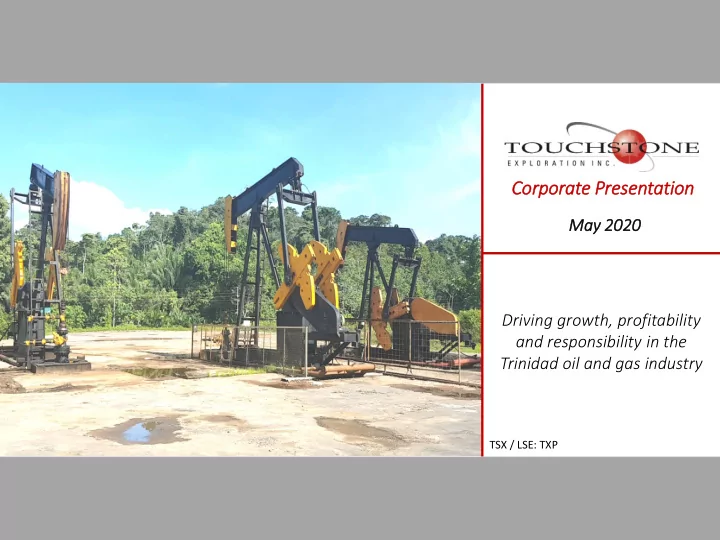
May 2020 2020 Driving growth, profitability and responsibility in the Trinidad oil and gas industry
TSX / LSE: TXP
Corporate Pre resentation May 2020 2020 Driving growth, - - PowerPoint PPT Presentation
Corporate Pre resentation May 2020 2020 Driving growth, profitability and responsibility in the Trinidad oil and gas industry TSX / LSE: TXP Forward-looking Information Unless otherwise stated, all financial amounts herein are presented in
TSX / LSE: TXP
Unless otherwise stated, all financial amounts herein are presented in United States dollars (“$”). The Company may also reference Canadian dollars (“C$”), Trinidad and Tobago dollars (“TT$”) and Pounds Sterling (“£”) herein. Certain information regarding Touchstone Exploration Inc. (“Touchstone” or the “Company”) set forth in this presentation, including assessments by the Company’s Management of the Company’s plans and future operations contains forward-looking statements that involve substantial known and unknown risks and uncertainties. All statements other than statements of historical fact may be forward-looking statements. Forward-looking statements are often, but not always, identified by the use of words such as “seek”, “anticipate”, “plan”, “continue”, “estimate”, “expect”, “may”, “will”, “project”, “predict”, “potential”, “targeting”, “intend”, “could”, “might”, “should”, “believe” and other similar expressions. Statements relating to “reserves” and “resources” are deemed to be forward-looking statements, as they involve the implied assessment, based on certain estimates and assumptions, that the reserves and resources described exist in the quantities predicted or estimated and can be profitably produced in the future. The Company has a reasonable basis for disclosing such statements, which represent the Company’s internal projections, estimates or beliefs concerning future growth, and results of operations. With respect to forward-looking information contained in this presentation, the Company has made assumptions regarding: production rates and production decline rates; the success of exploration opportunities; the magnitude of and ability to recover oil and gas reserves and resources; plans for and results of drilling activity; well abandonment costs; the ability to secure necessary personnel, equipment, production licences and services; environmental matters; future commodity prices; changes to prevailing regulatory, royalty, tax and environmental laws and regulations; the impact of competition, future capital and other expenditures (including the amount, nature and sources of funding thereof); future financing sources; and business prospects and opportunities, among other things. Many of the foregoing assumptions are subject to change and are beyond the Company's control. Some of the risks that could affect the Company's future results and could cause results to differ materially from those expressed in the forward-looking information are described under the heading “Advisories: Business Risks” in this presentation. New factors emerge from time to time, and it is not possible for Management to predict all of such factors and to assess in advance the impact of each such factor on Touchstone’s business or the extent to which any factor, or combination of factors, may cause actual results to differ materially from those contained in any forward-looking statements. In particular, forward-looking statements contained in this presentation may include, but are not limited to, statements with respect to: exploration, development and associated
volumes; estimated reserves and resources (including the quantity, commerciality and net present value thereof); and general business strategies and objectives. Investors should not place undue reliance on any such forward-looking statements or information. Further, any forward-looking statement or information speaks only as of the date on which such statement is made, and Touchstone undertakes no obligation to update any forward-looking statements or information except as required by law, including securities laws. All forward-looking statements and information contained in this presentation are qualified by such cautionary statements.
GAS PIPELINE
Balata East
10 MMbbls
OIL PIPELINE
OIL PIPELINE
Pool Pipeline
Discovery Pool Pipeline Well Facility
COHO ROYSTON
CAS-1ST1
CASCADURA
ROYSTON-1 CHINOOK-1
CHINOOK
Navette
57 MMbbls
Catshill
30 MMbbls
Carapal Ridge Baraka Baraka East COHO-1
Central Block
500 Bcf natural gas, 25 MMboe NGL
Central Block Gas Plant
Shell Trinidad Limited Balata West 7 (BW-7)
Spud: May 20, 1959
BW-9 BW-7, 7X & CHIN-1
BW-7 BW-7X CHINOOK-1
time and sidetracked
Shell Trinidad Limited BW-7X Sidetrack
TD: August 18, 1959
Shell Trinidad Limited Lizard Springs (OL-4)
P10 Case P50 Case P90 Case
Ortoire synclinal basin
TXP: 83.05% XEG: -52.48% XIU: -10.08%
250 200 150 100 50
April 30, 2019 to April 30, 2020
Source: TMX Money
Abbreviations bbl(s) barrel(s) Mbbls thousand barrels MMbbls million barrels bbls/d barrels per day boe(s) barrel(s) of oil equivalent Mboe thousand barrels of oil equivalent MMboe million barrels of oil equivalent boe/d barrels of oil equivalent per day MMcf million cubic feet MMcf/d million cubic feet per day Bcf billion cubic feet NGL Natural gas liquids API API gravity AOF Absolute open flow rate BECR Best estimate contingent resources BEPR Best estimate prospective resources psi pounds per square inch C$ Canadian dollar $ or US$ United States dollar $MM million dollars Brent The reference price paid for crude oil FOB North Sea LOA Lease Operator Agreement SPT Supplemental Petroleum Tax AIM AIM market of the London Stock Exchange plc TSX Toronto Stock Exchange Corporate Information Head Office Suite 4100, 350 7th Ave SW Calgary, AB T2P 3N9 Office: (403) 750-4400 Website: www.touchstoneexploration.com Fax: (403) 266-5794 info@touchstoneexploration.com Trinidad Office Touchstone Exploration (Trinidad) Ltd. #30 Forest Reserve Road Fyzabad, Trinidad Office: (868) 677-7411 Contacts Paul R. Baay President and Chief Executive Officer pbaay@touchstoneexploration.com (403) 750-4488 Scott Budau Chief Financial Officer sbudau@touchstoneexploration.com (403) 750-4445 James Shipka Chief Operating Officer jshipka@touchstoneexploration.com (403) 750-4455 Year End: December 31 Engineers: GLJ Petroleum Consultants Ltd. Auditors: Ernst & Young LLP Legal: Norton Rose Fulbright LLP Nunez & Co. Transfer Agent: Computershare Trust Company
1) Source: BP Statistical Review of World Energy 2019, 68th edition. 2) Source: International Gas Union: 2019 World LNG Report. 3) Based on December 31, 2019 GLJ Petroleum Consultants Ltd. independent reserves evaluation. See “Advisories: Oil and Gas Reserves”. 4) See “Advisories: Oil and Gas Test Results”. Please refer to the Company’s press releases dated September 9, 2019 and November 18, 2019 for full disclosure regarding Coho-1 test results, including applicable advisories related thereto. Furthermore, please refer to the Company’s press release dated February 6, 2020 for full disclosure regarding initial Cacadaura-1ST1 test results, including applicable advisories related thereto. 5) Drilling locations are based on December 31, 2019 GLJ Petroleum Consultants Ltd. independent reserves evaluation and internal estimates. See “Advisories: Drilling Locations”. 6) Non-GAAP measure. Refer to “Advisories: Non-GAAP Measures”. 7) .
Operating Netback Three months ended March 31, 2020 ($000’s unless otherwise indicated) Petroleum revenue 6,698 Royalties (2,019) Operating expenses (1,975) Operating netback 2,704 Crude oil production (bbls) 145,301 Operating netback ($/bbl) 18.61
8) 9) Calculated as the product of the Company’s TSX common share closing price on May 25, 2020 (C$0.73/share) and 183,590,795 common shares
($000’s) March 31, 2020 Current assets (19,961) Less: current liabilities 11,867 Working capital surplus 8,094
Advisories This presentation is for information purposes only and is not under any circumstances to be construed as a prospectus or an advertisement for a public offering of such securities. No securities commission or similar authority in Canada or elsewhere or the Toronto Stock Exchange has in any way passed upon this presentation, or the merits of any securities of Touchstone Exploration Inc., and any representation to the contrary is an offence. An investment in Touchstone Exploration Inc.’s securities should be considered highly speculative due to the nature of the proposed involvement in the exploration for and production of oil and natural gas. This presentation and the information contained herein does not constitute an offer to sell or a solicitation of an offer to buy any securities in the United States. The securities of Touchstone Exploration Inc. have not been registered under the United States Securities Act of 1933, as amended (the “U.S. Securities Act”) or any state securities laws and may not be offered or sold within the United States or to U.S. Persons unless registered under the U.S. Securities Act and applicable state securities laws or an exemption from such registration is available. Business Risks The Company is exposed to numerous operational, technical, financial and regulatory risks and uncertainties, many of which are beyond its control and may significantly affect anticipated future results. The Company is exposed to risks associated with negotiating with foreign governments as well as country risk associated with conducting international activities. Operations may be unsuccessful or delayed as a result of competition for services, supplies and equipment, mechanical and technical difficulties, ability to attract and retain qualified employees on a cost- effective basis, commodity and marketing risk. The Company is subject to significant drilling risks and uncertainties including the ability to find oil and gas reserves on an economic basis and the potential for technical problems that could lead to well blow-outs and environmental damage. The Company is exposed to risks relating to the inability to obtain timely regulatory approvals, surface access, access to third-party gathering and processing facilities, transportation and other third-party related operation risks. The Company is subject to industry conditions including changes in laws and regulations, including the adoption of new environmental laws and regulations and changes in how they are interpreted and enforced. There are uncertainties in estimating the Company’s reserve and resource base due to the complexities in estimated future production, costs and timing of expenses and future capital. The Company is subject to the risk that it will not be able to fulfill the contractual obligations required to retain its rights to explore, develop and exploit any of its properties. The financial risks the Company is exposed to include, but are not limited to, the impact of general economic conditions in Canada and Trinidad, continued volatility in market prices for oil and gas, the impact of significant declines in market prices for oil and gas, the ability to access sufficient capital from internal and external sources, changes in income tax laws, royalties and incentive programs relating to the oil and gas industry, fluctuations in interest rates, the C$ to US$ exchange rate and the US$ to Trinidad and Tobago dollar exchange rate. The Company is subject to local regulatory legislation, the compliance with which may require significant expenditures and non-compliance with which may result in fines, penalties or production restrictions or the termination of licence, LOA or farm-in rights related to the Company’s oil and gas interests in Trinidad. Certain of these risks are set out in more detail in the Company’s 2019 Annual Information Form dated March 25, 2020 which has been filed on SEDAR and can be accessed at www.sedar.com.
Oil and Gas Reserves The reserves information summarized in this presentation are from the Company’s December 31, 2019 independent reserve report prepared by Touchstone’s independent reserves evaluator, GLJ Petroleum Consultants Ltd. (“GLJ”), dated March 4, 2020. This report was prepared in accordance with definitions, standards and procedures contained in the Canadian Oil and Gas Evaluation Handbook (“COGEH”) and National Instrument 51-101 - Standards of Disclosure for Oil and Gas Activities (“NI 51-101”). All December 31, 2019 reserves presented are based on GLJ’s forecast pricing dated January 1, 2020 and estimated costs effective December 31, 2019. Additional reserves information as required under NI 51-101 is included in the Company’s 2019 Annual Information Form dated March 25, 2020. Oil and Gas Measures Where applicable, natural gas has been converted to barrels of oil equivalent based on six thousand cubic feet to one barrel of oil. The barrel of oil equivalent rate is based on an energy equivalent conversion method primarily applicable at the burner tip, and given that the value ratio based on the current price of crude oil as compared to natural gas is significantly different than the energy equivalency of the 6:1 conversion ratio, utilizing the 6:1 conversion ratio may be misleading as an indication of value. Oil and Gas Metrics This presentation may contain certain oil and gas metrics that are commonly used in the oil and gas industry such as finding and development costs and recycle ratio. These metrics do not have standardized meanings or standardized methods of calculation and therefore such measures may not be comparable to similar measures presented by other companies. Such metrics have been included herein to provide readers with additional metrics to evaluate the Company’s performance; however, such measures are not reliable indicators of the future performance of the Company, and future performance may not compare to the performance in prior periods and therefore such metrics should not be unduly relied upon. The Company uses these oil and gas metrics for its own performance measurements and to provide shareholders with measures to compare the Company’s operations over time. Readers are cautioned that the information provided by these metrics, or that can be derived from the metrics presented in this presentation, should not be relied upon for investment purposes. Finding and development costs are the sum of capital expenditures excluding capitalized general and administrative costs and corporate capital expenditures incurred in the period and the change in future development costs required to develop those reserves. Finding and development costs per barrel is determined by dividing current period net reserve additions to the corresponding period’s finding and development cost. The aggregate of the exploration and development costs incurred in the most recent financial year and the change during that year in estimated future development costs generally will not reflect total finding and development costs related to reserves additions for that year. Recycle ratios are calculated by dividing the current period finding and development costs per barrel to operating netbacks before hedging in the corresponding period (see “Non-GAAP Measures”). The recycle ratio compares netbacks from existing reserves to the cost of finding new reserves and may not accurately indicate the investment success unless the replacement of reserves are of equivalent quality as the produced reserves.
Oil and Gas Test Results References in this presentation to production test rates and initial flow rates are useful in confirming the presence of hydrocarbons; however, such rates are not determinative of the rates at which such wells will commence production and decline thereafter and are not indicative of long-term performance or of ultimate recovery. Additionally, such rates may also include recovered "load oil" fluids used in well completion stimulation. While encouraging, readers are cautioned not to place reliance on such rates in calculating the aggregate production for the Company. With A pressure transient analysis or well-test interpretation has not been carried out in respect of the Cacadura-1ST1. Accordingly, the Company cautions that the Cascadura-1ST1 test results should be considered preliminary. Drilling Locations This presentation discloses total drilling locations. Drilling locations are classified into three categories: (i) proved locations; (ii) probable locations; and (iii) unbooked locations. Proved locations and probable locations are derived from the Company's reserves evaluation of GLJ Petroleum Consultants Ltd. effective December 31, 2018 and account for locations that have associated proved and/or probable reserves, as applicable. Unbooked locations are internal estimates based on the prospective acreage associated with the Company’s assets and an assumption as to the number of wells that can be drilled based on industry practice and internal review. Unbooked locations do not have attributed reserves. Of the approximately 208 (net) drilling locations identified herein, 61 are proved locations, 29 are probable locations, and the remaining are unbooked locations. Unbooked locations have been identified by Management as an estimation of potential multi-year drilling activities based on evaluation of applicable geologic, seismic, engineering, production and reserves information. There is no certainty that the Company will drill all unbooked drilling locations, and if drilled there is no certainty that such locations will result in additional oil and gas reserves or production. The locations on which the Company will drill wells will ultimately depend upon the availability of capital, regulatory approvals, crude oil prices, costs, actual drilling results, additional reservoir information that can be obtained and other factors. While certain of the unbooked drilling locations have been de-risked by drilling existing wells in relative close proximity to such unbooked drilling locations, other unbooked drilling locations are farther away from existing wells where Management has less information about the characteristics of the reservoir and therefore there is more uncertainty whether wells will be drilled in such locations, and if drilled there is more uncertainty that such wells will result in additional oil and gas reserves or production. Non-GAAP Measures This presentation may contain terms commonly used in the oil and natural gas industry, such as funds flow from operations, working capital, and operating netback. These terms do not have a standardized meaning under International Financial Reporting Standards (“IFRS”) and may not be comparable to similar measures presented by other companies. Shareholders and investors are cautioned that these measures should not be construed as alternatives to cash provided by operating activities, net income, or other measures of financial performance as determined in accordance with GAAP. Management uses these non-GAAP measures for its own performance measurement and to provide stakeholders with measures to compare the Company’s operations
Non-GAAP Measures (Continued) Funds flow from operations is an additional GAAP measure included in the Company’s consolidated statements of cash flows. The Company uses operating netback as a key performance indicator of field results. Operating netback is presented on a total and per barrel basis and is calculated by deducting royalties and operating expenses from petroleum sales. If applicable, the Company also discloses operating netback both prior to realized gains or losses on derivatives and after the impacts of derivatives are included. Realized gains or losses represent the portion of risk management contracts that have settled in cash during the period, and disclosing this impact provides Management and investors with transparent measures that reflect how the Company’s risk management program can impact netback metrics. The Company considers operating netback to be a key measure as it demonstrates Touchstone’s profitability relative to current commodity prices. This measurement assists Management and investors with evaluating operating results on a historical basis. Working capital is calculated as current assets minus current liabilities as they appear on the consolidated statements of financial position. The Company uses operating netback as a key performance indicator of field results. Operating netback is presented on a total and per barrel basis and is calculated by deducting royalties and
This measurement assists Management and investors with evaluating operating results on a historical basis. The Company closely monitors its capital structure with a goal of maintaining a strong financial position in order to fund current operations and the future growth of the Company. The Company monitors working capital and net debt as part of its capital structure to assess its true debt and liquidity position and to manage capital and liquidity risk. Working capital is calculated as current assets minus current liabilities as they appear on the consolidated statements of financial position. Net debt is calculated by summing the Company’s working capital and the principal (undiscounted) amounts of long-term debt.