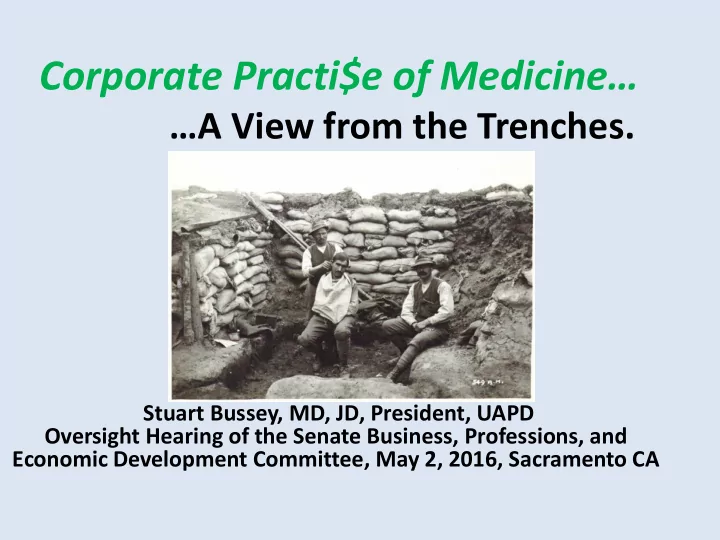
Corporate Practi$e of Medicine A View from the Trenches. Stuart - - PowerPoint PPT Presentation

corporate practi e of medicine a view from the trenches
SMART_READER_LITE
LIVE PREVIEW

Corporate Practi$e of Medicine A View from the Trenches. Stuart - - PowerPoint PPT Presentation

Corporate Practi$e of Medicine A View from the Trenches. Stuart Bussey, MD, JD, President, UAPD Oversight Hearing of the Senate Business, Professions, and Economic Development Committee, May 2, 2016, Sacramento CA If you do not change


slide-1
SLIDE 1

Corporate Practi$e of Medicine…

…A View from the Trenches.

Stuart Bussey, MD, JD, President, UAPD Oversight Hearing of the Senate Business, Professions, and Economic Development Committee, May 2, 2016, Sacramento CA

slide-2
SLIDE 2
slide-3
SLIDE 3
slide-4
SLIDE 4
slide-5
SLIDE 5

“If you do not change direction, you may end up where you are heading”

  • -Lao Tzu
slide-6
SLIDE 6

Agricultural and First Industrial Revolution-Europe and Northeast U.S. 1760- 1860

  • As population and demand for food increased, improvements

made in farm practices and machinery. Standards of living and longevity rose.

  • Steam engine invention leads to the rise of the factories,

transportation and cities. Cotton spinning became mechanized. textile manufacturing. Change in energy from wood to coal and iron

  • Child labor 1700s/1800s cheap/comparable. Long hours set by

machine pace.

  • Luddite movement 1811. Capt.Swing riots 1830. Tolpuddle

Martyrs 1834 Factory Acts 1833,1844, 1850 child mining laws in UK. The Chartist movement led to General Strike of 1842...Trade unions supported political parties—led to British Labour Party formation

  • U.S. trade unions began in NYC and Phila.1794

Shoemakers(!827) Mechanics United craft unions, 1852 International typographical—Professional Guilds (AMA)

slide-7
SLIDE 7

Frederick Taylor (1856- 1915) “scientific management “ principles (Taylorism): 1.Scientific studies of the task 2.Scientifically select and train each employee 3.Detailed instruction/supervision of worker’s tasks 4.Divide work equally between managers who plan the work and workers who perform the tasks.

The Second Industrial Revolution in the United States 1860-early 1900s; ---steel,garment and automotive assembly lines

Relevant labor laws and miletones – Sherman Antitrust(1890) and Clayton(1914) Acts AFL created 1886 CIO 1928 Merger 1955 Pullman Railway Strike of 1894 Department of Labor Created 1912

slide-8
SLIDE 8
  • Mainframes, Faxes, PCs, tablets, ipods,2 billion
  • n web, 5 billion cellphones, socio-political,

economic networks

  • Objects of labor: matter, energy, information
  • Information: an increasing factor of

production

  • Managers develop information control &

processing

  • Data &Information vs. Knowledge & Wisdom

Digital/Information Revolution: 1950s --Present

slide-9
SLIDE 9

Increasing Employment Means Provider Accountability to patients, hospitals, insurers, medical groups, IPAs, ACOs, attorneys and to…Employers. Doctor Patient relationship is changing Into… SYSTEM

Employer Patient Provider

slide-10
SLIDE 10

Driven by… Increasing demand for services due to ACA patient influx and an increasingly aged population with… Greater Efficiencies/Technologies in access, dx/tx, convenience, mobility, communication, education, privacy and information

Industrialization of Healthcare

slide-11
SLIDE 11
slide-12
SLIDE 12

0% 10% 20% 30% 40% 50% 60% 70% 80% 90% 100%

Physician Ownership by Specialty

Owner Indep.Cont Employee

.

slide-13
SLIDE 13

Projected Supply and Demand, Full-time Equivalent Physicians Active in Patient Post Health Care Reform, 2008-2025 AAMC Workforce Studies 6/2010

YEAR

  • Phys. Supply

(All Specialties)

  • Phys. Demand

(All Specialties)

  • Phys. Shortage

(All Specialties)

  • Phys. Shortage

(Non-Primary) 2008 699,100 706,500 7,400 None 2010 709,700 723,400 13,700 4,700 2015 735,600 798,500 62,900 33,100 2020 759,800 851,300 91,500 46,100 2025 785,400 916,00 130,600 64,800 Provider Type 2010 Number 2010 % Total 2025 Number 2025 % Total Physicians 210,00 71% 216,000 60% NursePract itioners 56,000 19% 103,000 29% Phys.Assts. 30,600 10% 42,000 12%

Primary Care Provider Projection,2010-25 Health Affairs, 11/2013

slide-14
SLIDE 14
  • As practice ownership hassles(overhead,EHR) go up & profits

dwindle; 2012 owner income down 6% , employees up 2%.

  • New, younger breed of doctor seeks life balance ,has high debt -

analogy of industrial worker flight to the factories(hospital)

  • Deep pocket Hospitals, Megagroups and MCOs also hiring older

docs, etc. to take greater control of the market and the human capital needed to deliver services and capture referrals

  • Most states do not have a corporate bar- i.e. hospitals can

directly employ physicians, other states allow exceptions

  • Will provider(esp. primary care) shortages, economies of scale

favor employee income/work conditions in the long run?

Physician Employment is…

Accelerating

slide-15
SLIDE 15

Physician Unions in the Medical Industrial Revolution

  • -Insurer Monopolies, Mega groups, Public

Employers promote Micromanagement and the reemergence of Taylorism: Examples: Provider Report cards, economic

  • utliers, sham peer review, “Care Suggestions”,

support teams, Pay for performance, Production quotas (esp. for public physician employees)

slide-16
SLIDE 16

Most Frequently Cited Professional Concerns:

  • Fees and Reimbursement

(68%)

  • Burden of Paperwork (56%)
  • Healthcare Reform (54%)
  • Value of Primaries v.

Specialists, Midevels (43%)

  • Third Party Interference

(43%)

  • Malpractice/Tort Reform

(39%)

  • Doctor Shortage (29%)
  • EHRs (28%)
  • Account.Care

Organizations(17%)

Source: Medical Economics 11/2013

slide-17
SLIDE 17

Reemerging Interest in Physician Unions?

  • 1st physician unions in Germany and UK early 1900s,

then 26 US physician unions formed after Medicare in ‘60s…now only a few unions left with 25k members… but with more physician employees and ACA…more interest?

  • Current physician organizations (medical groups, IPAs,

ACOs, Medical Associations) are not satisfactorily designed for negotiating or maintaining salary, benefits, and working conditions.

  • Other healthcare unions (especially nurses) have been

successful in increasing salaries and power.

slide-18
SLIDE 18

Physician Unions in the Medical Industrial Revolution

Intern or Resident? $alaried employee?

UNION

Yes No Manager

  • r Supervisor

Yes No ELIGIBLE

No

NOT UNION ELIGIBLE

Yes

slide-19
SLIDE 19

Physician Unions in the Medical Industrial Revolution

Employee or Independent Contractor Status?

  • -Public employee physicians-determined by government

codes, statutes, bodies

  • -Private employee physicians- less clear,determined by
  • NLRB. IRS criteria:”employer control”. NLRB v.Hearst

Publication(1944) Amerihealth,Inc.329 NLRB No.76 (1999)

  • -Hybrid/Joint Employee Physicians- an emerging trend,

UAPD v. Ventura County PERB Decision No.2067M(2009) Employee or Manager?- NLRB v.Yeshiva Univ. 44 U.S. 672,1980 – employed private university faculty who formulate policies are managers

slide-20
SLIDE 20

Physician Unions in the Medical Industrial Revolution

Supervisory v. Nonsupervisory Employees NLRA section 2(11) Employee is “supervisor” if:

  • authority to hire,fire,transfer,suspend,layoff,recall,

promote,assign,reward,discipline,adjust grievances or responsibly direct.

  • He/she exercises authority in interest of employer
  • The exercise of authority is not merely routine or clerical, but

involves independent judgment In the “Kentucky River Trilogy” Oakwood Healthcare Inc. Croft Metals, Golden Crest Heathcare 348 NLRB Nos.37-39 (2006),NLRB clarifies its definition – supervisors must be accountable for other’s acts, must have actual authority,use discretionary judgment ,at least 15-20% of their time.

slide-21
SLIDE 21

Physician Unions: “Collective Bargaining”

Opening Proposals Bargaining Responses Temp Agreement Last/Best Offer Impasse Mediation

Final Agreement

No Agreement

slide-22
SLIDE 22
slide-23
SLIDE 23
slide-24
SLIDE 24

Physician Unions in the Medical Industrial Revolution Pro Union Legislation 1915-

  • Railway Labor Act 1926
  • Norris Laguardia Act 1932
  • Wagner Act (NLRA) 1935
  • Fair Labor Stds. Act 1938
  • AFL-CIO merge 1955
  • Taylor Act 1967
  • OSHA 1970
  • Doctor CB Bills 2000/2011
  • Employee FreeChoice Act 2007
  • Lillie Ledbetter Act 2009

Anti Union Legislation 1915-

  • State Right to Work Laws 1943
  • Taft Hartley Act 1947
  • Landrum Griffin Act 1959
  • Pres. Reagan v. PATCO 1981
  • Kentucky River Trilogy 2006
  • Municipal Bankruptcies 2008-
  • State Coll.Barg. Repeals 2011-
  • Anti-Public Pension Bills and

Referendums 2012-

  • Micro-Union Decision 2014?
  • Harris v. Quinn SCOTUS 2014
slide-25
SLIDE 25

Physician Unions Going Forward

  • Contracts: review, negotiate, enforce(grieve)
  • Maintain scope of practice, increase doctor supply
  • Stop income/job loss to ancillaries, technologies
  • Reduce the Hassle Factors
  • Ensure due process and fight sham peer review
  • Political reforms and legislation: healthcare,

insurance, collective bargaining, tort and social.

  • Synergy with other medical, healthcare orgs.
slide-26
SLIDE 26

Physician Unions in the Medical Industrial Revolution Thank you for listening! Stuart Bussey, MA,MD,JD ,FCLM, President of the Union of American Physicians & Dentists/AFSCME 180 Grand Avenue,Suite 1380, Oakland,CA 94612 1-800-622-0909 www.uapd.com References: When Doctors Join Unions, Grace Budrys, Cornell University Press, 1997, New England J.Med.,2011,364:1790-3, University of Chicago Law Review, Vol.40 (1972)pp. 185-205.