SLIDE 1 Corporate Noncompliance:
Trends in the Law
Aroundtable d i s c u s s i o n • n o n c o m p l i a n c e s p e c i a l a d v e r t i s i n g s e c t i o n
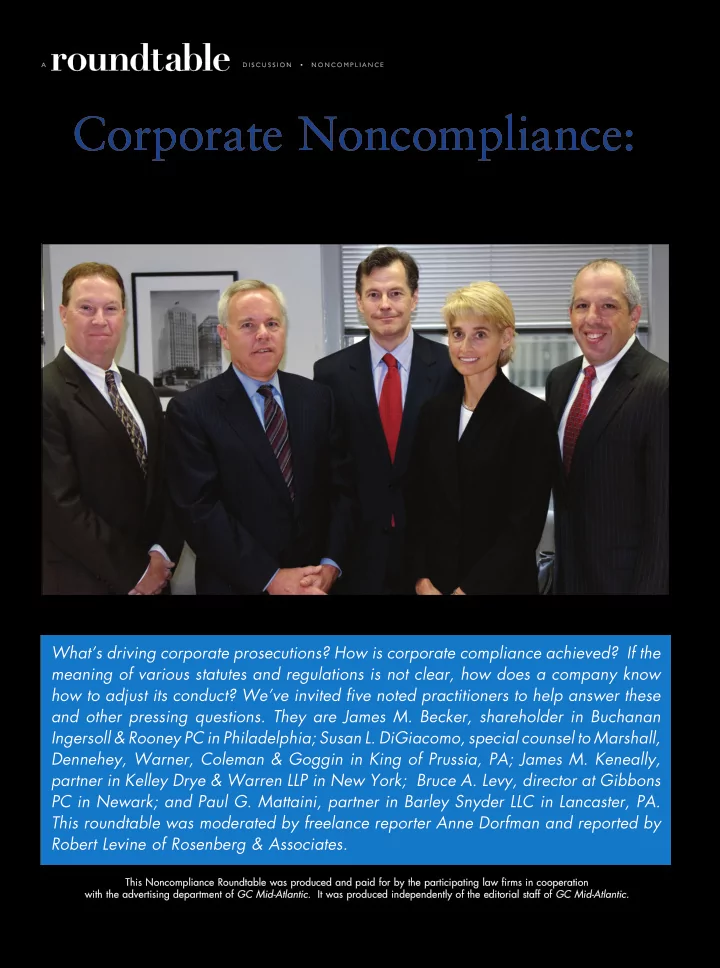
What’s driving corporate prosecutions? How is corporate compliance achieved? If the meaning of various statutes and regulations is not clear, how does a company know how to adjust its conduct? We’ve invited five noted practitioners to help answer these and other pressing questions. They are James M. Becker, shareholder in Buchanan Ingersoll & Rooney PC in Philadelphia; Susan L. DiGiacomo, special counsel to Marshall, Dennehey, Warner, Coleman & Goggin in King of Prussia, PA; James M. Keneally, partner in Kelley Drye & Warren LLP in New York; Bruce A. Levy, director at Gibbons PC in Newark; and Paul G. Mattaini, partner in Barley Snyder LLC in Lancaster, PA. This roundtable was moderated by freelance reporter Anne Dorfman and reported by Robert Levine of Rosenberg & Associates.
photography: nanette Kardaszeski
This Noncompliance Roundtable was produced and paid for by the participating law firms in cooperation with the advertising department of GC Mid-Atlantic. It was produced independently of the editorial staff of GC Mid-Atlantic.
SLIDE 2 n o n c o m p l i a n c e • Aroundtable D I S C U S S I O N s p e c i a l a d v e r t i s i n g s e c t i o n
MODERATOR: State attorneys general have recently taken a greater role in enforcing laws that govern corporate behavior. BECKER: Historically, state attorneys general tended to defer to the federal government. That has changed dramatically in that they are with increasing frequency devoting substan- tial resources to enforcement of state criminal and civil laws against large national and multinational corporations. A com- pany’s problems can no longer be resolved solely at the federal
- level. In New York it’s not uncommon to have to deal with the
state attorney general, the U.S. Department of Justice in the Southern or Eastern District, and the Securities and Exchange
- Commission. That makes managing the problem and obtain-
ing an acceptable resolution far more challenging. In some areas the problem is particularly complex. In the pharmaceuti- cal industry, for example, the federal government often seeks to recover significant dollar amounts through enforcement of complex Medicare, Medicaid, and other federal regulations. Meanwhile, state attorneys general across the country have their own interests in recouping money for their state Medicaid
- programs. A pharmaceutical company can find itself having to
deal not only with federal enforcement authorities, but also with multiple state attorneys general. KENEALLY: We’re also finding, especially in New York, that state regulatory agencies which just a few years ago were not considered high-profile players in enforcement are jump- ing into the fray. Most notably, the New York State Insurance Department is now a significant player on the regulatory front, and also behind the scenes. New York is an interesting forum because the AG has the Martin Act, a broad law giving it jurisdiction over various types of business fraud. On the civil side, it gives the AG a quasi-SEC role at the investigative stage. You don’t have to rely on grand jury subpoenas; you can take Martin Act depositions the way the SEC takes investigative
- depositions. Eliot Spitzer used it to bring criminal actions in the
insurance-brokerage and mutual-fund scandals. Under Andrew Cuomo, the AG’s office is entering very quickly into financial settlements of student-loan cases and auction-rate securities cases rather than pursuing long, drawn out criminal investiga- tions and threatening criminal prosecution. MATTAINI: The auction-rate securities issue is interesting because a lot of states that have never been that active have been active on this issue. In a lot of cases, the states’ main goal has appeared to be to get some liquidity in the market. MODERATOR: What are auction-rate securities? MATTAINI: There was a market for a good 20 years which, in effect, made what were structurally long-term securities into short-term securities because their interest rates were reset every week through a market mechanism. Unfortunately, the market mechanism started to fail. There was no credit problem with the underlying securities, but there was no market for them. If you look at the written disclosures, you can argue that the necessary disclosures were there — but they might have been marketed differently than the written disclosures indicate. The difference in this case is that the regulators wanted to solve this problem. They were faced with people holding hundreds of billions of dollars of securities that were not as liquid as had been thought. This situation probably worked out in a satisfactory manner — unless, of course, you were one of the investment banks that had to repurchase the securities. KENEALLY: The legal question is the same for securities related to subprime mortgages — whether or not you were providing pro-per disclosures and how you were representing them to the marketplace. The subprime issues go beyond that, though, because the brokers and bankers themselves have sustained such incredible losses on them. So another issue is how the banks and investment firms valued the securities, as well as the time of those valuations. That is probably something better addressed by the SEC than by attorneys general. MATTAINI: The securities need to be “marked to market,” but there is no market. THE MODERATOR: Is it a question of potential fraud in the way they were marketed? MATTAINI: Some people knew better. They will claim they didn’t, of course, but there are situations where the people who were put into financial products would clearly have qualified for products that were more beneficial for them, but it was more profitable for the brokers and mortgage companies to put them in some of these other products. DiGIACOMO: It’s no different than marketing in other highly regulated industries, like the health care industry. When the perception is that there’s harm to the public because something was not disclosed, or that there is a large amount of greed at the top of an organization, we begin to see government regula- tion and enforcement actions. We have seen this for years in the health care industry. Pharmaceutical companies and health care providers have been unwilling to go to trial to test the gov- ernment’s allegations. Settlements are reached with provisions allowing the government to continue to assure the corporation’s compliance over time. A settlement usually allows for continued participation in government programs such as Medicare. MODERATOR: Is this what some call “regulation by investiga- tion”? DiGIACOMO: Yes, and it’s also regulation by perception. Investigations further a perception that the government tries to make the playing field more level, with the notion that everyone should have the same chance at making money in the stock market, or buying a house, or getting health care, or knowing the benefits and harms of the drugs they are prescribed. LEVY: That’s particularly true in the health care industry, and particularly with pharmaceutical companies. For example, DOJ investigations regarding off-label promotion of drugs are resulting in large civil settlements. A Government Accountability Office report issued this summer concluded that the Food and
SLIDE 3 Drug Administration lacks adequate infrastructure to carry out its responsibility
- f regulating prescription-drug marketing activities, especially promotion for
- ff-label uses. From 2003 through 2007 the FDA issued 42 warning letters
to companies relating to off-label promotion violations; these letters are issued to alert companies to alleged violations that do not warrant intervention by
- DOJ. Remedies for warning letters are usually negotiated with the FDA and
typically include cessation of the conduct. During this same period, the Justice Department settled 11 off-label investigations where the remedies included fines and penalties totaling hundreds of millions of dollars. Therefore, the meaningful enforcement of off-label regulations is being done through civil and criminal investigations conducted by DOJ, where the stakes are infinitely higher. The issue for drug and device manufacturers is: When the rules are unclear, how do you respond when what you can and can’t do becomes the subject of a high-stakes DOJ investigation? In other areas, litigation often clarifies ambigu- ity in the law. But here the consequence of losing — exclusion from federal programs — is so great that corporations don’t litigate. The few cases where these theories have been tested occurred after TAP Pharmaceuticals and Serono Laboratories settled corporate investigations for hundreds of millions of dollars
- each. Later criminal prosecutions of the individuals involved resulted in acquit-
tals, so you can make a strong argument that the evidence and theories in those cases did not hold up when they were finally tested in court. BECKER: In those cases, the companies undoubtedly recognized that no matter how good their chances of success at trial, they and their shareholders would have to withstand a lengthy pretrial period of uncertainty. In exchange for the guilty pleas, enormous financial payments, and other conditions, the companies were able to continue in business, and obtained financial certainty. However, neither company had its day in court before a neutral party on the merits of the allegations against it. Because each company resolved the matter prior to the filing of criminal charges, the company’s only opportunity to be heard on the merits was in settlement negotiations with its powerful adversary. LEVY: My clients, many of which are device and pharmaceutical manufactur- ers, are run by good people, with sharp lawyers and responsible CEOs who are doing everything humanly possible to ensure that their companies are in
- compliance. The issue in this area is the lack of clarity provided by the law.
Regarding off-label promotion, there’s a tension in the law that permits physi- cians to prescribe a drug for any reason but prohibits companies from promot- ing it for anything other than the approved use. Similarly, the anti-kickback statute provides that drug and device manufacturers can’t offer anything to a provider for ordering products that get billed to the federal government. So long as one purpose of the payment is to increase business, the statute is violated. On some level, increasing sales is a purpose of every marketing program, and this puts the leaders of these companies in an almost untenable position that is made more difficult by the lack of clarity in the law. KENEALLY: In the pharmaceutical industry, especially, companies rely on door- to-door salespeople who try to get physicians to prescribe their medicines with-
- ut any bright-line definitions to follow, just generally knowing, “I can’t try to sell
this for off-label purposes, but there’s nothing to stop a physician from using it for those purposes, and the physicians want to know about every possible use for a drug. Where is my gray area? How do I make my sale?” You have the same problem in the brokerage industry, which is that you can have as many disclosures as possible in the offering documents, but face-to-face or over the phone it’s very difficult to control oral communications between your sales force
Aroundtable d i s c u s s i o n • n o n c o m p l i a n c e s p e c i a l a d v e r t i s i n g s e c t i o n
“
Before the recent increased use
prosecution agreements in these cases, there would be a civil case, a large settlement, and a Corporate Integrity Agreement. — Bruce A. Levy
SLIDE 4 n o n c o m p l i a n c e • Aroundtable D I S C U S S I O N s p e c i a l a d v e r t i s i n g s e c t i o n
and customers. DiGIACOMO: Here’s the problem: Most of these cases are started by whistle-blowers who have an incentive to blow the whistle because they are going to get a percentage of the ultimate settlement. There’s potentially a lot of money to be made by an employee reporting corporate wrongdoing to the government. LEVY: In the TAP case the lead whistleblower got $77 million. MODERATOR: If there’s a problem, wouldn’t you want a whistle-blower to blow the whistle so you can correct it? DiGIACOMO: You would like them to blow the whistle in house first, to give the company a chance to address the
- issue. Once the government starts an investigation, a corporation could be tied up legally for years. At some point a
public corporation would have to disclose the government’s investigation to its shareholders and in SEC filings. Counsel need to be aware of the collateral consequences of a government investigation or enforcement action. MODERATOR: The DOJ has also recently been bringing more cases under the Foreign Corrupt Practices Act. Why? KENEALLY: One reason is that you have significantly heightened cooperation among nations, particularly in regard to bribery laws, and, at its heart, the FCPA is an anti-bribery statute. Also, because such cases are difficult to detect, self- reporting is encouraged and plays an important role, because the penalties under the FCPA are significant. In addition to fines, the impact on a company’s ability to conduct business is significant. Lockheed had a case in Egypt where it paid millions of dollars in fines but was also forced to forfeit a $1.6 billion contract with the Egyptian government. If a company believes there’s a way to avoid that by turning itself in to the U.S. government, it will do it. MATTAINI: The other reason is that the world is getting smaller. I can’t tell you how many companies are now ask- ing for policies or training on the FCPA. Also, companies that are owned by private equity firms often emulate public companies in terms of compliance. BECKER: You also see increased international cooperation among enforcement authorities in the antitrust area. You see, for example, Korean business executives agreeing not just to plead guilty in the United States to criminal antitrust charges, but, in one case, agreeing to serve 14 months in a U.S. prison. The Justice Department now has the leverage to obtain these resolutions, partly because of this increased cooperation. MATTAINI: Doing business in different countries can be a challenge in terms of compliance. There are some things that have been totally accepted in other countries for generations as just part of doing business that may not match up with what we do, or with what is acceptable, in the United States. This can put companies in a tough position. MODERATOR: At what point before or during an internal investigation do general counsel start worrying about themselves? MATTAINI: It is not always clear what the SEC would consider to be “obstruction.” As with many things, it is a lot easier in retrospect to see what should have been done. Business people, understandably, tend to have a bit of a circle-the-wagons mentality: “We’re being attacked.” Counsel have to work through all of that. DiGIACOMO: You have to advise your clients immediately of two basic principles: Do not destroy anything and don’t lie to the government. Individuals can respectfully decline to answer an agent’s questions and can seek the advice of counsel. MATTAINI: Of course, sometimes the government wants to know what you propose to do before you know yourself; you are often only at the fact-finding stage. Then throw in the fact that, if you have a public-company client, you want to disclose as promptly as possible. However, sometimes premature disclosure can be more of a detriment than a benefit because you don’t know the whole story at that point. It can be very important to bring in outside counsel early in the process, for an objective viewpoint if for nothing else. MODERATOR: If the government has initiated the investigation, you’re in a different position. KENEALLY: Then it’s easy to make the decision to retain outside counsel. I always think it’s better to act sooner rather than later, because the worst position for a company and its in-house counsel to be in is not to have control over the
SLIDE 5
- situation. You clearly don’t have control over the situation when there have been search warrants executed, and subpoe-
nas issued, and people have been cornered by FBI agents and questioned before you’ve even ascertained all the issues. When that occurs, you can begin to reverse things by engaging outside counsel and launching an internal investigation as quickly as possible. LEVY: Corporations often feel that even when they come forward and disclose to the government so that they can resolve violations or potential violations, they don’t get credit for cooperating; or that unreasonable demands, such as to waive the attorney-client privilege and the like, are being placed on them. MODERATOR: Will this change under the recent Filip guidelines for assistant U.S. attorneys who are prosecuting corpora- tions? LEVY: The Filip guidelines are directed at alleviating some of that tension, at appeasing corporations and encouraging cooperation with prosecutors by doing things like directing assistant U.S. attorneys not to demand waivers of attorney- client privilege. BECKER: There’s sometimes a disconnect between what Washington pronounces in one of these memos and what takes place out in the field. KENEALLY: It remains to be seen. The guidelines say what they say with respect to DOJ policy. We’ll just have to see how prosecutors, and, in fact, defense counsel, react. MODERATOR: Why are we now seeing so many deferred prosecution agreements? BECKER: The increased use of deferred prosecution agreements and non-prosecution agreements with corporations came in direct response to the demise of Arthur Andersen following its criminal prosecution in the Enron matter. Whether a deferred prosecution agreement or non-prosecution agreement would have saved Arthur Andersen may be unclear. Nevertheless, the perception was that these agreements are beneficial because they allow for corporate sanctions and oversight without imposing the more devastating penalties that a full-blown criminal prosecution and conviction might entail. DiGIACOMO: In our region, New Jersey has been a big proponent of deferred prosecution agreements. However, a prob- lem arose regarding how monitors were selected to oversee a corporation’s compliance. Former U.S. Attorney General John Ashcroft received a monitorship and made a lot of money. It became a public perception problem. Recently, DOJ guidelines were created to ensure that both sides have input into selection of the monitor, and, further, that the monitor is someone who is able to deal with the particular problems of the corporation. KENEALLY: These so-called Morford guidelines provide nine principles as to how prosecutors should be guided in crafting their DPAs. One of the significant features missing from Morford is guidance as to the cost of monitorship. You pay for the monitor and his or her staff to oversee you. Your ability to object and to disregard what the monitor is suggesting is
- circumscribed. So, in theory, you could be paying tens of millions of dollars to be made to do something that you really
don’t want to do and have little power to object to. LEVY: At least in the health care industry, this begs the question whether monitorships are necessary in the cases where they are being imposed. Before the recent increased use of DPAs in these cases, there would be a civil case, a large settlement, and a Corporate Integrity Agreement administered by the Office of the Inspector General of Health and Human Services. Under a C.I.A., the government gets much the same benefit it gets under a monitorship — improved compliance. What are we getting from deferred prosecution agreements and the imposition of federal monitors that we weren’t getting from Corporate Integrity Agreements? Under a C.I.A., how a corporation gets to an acceptable level of compliance is largely left to the corporation. What’s fundamentally different about a monitorship is the loss of control in the process. The government is imposing an external force that has decision-making authority, reports directly to the U.S. attorney, and is physically pres- ent at the company — at an hourly rate. DPAs don’t seem to be implemented the way pretrial diversion is in criminal cases involving individuals, although DPAs potentially do the same thing for corporations. It appears that we are seeing DPAs in cases where there would not otherwise have been a prosecution, or in health care cases where there would have been a civil settlement and a Corporate Integrity Agreement. DPAs represent an expansion of the Justice Department’s traditional role and of its influence over corporations. This begs the question whether there is something between the Corporate Integrity
Aroundtable d i s c u s s i o n • n o n c o m p l i a n c e s p e c i a l a d v e r t i s i n g s e c t i o n
SLIDE 6 Agreement and the deferred prosecution agreement. So far, it’s unclear why some cases result in DPAs and others in Corporate Integrity Agreements. DiGIACOMO: Sometimes it’s what the individual U.S. attorneys in the various districts prefer. New Jersey did DPAs all the time, but we did not see them in the Eastern District of Pennsylvania. LEVY: The costs of a DPA are astronomical. For example, the disclosure to the SEC regarding Senator Ashcroft estimated his fees for monitoring Zimmer Holdings after settlement of a kickback case at $50 million. MATTAINI: It was so material to that company that it felt compelled to disclose it. LEVY: Fifty million dollars for a monitor doesn’t come out of thin air. It gets built into the cost of providing the product. MATTAINI: Also, in a senior management meeting addressing important strategic decisions for the company, the monitor is there as well — which could be somewhat disruptive and intrusive if you think about it from a business perspective. KENEALLY: They’re basically embedded in the company. MODERATOR: Wouldn’t it be better to go to trial? KENEALLY: If you’re a regulated industry where you do regular business with the government, and the downside of losing a trial is losing the ability to do business with the government — which is basically a death sentence — no, it’s not worth going to trial. BECKER: Public companies in particular want to resolve these contingent liabilities and to move on, thereby avoiding the substantial risk and inherent uncertainty involved in litigation against the government. In today’s climate, non-prosecution agreements, deferred prosecution agreements, or Corporate Integrity Agreements are simply part of the price of obtaining certainty. MODERATOR: When you’re facing an investigation or a trial, you and general counsel work with accountants. How has that relationship changed post–Sarbanes-Oxley? MATTAINI: It’s clearly a different world. There is a different relationship between the company and its accountants, and between the accountants and the company’s other advisors. Accountants’ independance is a much bigger issue, and accountants are not able to be service providers anymore. Some people even complain that you might as well just have the government appoint them, and the accountants are so independent that you wonder whether this might not happen at some point. However, they have good reason to be this way because there’ve been so many suits against them. BECKER: The relationship with outside auditors has changed significantly, especially if the company is dealing with an issue that might involve corporate criminal wrongdoing. Now, because of the way in which outside auditors view their responsibilities, they may be far more aggressive in demanding to see certain information: “We want to see counsel’s interview notes of managers and employees, and we want to see counsel’s attorney work product, because we have to make an independent determination of whether there is information available that could affect our audit of the company’s financials.” If you’re talking about an issue that potentially implicates senior management, they say, “We now have a credibility question as to whether we can believe anything management is telling us.” Post–Sarbanes-Oxley, these lines of inquiry by outside auditors are no longer uncommon. MATTAINI: Without their signing off, no report is filed with the SEC, and that is not an option. BECKER: Dealing with the government is difficult enough. When the outside auditor becomes the company’s adversary, the challenges become even greater. As Paul points out, the company’s most immediate obligation may be a filing requirement with the SEC. Without the sign-off by the outside auditors, the company cannot file and must then begin to explain why to both the SEC and the exchange on which it is listed. If the outside auditor’s concerns cannot be satisfactorily addressed, the auditor might choose to resign from the account (particularly if the account is not a significant one), and even to notify the SEC. For all of this to play out during an ongoing government investigation is a potential disaster.
n o n c o m p l i a n c e • Aroundtable D I S C U S S I O N s p e c i a l a d v e r t i s i n g s e c t i o n
SLIDE 7 Aroundtable d i s c u s s i o n • n o n c o m p l i a n c e s p e c i a l a d v e r t i s i n g s e c t i o n
MATTAINI: In some cases the accountants involve their own counsel, either inside or outside. With the kind of dollars involved in suits against accountants, they have to deal with their potential liability. There’s no way around it. LEVY: In my experience, the percentage of every revenue dollar that accountants have to pay to defend themselves, or to pay out in recoveries, is much higher than in other industries. KENEALLY: That’s why you see more accounting firms going into forensic accounting and consulting, rather than public auditing. MATTAINI: Some of the regional accounting firms will not audit public companies anymore, in part because of the require- ments and restrictions of Sarbanes-Oxley. For example, they may not be permitted to provide non-audit services to their audit
- clients. Some firms have decided that it may be more profitable, and there is less exposure, in other areas. We have less
competition in the audit world as a result. Also, a lot of former accountants who used to sit on boards of directors’ audit committees are now thinking twice about doing so. MODERATOR: What is the current enforcement environment in this election year? LEVY: We’re seeing increased resources devoted to things like Medicaid enforcement, at both the federal and state levels. We’re seeing an increase in settlements and investigation activity across the board — pharmaceutical companies, device companies, hospitals, all kinds of health care providers. Regardless of the outcome of the election, in the health care industry increased enforcement clearly is the trend. DiGIACOMO: I think we are going to see increased scrutiny and more audits in every aspect of the health care industry. Medicare’s RAC program — Recovery Audit Contractors — will continue in all states by 2010; previously it was a dem-
- nstration program covering only a few states. RACs are private contractors hired to identify inappropriate Medicare
- payments. The RACs receive a percentage of their findings, so these auditors have every incentive to find as many errors
as they can. These audits can also lead to further government investigation. Due to fiscal pressures, both the federal and state governments are looking at every penny paid for health care, and the industry will remain under a microscope no matter what political party wins the White House. Privacy in health care is also an issue. Health Insurance Profitability and Accountability Act violations are numerous and the government has stepped up its enforcement and audits in this
- area. Especially in light of the increased use of electronic health records, medical identity theft is an emerging prob-
- lem. Quality of care is also becoming a focal issue. The government is not going to pay for hospital mistakes which it
believes should never happen or for conditions which are reasonably preventable, because it hopes that by withholding payment for care associated with treating certain hospital-acquired conditions, including “never events,” patient safety will improve. Examples of conditions which Medicare, and most of us, believe never should happen include surgery on the wrong body part and objects left in a patient after surgery. Some of these events are clear-cut, but others are not. These new payment rules will have consequences that are not only financial, but also may impact the false claims and malpractice arenas. KENEALLY: There will be heightened enforcement in the financial industry. It’s going to be partly contingent on the direction the economy takes. Enforcement efforts will likely precede whatever new legislation and regulation is permanently enacted. MATTAINI: Both candidates say they’re going to clean up Wall Street. BECKER: It’s not a climate where there’s a significant difference between Republicans and Democrats. Everyone wants to appear to be tough on corporate crime. Health care fraud enforcement will continue, especially in view of escalating costs and cries for health care reform. Because they are perceived as deep pockets, the focus on pharmaceutical companies will
- continue. And with turmoil in the financial markets, the government will look to prosecute companies and individuals who
failed to evaluate and to adequately disclose risks associated with novel investment products. MATTAINI: With Sarbanes-Oxley there were specific things that could be addressed. There was a question about financial reporting: Were we getting the right numbers? Were there enough internal controls? That kind of thing. With some of the things we’ve seen recently, though, it’s going to be tougher to come up with legislation that goes right to the issues. KENEALLY: You might also see increased regulation of risk management practices. You have a lot of unregulated instruments out there which up to now have been governed by the varying internal controls imposed by the banks and financial firms dealing in them.
SLIDE 8 n o n c o m p l i a n c e • Aroundtable D I S C U S S I O N s p e c i a l a d v e r t i s i n g s e c t i o n
Bruce A. Levy has extensive experience in criminal, civil, and administrative cases arising from federal and state health care fraud investigations, health care compli- ance, corporate investigations, and white collar criminal law. He represents numer-
- us clients in ongoing investigations, including an executive at a publicly traded
pharmaceutical company in connection with an SEC/Department of Justice investigation into allegations of improper accounting and marketing practices. He counsels drug manufacturers on sales and marketing compliance issues, and he currently represents two drug manufacturers in multi-district litigation concerning average wholesale prices pending in federal court in Boston. Prior to joining Gibbons, Mr. Levy was an assistant U.S. attorney for the District of New Jersey. With 230 attorneys, Gibbons is a leading law firm in the New York, New Jersey, Philadelphia, and Delaware metropolitan regions, ranked among the nation’s top 200 by The American Lawyer. The firm provides transactional, litigation, and counsel- ing services to leading businesses nationwide. Gibbons is ranked among the top 50 firms nationwide for working women by Working Mother, and among the top 100 for diversity by MultiCultural Law. The firm has also been recognized as one of the Best Places to Work in America by the Society for Human Resource Management and Great Place to Work Institute, as well as in both New Jersey and Pennsylvania by leading publications. For more information, visit www.gibbonslaw.com.